CLOSING THE CIRCLE - SPRING 2023


HOME | NEWS | PUBLICATIONS | RESOURCE LIBRARY

 

National Collaborating Centre for Indigenous Health (NCCIH)
3333 University Way, Prince George, BC, Canada, V2N 4Z9
T: (250) 960-5250 | F: (250) 960-5644
nccih@unbc.ca
nccih.ca


Follow the NCCIH on Twitter Like the NCCIH on Facebook Connect to the NCCIH on LinkedIn Watch NCCIH videos on Vimeo Watch NCCIH videos on YouTube Listen to NCCIH on SoundCloud Read NCCIH knowledge resources on ISSUU


Welcome


Our knowledge keepers often refer to spring as a time of awakening, renewal, and the arrival of new life that appears after the long winter of hibernation.


In the Tsek’ehne First Nation’s calendar, for example, the transition is quite literally from wətənehk’aneh (ice forms on the snow) to k’anawdeslətneh (patches of bare ground appear) to nawdijilneh (things begin to grow). Then the sas (black bears) play.


For all our Peoples, the celebration of the spring equinox brings with it earlier sunrises and later sunsets. The sun’s rays cascade across Turtle Island for a longer duration, warming the earth and waterways. The last signs of winter slowly give way to healthy, lush green grasslands, flower blossoms, and tree buds. Rivers and streams swell with melting snow and ice travelling down from distant rugged mountains.


The renewal of our health, like of the arrival of spring, is connected to the land. The interdependence of our health and the land is underscored in two recent installments of the NCCIH’s Voices from the Field podcast series: Our Highway, Our Tears: Indigenous Women’s and Two Spirit People’s Health and Resource Extraction and Youth Protection, Social Determinants of Health, and Reappropriation of Decision-Making Power: Quebec First Nations Demands.


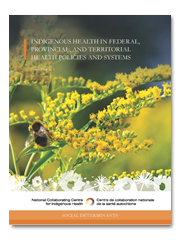
Similarly, the recently published Indigenous health in federal, provincial, and territorial health policies and systems report explores the laws, policies, and treaties that support the health of Indigenous people in Canada, while suggesting policy improvements, underscoring gaps and suggesting areas for further investigation.


Health equity considerations are at the heart of several other new NCCIH publications. The Physical activity fact sheet draws on our 2021 literature review and environmental scan of sports and recreation programs and partnerships across Canada produced as part of the Public Health Agency of Canada’s Let’s Get Moving initiative. The Improving access to mental health and addictions services and supports for older Indigenous adults, using a cultural safety and equity lens report discusses current strategies and innovations for improving the accessibility, availability, and acceptability of culturally safe mental health and addiction services and supports for our Elders. The Knowledge, perspectives, and use of cannabis among Indigenous populations in Canada in the context of cannabis legalization: A review of the literature report explores the diverse knowledges, perspectives, and uses of cannabis among First Nation, Inuit, and Métis Peoples. It concludes with a list of resources as well as a discussion on knowledge gaps that must be addressed in designing culturally relevant and high-quality public health initiatives in Indigenous communities.


If you are interested in knowing about other publications, please see our visit our web site or subscribe to our mailing list to receive notifications of newly released NCCIH resources, upcoming webinars and our regular seasonal newsletters. Please enjoy and share our knowledge resources with your community and networks, and if you have not already done so, join us on Twitter, Facebook, LinkedIn, Vimeo, YouTube, SoundCloud, or ISSUU to participate in updates as they happen.


Finally, as Dr. Margo Greenwood bids us a final farewell, we were both welcomed aboard to take our places as NCCIH’s new Academic Co-leads. On behalf of all the staff at the NCCIH, we wish you renewed health in 2023 and beyond, and we look forward to sharing our work with you over the coming months and years.


Mussi cho/Ham i yaa,


Dr. Sheila Blackstock, Academic Co-Lead,
National Collaborating Centre for
Indigenous Health (NCCIH)


Anko,


Dr. Daniel Sims, Academic Co-Lead,
National Collaborating Centre for
Indigenous Health (NCCIH)


NCCIH news and promotions

Resources to support vaccine confidence among First Nations, Inuit, and
Métis people and communities

The National Collaborating Centre for Indigenous Health (NCCIH), in collaboration with the National Collaborating Centre for Infectious Diseases (NCCID), has produced several resources to support vaccine confidence among First Nations, Inuit and Métis people and communities. The resources for individuals, families and communities are now available in Cree, Ojibway, and Inuktitut.


The NCCIH announces new Academic Co-Leads

Dr. Sheila Blackstock and Dr. Daniel Sims, both Indigenous scholars and Associate Professors at the University of Northern British Columbia, began their new roles as Academic Co-Leads of the NCCIH on February 1, 2023.


Farewell from NCCIH Academic Lead, Dr. Margo Greenwood

"It has been a profound honour to serve as Academic Leader of the NCCIH for the past two decades. During this time, I have watched the centre grow from an idea to a flourishing organization. We have had incredible opportunities to create transformation and change. It is with humility and excitement that I now continue my work in my new role as an independent Senator." Read the full message.


Attended events


UNBC Research Week, Prince George, B.C., Feb. 27 – March 2, 2023. unbc.ca/office-research-and-innovation/research-week


Gathering Wisdom for a Shared Journey XII, Vancouver, B.C., Feb. 28 - March 2, 2023. gathering-wisdom.ca


Les Journées annuelles de santé publique (JASP), Montréal, Que., March 13-16, 2023. inspq.qc.ca/jasp/accueil


The International Meeting on Indigenous Child Health (IMICH), Tulsa Oklahoma, March 24-26, 2023. cps.ca/en/imich


Canadian Immunization Conference (CIC), Ottawa, Ont., April 25-27, 2023. cpha.ca/cic2023-overview


Taking Action to Disrupt the HIV-STBBI Status Quo, Winnipeg, Man., May 11, 2023. disruptthestatusquo.com


NAISA 2023 Tkaronto Conference, Toronto, Ont., May 11-13, 2023. naisa.org/2023-tkaronto-conference-website


CASN Biennial Canadian Nursing Education Conference, St. John’s, N.L., May 29-30, 2023. casn.ca/2022/05/he-casn-biennial-canadian-nursing-education-conference-2023


CHA Annual Meeting – York University, Ottawa, Ont., May 29-31, 2023. cha-shc.ca/about/what-we-do/annual-meeting


Upcoming events


Network for Sharing Indigenous Information and Research (NSIIR), Virtual, June 1, 2023.


Indigenous Cultural Heritage Advisory Council, Whitehorse, Y.T., June 7-8, 2023. parks.canada.ca/culture/autochtones-indigenous/conseil-council


BC NEIHR Gathering for Indigenous Health Researchers (GIHR), Terrace, B.C., June 8-9, 2023.


International Council of Nurses (ICN) Congress, Montréal, Que., July 1-5, 2023. icn.ch/events/icn-congress-2023-montreal


Please visit the online NCCIH calendar of events, which highlights conferences, workshops, and other events of interest in the field of Indigenous Health including regional, national and global listings.


Send an email to nccih@unbc.ca with "Calendar submission" in the subject line if you have an event you would like added to our calendar.


New NCCIH publications and resources


A series of resources to support vaccine confidence now available
in Plains Cree, Ojibway, and Inuktut


GUIDE - Don’t Wait, Vaccinate! A Guide to Immunization for First Nations, Inuit and Métis Peoples and Communities - English | French | Plains Cree | Ojibway | Inuktitut


CALENDAR - Don’t Wait, Vaccinate! A Calendar to Immunization for First Nations, Inuit and Métis Peoples and Communities - English | French | Plains Cree | Ojibway | Inuktitut


FACT SHEET - Information and Resources to Build Vaccine Confidence for First Nations, Inuit and Métis People - English | French | Plains Cree | Ojibway | Inuktitut


FACT SHEET - Vaccines – the Facts - English | French | Plains Cree | Ojibway | Inuktitut


FACT SHEET - Vaccine Preventable Diseases in Canada: What are They? - English | French | Plains Cree | Ojibway | Inuktitut


Voices from the Field podcast series

Two new episodes discuss chapters from the university-led textbook Introduction to Determinants of First Nations, Inuit, and Métis Peoples’ Health in Canada.


Episode 24Our Highway, Our Tears: Indigenous Women’s and Two Spirit People’s Health and Resource Extraction with Ryan O’Toole.


Episode 25Youth Protection, Social Determinants of Health, and Reappropriation of Decision-Making Power: Quebec First Nations Demands with Marjolaine Siouï and Richard Gray.


Voices from the Field


Indigenous health in federal, provincial, and territorial health policies and systems


Indigenous health in federal, provincial, and territorial health policies and systems, updates and expands previous work of the NCCIH and its 2011 report, Looking for Aboriginal health in legislation and policies, 1970-2008: The policy synthesis project. This updated report collects all federal, provincial, and territorial level health policies and legislation, as well as modern treaties and self-government agreements that have been developed as of April 2022 and specifically mention Indigenous health.


Indigenous health in federal, provincial, and territorial health policies and systems


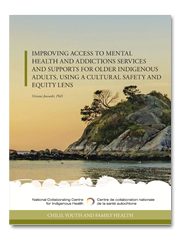
Improving access to mental health and addictions services and supports for older Indigenous adults, using a cultural safety and equity lens


Older Indigenous adults residing in off-reserve urban population centres face unique and complex challenges and barriers to accessing mental health and addictions services and supports because of such factors as past and ongoing colonialism, racism, poverty, and a lack of culturally safe and relevant care. Improving access to mental health and addictions services and supports for older Indigenous adults, using a cultural safety and equity lens, reviews and contextualizes the current available evidence on how to rapidly improve access to culturally safe and relevant mental health and substance use services for older Indigenous adults (45+) residing in urban population centres.


Improving access to mental health and addictions services and supports for older Indigenous adults, using a cultural safety and equity lens


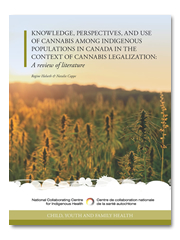
Knowledge, perspectives, and use of cannabis among Indigenous populations in Canada in the context of cannabis legalization: A review of literature


The report, Knowledge, perspectives, and use of cannabis among Indigenous populations in Canada in the context of cannabis legalization: A review of the literature, explores the diverse knowledge(s), perspectives, and uses of cannabis among First Nations, Inuit, and Métis peoples in Canada. This information informs the values, priorities, and concerns Indigenous communities have about cannabis as they strive to achieve a balance between economic opportunity and health and wellness.


Knowledge, perspectives, and use of cannabis among Indigenous populations in Canada in the context of cannabis legalization: A review of literature


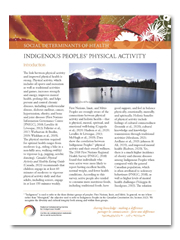
Indigenous Peoples’ physical activity


The incidence of obesity and chronic diseases is much higher among Indigenous Peoples compared to the general population. Improving Indigenous Peoples’ physical activity can contribute to improved physical and mental health outcomes and overall wellness. Adapted from the report Indigenous sports and recreation programs and partnerships across Canada: A Literature review and environmental scan, this fact sheet offers information on Indigenous Peoples’ health and physical activity, with a focus on sports and physical recreation, including traditional activities.


Indigenous Peoples’ physical activity


Request NCCIH knowledge resources


Did you know you can request NCCIH publications free of charge? Send your request to us by filling out the “Request this Publication” form found at the bottom of each online publication page, indicate how many copies you’d like, a note about how you will utilize the resource, your name and mailing address. We will do our best to accommodate your request based on our current available printed inventory. If you have multiple publication requests, please use the “Request Publications” text link found in the top right hand corner of the NCCIH web site.


Online resources


In support of creating a health community focused on knowledge synthesis, transfer and exchange we have chosen a sampling of current online resources to share. Please note the links provided in the NCCIH newsletters are for general interest only and do not indicate an endorsement. The views expressed in the linked resources do not necessarily represent the views of the NCCIH or our funder the Public Health Agency of Canada.


Send us an email to nccih@unbc.ca with "Online resource" in the subject line if you have an online resource you would like added to our next newsletter.


International Journal of Environmental Research and Public Health (IJERPH) - Grounding Wellness: Coloniality, Placeism, Land, and a Critique of “Social” Determinants of Indigenous Mental Health in the Canadian Context


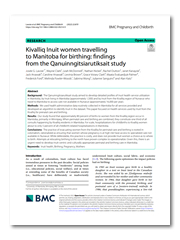
BMC Pregnancy and Childbirth, Kivalliq Inuit women travelling to Manitoba for birthing: findings from the Qanuinngitsiarutiksait study


AlterNative: An International Journal of Indigenous Peoples, Vol. 19, Issue 1, March 2023


Canadian Medical Association Journal (CMAJ), Vol. 195, Issue 12, March 27, 2023, Medicine and society: The Healing Path: reconciling the attempt to eliminate Indigenous healing in Canada


Cultural Survival, We are the voice of nature, Vol. 47, Issue 1, March 2023


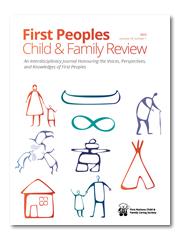
First People Child and Family Review, Vol. 18, No. 1, 2023


The Northern Review, No. 54, 2023


Newsletter of the Métis Nation,
Jan. 31, 2023


BC Aboriginal Child Care Society (BCACCS) E-News January 18, 2023


News and Updates: First Nations Health Authority (FNHA), April 2023


NCCHPP - Impact Assessments in Indigenous Contexts: Promising Avenues for Reflection and Improvement for Health Impact Assessment


Assembly of First Nations (AFN) - Implementing the UN Declaration


Statistics Canada – The Daily – Indigenous peoples, 2 publications released in 2023


Public Health Agency of Canada (PHAC), Canada Communicable Disease Report, April 2023


First Peoples’ Cultural Council (FPCC), Report on the Status of First Nations Languages, Fourth Edition


Inuit Tapiriit Kanatami (ITK), The Oceans We Share: Inuit Nunangat Marine Policy Priorities and Recommendations


Inuit Tapiriit Kanatami (ITK), Inuit Nunangat Housing Strategy Implementation Plan


Inuit Tapiriit Kanatami (ITK), UN Declaration Act Action Plan Proposals


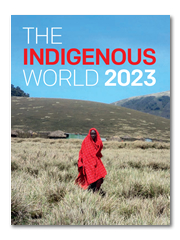
International Work Group for Indigenous Affairs (IWGIA), The Indigenous World 2023


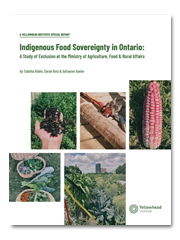
Yellowhead Institute, Indigenous Food Sovereignty in Ontario: A Study of Exclusion at the Ministry of Agriculture, Food & Rural Affairs


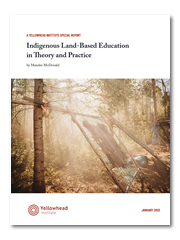
Yellowhead Institute, Indigenous Land-Based Education in
Theory & Practice


Online multimedia


This section features infographics, interactives, apps or videos that we found interesting or educational. Please note the links provided in the NCCIH newsletters are for general interest only and do not indicate an endorsement. The views expressed in the linked resources do not necessarily represent the views of the NCCIH or our funder the Public Health Agency of Canada.


Send us an email if you have multimedia resources you would like included in our next newsletter to nccih@unbc.ca with "Multimedia submission" in the subject line.


1) kikapekiskwewin - An academic podcast on why cultural values are so important to Indigenous peoples involved in research with Indigenous peoples by Dr. Josie Auger.


2) The Kishkayhta (Learn), Kiikew (Heal), Kiihtwaam ooshtaahk (Rebuild) Métis Speaker Series is organized around the theme of Métis cultural healing and rebuilding.


3) Unreserved with Rosanna Deerchild, a storyteller, journalist, broadcaster and poet, guides listeners within a space for Indigenous voices to better understand our shared story.


The NCCs of NCCPH

Established in 2005 and funded through the Public Health Agency of Canada (PHAC), the six National Collaborating Centres (NCCs) for Public Health (NCCPH) work together to promote the use of scientific research and other knowledge to strengthen public health practices, programs and policies in Canada.


A unique knowledge hub, the NCCs identify knowledge gaps, foster networks and provide the public health system with an array of evidence-based resources, multi-media products, and knowledge translation services.


NCC for Indigenous Health (NCCIH), University of Northern British Columbia, Prince George, BC


NCC for Determinants of Health (NCCDH), St. Francis Xavier University, Antigonish, Nova Scotia


NCC for Healthy Public Policy (NCCHPP), Institut national de sante publique du Quebec (INSPQ), Montreal, Quebec


NCC for Infectious Diseases (NCCID), University of Manitoba, Winnipeg, Manitoba


NCC for Environmental Health (NCCEH), British Columbia Centre for Disease Control, Vancouver, BC


NCC for Methods and Tools (NCCMT), McMaster University, Hamilton, Ontario