|
Dear Friends of CRRJ,
In the face of growing assaults on education, the rule of law, democratic participation, and racial justice, CRRJ continues its programs to bring to the surface deeply rooted historical structures, and to commemorate the resistance they generated. As our Nation confronts these new challenges, we believe that historical introspection is more important than ever.
For 18 years, it has been our great privilege to mentor our justice-minded students and to advocate for legacy communities. We share our recent work here, thank you for your support, and look forward to our continuing partnership.
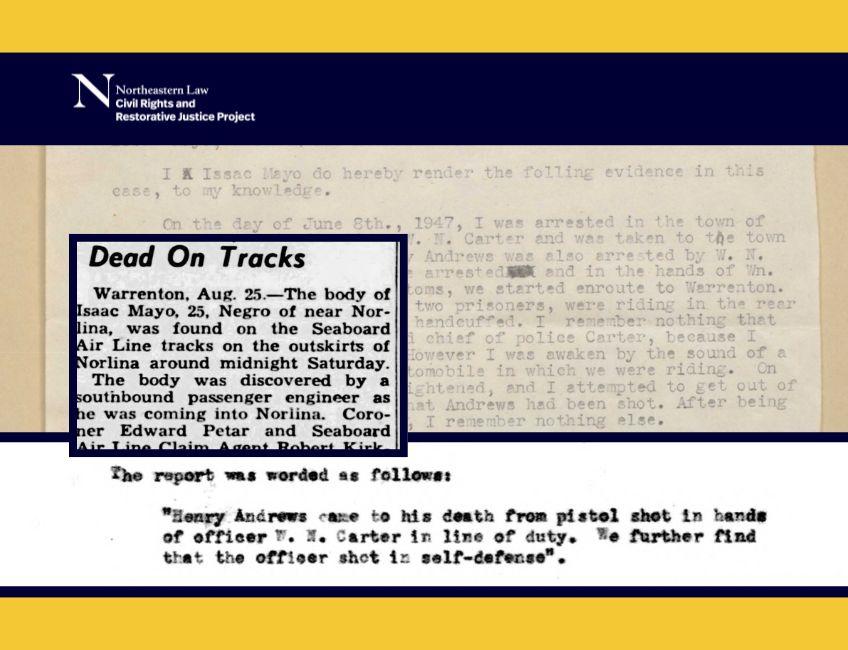
| | CRRJ Director and founder, Professor Margaret Burnham | | From the Burnham-Nobles Archive: The Killing of Henry Andrews and Issac Mayo, NC 1947 | | Above: Henry Gray Andrews (1923 – 1947), a farmer and WWII veteran, was killed by police chief W. N. Carter in Warren County, North Carolina. While taking Andrews to jail in a police car, Carter fatally shot Andrews. The chief alleged that Andrews attacked him. | | |
June 7, 2025 marks 75 years since, Henry Andrews, a World War II veteran, was shot and killed by Norlina’s Chief of Police, in North Carolina. His death followed a series of events that, to this day, Andrew’s family members are continuing to unravel but refuse to forget.
His family still refer to Andrews, who was 25-years-old when he was killed, as “Uncle Henry.” They are choosing to mark this year’s anniversary with a soil collection ceremony and marker installation close to where Andrews was lynched. His relatives are also working on launching a tour of the area surrounding the site, and a podcast.
“He was a very jolly type of person,” said Eddie Fitts, during a 2022 interview with CRRJ Clinic student Julian Montijo ‘22. Fitts is Andrews’ nephew and was three years-old when his uncle was slain. “I knew for a fact that he was well liked among the neighborhoods, among the whites and Blacks … I’d never known or heard of him having an enemy. So that day, it’s a mystery to me.”
Chief W.N. Carter and Deputy Sheriff Mark Bottoms apprehended Andrews, following an alleged altercation with a country store owner. He was placed in the back of their patrol car with another Black man, Isaac Mayo, who was arrested earlier that day at a bus stop in a neighboring town. Both men were detained on “drunkenness” charges. According to all witness statements, Andrews did not resist arrest and went peacefully with the officers. Once in the vehicle, Bottoms started the drive to Warrenton jail, less than ten miles away.
The exact detail of what happened during that car ride remains unclear. Initially, it was reported Andrews had pled with the officers to let him go, placing a hand on Carter’s shoulder as he appealed to them. Seemingly enraged by a Black man’s physical touch, Carter told Andrews to get his hand off him, and Andrews sat back proclaiming that he meant no harm. Carter then shot Andrews three times in the neck.
The car stopped and Mayo tried to jump out, fearing for his own safety. Mayo was physically subdued by Bottoms and placed back in the police vehicle.
The officers claimed self-defense, alleging Andrews struck Carter over the head and reached for the officer’s holster, attempting to take his gun.
| | Updates at CRRJ and in the Field | |
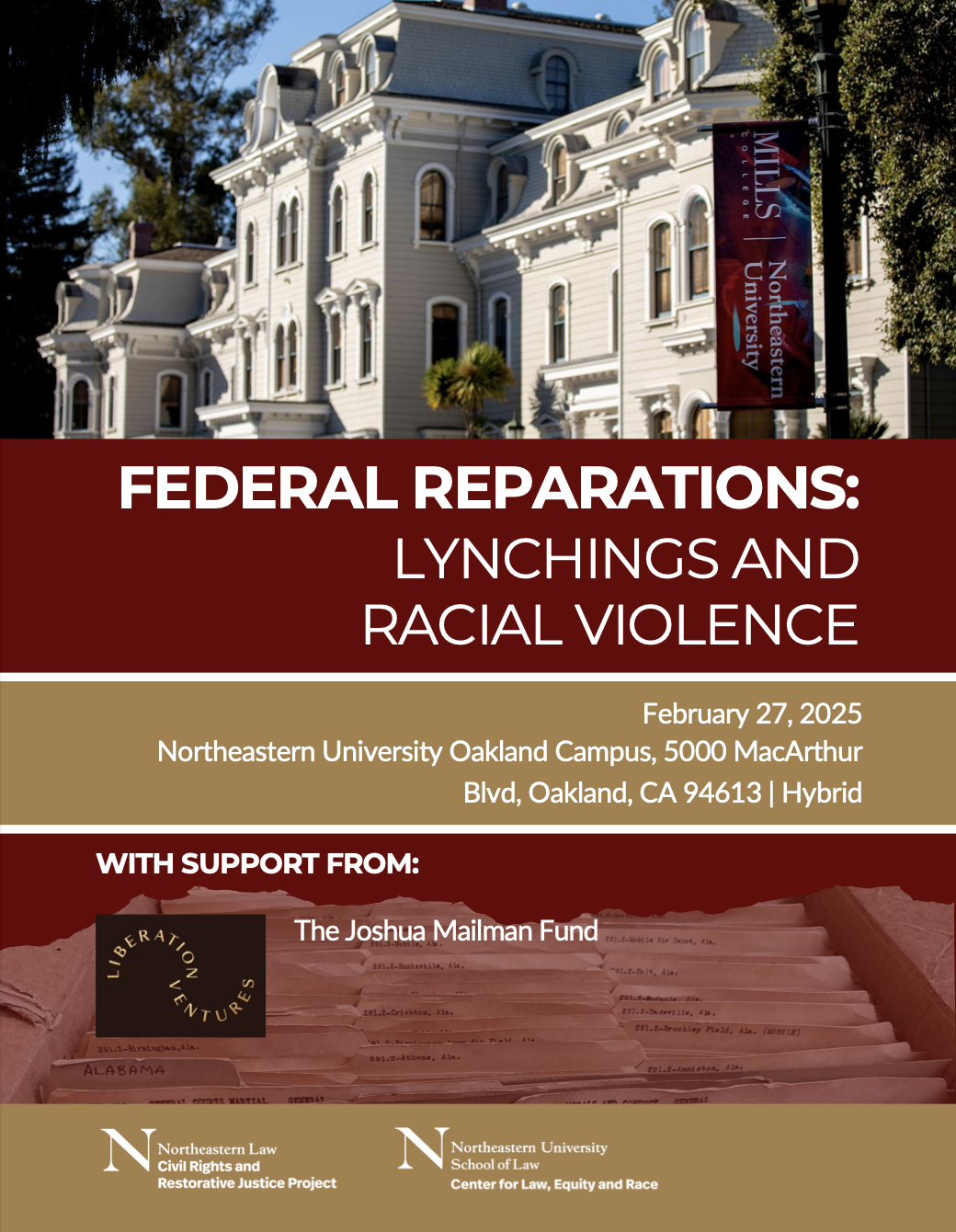
CRRJ Federal Reparations Project Launched at NU Mills Conference, in Oakland CA | |
A pivotal moment in the national dialogue on reparative justice took place at Mills College at Northeastern University during a two-day conference, Towards Justice: Addressing Racial Violence, Advancing Legal Clarity, and Restoring Community. National leaders in the reparations movement joined experts and advocates in the field on February 27-28, 2025.
On day one of the conference, Northeastern University School of Law’s Center for Law, Equity and Race (CLEAR) Managing Director Dr. Deborah A. Jackson introduced the hundreds of attendees, present in the historic Mills Hall, on Northeastern’s Oakland campus, and online, to the Federal Reparations: Lynching and Racial Violence Project.
Initiated by CRRJ’s Reparations Lab, and thereafter implemented by CRRJ and CLEAR, the federal reparations project aims to explore how the federal government can address harms associated with racial violence that are, in part, attributable to its failure to fulfill its law enforcement responsibilities in the years from 1885 to 1965.
“The lingering, multidimensional traces of historical racial violence have impeded our Nation’s efforts to overcome past racial subordination and conflict,” said Burnham. “This initiative provides us with a meaningful opportunity to re-examine and redress these atrocities.”
| | | | Top photograph: (Left to right, front row): Erika Weissinger, Adjoa Aiyetoro, Nkechi Taifa, Margaret Burnham and Deborah Jackson (Left to right, back row): Jay Driskell, Daryle Hatley, Delbert Jackson, Alex Stein, Jennifer True, Lerone Martin, Cynthia Mitchell, Lydia Beal, Evan Lewis, Shivangi Basu, Vikas Maturi, Ashley Adams and Sarah Bohl | |
Congresswoman Ayanna Pressley Visits CRRJ, Kickstarts H.R. 40 Campaign | |
Congresswoman Ayanna Pressley met with CRRJ staff and faculty, as her and her office takes on the task of reigniting interest in and riding co-sponsors for H.R. 40, and reparations broadly.
Congresswoman Pressley (D-MA-07) traveled to meet with the CRRJ in-person in Boston, accompanied by her Deputy District Director Eddie Rupia, and Press Secretary Avery Manousos. She met with members of CRRJ including Directors Margaret Burnham and Rose Zoltek-Jick, and CRRJ Staff Attorney and Program Director, Alex Stein. Pressley’s visit to CRRJ was the first stop as her and her team spend the coming weeks meeting with community members, advocacy groups, and entities like CRRJ as they relaunch the campaign for H.R.40.
| | | |
Burnham-Nobles Digital Archive student researchers showcase investigations into historical cases of racial violence | |
On December 3, the fall 2024 cohort of Burnham-Nobles Digital Archive (BNDA) undergraduate student researchers showcased their semester-long investigations to CRRJ staff and faculty. The culmination of their groundbreaking research, five students presented their contributions to the (BNDA) reflected on the significance of their research, and provided insights into the broader historical and social context surrounding the cases that they investigated.
“Our undergraduates bring unique insights from their respective fields, including politics, philosophy, economics, history, culture studies, law, and public health,” said Lydia Beal, CRRJ’s Research Associate who led this student group in their investigations. “Together, their contributions ensure these cases are visible and accessible through the archive.”
| | | |
Rhodes Scholar at the University of Oxford joins CRRJ for fellowship | The Civil Rights and Restorative Justice Project was joined at the end of 2024 by Aimee Clesi, CRRJ visiting researcher and Rhodes Scholar (Balliol College, University of Oxford '22). Studying for her doctoral degree in Criminology and Criminal Justice, Clesi spent five weeks researching cases for CRRJ's posthumous exonerations project. | | | CRRJ Director Gives Keynote at Inaugural Legacies of Lynching Gathering | |
Professor Margaret Burnham, director of the Civil Rights and Restorative Justice Project (CRRJ) gave the keynote address at "Legacies of Lynching: An Inaugural Gathering," Saturday, March 1, 2025.
Burnham discussed how the United States’ legacy of lynching has impeded our Nation’s efforts to overcome past racial subordination and conflict. She described ten principles or guidelines that, she asserted, are common to the work of remembrance coalitions and similar projects focused on racist terror and historical injustice.
| | | |
People's Law Office Attorneys, Taylor and Thomson, visit CRRJ Clinic | CRRJ hosted two guest speakers from the Chicago-based attorney's office, People's Law Office. Attorneys Flint Taylor and Brad Thomson spoke with CRRJ Clinic students about using civil rights lawsuits to advance racial justice, particularly in cases involving police violence. | | | CRRJ to Host Summer 2025 Undergraduate Program | |
This summer, CRRJ will, once again, host several upper-level students from universities across the country, engaging them in unique research opportunities and exploring the intersection of historical violence and the law.
As in previous years, this program is designed to give students supervised practical experience related to their interests in racial redress and reconciliation. Committed to working 30-hours a week, these students will be tasked with developing individual case investigations, examining cases of racially motivated homicides during the Jim Crow period, as well as a collaborative group project.
| | | |
Jordan Neely's death on NYC subway: A history of white citizens and racial homicide on public transportation | |
Neely’s tragic death at the hands of a private citizen — acting out of a sense of public duty or not — is a familiar story, one told many times in the Burnham-Nobles Digital Archive in the cases of racially-motivated homicide on public conveyances in the Jim Crow South.
Throughout the twentieth century, white vigilantism was a real and threat to African Americans in public spaces. The archive contains many cases in which private citizens felt empowered to violently police Black behavior, some acting with probable cause but many without.
| | | |
DOJ finds Memphis police use excessive force: Burnham-Nobles Digital Archive exposes MPD historical racial violence | |
In December 2024, the Department of Justice (DOJ) released a report stating the Memphis police department uses excessive force against Black people and “regularly violates” their civil rights. The DOJ’s findings marked six months of federal investigation into the Memphis Police Department’s methods and practices, following the death of Tyre Nichols in 2023.
The history of racial discrimination, the denial of Black civil rights, and the use of excessive force within the MPD can be traced far earlier than the death of Nichols. This most recent high-profile police killing is the outcome of decades of impunity enjoyed by police who have ended Black lives without suffering any legal consequences.
| | | | Launched in 2007 by University Distinguished Professor Margaret Burnham, the center of CRRJ’s work is the investigation of racially motivated homicides in the Jim Crow South, and the creation of the Burnham-Nobles Digital Archive, which contains more than 1,000 cases. In 2022, CRRJ became a program of the Law School's Center for Law, Equity and Race. | | We rely on donors like you to continue our work. Donations are used for litigation expenses, field research and restorative justice projects. With your help, we can continue training tomorrow’s civil rights lawyers, filling in the gaps in U.S. history and informing our national dialogue on racial redress and criminal justice. | | | | |