Wisconsin Coastal Resilience Newsletter

Greetings from the Wisconsin Coastal Resilience Team!


This month's newsletter contains:

  • Collaboration Classifieds: Share Your Policy and Planning Projects
  • Lake Michigan Water Level Update
  • Events: Winter 2023 CALM Network Meeting Recording & Summary
  • Resource of the Month: NOAA Digital Coast
  • Around the Great Lakes: Funding the Samuel Myers Park Restoration Project
  • Funding:
  • UASCE Flood Risk Management Request for Proposals
  • WCMP is Seeking Project Ideas for Bipartisan Infrastructure Law 2023 Funding Competition

Collaboration Classifieds

Share Your Policy and Planning Projects

Background: CALM is supporting community-to-community learning by developing case studies of policy-change and planning projects in Wisconsin's Lake Michigan region.


Request: CALM is looking for communities interested in sharing policy-change and/or planning projects with the rest of the network. Information about the projects will be compiled into a case study and shared on the Wisconsin Coastal Resilience website as a resource for the network.


If you interested in sharing a policy-change or planning project with the CALM network, please reach out to Lydia Salus at lydia.salus@wisconsin.gov. 

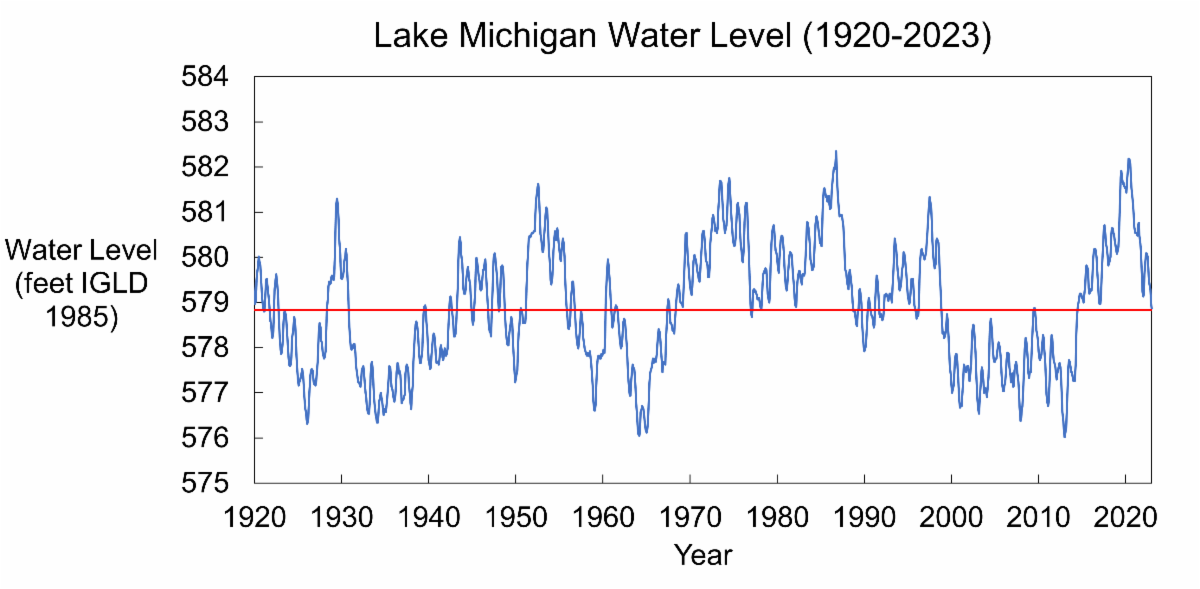
February 2023 Water Level Update

Lake Michigan water levels continued their seasonal decline, decreasing 1 inch from January to February. Though Lake Michigan is now about 33 inches below the highest monthly water level recorded for February 2020, the Lake is still about 4 inches above the long-term average water level for the month. Water levels are expected to begin their seasonal rise over the next month.

Go to full update

Event

CALM Winter Network Meeting

Recording Available

On February 2nd, 2023 CALM hosted its winter 2023 network meeting. This meeting of the CALM network featured presentations about resilience and climate adaptation projects that have leveraged different types of funding sources. Presentations were followed by an opportunity for attendees to connect with each other via breakout rooms on the topics of climate adaptation and coastal resilience.


We’d like thank John Edlebeck (Village of Whitefish Bay), Susan Coyle (Milwaukee Metropolitan Sewerage District), and Bob Micheel (Monroe County) for their engaging presentations.


For those of you who were unable to attend, or would like to revisit any of the presentations, a captioned recording and meeting summary are now available. 

Summary & Recording

Resource of the Month

NOAA Digital Coast

The Digital Coast website provides coastal data, tools, training, and case studies. The content found in these resources can be used by community leaders, the public and decision-makers to make informed decisions affecting the coast. It can be used to inform relevant groups about coastal processes, promote success stories to be modeled off of, and access tools for further education.


NOAA has put together a recorded training on how to navigate the website with resources related to the Great Lakes. The virtual training recording can be found here and a list of the featured resources is also available: Diving into the Digital Coast Great Lakes resources.

Go to Blog

Around the Great Lakes

Funding the Samuel Myers Park Restoration Project

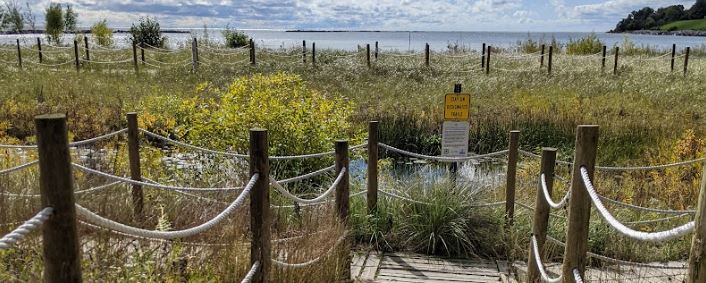
In 2014, the City of Racine Public Health Department (the Health Department) initiated a project to improve nearshore water quality, habitat, ecosystem function, and community access at Samuel Myers Park utilizing an adaptive management approach to help achieve resiliency.


The Health Department utilized 23 different funding sources to support initial research and fact finding as well as construction activities. Health Department staff applied for grant opportunities and conducted outreach to secure donations.


This case study dives into the different sources used to fund this project as well as cost effective practices employed, and lessons learned.


Total Project Cost: $1,254,641

Read more

Funding Opportunity

USACE Floodplain Management Services Interagency Nonstructural Program

The USACE Floodplain Management Services (FPMS) Interagency Nonstructural Program is seeking proposals for projects to reduce flood risk.  


All proposals must be interagency and will leverage resources invested by others (monetary or in-kind). At least two governmental or tribal partners beyond USACE must be identified for the effort to be considered interagency. Public-private partnerships are welcome.  


Examples of nonstructural FPMS products*:

  • flood warning plans
  • floodplain mapping and management
  • structure damage assessments
  • flood emergency preparedness plans
  • dam education and awareness


*These studies do not result in construction but can help communities better manage their local flood risk.


Studies are typically budgeted at or under $100k. Proposals should describe work capable of being completed within 12-18 months from initiation, although a 12-month timeline is preferred. 


In order to apply, fill out and submit the proposal template and partner support template to Kira.M.Baltutis@usace.army.mil and Dave Handwerk at david.r.handwerk@usace.army.mil.


Applications Due: March 15th, 2023


Application Documents:

Request for Proposals

WCMP is Seeking Project Ideas for Bipartisan Infrastructure Law 2023 Funding Competition

The Bipartisan Infrastructure Law (BIL) is providing funds to NOAA’s Office for Coastal Management to invest in coastal protection and restoration projects to increase coastal communities’ resilience to climate change and coastal hazards.


The Wisconsin Coastal Management Program (WCMP) is seeking out three projects to competitively apply to the 2023 National Coastal Zone Management Program BIL funding competition in early Summer 2023. Priority projects for this opportunity include habitat restoration; habitat restoration planning, engineering, and design; and land acquisition projects with a public entity partner.


For more information, see WCMP’s one-page factsheet, and contact WCMP with project ideas (coastal@wisconsin.gov) to begin a conversation.

BIL Factsheet
For questions about the CALM Network, or to submit something to the Collaboration Classifieds, contact:

Lydia Salus
608-266-3687

For questions about Lake Michigan coastal hazards or how to approach, plan, and prepare for them, contact:

Adam Bechle
608-263-5133

For more information, visit the Wisconsin Coastal Resilience website.

University of Wisconsin Sea Grant Institute | (608) 262-0905 | 1975 Willow Drive, 2nd Floor, Madison, WI 53706