Wisconsin Coastal Resilience Newsletter | |
|
Greetings from the Wisconsin Coastal Resilience Team!
This month's newsletter contains:
Collaboration Classifieds:
- Great Lakes Commission Collecting Implementation Tactics for Online Map
- FEMA "Achieving Equitable Recovery Guide" Open Comment Period
Lake Michigan Water Level Update
Resource of the Month: Great Lakes Natural & Nature-Based Features Playbook
Around the Great Lakes: Virtual Walking Tour of Sam Myers Park Restoration Project
Funding Opportunities
- STORM Act (FEMA)
- Great Lakes Coastal & Nearshore Engineering & Design (CSO)
- National Coastal Resilience Fund (NFWF)
- Bipartisan Infrastructure Law (WCMP)
Trainings
- Floodplain Zoning Webinar Series
- Local Hazard Mitigation Planning Workshop
- Economic Guidance for Coastal Management Professionals
| |
Collaboration Classifieds | |
Share Your Water Infrastructure Implementation Tactics with the Great Lakes Commission for Online Map | |
|
Background: The Great Lakes Commission (GLC) convened a Regional Working Group on Water Infrastructure made up of diverse partners and stakeholders to identify approaches for improving water infrastructure in the Great Lakes region. These approaches consist of four priority areas: public health and safety; community engagement and trust-building; equitable distribution of investments and benefits; and asset management and workforce development. At the GLC’s Annual Meeting in October 2022, Commissioners approved the Working Group’s document, “Approaches for Improving Great Lakes Water Infrastructure: A Blueprint,” with the goal of propelling actions to address the region’s water infrastructure needs.
Request: Now, the GLC is collecting “implementation tactics” from utilities, state agencies, and other organizations to share how the Great Lakes community has put these approaches into action on a dynamic map for other stakeholders to learn from.
Reach out to Program Specialist James Polidori to share how your organization is implementing blueprint approaches to advance water infrastructure improvements across the region.
| |
FEMA Seeks Feedback on Achieving Equitable Recovery Guide | |
|
FEMA is seeking feedback on the draft “Achieving Equitable Recovery: A Post-Disaster Guide for Local Officials.” The open comment period will end on March 15.
Disaster recovery presents communities with the opportunity to rebuild in a thoughtful, equitable and resilient way. This guide supports local officials in:
- Their efforts to identify needs.
- Establishing critical partnerships.
- Leveraging new opportunities.
- Conducting strategic public engagement.
- Making a strong case for funding in an equitable manner.
The guide is organized around eight goals focused on approaches to engaging and identifying the needs of all community members and ensuring a more accessible, inclusive and equitable recovery planning process.
FEMA will host a series of 60-minute webinar sessions to provide an overview of the draft guide and gather feedback from whole community partners. The sessions will include facilitated discussions with stakeholders to help improve the existing draft.
For more information about the webinars and to access the draft Equity Guide and related documents, visit FEMA.gov.
| |
March 2023 Water Level Update | |
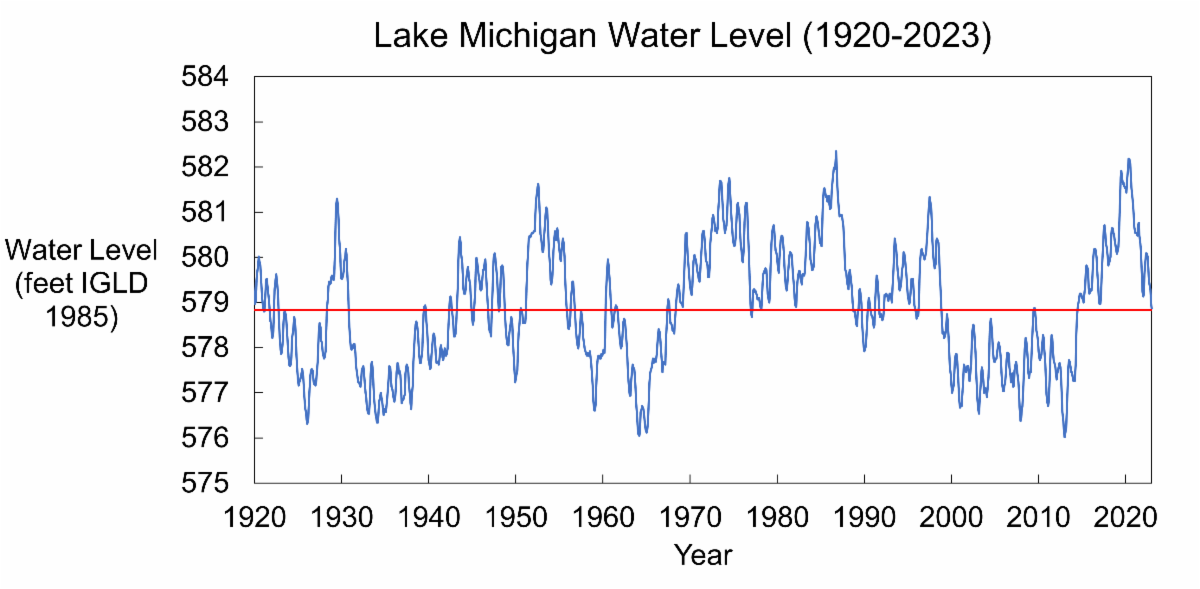
Lake Michigan water levels began their seasonal incline, increasing 1 inch from February to March. Though Lake Michigan is now about 31 inches below the highest monthly water level recorded for March 2020, the Lake is still about 4 inches higher than the long-term average water level for the month. Water levels are expected to continue their seasonal rise over the next month. | |
Great Lakes Natural and Nature-Based Features Playbook | |
|
The objective of this project is to develop a Great Lakes specific guide (“playbook”) to natural and nature-based features (NNBF) and multiple lines of defense (MLD) to improve future coastal resiliency. The guide will significantly advance the understanding of NNBF and MLD emerging technologies as applied to the entire Great Lakes region. The guide will provide additional needed confidence to federal, state, and local government agencies to plan, design, and implement sustainable, adaptable and cost-effective NNBF measures, either instead of, or in addition to, traditional structural and non-structural flood risk management (FRM) practices.
This project is led by the U.S. Army Corps of Engineers (USACE) Engineering With Nature® (EWN) Initiative which enables more sustainable delivery of economic, social, and environmental benefits associated with infrastructure.
Project Fact Sheet
Contribute to the Playbook through Survey123:
Follow the link to share existing or ongoing efforts in the Great Lakes region. Results will be added to EWN ProMap.
| |
Virtual Walking Tour of Samuel Myers Park Restoration Project | |
|
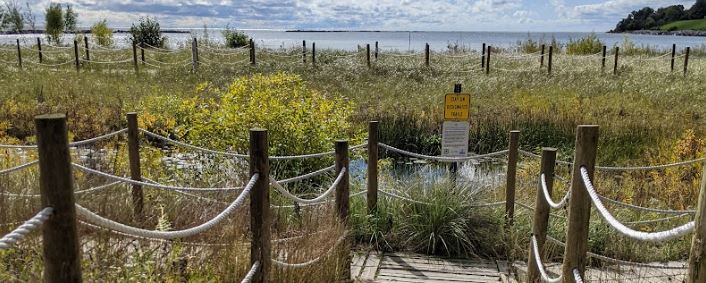
CALM hosted a field trip to Samuel Myers Park in Racine, Wisconsin on September 22, 2022. The City of Racine Public Health Department co-hosted the field trip and presented on a project the Department initiated in 2014 to improve nearshore water quality, habitat, ecosystem function, and community access at Samuel Myers Park utilizing an adaptive management approach to help achieve resiliency.
A virtual walking tour of this field trip is now available. As you click through each stop on the tour, you will learn about the history of the site, the different components of the restoration project, how they adapted to storm damage, and what the results of the restoration have been.
| |
STORM Act Notice of Funding Opportunity | |
|
The Federal Emergency Management Agency (FEMA) issued a notice of funding opportunity (NOFO) on January 1, 2023 for the Safeguarding Tomorrow through Ongoing Risk Mitigation (STORM) Act .The STORM Act establishes a hazard mitigation revolving loan funds to provide needed and sustainable funding for hazard mitigation and resilience projects.
Reach out to Wisconsin Emergency Management for projects that could be considered for funding.
Proposal Due Date: March 17, 2023
Quick Reference Guide
| |
Great Lakes Coastal & Nearshore Engineering & Design RFP | |
|
The Coastal States Organization (CSO) is issuing a request for proposals (RFP) for a design team to address coastal and nearshore habitat restoration engineering and design needs in the Great Lakes. To carry out this project, the design team (led by a primary contractor) will work with three Great Lakes states to complete engineering and design work on the projects selected. The project is funded via the Great Lakes Restoration Initiative through the NOAA Office of Coastal Management.
Project work is slated to take place between April 15, 2023 and January 15, 2024.
CSO is scheduling a Pre-bid Webinar for the second week of March (subject to availability of project partners). To register and receive updates on webinar date and time, please use this link: Webinar Registration.
Proposal Due Date: 5:00 PM (your time zone) March 31, 2023
Proposals shall be submitted electronically in PDF format to Vidya Balasubramanyam and consist of two components in separate documents: 1) Technical Proposal, and 2) Budget and Fees.
| |
National Coastal Resilience Fund RFP | |
The National Fish and Wildlife Foundation (NFWF), in partnership with the National Oceanic and Atmospheric Administration (NOAA), the U.S. Department of Defense, Occidental, Shell, and TransRe is now soliciting Pre-Proposals for the 2023 National Coastal Resilience Fund.
NFWF will award up to $140 million in grants to create and restore natural systems in order to increase protection for communities from coastal hazards while improving habitats for fish and wildlife species. NFWF prioritizes projects that are community led or incorporate direct community engagement and benefit underserved communities facing disproportionate harm from climate impacts.
This year, the National Coastal Resilience Fund will invest in projects in four project categories:
1. Community Capacity Building and Planning
2. Site Assessment and Preliminary Design
3. Final Design and Permitting
4. Restoration Implementation
Pre-Proposal Due Date: Wednesday, April 12, 2023
Applicant Webinar Recording
Pre-proposals must be submitted through NFWF’s Easygrants system. For more information or questions about this RFP, please contact Jessica Grannis or Arielle Mion.
| WCMP is Seeking Project Ideas for Bipartisan Infrastructure Law 2023 Funding Competition | |
|
The Bipartisan Infrastructure Law (BIL) is providing funds to NOAA’s Office for Coastal Management to invest in coastal protection and restoration projects to increase coastal communities’ resilience to climate change and coastal hazards.
The Wisconsin Coastal Management Program (WCMP) is seeking out three projects to competitively apply to the 2023 National Coastal Zone Management Program BIL funding competition in early Summer 2023. Priority projects for this opportunity include habitat restoration; habitat restoration planning, engineering, and design; and land acquisition projects with a public entity partner.
For more information, see WCMP’s one-page factsheet, and contact WCMP with project ideas (coastal@wisconsin.gov) to begin a conversation.
| |
Floodplain Zoning Webinars | |
|
UW-Stevens Point’s Center for Land Use Education is hosting a series of three webinars regarding floodplain zoning. This series will introduce participants to the basic tools and objectives of floodplain management and take a closer look at floodplain zoning ordinance adoption and administration in Wisconsin.
March 9th @ 12 - 1pm: Floodplain Management Basics
- Planning and management tools to reduce flood hazards
- Role of FEMA, DNR, and municipalities
- Basics of floodplain zoning
March 16th @ 12 - 1pm: Ordinance Adoption
- Model floodplain zoning ordinance
- Ordinance adoption process, including DNR review
- Review of recent statutory changes related to nonconforming buildings
March 23rd @ 12 - 1pm: Ordinance Administration
- Considering floodplains in the development review process
- Common questions and scenarios
- Sample forms and materials
Additional Information & Resources
| |
Local Mitigation Planning Workshop | |
|
The Federal Emergency Management Agency (FEMA) is hosting a virtual Local Mitigation Planning Workshop in March. This training covers the basics of mitigation planning for local communities. You will learn about the planning process, assessing risks, and developing and implementing effective mitigation strategies. This course is updated to reflect new guidance, resources and material related to the 2022 Local Mitigation Planning Policy Guide.
This workshop is for local community officials, emergency managers, planners and other partners in hazard mitigation planning. It is most helpful to take this training when participants are in the early stages of starting their plan development/update.
Have your expiration date handy when registering. Not sure when it is? Check the Plan Status Map. Participants whose plans are 18-24 months from expiration will be prioritized to ensure the timing of the workshop is beneficial.
Date: March 13 - 16, 2023
Time: Noon - 4pm (Eastern) Daily
Virtual Platform: Zoom
Email FEMA with any questions.
| |
Economic Guidance for Coastal Management Professionals | |
|
The National Oceanic and Atmospheric Administration (NOAA) is hosting two upcoming economic valuation trainings for coastal managers. The following training opportunities provide information about approaches for economic analysis and relevant examples, and a guide on how to conduct simple ecosystem service valuation. They can be taken sequentially or independently. Please join us!
March 15th: Introduction to Economic Analysis and Valuation
March 29th: Pathways to Valuing Ecosystem Services
| |
For questions about the CALM Network, or to submit something to the Collaboration Classifieds, contact:
Lydia Salus
608-266-3687
| |
For questions about Lake Michigan coastal hazards or how to approach, plan, and prepare for them, contact:
Adam Bechle
608-263-5133
| |
University of Wisconsin Sea Grant Institute | (608) 262-0905 | 1975 Willow Drive, 2nd Floor, Madison, WI 53706 | | | | |