Wisconsin Coastal Resilience Newsletter | |
|
Greetings from the Wisconsin Coastal Resilience Team!
This month's newsletter contains:
Member-to-Member Updates:
- Bay-Lake Regional Planning Commission Waterfront Toolkit
-
Mineral Springs Creek Corridor Restoration and Resiliency
- Lake Michigan Public Access Stairway at Virmond County Park
Lake Michigan Water Level Update
Resource of the Month: Building Community Resilience with Nature-Based Solutions
Funding Opportunities
- EPA Great Lakes Environmental Justice Grant Program
- GLISA Small Grants Program
- Bipartisan Infrastructure Law (WCMP)
Trainings: Building Blocks for Sharing Science
Webinars: Climate Migration – Is the Great Lakes Region a Climate Haven?
News: International Great Lakes Datum Update (IGLD 2020)
| |
Collaboration Classifieds | |
Bay-Lake Regional Planning Commission Waterfront Toolkit | |
|
Update from BLRPC: The Bay-Lake Regional Planning Commission has launched the Waterfront Planning Toolkit, a Wisconsin Coastal Management Program funded project designed to provide assistance and resources to communities interested in planning for the unique obstacles and opportunities that come with development on the waterfront. It strives to articulate the value of waterfront plans and help communities shape the long-term resilience and sustainability of their waterfronts by establishing a set of tools and best practices to promote successful planning efforts.
Contact: If you have any questions or feedback, please reach out to Izzy Fuller, Environmental Planner at Bay-Lake Regional Planning Commission.
| |
Mineral Springs Creek Corridor Restoration and Resiliency through Applied Ecology | |
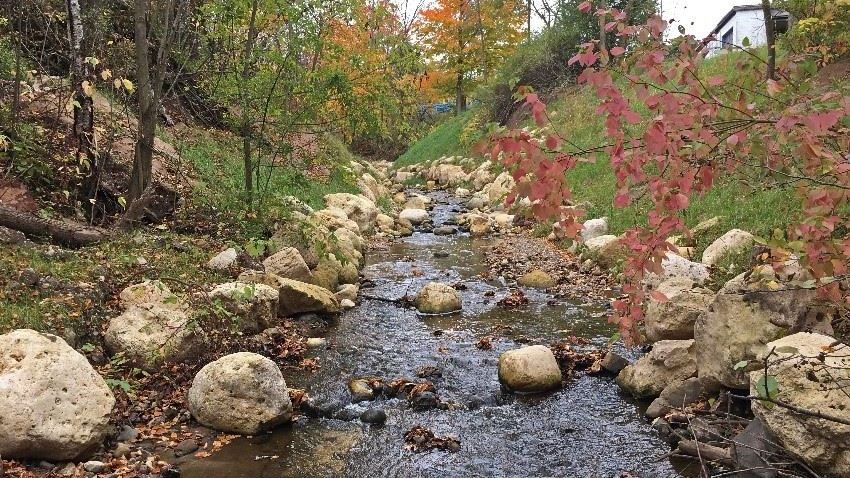 | |
Background: The Ozaukee County Planning and Parks Department has designed and is implementing a coastal resiliency and restoration project on Mineral Springs Creek (MSC), a tributary to Lake Michigan, in the City of Port Washington, Wisconsin. MSC originates in the Ulao Swamp and flows northeast to its confluence with Sauk Creek, approximately 200 feet upstream of Sauk Creek’s confluence with the Port Washington harbor on Lake Michigan. MSC connects over 195 acres of high-quality wetland habitat to Lake Michigan, but has been heavily manipulated. In 2018, the creek’s watershed experienced a 500+ year rainstorm that scoured the stream bed and the steep unstable banks, exposing a sanitary sewer line. In response, the City of Port Washington installed emergency protection of the utility corridor. This new structure created a major barrier for fish passage less than a mile from Lake Michigan.
Update: The Department coordinated with WDNR, USACE, City of Port Washington, and private landowners to design and engineer a nature-based coastal resiliency restoration project to restore the stream corridor and improve fish passage, while protecting critical infrastructure. Since 2013, the Department has secured and/or leveraged approximately $1,050,000 in federal, state, and private foundation grant funding and a local municipal contribution to support project activities on Mineral Springs Creek. This grant funding has supported project coordination and planning with stakeholders, public outreach, design and engineering, permitting, site preparation, construction and restoration including native vegetation restoration, construction activities, materials and supplies, equipment, and environmental monitoring activities.
| |
Resilient Lake Michigan Public Access Stairway at Virmond County Park | |
|
Background: In 2023, the Ozaukee County Planning and Parks Department completed an innovative public access stairway to the Lake Michigan shoreline and the National Lake Michigan Water Trail at Virmond County Park. The stairway is a low-impact, “floating design” with approximately 225 steps down 130-foot-high clay seepage bluffs. These unstable bluffs greatly limit public access to Lake Michigan and the shoreline in Ozaukee County. The Department coordinated with the Wisconsin Coastal Hazards Work Group, University of Wisconsin, Wisconsin Sea Grant, Ambrose Engineering, and About Nature LLC, for the design, engineering and construction of the stairway. This recently patented design meets public infrastructure and safety international design standards and includes independent, adjustable stairway sections on surface bearing “sleds” that are secured by cables and anchors at the top of the bluff. Sections can “float” over native unstable soils and sections can be tightened, adjusted and releveled in the event of bluff erosion and slumping.
Update: Since 2017, the Department has secured over $350,000 in federal and state (Wisconsin Coastal Management Program, Wisconsin Department of Natural Resources Stewardship) grants, private foundation (Brookby Foundation) funding, County funding, and private donations to support project activities. The stairway will provide approximately 700 daily park users safe, ecologically sensitive public access to Lake Michigan and is informing public access projects over unstable bluffs across the Great Lakes. The stairway is scheduled to be open to the public in July 2023.
| |
May 2023 Water Level Update | |
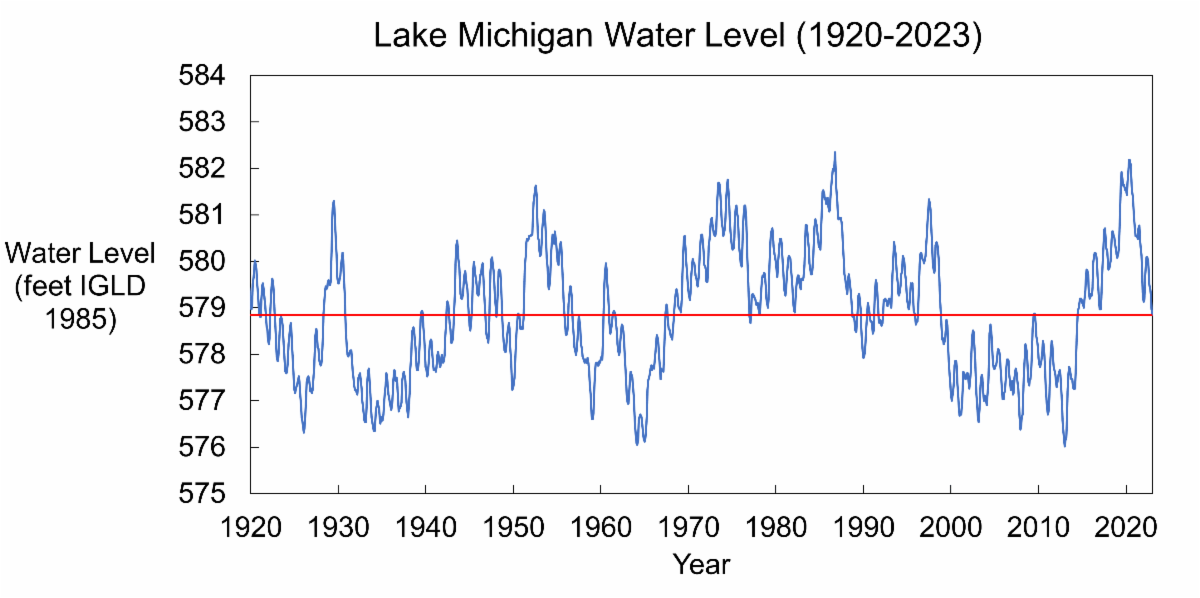
Lake Michigan water levels continued their seasonal incline, increasing 5 inches from April to May. Though Lake Michigan is now about 27 inches below the highest monthly water level recorded in May 2020, the Lake is still about 7 inches higher than the long-term average water level for the month. Water levels are expected to continue their seasonal rise over the next month. | |
Building Community Resilience with Nature-Based Solutions | |
|
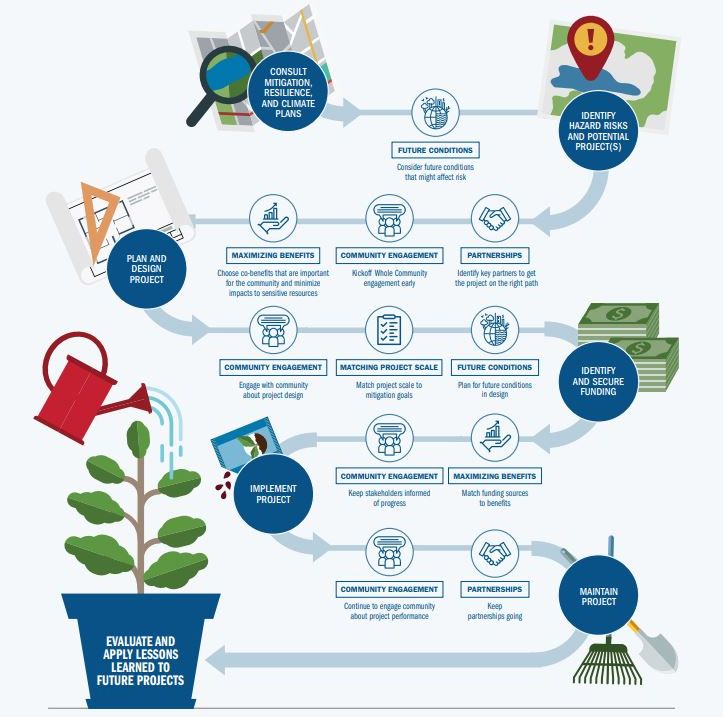
Building Community Resilience with Nature-Based Solutions is a series of guides produced by FEMA to help community leaders use nature-based solutions (NBS) to minimize the risks of natural hazards. These are non-technical guides that outline how communities can plan, develop partnerships, and invest funds in ways that will contribute to the effectiveness and sustainability of NBS.
The first guide, Building Community Resilience With Nature-Based Solutions: A Guide for Local Communities makes the case for using NBS. It tells readers how to include NBS in community planning, and it goes over funding options. The second guide, Building Community Resilience with Nature-Based Solutions: Strategies for Success outlines five strategies to help implement NBS projects. These strategies are meant to provide community leaders with resources for success, including case studies about how others have used the strategies to advance their project.
| |
EPA Great Lakes Environmental Justice Grant Program | |
|
The EPA is soliciting applications for their Great Lakes Environmental Justice Grant Programs (GLEJGP). This funding opportunity designed to direct funds to projects benefitting underserved communities experiencing or affected by adverse and disproportionate environmental and human health risks or harms. The GLEJGPs will provide funding for two types of applications aimed at furthering the goals of the Great Lakes Restoration Initiative (GLRI): 1) applications that aim to create a GLEJGP to provide funding for projects in a particular region of the Great Lakes Basin; and 2) applications that aim to create a GLEJGP to provide funding for projects across the entire Great Lakes Basin.
This RFA is not targeted directly at underserved communities themselves - it is targeted at a potential pass-through entity or entities with established relationships with underserved communities or with the ability to quickly build and sustain such relationships with those communities.
Priority activities in support of the GLRI Action Plan include:
- Habitat restoration/enhancement/protection
- Invasive species control
- Non-point source runoff reduction
- Aquatic connectivity
- Hands-on, place-based Great Lakes environmental educational opportunities
Due Date: August 11, 2023
| |
GLISA Small Grants Program | |
|
Great Lakes Integrated Sciences and Assessments (GLISA) is seeking letters of intent for their 2023 small grants program. GLISA will award several 2-year grants of up to $30,000 each to organizations that will collaborate with GLISA to advance equitable climate adaptation in the Great Lakes region. Our goal is to foster and sustain a suite of collaborative projects that increase GLISA’s impact and address and amplify dimensions of justice, equity, diversity, and inclusion (JEDI) in adaptation action.
Eligible applicants include community groups, non-governmental organizations, academic institutions, local, state, and Tribal governments, trade associations, and other not-for-profit or private entities active in the Great Lakes region.
Applicants will have two funding categories to choose from:
- Scale up or improve GLISA’s existing suite of tools and approaches; or
- Propose an idea to advance priorities of frontline communities and increase their capacity to adapt.
Dues Date: Friday, June 23 at 5pm Eastern
| |
WCMP is Seeking Project Ideas for Bipartisan Infrastructure Law 2023 Funding Competition | |
|
The Bipartisan Infrastructure Law (BIL) is providing funds to NOAA’s Office for Coastal Management to invest in coastal protection and restoration projects to increase coastal communities’ resilience to climate change and coastal hazards.
The Wisconsin Coastal Management Program (WCMP) is seeking out three projects to competitively apply to the 2023 National Coastal Zone Management Program BIL funding competition in early Summer 2023. Priority projects for this opportunity include habitat restoration; habitat restoration planning, engineering, and design; and land acquisition projects with a public entity partner.
For more information, see WCMP’s one-page factsheet, and contact WCMP with project ideas (coastal@wisconsin.gov) to begin a conversation.
| |
Building Blocks for Sharing Science | |
|
The Lake Superior Reserve Coastal Training Program and the Ohio Coastal Training Program are hosting a virtual training series tailored for professionals, practitioners and leaders working on Great Lakes coastal issues and is designed to address communication challenges we commonly encounter in environmental and science-adjacent careers. The courses will help you build confidence whether you facilitate meetings, develop graphics, author reports or proposals, or articulate the value of the natural world.
Course Highlights:
September 21st @ 1 - 3pm: How to Design a Compelling Grant Proposal & Presentation
October 17 @ 9 - 11am: Pathways to Valuing Ecosystem Services
*There is a $20 charge for each two-hour course*
| |
Climate Migration – Is the Great Lakes Region a Climate Haven? | |
This webinar features a panel of data scientists, researchers and government representatives who discussed the reality of climate migration in the Great Lakes region and the challenges and opportunities that come with it. | |
International Great Lakes Datum Update (IGLD 2020) | |
|
The International Great Lakes Datum (IGLD) is a common vertical reference used throughout the Great Lakes - St. Lawrence River system to measure water levels. IGLD was first released in 1955 by the Coordinating Committee on Great Lakes Basic Hydraulic and Hydrologic Data, a bi-national committee dedicated to joint water resource management. IGLD needs to be revised every 25-35 years to account for Glacial Isostatic Adjustment (GIA), or the ongoing “rebounding” of land brought on by the retreat of glaciers. Over time, GIA tilting of the region leads to changes in water levels relative to the rising or subsiding shorelines.
IGLD (1985), the current datum, is expected to be replaced by IGLD (2020) in 2025. To maintain consistency with national datums, IGLD (2020) will align with the new geoid-based North American Geopotential Datum of 2022 that is expected to be adopted in the U.S. by 2025.
Webinar Recording: International Great Lakes Datum and Low Water Datum (April 6)
| |
|
For questions about the CALM Network, or to submit something to the newsletter, contact:
Lydia Salus
lydia.salus@wisconsin.gov
608-266-3687
| |
For questions about Lake Michigan coastal hazards or how to approach, plan, and prepare for them, contact:
Adam Bechle
608-263-5133
| |
University of Wisconsin Sea Grant Institute | (608) 262-0905 | 1975 Willow Drive, 2nd Floor, Madison, WI 53706 | | | | |