Wisconsin Coastal Resilience Newsletter | | |
Greetings from the Wisconsin Coastal Resilience Team!
This month's newsletter contains:
Member-to-Member Updates:
- Lake Michigan Ice Cover: Current Conditions & Historical Trends
Lake Michigan Water Level Update
Resource Highlights:
- Updated WICCI Coastal Resilience Working Group Webpage
- DOI Nature-based Solutions Roadmap
Around the Great Lakes:
- Into the Outdoors Airs Episode Featuring CALM's Lydia Salus
Funding Opportunities:
- USFWS Midwest Region Coastal Program
- Wisconsin Recreational Trails Program
- MMSD Green Infrastructure Partnership Program
- Climate Smart Communities Initiative Grant
- Municipal Flood Control Grant Program
Trainings & Webinars:
- Adaptive Management & RAD Webinar
Conferences & Events:
- East River Collaborative Winter Forum
- Clean Rivers, Clean Lake Conference
- Wetland Science Conference
- Wisconsin Land + Water Annual Conference
- Wisconsin American Water Resources Association Annual Meeting
- Wisconsin Lakes and Rivers Convention
| | Lake Michigan Ice Cover: Current Conditions & Historical Trends | | |
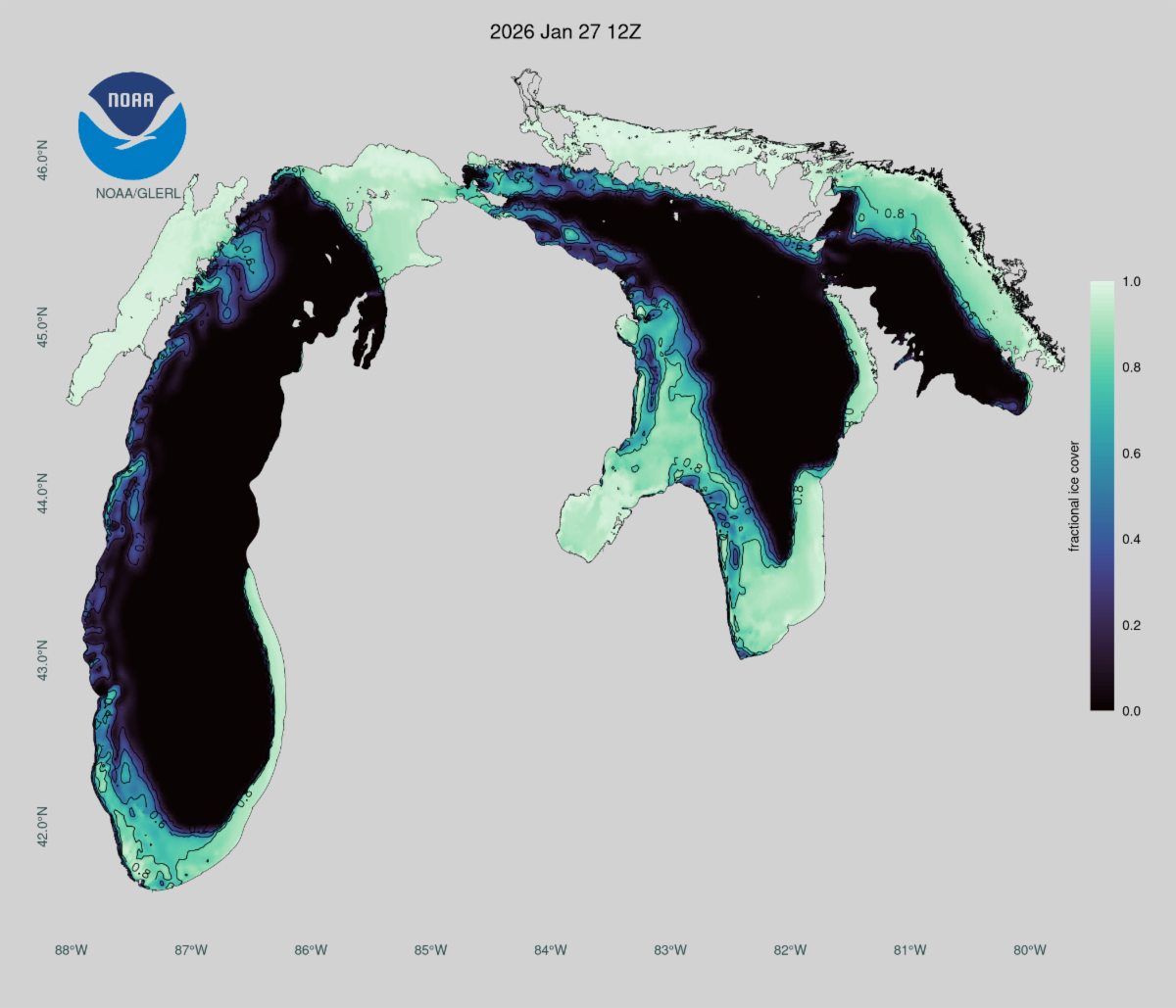
Winter is in full swing across Wisconsin, so it’s time to check in on Lake Michigan ice cover. According to the National Weather Service, the arctic air mass covering the region has resulted in ice expansion across the Great Lakes over the last several days. Ice cover for the 2025-2026 winter season is now pacing well ahead of the 53-year historical average (see graph). Below normal temperatures will remain in place across the Great Lakes through the next several days which will allow for additional moderate ice growth this week. Current ice cover concentration is highest in the Bay of Green Bay, with significant partial ice cover near Two Rivers, Manitowoc, Racine, and Kenosha (see map).
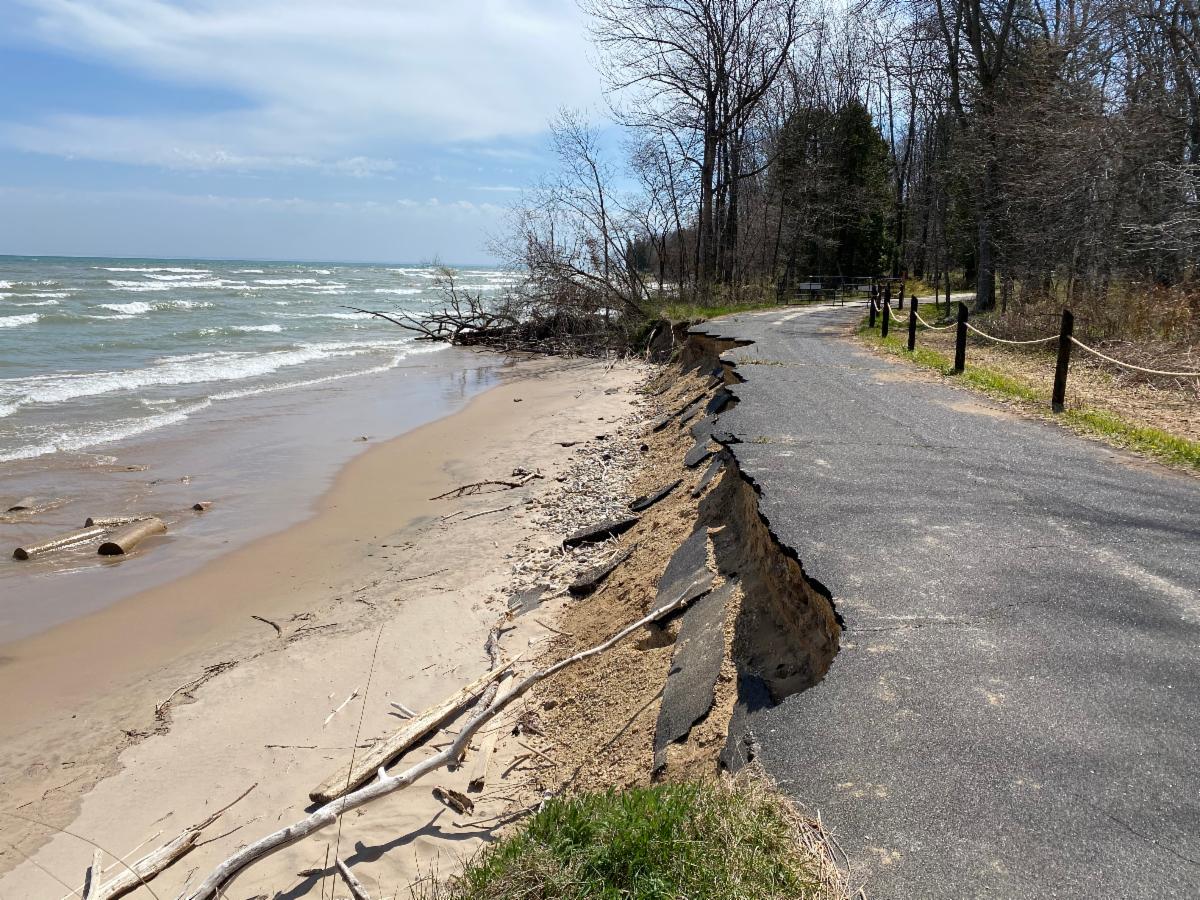
Some areas of the Great Lakes have experienced a trend of decreasing ice cover duration, but that trend varies greatly depending on location. For example, while Superior, WI lost 1 to 1.5 days of ice cover per year between 1973 and 2019 (or 46 to 70 days total), Port Washington, WI lost 0 to 0.5 days of ice cover per year (or 0 to 23 days total). Areas with a reduction in ice cover duration are likely to experience relatively greater winter storm impacts like erosion and flooding. Learn more about historic and projected changes in ice cover on the Great Lakes and their relation to coastal hazards here.
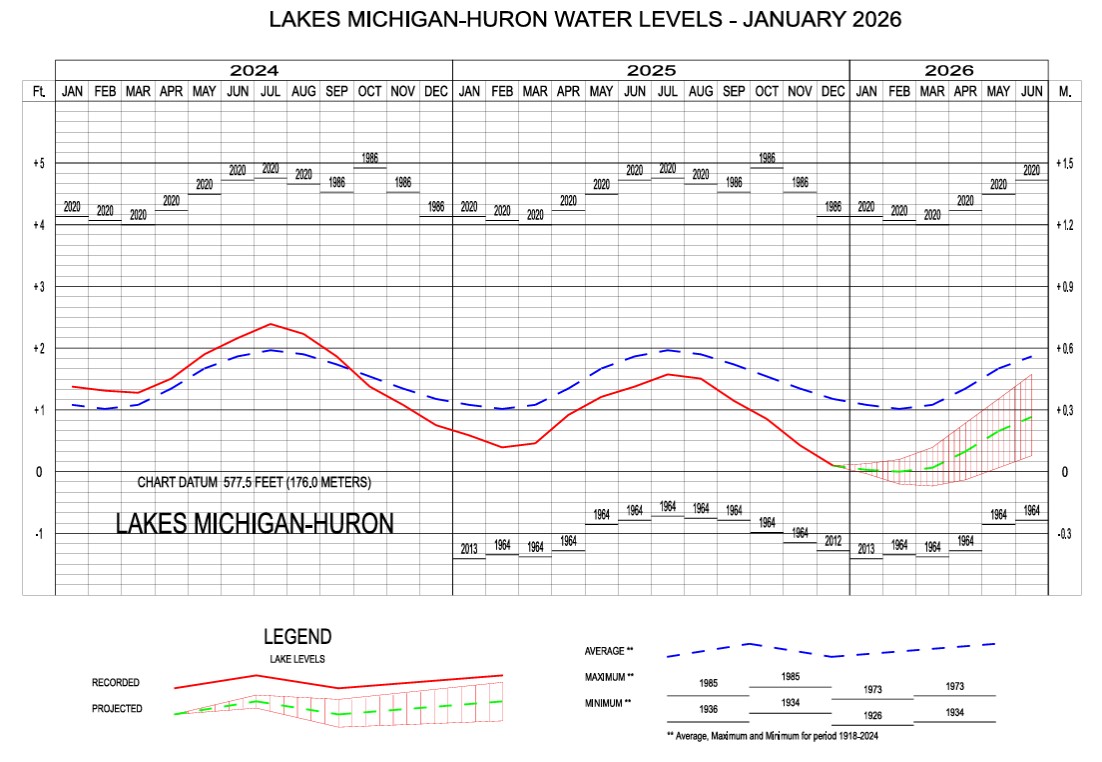
| | January 2026 Water Level Update | | Lake Michigan water levels appear to have reached their seasonal low in December, and increased 2 inches from December to January. Lake Michigan is still about 11 inches below the long-term average water level for the month. Water levels are expected to remain steady in February before increasing in the spring. | | Updated WICCI Coastal Resilience Working Group Webpage | | |
WICCI’s Coastal Resilience Working Group webpage has been updated with new information, resources, and examples to help coastal communities and property owners adapt to a changing climate. Explore issues and impacts with new briefs and publications on fluctuating water levels, coastal erosion rates, and more. If you’ve identified a specific issue, a range of possible strategies to address it are provided in the WICCI Coastal Resilience Issues/Impacts/Strategies Table. If you’re looking for general guidance on how to make your community more resilient, check out our nine guiding principles, now with resources and examples provided for each.
| | DOI Nature-based Solutions Roadmap | | |
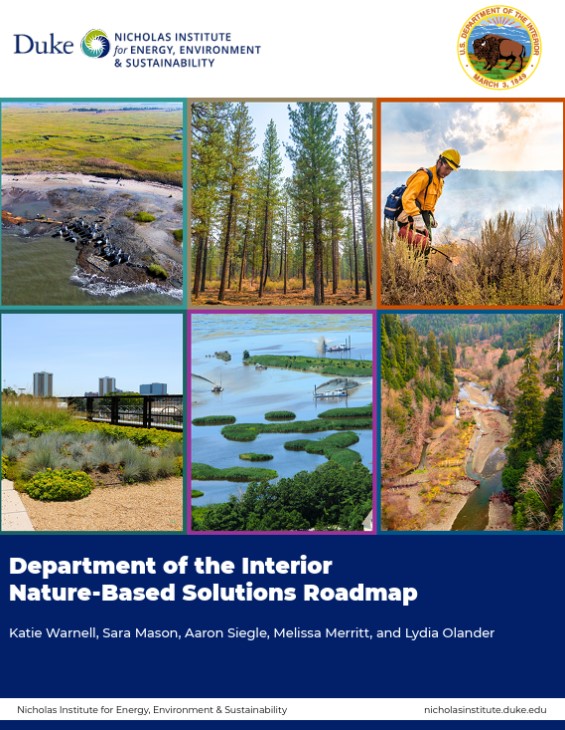
Nature-based solutions are actions that incorporate natural features and processes to protect, conserve, restore, sustainably use, and manage natural or modified ecosystems to address socio-environmental challenges while providing measurable co-benefits. Nature-based solutions can help address challenges like coastal erosion and stormwater management. The Roadmap is a comprehensive resource to support anyone interested in implementing nature-based solutions (NBS). It includes strategies, case studies, tools, and funding opportunities, and is available as both a searchable database and PDF document.
| | Into the Outdoors Airs Episode Featuring CALM's Lydia Salus | | In November, Emmy Award-winning children’s program Into The Outdoors aired “Mapping the Mysteries: Great Lakes Careers”. The episode covers Great Lakes research, conservation, and career pathways. Give the episode a watch and you’ll notice an appearance from CALM’s own Lydia Salus as she explains what coastal management is and why it’s important. This episode is the first of three productions developed in partnership between Discover Mediaworks and the Wisconsin Coastal Management Program. The following two episodes are due to be released this year. | | USFWS Midwest Region Coastal Program | | |
The U.S. Fish and Wildlife Service's Midwest Coastal Program is once again seeking opportunities to support and collaborate on coastal habitat projects in the Southwestern Lake Michigan region. The Midwest Region Strategic Work Plan outlines geographic focus areas and priority species for each. We are especially interested in projects that occur within designated focus areas; provide direct, measurable benefits to priority species and habitats; and result in acres of miles of habitat restored, enhanced, or protected. Ideal funding requests range from $50,000 to $150,000, but up to $200,000 can be requested. Please reach out to Lacey Hill (lacey_hill@fws.gov) with any project ideas in this region and for more information.
Application Deadline: February 20, 2026 and on a rolling basis throughout the year
| | Wisconsin Recreational Trails Program | | |
The Recreational Trails Program is a federal program administered in most states. Municipal governments and incorporated organizations are eligible to receive reimbursement for the development, rehabilitation, and maintenance of recreational trails and trail-related facilities for both motorized and non-motorized recreational trail uses.
Eligible Applicants: Towns, villages, cities, counties, tribal governing bodies, school districts, state agencies, federal agencies or incorporated organizations
Application Deadline: March 1, 2026
| | MMSD Green Infrastructure Partnership Program | | |
The Milwaukee Metropolitan Sewerage District invites public, private, and not-for-profit organizations that plan to install Green Infrastructure (GI) strategies on their property to submit applications for partnership funding from the 2026 Green Infrastructure Partnership Program (GIPP). More information regarding this Request for Application can be found on the District’s Bonfire Procurement Portal website, reference #G98024P38. All inquiries should be directed to Nathan Churchill, Senior Procurement Specialist, at nchurchill@mmsd.com.
Eligible Applicants: Public, private, and not-for-profit organizations
Application Deadline: March 5, 2026 at 10am
| | Climate Smart Communities Initiative Grants | | |
CSCI awards provide funding and technical assistance to advance community-based climate resilience in US communities or regions that are highly vulnerable to the impacts of climate change. The total grants budget is $1.5-2 million, and grants typically range from $75,000 to $115,000 based on the scope of work proposed in the application. CSCI anticipates awarding between 16-20 grants for the 2026 cycle. The program prioritizes funding for communities that include historically disinvested populations at increased risk to climate-related impacts. Watch the applicant webinar for more information.
Eligible Applicants: US-based project teams composed of a climate adaptation practitioner and representatives from a local or regional government entity and a community-based organization.
Application Deadline: March 12, 2026
| | Municipal Flood Control Grant Program | | |
Recognizing the responsibility to protect life, health, and property from flood damages, the Wisconsin Department of Natural Resources offers this grant assistance package to all cities, villages, towns, tribal governments, and metropolitan sewerage districts concerned with municipal flood control management. This grant program is not intended to be an emergency relief program and is instead a way to proactively mitigate the impacts of a changing climate; reduce flood hazard vulnerabilities; and improve the resilience and preparedness of Wisconsin municipalities. The total available funding for this grant cycle is $3 million and the maximum grant award for an individual applicant is $600,000.
Eligible Applicants: Local governments, tribal governments, and metropolitan sewerage districts.
Application Deadline: March 16, 2026 at 4pm
| | Adaptive Management & RAD Webinar | | |
April 22
2pm-3pm
Virtual
The USGS National Climate Adaptation Science Centers are hosting a quarterly webinar series on the RAD (Resist-Accept-Direct) framework, a tool that helps resource managers make informed choices for responding to change. This webinar will feature a panel of experts from the U.S. Geological Survey, University of North Dakota, and University of Colorado who will discuss how combining RAD (Resist-Accept-Direct) with Adaptive Management can support conservation and natural resource management. The webinar will focus on real-world examples of operationalizing RAD Adaptive Management and future opportunities for implementing.
| | |
February 5
9am-11:30am
Virtual
Join the East River Collaborative for their annual Winter Forum! At this regional networking event, you'll learn from partners on a range of topics, such as flood resiliency efforts, project updates, and recreational improvements in the East River Watershed. View the draft agenda here. Don't miss out! This event only comes once a year, so be sure to register today!
| | |
February 10
Milwaukee, WI
For over 20 years, Sweet Water’s annual Clean Rivers, Clean Lake (CRCL) Conference has been a hallmark occasion for the watershed community of practice in southeastern Wisconsin. Participants from public, private, nonprofit, and academic organizations gather to discuss strategies and projects to improve the health of our shared watersheds. This all day event includes presentations from water quality experts, engaging discussions, networking opportunities, catered lunch, and more! Additionally, CALM will be represented at the conference as part of a joint coastal resilience session from the Wisconsin Coastal Management Program.
| | Wetland Science Conference | |
February 24-26
Baraboo, WI
The 31st Annual Wetland Science Conference, a program of Wisconsin Wetlands Association, will be held February 24-26 at the Ho-Chunk Hotel & Convention Center in Baraboo, WI. The conference typically includes a keynote address, topical oral sessions, a poster session, workshops, working groups, a Wednesday evening networking event, and field trips to area wetlands.
| | Wisconsin Land + Water Annual Conference | | |
March 4-6
Wisconsin Dells, WI
Wisconsin Land + Water's Annual Conference provides valuable networking opportunities, forums to discuss current work and new ideas with colleagues, a chance to build technical knowledge, and space to be re-inspired by the passion for conservation across the state. The conference includes keynote and plenary speakers, youth education poster and speaking contests, honoring the winners of our Conservation Awards, networking and social hours, and a silent auction to benefit youth education programs.
| | Wisconsin American Water Resources Association Annual Meeting | | |
April 9-10
Brookfield, WI
The Wisconsin Chapter of the American Water Resources Association (AWRA) provides an interdisciplinary forum for people involved in all aspects of water resources research and management. The 2026 WI AWRA meeting is a major milestone: the 50th anniversary of our organization! Professionals and students from throughout Wisconsin and beyond will gather to learn from each other and discuss a wide range of water resource-related topics. We are planning plenary, oral, and poster sessions addressing both surface water and groundwater issues in Wisconsin.
| | Wisconsin Lakes and Rivers Convention | |
April 15-17
Stevens Point, WI
When tackling a monumental challenge, it sometimes takes a long time to see results. The 2026 Lakes and Rivers Convention will look back on the long-term programs and the accumulated actions of countless people that have persevered through many decades. Their dedication has ensured that the programs that developed in the 70’s, 80’s and 90’s are still with us in the 2020’s and beyond. We will also celebrate the people who will continue to carry the torch for water protection and restoration into the future.
| | |
For questions about the CALM Network, or to submit something to the newsletter, contact:
Jake Kolanowski
jacob.kolanowski1@wisconsin.gov
608-261-9197
| | |
For questions about Lake Michigan coastal hazards or how to address them, contact:
Adam Bechle
bechle@aqua.wisc.edu
608-263-5133
| | University of Wisconsin Sea Grant Institute | (608) 262-0905 | 1975 Willow Drive, 2nd Floor, Madison, WI 53706 | | | | |