Wisconsin Coastal Resilience Newsletter | | |
Greetings from the Wisconsin Coastal Resilience Team!
This month's newsletter contains:
Member-to-Member Updates:
- RECAP: CALM Field Trip to Upper Lake Park & Valley Creek
Lake Michigan Water Level Update
Resource Highlights:
- Great Lakes Climate Adaptation Resource Guide
Around the Great Lakes:
- Shaping the Shoreline: Video Series
Funding Opportunities:
- GLOS Coastal Monitoring Request for Proposals
- Allen Family Philanthropies Natural Climate Solutions RFP
- DNR Municipal Flood Control Grant Program
Trainings & Webinars:
- Messaging Deep Dive: Disaster Resilience and Natural Defenses
Conferences & Events:
- 2026 Wetland Science Conference
- 20th Annual Clean Rivers, Clean Lake Conference
| | RECAP: CALM Field Trip to Upper Lake Park & Valley Creek | | |
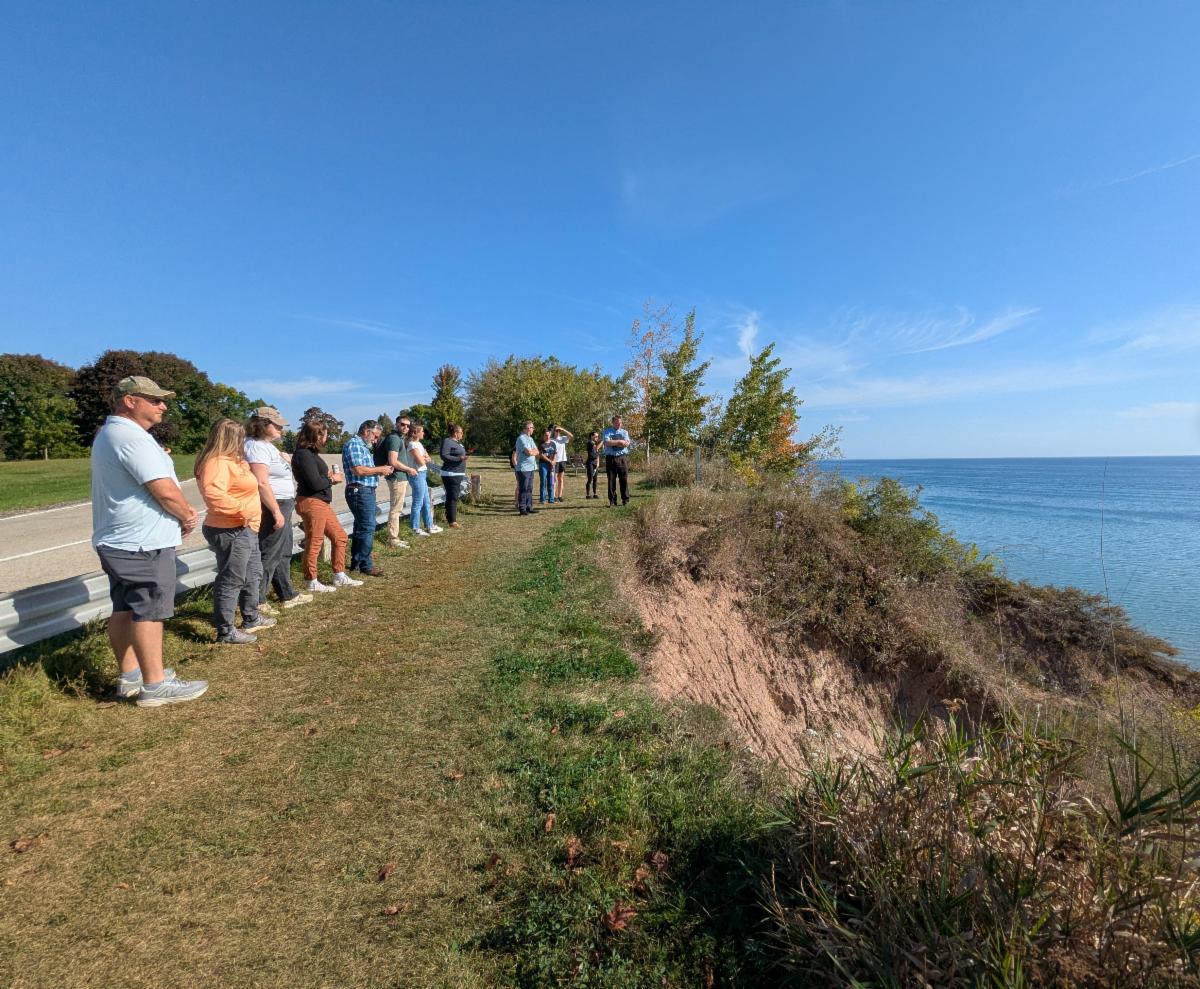
This fall, CALM members traveled to Port Washington to tour Upper Lake Park and Valley Creek. First, attendees stopped at the edge of the eroding bluff (pictured) and heard about efforts to stabilize it, including the completed installation of drainage lines, the planned cutback of the bluff, and the likely relocation of a park road. Then, attendees stopped at Valley Creek and saw concept renderings for the restoration of the stream. Goals of the restoration include stabilizing streambanks to reduce erosion, creating fish habitat and removing barriers to fish passage, and restoring wetlands to reduce flood risk. The tour ended with questions and discussion at one of the park's pavilions. Thanks to Rob Vanden Noven, Amy Lentz, and Melissa Curran for leading us and answering our questions. If you couldn’t make the trip this time, stay tuned and join us for more in-person and virtual CALM events 2026!
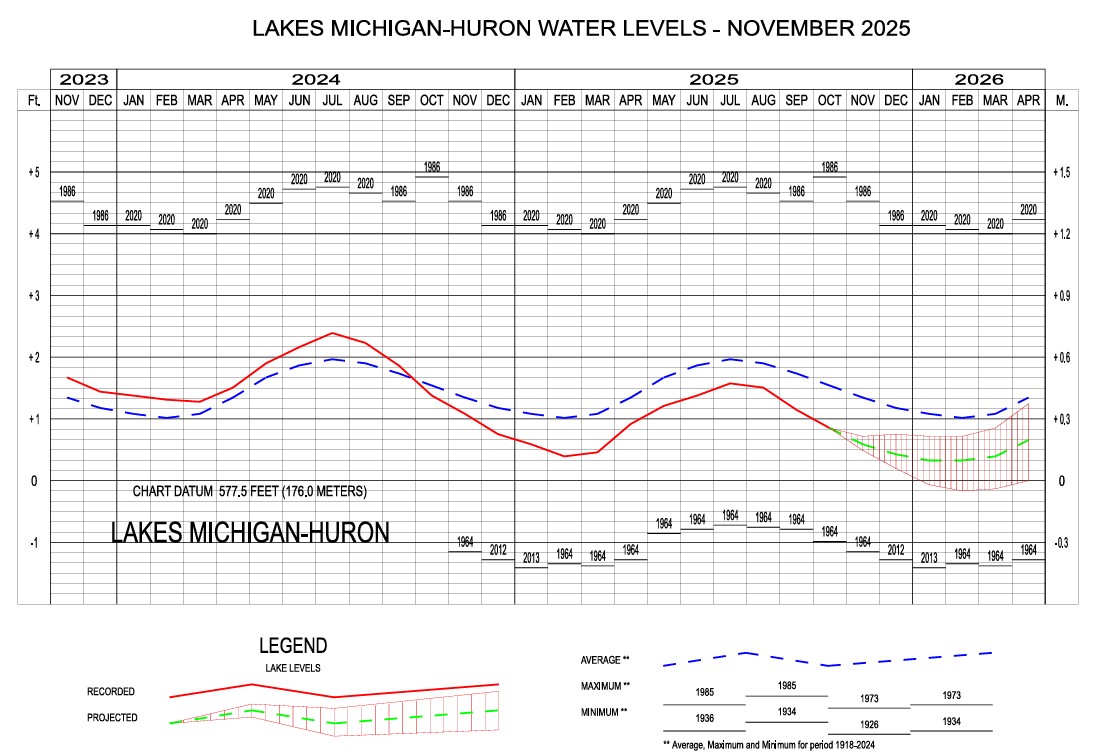
| | November 2025 Water Level Update | | Lake Michigan water levels continue their seasonal decline, decreasing 6 inches from October to November. Lake Michigan is still about 8 inches below the long-term average water level for the month. Water levels are expected to continue their decline through February before increasing in the spring. | | Great Lakes Climate Adaptation Resource Guide | | |
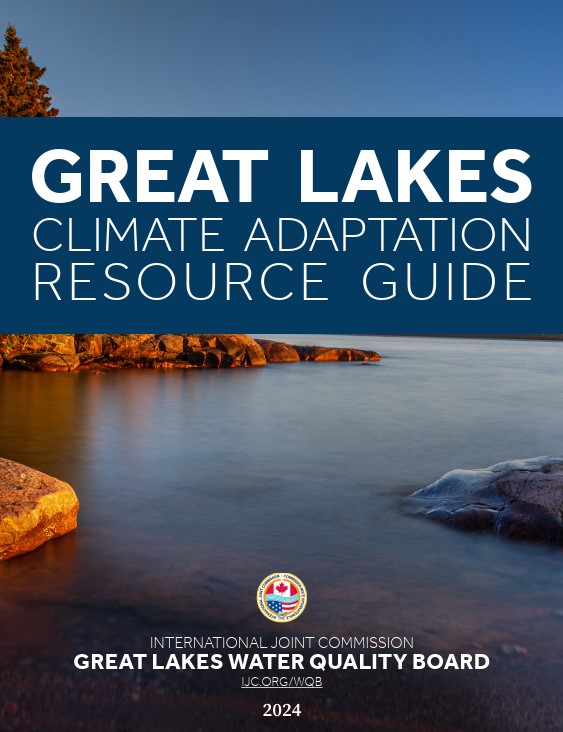
For hundreds of small and medium-sized communities across the Great Lakes region, preparing for the water-related impacts of changing weather patterns can be challenging. The International Joint Commission’s (IJC) Great Lakes Water Quality Board has developed a new Great Lakes Climate Adaptation Resource Guide. The guide highlights tools and approaches (including the CALM community of practice!) to help communities integrate Great Lakes water topics into their climate adaptation and resilience strategies. For additional information, read the one-pager or view the informational webinar.
| | Shaping the Shoreline: Video Series | | Illinois-Indiana Sea Grant has released a new video series on coastal processes, revetments, and groins. Each educational video is about 5 minutes of concise information on one topic. Through visualizations and expert interviews, the Shaping the Shoreline video series helps educate communities on natural processes and coastal protection structures, knowledge of which is fundamental to fostering a resilient Great Lakes coast. | | GLOS Coastal Monitoring Request for Proposals | | |
The Great Lakes Observing System (GLOS) is increasing efforts to enhance coastal resilience, by soliciting proposals to support the expansion of coastal hazard monitoring. Proposals should address one or more of the following areas of interest:
- Increasing the spatial and/or temporal coverage of observing assets for coastal hazards, such as water levels and waves
- Improving product development and dissemination to better inform and engage coastal property owners, managers, and communities
Eligible Applicants: Governmental agencies, non-profit organizations, academic institutions, and for-profit organizations.
Application Deadline: December 1, 2025 at 4pm CT
| | Allen Family Philanthropies Natural Climate Solutions RFP | | |
Allen Family Philanthropies has issued a call to non-profit organizations across the U.S. that are working in the Natural Climate Solutions (NCS) space to break implementation barriers using science and technology. The foundation is particularly interested in U.S.-based projects consisting of diverse teams of scientists, practitioners, and key stakeholders (e.g., community members, landowners, state land managers, etc.) to co-develop, test, and deploy science and technology solutions addressing barriers to NCS implementation. A total of $10M will be available to fund 6-7 projects (each lasting up to 3 years in duration) via this Request for Proposals (RFP). Freshwater wetland projects are among those being considered.
Eligible Applicants: Nonprofits, units of state or local government, state or federally recognized tribal communities or tribes, and public and private colleges and universities.
Informational Webinar: December 9, 2025 at 11am CT; Register
Letter of Interest Deadline: January 15, 2026 at 2pm CT
| | DNR Municipal Flood Control Grant Program | | |
Recognizing the responsibility to protect life, health, and property from flood damages, the Wisconsin Department of Natural Resources offers this grant assistance package to all cities, villages, towns, tribal governments, and metropolitan sewerage districts concerned with municipal flood control management. This grant program is not intended to be an emergency relief program and is instead a way to proactively mitigate the impacts of a changing climate; reduce flood hazard vulnerabilities; and improve the resilience and preparedness of Wisconsin municipalities. The total available funding for this grant cycle is $3 million and the maximum grant award for an individual applicant is $600,000.
Eligible Applicants: Local governments, tribal governments, and metropolitan sewerage districts.
Application Deadline: March 16, 2026 at 4pm
| | Messaging Deep Dive: Disaster Resilience and Natural Defenses | | |
December 9
Virtual
From fire to flooding, climate disasters and extreme weather are getting more frequent and severe. Are you wondering about public opinion on the government’s role in disaster resilience? Or how to turn that concern from extreme weather into support for natural defenses like protecting parks, forests, and wetlands? Join the Water Hub and Climate Advocacy Lab for an in depth research discussion. In this webinar, we will share results from our recent Audience Understanding survey and Rapid Message Testing results.
| | 2026 Wetland Science Conference | |
February 24-26
Baraboo, WI
The 31st Annual Wetland Science Conference, a program of Wisconsin Wetlands Association, will be held February 24-26 at the Ho-Chunk Hotel & Convention Center in Baraboo, WI. The conference typically includes a keynote address, topical oral sessions, a poster session, workshops, working groups, a Wednesday evening networking event, and field trips to area wetlands. Registration will open in December.
| |
February 25
Milwaukee, WI
For the past twenty years, the Clean Rivers, Clean Lake Conference has been a hallmark occasion for the watershed community of practice in southeastern Wisconsin to come together to discuss strategies and projects to improve the health of our watersheds. This all day event will include presentations from water quality experts and engaging panel discussions. Each year, participants from nonprofit, government, business and academic organizations gather for the Clean Rivers, Clean Lake Conference to learn about improving the health of our watersheds through policy innovation, technical and engineering advances, watershed restoration planning and practices, and collaborative stakeholder involvement. Potential 2025 topics include water quality improvement tactics and strategies, advances in bacterial science, reforestation initiatives, WDNR resources updates, and much more!
| | |
For questions about the CALM Network, or to submit something to the newsletter, contact:
Jake Kolanowski
jacob.kolanowski1@wisconsin.gov
608-261-9197
| | |
For questions about Lake Michigan coastal hazards or how to address them, contact:
Adam Bechle
bechle@aqua.wisc.edu
608-263-5133
| | University of Wisconsin Sea Grant Institute | (608) 262-0905 | 1975 Willow Drive, 2nd Floor, Madison, WI 53706 | | | | |