Wisconsin Coastal Resilience Newsletter | |
|
Greetings from the Wisconsin Coastal Resilience Team!
This month's newsletter contains:
Survey: Upcoming Training Opportunities
Member-to-Member Updates: Building Coastal Resilience and Coalitions in NE Wisconsin
Lake Michigan Water Level Update
Resource Highlights:
- Wisconsin Climate Table
- Wisconsin Culvert Inventory Database and Online Mapping App
Around the Great Lakes: New Center for Understanding Climate Change Impacts
Funding Opportunities
- Funding Navigator Tool from HUD
- Building Resilient Infrastructure and Communities (BRIC)
Training: A Seat at the Table: Whole Community Climate Resilience Planning
Webinars
- Seven Best Practices for Risk Communication
- Great Lakes NBS Coastal Solutions Community of Practice Recording
- FEMA National Mitigation Planning Program Webinar Series
News: Drones offer WI Researchers Insights on What Happens to Eroded Soil
| |
Tell Us About Your Interest in Upcoming
NOAA Training Opportunities
| |
|
NOAA’s Office for Coastal Management is offering instructor-led trainings throughout the next year (Oct. 1, 2023 – Sep. 30, 2024). CALM has the opportunity to host a training(s) here in Wisconsin! There are options for in-person or virtual trainings (details linked below). Continuing education credits are available for some professional certifications. We’d like to hear from you about your interest in attending a training. Please respond to the Google Form to share your input on the training type, topic, and timing.
NOAA Training Options:
Virtual/Online
In-person/Onsite
Link to Google Form: https://docs.google.com/forms/d/e/1FAIpQLSefaX1zOw1rg8gByPTaJOFixifWZkPDBpBursnt8QJF4xrXKQ/viewform?usp=sf_link
| |
Building Coastal Resilience and Coalitions in Northeast Wisconsin | |
|
Would you like to host the Extreme Event Game?
Wisconsin Sea Grant (WSG), in partnership with the Bay Lake Regional Planning Commission (BLRPC) and Wisconsin Emergency Management (WEM), has been working throughout coastal communities in northeast Wisconsin to build greater capacity for disaster resilience. In addition to technical analysis of flood vulnerability across seven counties on Lake Michigan’s coast, the project team has hosted a series of Community Flood Preparedness Events to bring together local officials and community leaders to engage in discussions around coalition building for disaster resilience.
Events held this summer in Oconto, Marinette, and Manitowoc featured the Extreme Event Game (EEG), a game developed by the National Academies of Sciences, Engineering, and Medicine, to stimulate discussion around community resilience and the importance of building coalitions across all sectors to prepare for a disaster. The events have helped establish and strengthen county-level Community Organizations Active in Disaster (COAD) groups, which are loose networks of local organizations in each county that cooperate, coordinate, communicate, and collaborate during disasters. The project team is looking to hold additional events in other counties across northeast Wisconsin and the rest of the state. Communities interested in bringing the Extreme Event Game to their county can contact Jackson Parr at jgparr@wisc.edu.
|  | |
Fall 2023 Water Level Update | |
|
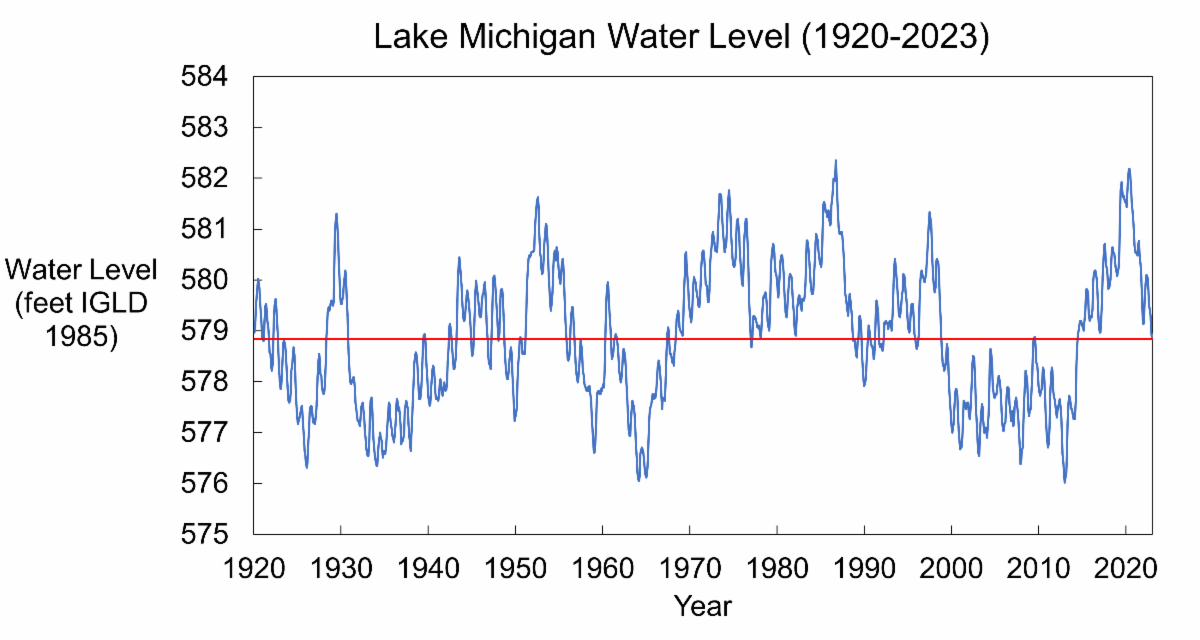
Through the late summer (August) and early fall (September and October), Lake Michigan water levels began their seasonal decline. From July to October, water levels on Lake Michigan fell approximately 7 inches. Over the past year, Lake Michigan experienced below average precipitation. Despite water levels now being approximately 37 inches below the highest monthly water level recorded in October 1986, the Lake is still about 3 inches higher than the long-term average water level for the month. Water levels are expected to drop another 2 inches by the end of November and continue their seasonal decline through the winter.
Key topics in this season’s water level update: El Niño, fall storm events, and more!
| |
|
Wisconsin Climate Table:
Tool Kit for Equity & Justice in Local Climate Action Planning
| |
|
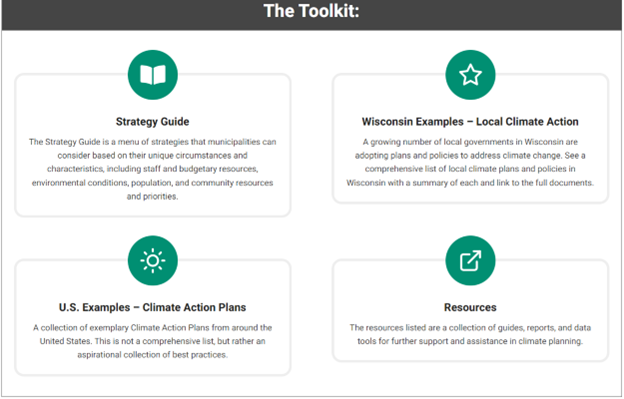
The WCT Local Climate Action Planning Tool Kit is a resource for communities that are looking to center equity in climate planning and policy. It contains a strategy guide of options based on community characteristics, municipal examples from across the state and country, and a list of resources for planners and policy makers.
| |
Wisconsin Culvert Inventory Database and Online Mapping App | |
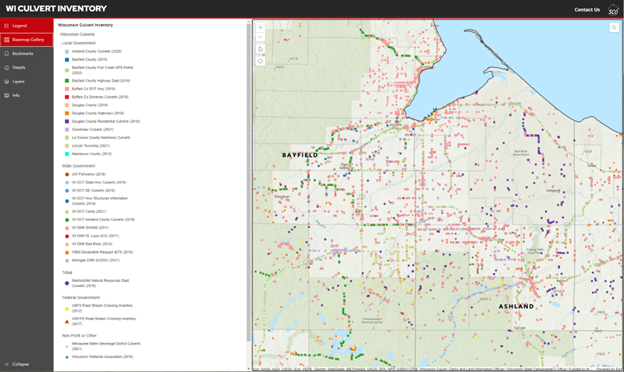
The Wisconsin Coastal-Management Data Infrastructure (WICDI) Project provided data, tools and training to coastal communities in Wisconsin. Increased frequency and intensity of rain events can cause damage to infrastructure including culverts. Culverts were inventoried and mapped to help identify at-risk culverts and justify infrastructure upgrades or replacements. WICDI provided resources needed for coastal and culvert managers to quickly and appropriately respond to damages or identify vulnerable culverts before catastrophe.
One of the outputs of the WICDI project is a standardized culvert database, developed with support from partners across the state.The database is available for download with full metadata from geodata@wisconsin here. An online culvert app, allowing access to the dataset, is available here. The app differentiates culverts using symbology based on data source. Each culvert can be clicked on to get the full list of attributes and values. Download of the dataset from the app is facilitated with a link to the Geodata@Wisconsin record.
|  | |
New Center for Understanding Climate Change Impacts | |
The U.S. National Science Foundation has awarded $5 million to the University of Michigan to establish the Global Center for Understanding Climate Change Impacts on Transboundary Waters. Partners include Cornell University, the College of Menominee Nation, the Red Lake Nation, and the University of Wisconsin. The new center will initially focus on climate change adaptation in the Great Lakes region with a special emphasis on Indigenous and climate-vulnerable communities. | |
Funding Navigator Tool from HUD | |
The U.S. Department of Housing and Urban Development (HUD) recently launched a tool to provide information on funding opportunities made available under the Inflation Reduction Act, Bipartisan Infrastructure Law, and other Federal programs that support a wide range of efforts. Find open and upcoming opportunities, including funding status and where to apply for funds to implement projects that strengthen resiliency in communities. | |
Building Resilient Infrastructure and Communities (BRIC) | |
|
FEMA’s annual BRIC program is making $1 billion available for projects that protect people and infrastructure from natural hazards and the effects of climate change. Funding will be available for capability and capacity building activities, hazard mitigation projects, and management costs.
Due Date: February 29, 2024
Notice of Funding Opportunity: https://www.grants.gov/web/grants/search-grants.html?keywords=BRIC
Connect with Wisconsin Emergency Management to discuss eligible projects.
| |
|
A Seat at the Table:
Training for Whole-Community Climate Resilience Planning
A Self-Paced NOAA Digital Coast Training, This online learning resource helps coastal resilience planning practitioners incorporate the needs and perspectives of socially vulnerable populations into resilience planning using inclusive, community-driven processes. The resource provides helpful checklists, visuals, and examples, and an overview of whole-community planning with resources for identifying and engaging socially vulnerable populations.
| |
|
Seven Best Practices for Risk Communication
NOAA’s Office for Coastal Management is hosting an interactive webinar about best practices, techniques, and examples for connecting with diverse audiences about hazards. Wherever you are in your effort to help communities prepare for hazards, applying risk communication principles will lead to more effective results. More information can be found on the Digital Coast Academy website.
Date: Thursday, November 2nd, 2023
Time: 2:00 p.m. to 3:30 p.m. Eastern | 1:00 p.m. to 2:30 p.m. Central
Registration link: https://docs.google.com/forms/d/e/1FAIpQLScdaz4Zsl3MrGKZEEoRaVLjgZVNgJQtoNxSdoO7GQoNkrRCWA/viewform
| |
|
Great Lakes Nature Based Coastal Solutions
Community of Practice Webinar Recording
A webinar recording discussing various Nature-Based Coastal Solutions from around the Great Lakes. Featured speakers include:
● Peter Zuzek, Zuzek Inc., spoke on the Coastal Resilience Framework.
● Jenny Gharib, Essex Region Conservation, spoke on the Restoration of Hillman Marsh.
● Scott Baker, National Research Council, spoke on the Scarborough Waterfront Project.
Webinar Recording Link: https://www.youtube.com/watch?v=xBgjFmbLitA
| |
|
Your copy should address 3 key questions: Who am I writing for? (Audience) Why should they care? (Benefit) What do I want them to do here? (Call-to-Action)
Create a great offer by adding words like "free" "personalized" "complimentary" or "customized." A sense of urgency often helps readers take an action, so think about inserting phrases like "for a limited time only" or "only 7 remaining"!
| |
Drones offer Wisconsin researchers insights on what happens to eroded soil and how to prevent shoreline loss | |
|
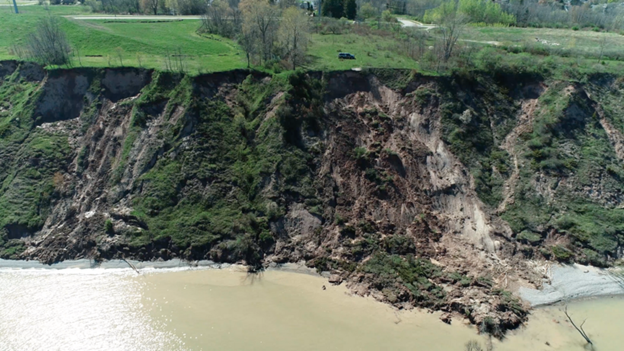
A research team at the UW-Madison is using drones to study erosion along Lake Michigan. We hear from the lead scientist about methods to track where eroded soil ends up and how the research might prevent more shoreline loss.
(image credit: Collin Roland)
| |
|
For questions about the CALM Network, or to submit something to the newsletter, contact:
Lydia Salus
lydia.salus@wisconsin.gov
608-266-3687
| |
|
For questions about Lake Michigan coastal hazards or how to address them, contact:
Adam Bechle
bechle@aqua.wisc.edu
608-263-5133
| |
University of Wisconsin Sea Grant Institute | (608) 262-0905 | 1975 Willow Drive, 2nd Floor, Madison, WI 53706 | | | | |