Wisconsin Coastal Resilience Newsletter | |
|
Greetings from the Wisconsin Coastal Resilience Team!
This month's newsletter contains:
-
Collaboration Classifieds: Waterfront Project Questionnaire
- Lake Michigan Water Level Update
-
Resource of the Month: 2022 Shoreline Oblique Photos
-
Around the Great Lakes: Property Easement Helps Lakefront Path Move Ahead
- Funding Opportunities
-
NOAA Great Lakes Bay Watershed Education and Training (B-WET)
- NOAA Coastal Habitat Restoration & Resilience Grants
- Wisconsin Coastal Management Program Grants (2023-24)
-
Upcoming Events: CALM Fall Field Trip Series
- Trainings
- Hazard Mitigation Assistance Webinars
- NFIP 101: Introduction to Floodplain Management
-
In the News: Seawall Impacts Mequon Homes On Lake Michigan
| |
Collaboration Classifieds | |
Share your Experience with Waterfront Projects | |
 | |
Background: The Bay-Lake Regional Planning Commission (BLRPC) is in the process of developing a Waterfront Toolkit to help communities plan and manage their waterfront resources. The toolkit will offer extensive information to help waterfront communities support public access, environmental stewardship, and sustainable economic development. This includes case study examples of successful waterfront projects.
Request: BLRPC is looking for communities and organizations interested in participating in a waterfront project questionnaire. Information from the questionnaire will be utilized to develop waterfront project case studies. Any community located within the Great Lakes region or along rivers qualify to participate in the questionnaire. Any organization completing projects in the same areas are also welcome to participate!
If you are interested in filling out the questionnaire, please utilize this link: https://arcg.is/zGvDy. We ask that you fill out one questionnaire per waterfront project, and feel free to fill out as many questionnaires as you see fit.
For assistance or questions, contact Adam Christensen at achristensen@baylakerpc.org or 920-448-2820 ex. 106
| |
Reach out to Lydia Salus (lydia.salus@wisconsin.gov) to submit a classified. | |
September 2022 Water Level Update | |
|
Lake Michigan water levels have started the seasonal decline, decreasing 2 inches from August to September. Though Lake Michigan is now about 24 inches below the highest monthly water level recorded for August in 2020, the Lake is still about 9 inches above the long-term average water level. Water levels are expected to remain level until the seasonal decline in the fall.
Watch the USACE’s “On the Level” Youtube channel for monthly updates and information about the Great Lakes’ water levels and forecasts from Detroit District Hydraulics and Hydrology experts.
| |
|
2022 Shoreline Photos Now Available on the
Wisconsin Shoreline Inventory & Oblique Photo Viewer
| |
|
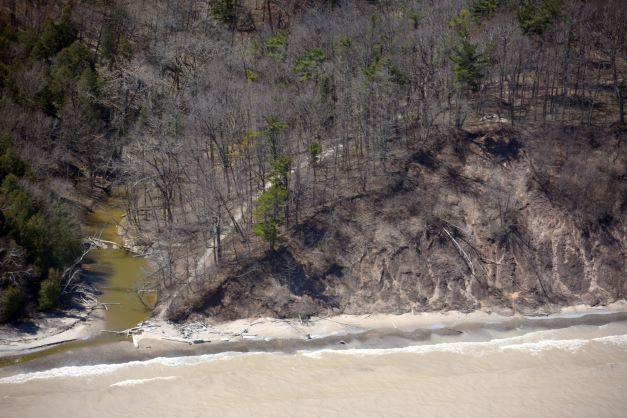
The Wisconsin Shoreline Inventory and Oblique Photo Viewer has been updated with oblique photos from May 2022. The viewers is a web-based, interactive map of Wisconsin coastal data that enables users to visualize the temporal changes to Wisconsin’s shorelines. Geolocated aerial photos and shoreline condition inventories allow users to view images from different years side-by-side to visualize coastal change. Additionally, this map contains measurements of bluff recession data (from 1956 to 2015) which provides both a qualitative and quantitative inventory of shoreline conditions on Wisconsin’s Great Lakes coasts. Lake Michigan coastal bluff and shoreline recession information is provided for Southeastern Wisconsin (for more information on recession mapping, see our Bluff Recession Measurement Report).
| |
Property Easement Helps Lakefront Path Move Ahead | |
A public-private partnership is helping Painesville, Ohio extend a lakefront trail along Lake Erie. A perpetual trail easement to Lake Metroparks park system is being donated by The Kurtz Brothers, a dredging company which owns property directly west of the existing Painesville Township Park. This will guarantee a bike path will be built along the lake despite the Lake Metroparks not owning the land. Construction will begin in spring 2023. Read more about this project here | |
Great Lakes Bay Watershed Education and Training (B-WET) Program | |
|
The NOAA Office of National Marine Sanctuaries is seeking proposals for the 2023 B-WET program. B-WET is a competitive grant program that supports existing, high quality environmental education programs, fosters the growth of new, innovative programs, and encourages capacity building and partnership development for environmental and place-based education programs throughout the entire Great Lakes watershed.
Eligible applicants include city or township governments, county governments, public and private institutions of higher education, Native American tribal governments and organizations, independent school districts, and state governments.
Contact the Great Lakes B-WET program coordinator for questions:
sarah.a.waters@noaa.gov or (989) 312-3520
Applications Due: Tuesday, September 20, 2022
Applicant Resources: https://sanctuaries.noaa.gov/bwet/greatlakes/
| |
NOAA Coastal Habitat Restoration and Resilience Grants for Underserved Communities | |
|
Up to $10 million in funding is available for habitat restoration and resilience awards for underserved communities. NOAA will engage underserved communities in habitat restoration activities that promote resilient ecosystems and communities. This funding will provide capacity for these communities to more fully participate in developing future transformational habitat projects.
Projects selected through this opportunity may include:
- Capacity building activities, including participation in municipal or regional-scale resilience planning, project planning and feasibility studies, stakeholder engagement, and proposal development for future funding.
- Restoration activities, including demonstration projects, engineering and design, permitting, and on-the-ground implementation.
Application Deadline: Wednesday, October 5, 2022.
| | Wisconsin Coastal Management Program Grants (2023-24) | |
|
The Wisconsin Coastal Management Program (WCMP) is seeking proposals to enhance, preserve, protect and restore resources within the state’s coastal zone – all counties adjacent to Lakes Superior and Michigan, with their nearly 1000 miles of shoreline. We anticipate awarding up to $1.6 million in grant funding.
WCMP Grants are available for coastal wetland protection and habitat restoration, nonpoint source pollution control, coastal resource and community planning, Great Lakes education, public access and historic preservation.
Applicants are encouraged to contact WCMP staff early to discuss ideas for project proposals and application requirements.
WCMP staff will host a live webinar on September 9, 2022. A recorded presentation will be made available and posted at http://coastal.wisconsin.gov.
Application Deadline: Friday, November 4, 2022
| |
CALM Fall Field Trip Series | |
|
This fall field trip series will bring the CALM community together to talk about coastal hazards issues and see the different ways that Lake Michigan coastal communities have moved forward in addressing those issues. Look for a sign-up email later this week.
Samuel Myers Park - Racine, WI
Wednesday, September 28, 2022
10:00am - 12:00pm
Virmond Park - Mequon, WI
Mid-October date to be determined soon
| |
Hazard Mitigation Assistance Webinars | |
|
Hazard Mitigation Assistance (HMA) webinars bring FEMA subject-matter experts and partners together to provide technical information, best practices, tools, and resources regarding the Building Resilient Infrastructure and Communities, Flood Mitigation Assistance, and Hazard Mitigation Grant Programs.
Dates: August 4th through October 4th, 2022
| |
NFIP 101: Introduction to Floodplain Management | |
|
Hosted in partnership with ASFPM, this training will help new and experienced floodplain administrators, emergency managers, elected officials, and others learn more about the NFIP and its requirements. New floodplain administrators will also learn how floodplain management decisions affect insurance, health, and public safety.
This training can be completed at online, at your convenience.
| |
Concordia’s Seawall Impacts Mequon Homes On Lake Michigan | |
By Mario Koran, Wisconsin Center for Investigative Journalism | | |
|
|
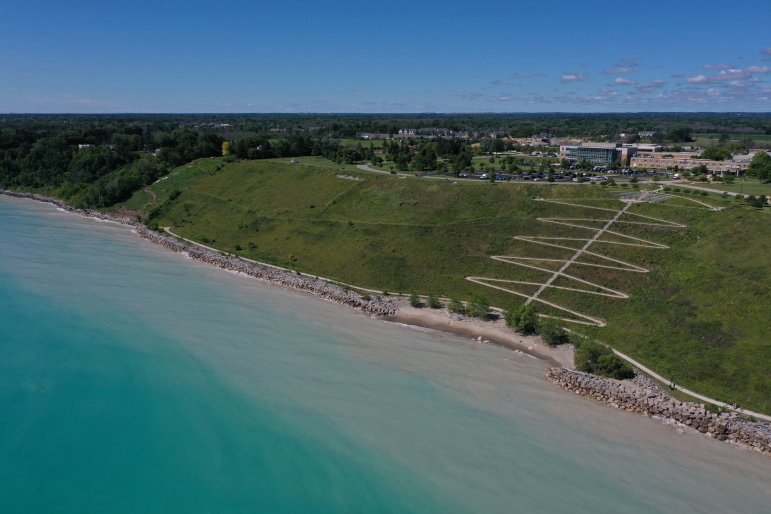
"Experts worry about the long-term effects of shoreline armoring while describing the practice as a short-term maneuver that benefits those who are fastest to build.
Revetments, a kind of seawall, are typically sloped, stacked rocks meant to buffer the beach against the impact of waves. But they can also affect downstream properties — making adjacent beaches deeper while blocking the natural movement that would otherwise replenish them."
| |
For questions about the CALM Network, or to submit something to the Collaboration Classifieds, contact:
Lydia Salus
608-266-3687
| |
For questions about Lake Michigan coastal hazards or how to approach, plan, and prepare for them, contact:
Adam Bechle
608-263-5133
| |
For more information, visit the Wisconsin Coastal Resilience website.
| |
University of Wisconsin Sea Grant Institute | (608) 262-0905 | 1975 Willow Drive, 2nd Floor, Madison, WI 53706 | | | | | |