Wisconsin Coastal Resilience Newsletter | |
|
Greetings from the Wisconsin Coastal Resilience Team!
This month's newsletter contains:
CALM Leadership Update
Member-to-Member Updates
Lake Michigan Water Level Update
Resource of the Month: USACE Beneficial Use of Dredged Sediment Webpage
Funding Opportunities
- Water Resources Projects for Small or Disadvantaged Communities
- EPA GLRI Environmental Justice Grant Program
- NOAA Climate Resilience Regional Challenge
Around the Great Lakes
- Natural Flood Management Addendum Added to Ashland County Hazard Mitigation Plan
- Protecting the Third Coast
| |
|
Dear CALM Network,
This summer we began a transition in leadership for this network. CALM will now be coordinated by the CALM leadership team. We wanted to take this opportunity to reintroduce ourselves. The CALM leadership team consists of six agencies, organizations, and programs that support coastal hazards work on Wisconsin’s Lake Michigan coastline: Wisconsin Coastal Management Program (WCMP), Wisconsin Department of Administration (DOA), Wisconsin Sea Grant Institute (Sea Grant), Wisconsin State Cartographer’s Office (SCO), Bay-Lake Regional Planning Commission (Bay-Lake RPC), and Southeastern Wisconsin Regional Planning Commission (SEWRPC).
| |
|
We will be taking charge of distributing network communications and planning events. After this month’s newsletter, we will begin sending the Coastal Resilience Newsletter on a quarterly basis. Additionally, as we navigate this transition, network meetings and events may vary in frequency. However, we remain dedicated to supporting the CALM network.
On the Wisconsin Coastal Resilience website, you can find an archive of past newsletters, coastal hazards and resilience resources, recordings and summaries of past meetings and events, and more!
To contact the CALM leadership team with questions, comments, concerns, or ideas, please reach out to Lydia Salus (lydia.salus@wisconsin.gov) or use the Contact Us form on the Wisconsin Coastal Resilience website.
Sincerely,
Adam, David, Kate, Lydia, Hannah, Mike, Jim, Howard, Aaron, and Izzy
| |
Do You Have Something to Share? | |
|
The Member-to-Member Updates is a dedicated space to share opportunities for collaboration with, request lessons learned and resources from, and/or provide project updates to other communities and organizations within Wisconsin’s Lake Michigan region.
Submit your content to Lydia Salus (lydia.salus@wisconsin.gov) or via the Contact Us page on the Wisconsin Coastal Resilience website.
| |
July 2023 Water Level Update | |
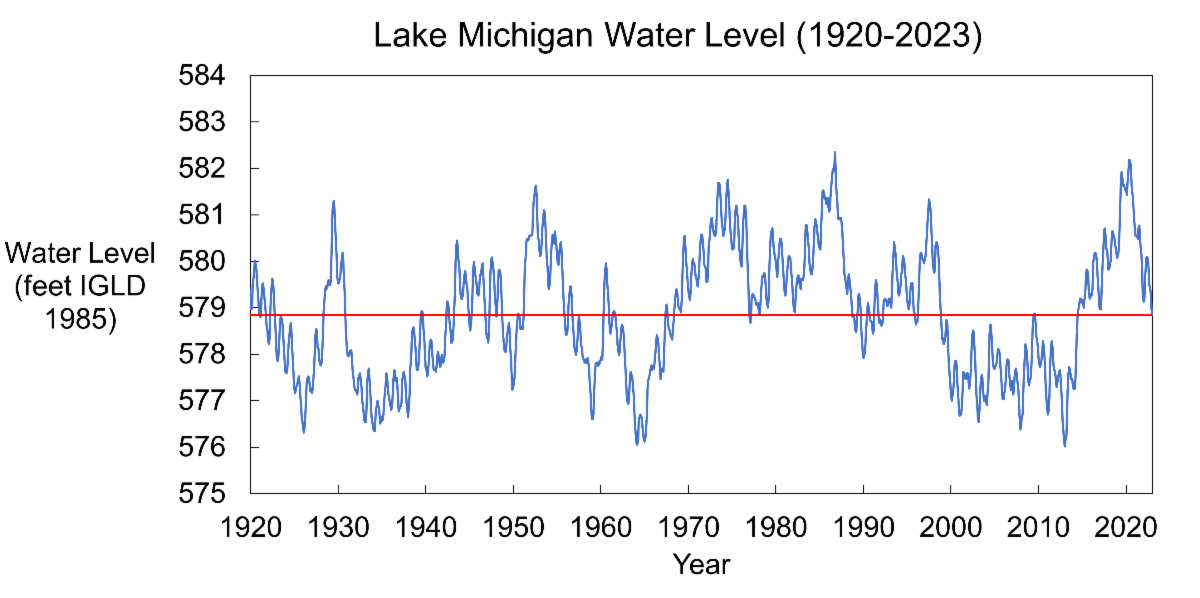
Lake Michigan water levels rose approximately two inches from June to July. Though Lake Michigan is now about 29 inches below the highest monthly water level recorded in July 2020, the Lake is still about 5 inches higher than the long-term average water level for the month. Water levels are expected to remain stable over the next month. | |
USACE Beneficial Uses of Dredged Sediment Website | |
|
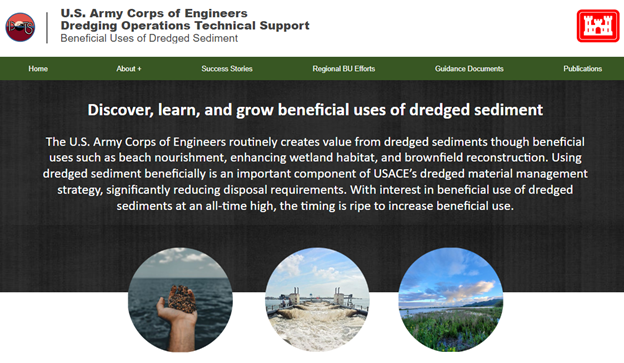
The U.S. Army Corps of Engineers (USACE) hosts a website on the beneficial use of sediment. The website contains information and resources about beneficial uses of dredged sediments to support the use of dredged materials in beach nourishment, wetland habitat, ecosystem restoration, and brownfield reconstruction. The website features guidance documents and USACE manuals related to BU as well as success stories of projects that have incorporated beneficial uses of dredged sediment. USACE has a goal to ensure that 70% of navigational dredging sediment is used beneficially by 2030.
In Wisconsin’s Lake Michigan coastal communities, dredged materials have been used for projects including the Samuel Myers Park Restoration Project in Racine, Kenosha Dunes Natural Infrastructure Project in Kenosha, and the Cat Island Restoration Project in Green Bay.
| |
U.S. Army Corps of Engineers | |
|
The United States Army Corps of Engineers (USACE) is a federal agency with a guiding mission to “deliver enduring engineering and water resource solutions to the nation, in collaboration with partners, to protect the environment, energize the economy, and strengthen our national security”. The USACE Chicago office outlines program priorities as supporting navigation, flood and coastal storm risk management, aquatic ecosystem restoration, lakes and recreation, emergency management, and regulation.
The USACE supports coastal resilience through funding opportunities, tools, data, technical guidance, and partnerships. The USACE recently signed a partnership agreement with all eight Great Lakes state coastal management programs to conduct a Great Lakes Coastal Resiliency Study. This is a first of its kind project encompassing the entire great lakes coastal area. The study will assess coastal resources over a range of future conditions and develop a watershed plan to support the management of Great Lakes coastal resources, and the identification, selection, and prioritization of resilient coastal investments.
| |
Water Resources Projects for Small or Disadvantaged Communities (Pilot Program) | |
|
The U.S. Army Corps of Engineers USACE) is launching a pilot program to fully fund small water resources projects for economically disadvantaged communities. The pilot program will fund planning activities including feasibility studies, design, and implementation for navigation, flood risk management, and ecosystem restoration projects.
Due Date: August 21, 2023.
Proposals can be sent to: wrda20cap165a@usace.army.mil. Please include Section 165 Project Proposal in the subject line of the message.
Chicago District Points of Contact:
● David Handwerk, Chief, Economic Formulation Section (David.r.handwerk@usace.army.mil)
● Alex Hoxsie – Section 204, 206, and 1135 Chief, Environmental and Cultural Resources Section (Alex.r.hoxsie@usace.army.mil)
● Dr. Akilah Martin, Environmental Justice Coordinator (Akilah.r.martin@usace.army.mil)
● David Bucaro Chief, Planning Branch (David.f.bucaro@usace.army.mil)
| |
EPA GLRI Environmental Justice Grant Program | |
|
The EPA is soliciting applications for their Great Lakes Environmental Justice Grant Programs (GLEJGP). This funding opportunity designed to direct funds to projects benefitting underserved communities experiencing or affected by adverse and disproportionate environmental and human health risks or harms. The GLEJGPs will provide funding for two types of applications aimed at furthering the goals of the Great Lakes Restoration Initiative (GLRI): 1) applications that aim to create a GLEJGP to provide funding for projects in a particular region of the Great Lakes Basin; and 2) applications that aim to create a GLEJGP to provide funding for projects across the entire Great Lakes Basin.
This RFA is not targeted directly at underserved communities themselves - it is targeted at a potential pass-through entity or entities with established relationships with underserved communities or with the ability to quickly build and sustain such relationships with those communities.
Priority activities in support of the GLRI Action Plan include:
- Habitat restoration/enhancement/protection
- Invasive species control
- Non-point source runoff reduction
- Aquatic connectivity
- Hands-on, place-based Great Lakes environmental educational opportunities
Due Date: August 11, 2023
| |
NOAA Climate Resilience Regional Challenge | |
|
The NOAA Climate Resilience Regional Challenge will support collaborative approaches to achieving resilience in coastal regions with an emphasis on risk reduction, regional collaboration, equity, and building enduring capacity. The Challenge is a $575 million competition with a Letter of Intent phase and two exclusive funding tracks designed to meet the needs of coastal communities wherever they are in the resilience and adaptation process. There is no matching requirement for this opportunity.
Track 1: Regional Collaborative Building and Strategy Development
Supports building capacity for, development of, and collaboration on transformational resilience and adaptation strategies for coastal communities. Successful applicants will receive $500,000 to $2,000,000 to support regional scale coordination, engagement, planning, advancement of equitable outcomes, and capacity building for resilience and adaptation.
Track 2: Implementation of Resilience and Adaptation Actions
Supports implementation of transformational resilience and adaptation strategies and associated actions for coastal communities anchored in previous planning efforts. Applicants must propose a suite of complementary adaptation actions that together build the resilience of multiple communities within a coastal region, including those that have been marginalized, underserved, or underrepresented. Applicants can apply for not less than $15,000,000 and not more than $75,000,000, with most awards being between $25,000,000 and $50,000,000.
Applications Due: August 21, 2023
Information Sessions: June 27th, July 11th, and July 12th, 2023
| |
Natural Flood Management Addendum Added to
Ashland County Hazard Mitigation Plan
| |
|
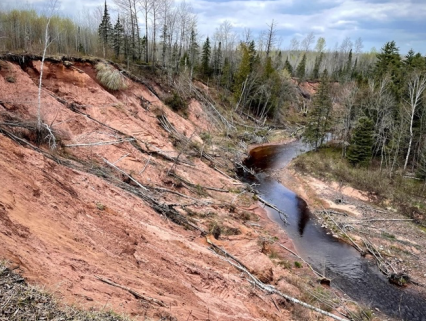
In March 2023, Ashland County approved an addendum to the county’s Hazard Mitigation Plan. The addendum, titled A Strategy for Natural Flood Management & Climate Resilient Infrastructure in Ashland County, incorporates pre-disaster mitigation strategies focused on natural flood management into the existing Hazard Mitigation Plan. Section I describes vulnerability factors that apply to high-risk watersheds in Ashland County. Section II describes goals & strategies for addressing fluvial erosion hazards & degraded hydrology. Ashland County collaborated with the Northwest Regional Planning Commission, the U.S. Geological Survey, and Wisconsin Wetlands Association to prepare this strategy. The effort was funded by a 2019 FEMA Pre-Disaster Mitigation Advance Assistance Grant. [image courtesy of Wisconsin Wetlands Association]
| |
Protecting the Third Coast | |
|
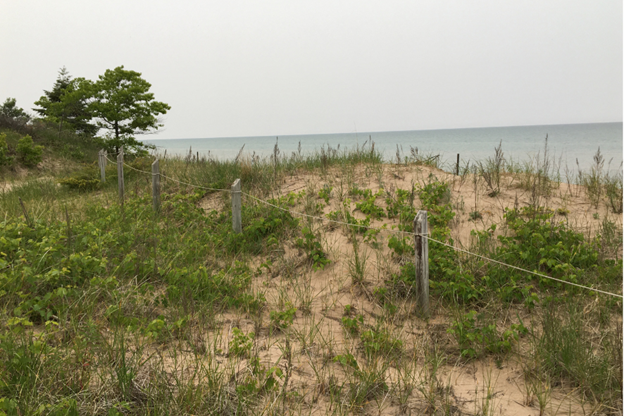
The Natural Resources Foundation of Wisconsin has been awarded a Fund for Lake Michigan grant to improve water quality, enhance wildlife habitat, and improve accessibility across a network of 5 properties in Havenwoods State Forest, Lakeshore State Park, Kohler-Andrae State Park, Point Beach State Forest, and Red Banks Alvar State Natural Area along the coast of Lake Michigan. This project builds on past efforts including an assessment of a 5-mile stretch of coast in Southeastern Wisconsin. [image credit: Shelly Torkelson]
| |
|
For questions about the CALM Network, or to submit something to the newsletter, contact:
Lydia Salus
lydia.salus@wisconsin.gov
608-266-3687
| |
|
For questions about Lake Michigan coastal hazards or how to address them, contact:
Adam Bechle
bechle@aqua.wisc.edu
608-263-5133
| |
University of Wisconsin Sea Grant Institute | (608) 262-0905 | 1975 Willow Drive, 2nd Floor, Madison, WI 53706 | | | | |