Wisconsin Coastal Resilience Newsletter | |
|
Greetings from the Wisconsin Coastal Resilience Team!
This month's newsletter contains:
Collaboration Classifieds:
- Share Your Experiences Managing Acquired Hazard-Challenged Properties
- Great Lakes Commission Collecting Implementation Tactics for Online Map
Lake Michigan Water Level Update
Resource of the Month: Wisconsin Coastal Resilience Funding Inventory
Funding Opportunities
- NFWF America the Beautiful Request for Proposals
- FEMA Releases New Hazard Mitigation Assistance Guide
- Bipartisan Infrastructure Law (WCMP)
Trainings
- Building Blocks for Sharing Science
- Nature-Based Solutions for Coastal Hazards: The Basics
Webinars: Cities Initiative Webinar on Great Lakes Coastal Resiliency Study
| |
Collaboration Classifieds | |
Share Your Experiences Managing Acquired Hazard-Challenged Properties | |
|
Background: The Coastal States Organization and Association of State Floodplain Managers have undertaken a partnership project through the NOAA Digital Coast Fellowship to assess and improve the technical guidance resources available to local communities to understand, plan for, and manage this subset of acquired or vacated properties on the changing coast. The Shifting Property Lines project aims to support coastal communities considering managed retreat strategies by creating technical guidance and case studies focused on local planning for cohesive and intentional management of acquired properties impacted by coastal erosion and inundation.
Request: The project team is looking to interview local governments that have acquired private property due to hazard risk and/or impacts and are now managing it (e.g., coastal inundation, erosion, riverine flooding, wildfire, landslides).
Contact: Reach out to Annika Tomson if you would like to share your experiences or have recommendations for potential interviewees.
| |
Share Your Water Infrastructure Implementation Tactics with the Great Lakes Commission | |
|
Background: The Great Lakes Commission (GLC) convened a Regional Working Group on Water Infrastructure made up of diverse partners and stakeholders to identify approaches for improving water infrastructure in the Great Lakes region. These approaches consist of four priority areas: public health and safety; community engagement and trust-building; equitable distribution of investments and benefits; and asset management and workforce development. At the GLC’s Annual Meeting in October 2022, Commissioners approved the Working Group’s document, “Approaches for Improving Great Lakes Water Infrastructure: A Blueprint,” with the goal of propelling actions to address the region’s water infrastructure needs.
Request: Now, the GLC is collecting “implementation tactics” from utilities, state agencies, and other organizations to share how the Great Lakes community has put these approaches into action on a dynamic map for other stakeholders to learn from.
Contact: Email Program Specialist James Polidori to share how your organization is implementing blueprint approaches to advance water infrastructure improvements across the region.
| |
April 2023 Water Level Update | |
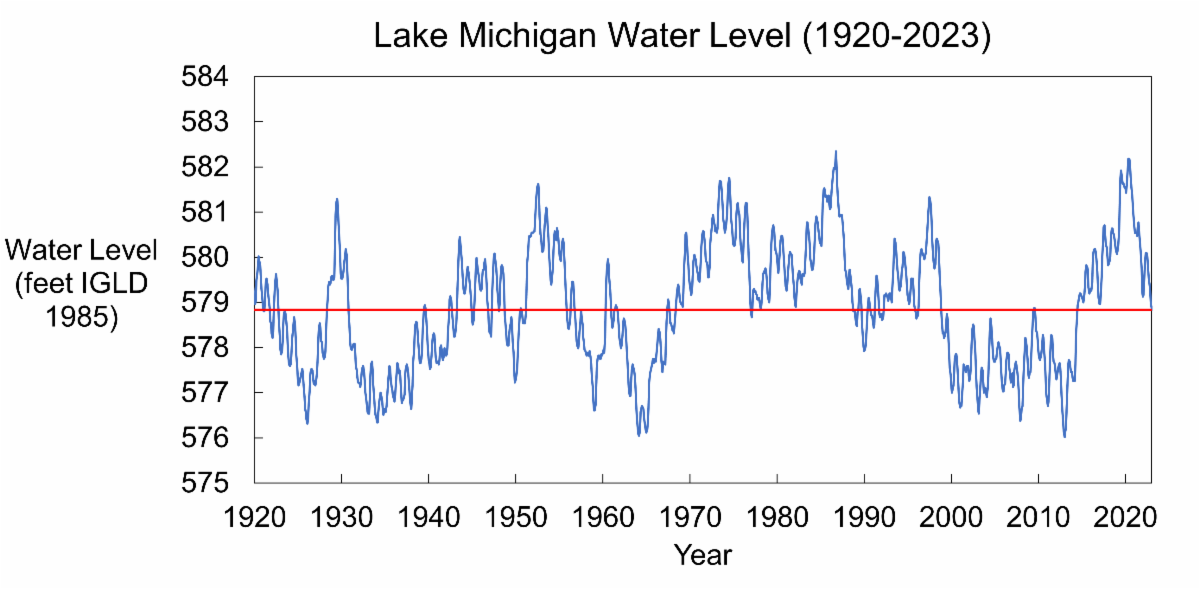
Lake Michigan water levels continued their seasonal incline, increasing 4 inches from March to April. Though Lake Michigan is now about 30 inches below the highest monthly water level recorded for April 2020, the Lake is still about 5 inches higher than the long-term average water level for the month. Water levels are expected to continue their seasonal rise over the next month. | |
Wisconsin Coastal Resilience Funding Inventory | |
|
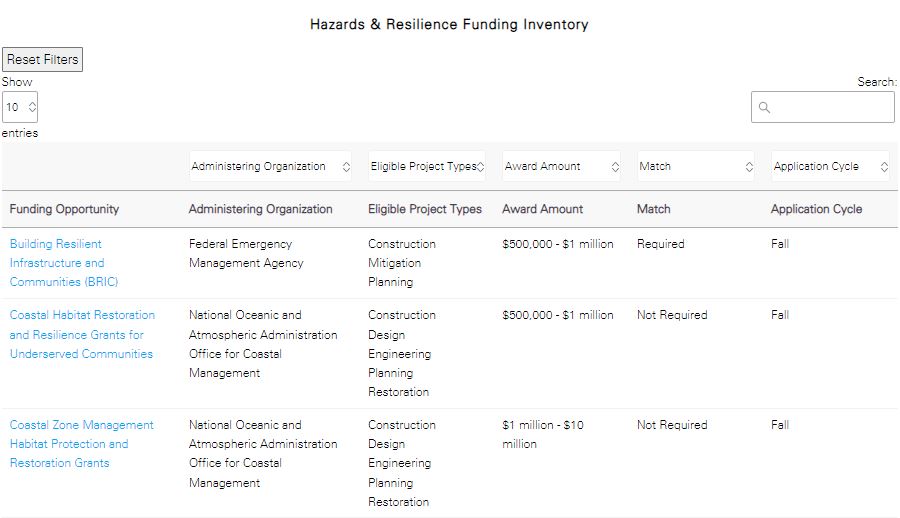
A inventory of funding opportunities that can be used specifically towards addressing coastal hazards and building coastal resilience is now available on the Wisconsin Coastal Resilience website. Funding opportunities can be filtered by award amount, match requirements, application cycle and more.
Along with the inventory, you can find a list of additional funding sources that could be used to support components of a hazards or resilience project.
The webpage also explore case studies about how Wisconsin’s Great Lakes coastal communities have leveraged different funding sources.
| |
NFWF America the Beautiful Challenge | |
|
The America the Beautiful Challenge is a public-private grant program for locally led ecosystem restoration projects that invest in watershed restoration, resilience, equitable access, workforce development, corridors and connectivity, and collaborative conservation.
Focus Areas:
- Conserving and restoring rivers, coasts, wetlands, and watersheds
- Conserving and restoring forests, grasslands, and other important ecosystems that serve as carbon sinks
- Connecting and reconnecting wildlife corridors, large landscapes, watersheds, and seascapes
- Improving ecosystem and community resilience to coastal flooding, drought, and other climate-related threats
- Expanding access to the outdoors, particularly in underserved communities
Applicants are encouraged to develop large landscape scale and/or cross jurisdictional projects that advance existing conservation plans or are informed by Indigenous Traditional Knowledge.
Pre-Proposal Due Date: April 20, 2023 @ 11:59pm ET
Applicant Webinar Recording
| |
FEMA Releases New Hazard Mitigation Assistance Guide | |
FEMA has released an updated Hazard Mitigation Assistance Program and Policy Guide. This guide is intended to help grant applicants successfully navigate FEMA mitigation grant programs enhancing climate resiliency. The four programs included in the HMA Guide are the Building Resilient Infrastructure and Communities (BRIC) program, Flood Mitigation Assistance program, Hazard Mitigation Grant Program, and Hazard Mitigation Grant Program Post Fire. State, local, tribal and territorial governments can use the guide to help them go through the Hazard Mitigation Assistance grant lifecycle process. FEMA’s mitigation grant programs provide funding for actions that address risks to and reduce disaster suffering from events like wildfires, drought, extreme heat, hurricanes, earthquakes and flooding. | |
WCMP is Seeking Project Ideas for Bipartisan Infrastructure Law 2023 Funding Competition | |
|
The Bipartisan Infrastructure Law (BIL) is providing funds to NOAA’s Office for Coastal Management to invest in coastal protection and restoration projects to increase coastal communities’ resilience to climate change and coastal hazards.
The Wisconsin Coastal Management Program (WCMP) is seeking out three projects to competitively apply to the 2023 National Coastal Zone Management Program BIL funding competition in early Summer 2023. Priority projects for this opportunity include habitat restoration; habitat restoration planning, engineering, and design; and land acquisition projects with a public entity partner.
For more information, see WCMP’s one-page factsheet, and contact WCMP with project ideas (coastal@wisconsin.gov) to begin a conversation.
| |
Building Blocks for Sharing Science | |
|
The Lake Superior Reserve Coastal Training Program and the Ohio Coastal Training Program are hosting a virtual training series tailored for professionals, practitioners and leaders working on Great Lakes coastal issues and is designed to address communication challenges we commonly encounter in environmental and science-adjacent careers. The courses will help you build confidence whether you facilitate meetings, develop graphics, author reports or proposals, or articulate the value of the natural world.
Course Highlights:
September 21st @ 1 - 3pm: How to Design a Compelling Grant Proposal & Presentation
October 17 @ 9 - 11am: Pathways to Valuing Ecosystem Services
*There is a $20 charge for each two-hour course*
| |
Nature-Based Solutions for Coastal Hazards | |
|
This NOAA Digital Coast training provides a framework for communities to identify their coastal hazard issues, ecosystem services that can reduce hazard impacts, and green infrastructure practices that can provide those services. The training also helps communities develop the beginnings of a community green infrastructure plan.
This is a 60-minute self-guided virtual training available online through the Digital Coast.
| |
Cities Initiative Webinar on Great Lakes Coastal Resiliency Study | |
|
The Great Lakes and St. Lawrence Cities Initiative and the Mayors Commission on Coastal Resilience are hosting a webinar on the Great Lakes Coastal Resiliency Study (GLCRS) featuring David Bucaro and Mike Padilla of the Chicago District of the U.S. Army Corps of Engineers (USACE).
The GLCRS is intended to help Great Lakes communities withstand, recover, and adapt to climate change and extreme weather events by assessing vulnerabilities, identifying solutions, and proposing a plan to guide further investments in coastal resilience along the 5,200 miles of U.S. shoreline. Now that USACE and the eight Great Lakes states have signed a cost-share agreement and completed initial scoping, it is time for affected communities to begin engaging with USACE in order to contribute their perspectives to the study.
Date: Thursday, April 20, 2023
Time: 12 - 1pm ET
| |
For questions about the CALM Network, or to submit something to the Collaboration Classifieds, contact:
Lydia Salus
608-266-3687
| |
For questions about Lake Michigan coastal hazards or how to approach, plan, and prepare for them, contact:
Adam Bechle
608-263-5133
| |
University of Wisconsin Sea Grant Institute | (608) 262-0905 | 1975 Willow Drive, 2nd Floor, Madison, WI 53706 | | | | |