Wisconsin Coastal Resilience Newsletter | |
|
Greetings from the Wisconsin Coastal Resilience Team!
This month's newsletter contains:
Member-to-Member Updates:
- Introduction to New Coastal Resilience Coordinator and CALM Leadership Team
- WCMP Coastal Hazards Strategy Survey
- CALM Lunch & Learn: Plan Integration for Resilience Scorecard
Lake Michigan Water Level Update
Resource Highlights:
- WaterNow Alliance Lake Michigan Funding Resiliency Dashboard
- NOAA C-CAP High-Resolution Land Cover
Around the Great Lakes:
- NOAA GLERL Prepares for 2025 Ice Season
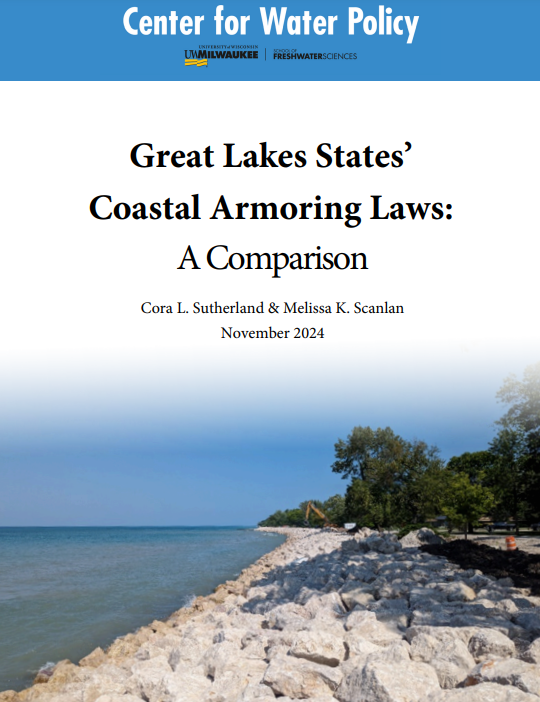
- Center for Water Policy Publishes “Great Lakes States’ Coastal Armoring Laws: A Comparison”
Funding Opportunities:
- NOAA Transformational Habitat Restoration and Coastal Resilience Grants
- Promoting Resilient Operations for Transformative, Efficient, and Cost-Saving Transportation (PROTECT) Program
- National Sea Grant Law Center 2025 Coastal Resilience Program Competition
Trainings:
- Advancing Coastal Resilience through Nature-Based Solutions: Weathering the Storm from NOAA’s Digital Coast
- NIACS & USDA Online Adaptation Planning and Practices Training
Conferences:
- East River Collaborative 5th Annual Winter Forum
- Wisconsin Wetland Association Wetland Science Conference
- Wisconsin AWRA 2025 Annual Meeting & Conference
- IAGLR's 68th Annual Conference on Great Lakes Research
| |
Introduction to New Coastal Resilience Coordinator and CALM Leadership Team | |
|
Happy New Year CALM Network!
My name is Jake Kolanowski and last month I started as the new Coastal Resilience Coordinator for the Wisconsin Coastal Management Program (WCMP). As part of my role, I’ll be facilitating CALM meetings, events, and the bi-monthly newsletter. I have a background in communications and environmental conservation, and prior to joining the WCMP I worked for the city of Madison and the Wisconsin Department of Natural Resources.
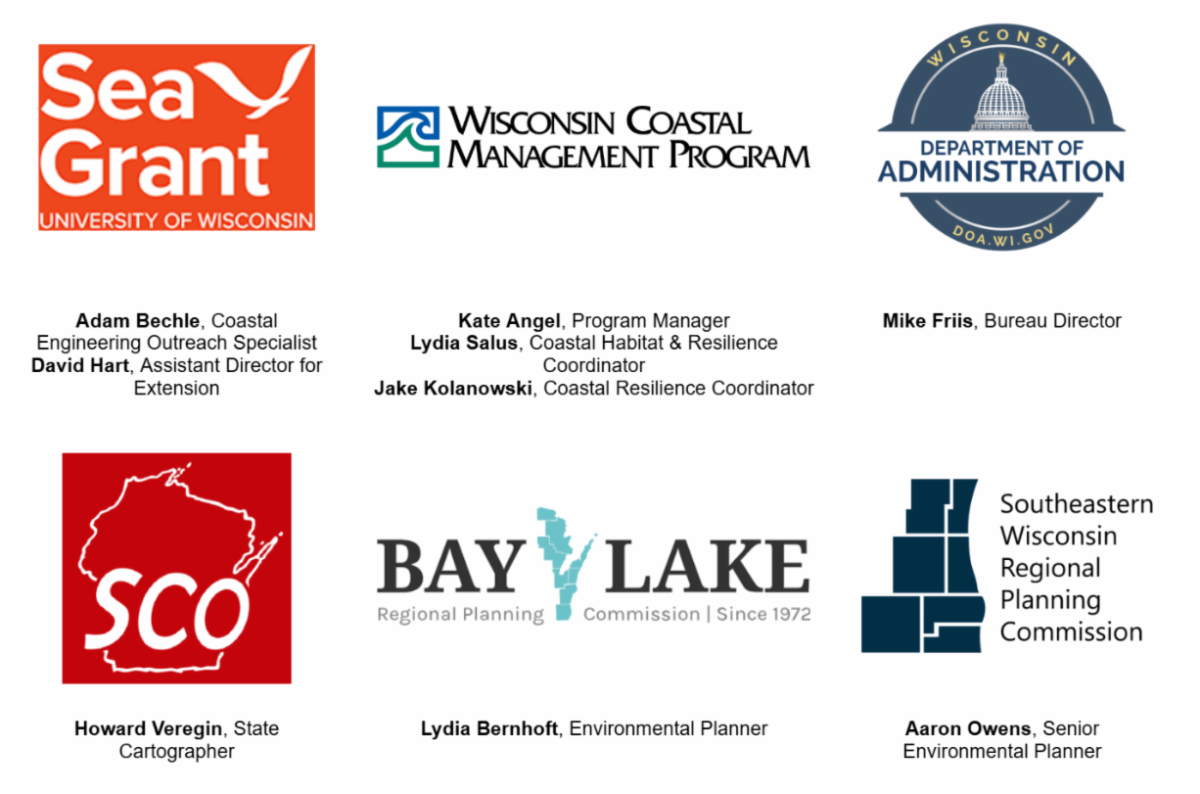
In the spirit of introductions and the new year, I’d also like to re-introduce the rest of the CALM Leadership Team. The CALM leadership team consists of representatives from six organizations that support coastal hazards work on Wisconsin’s Lake Michigan coastline:
| |
|
To contact the CALM leadership team with questions, comments, concerns, or ideas, please reach out to Jake Kolanowski (jacob.kolanowski1@wisconsin.gov) or use the Contact Us form on the Wisconsin Coastal Resilience website.
Sincerely,
Jake
| |
WCMP Coastal Hazards Strategy Survey | |
|
NOAA’s Coastal Zone Enhancement Program encourages state and territorial coastal management programs to strengthen and improve their federally approved coastal management programs every five years. The Wisconsin Coastal Management Program (WCMP) is currently developing its 2025-2030 Needs Assessment and Strategy and is looking for your feedback on how the Program can best address coastal hazards in Wisconsin. Your input will be used to help update the Coastal Hazards Strategy outlined in the previous 2021-2025 Strategy document.
Please take 5-10 minutes to fill out this survey and register your feedback for addressing coastal hazards in Wisconsin. Keep in mind the timeframe (5 years) and scope (Wisconsin’s Lake Michigan and Lake Superior shorelines) of this survey. Feel free to share this survey with your colleagues and networks. Register your responses by 11:59pm on Friday, January 31.
Please reach out to Lydia Salus (lydia.salus@wisconsin.gov) with any questions or comments that do not fit the survey form.
Thank you for your participation!
| |
CALM Lunch & Learn: Plan Integration for Resilience Scorecard | Last month, CALM members joined speaker Jackson Parr, Climate Hazards Planner at the University of Wisconsin-Madison Extension, for a virtual Lunch & Learn event on the Plan Integration for Resilience Scorecard (PIRS). Members learned how utilizing the PIRS method can help communities assess how well their planning documents align with local policies and help reduce the impacts from coastal hazards. To hear more about how PIRS was conducted for coastal counties and cities in northeast Wisconsin, view the recording of the event below. | |
January 2025 Water Level Update | |
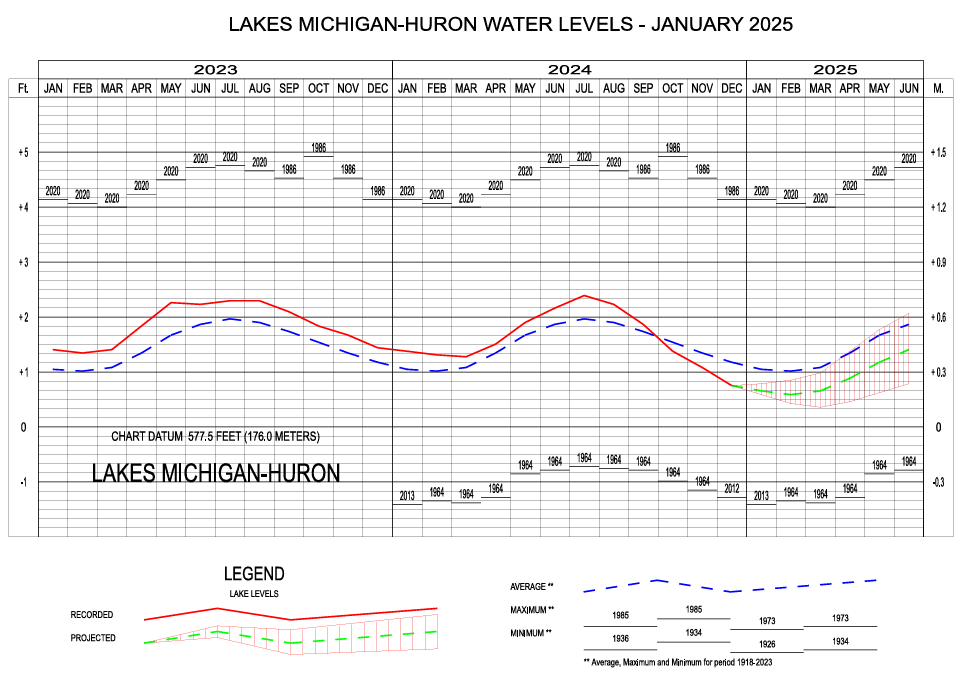
Lake Michigan water levels continued their seasonal decline, decreasing 1 inch from December to January. Lake Michigan is now about 5 inches below the long-term average water level for the month. Water levels are expected to continue to decrease another inch over the next month before beginning their seasonal rise in the spring. | |
WaterNow Alliance Lake Michigan Funding Resiliency Dashboard | |
American Rivers, in partnership with WaterNow Alliance, and One Water Econ developed a new resource for you—the Lake Michigan Funding Resiliency Dashboard. This dashboard was created specifically for municipalities and watershed partners to boost community resilience. The new guide provides a step-by-step process to identify and fund nature-based storm resilience projects. View each of the steps and discover funding opportunities for your lakeshore resilience project with the filterable database. | |
NOAA C-CAP High-Resolution Land Cover | |
|
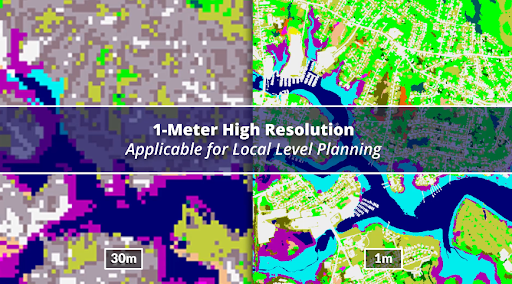
The National Oceanic and Atmospheric Administration (NOAA) is phasing in the next generation of high-resolution land cover data for the nation’s coastal areas. The new 1-meter products are useful at the local level in ways not previously possible with national-level data. Advanced artificial intelligence combined with expert human analysis, review, and editing are used to produce these high-quality, standardized, raster-based map products.
The new data products will be phased in through 2025. Initial data layers will focus on impervious, canopy, and water features. Later work will include up to 20 land cover categories, with regular data refresh schedules anticipated. Access the data at NOAA’s Digital Coast.
| |
NOAA GLERL Prepares for 2025 Ice Season | |
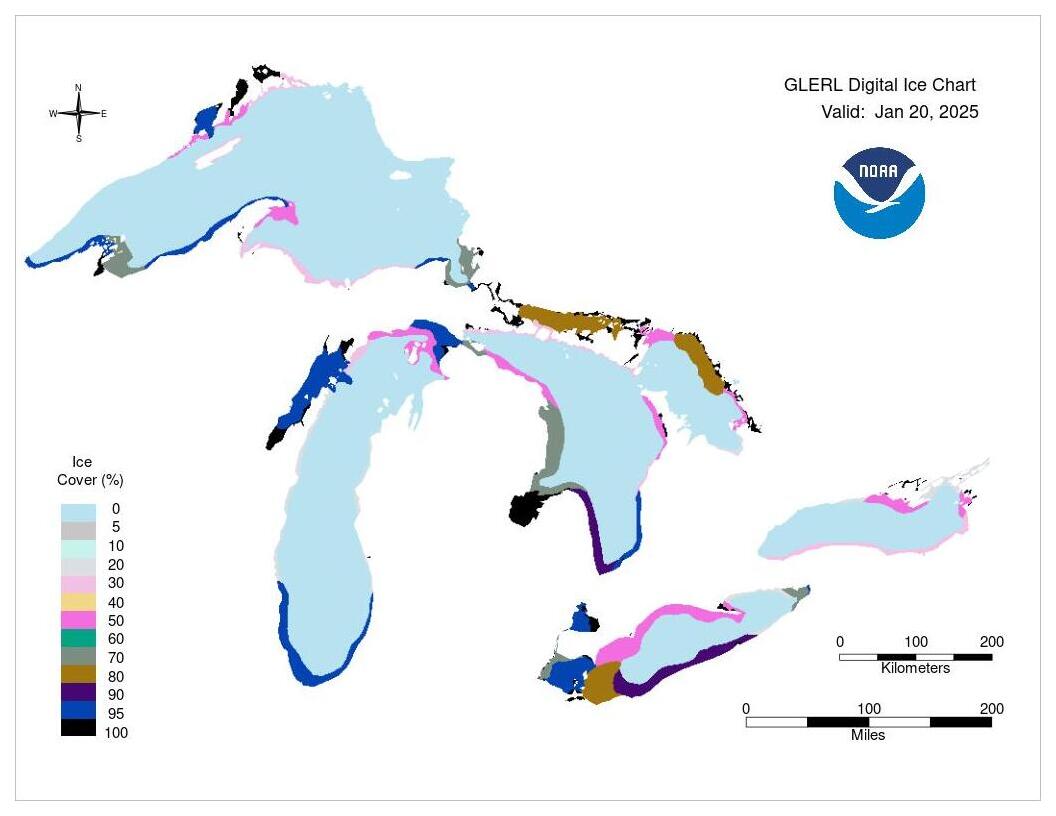
As we settle into winter in the Great Lakes region, many people are looking to NOAA’s Great Lakes Environmental Research Laboratory (GLERL) for information about the 2025 ice season. The U.S. National Ice Center’s official seasonal outlook for Great Lakes ice predicts slightly below normal ice conditions on Lakes Superior, Michigan, Huron and Erie this winter. Near normal ice conditions are predicted for Lake Ontario. Find more ice cover resources from GLERL, including current and historical ice cover data, on their blog. Read additional coverage of this year’s ice season from the Milwaukee Journal Sentinel. | |
Center for Water Policy Publishes “Great Lakes States’ Coastal Armoring Laws: A Comparison” | |
The UW-Milwaukee’s Center for Water Policy has published a report on shoreline armoring in the Great Lakes. Given increased climate disruption and uncertainty around the natural fluctuations of Great Lakes water levels, people are grappling with how to respond to waters that threaten the built environment of houses, roads, and other infrastructure. One common response is to armor the shoreline with structures like riprap revetments and seawalls. The report, “Great Lakes States’ Coastal Armoring Laws: A Comparison”, examines and compares coastal armoring statutes and regulations across the eight Great Lakes states. By comparing each state’s approach, this report highlights best practices and identifies areas for improvement to enhance compliance with public trust obligations and promote coastal resilience in response to evolving environmental hazards. Read the full report below.
| |
NOAA Transformational Habitat Restoration and Coastal Resilience Grants | |
|
$100 million in funding is available for transformational habitat restoration and coastal resilience projects under the Bipartisan Infrastructure Law. NOAA will accept proposals between $750,000 and $10 million for the entire award, with typical funding anticipated to range from $4 million to $6 million. Projects will support efforts such as reconnecting rivers to their historic floodplains, outplanting corals to rebuild reefs, building living shorelines that protect coasts from erosion and sea level rise, and more.
Eligible Applicants: Institutions of higher education, non-profits, commercial (for profit) organizations, U.S. territories, and state, local, and tribal governments.
Applicant Webinars:
Application Deadline: April 16, 2025
| |
Promoting Resilient Operations for Transformative, Efficient, and Cost-Saving Transportation (PROTECT) Program | |
|
The Promoting Resilient Operations for Transformative, Efficient, and Cost-Saving Transportation (PROTECT) Program is a discretionary grant through the U.S. Department of Transportation, to “strengthen surface transportation to be more resilient to natural hazards, including climate change, sea level rise, heat waves, flooding, extreme weather events, and other natural disasters through support of planning activities, resilience improvements, community resilience and evacuation routes, and at-risk coastal infrastructure [including the Great Lakes].” Proposed projects are encouraged to use innovative and collaborative approaches including the use of natural or nature-based solutions. The program cost share is 80% Federal and 20% non-Federal but may be up to 100% Federal for certain tribal projects.
Eligible Applicants: states, tribes, local governments, planning organizations, and transportation/port authorities.
Eligible Projects: planning, resilience improvement, community resilience and evacuation routes, and at-risk coastal infrastructure.
Application Deadline: February 24, 2025
| |
National Sea Grant Law Center 2025 Coastal Resilience Program Competition | |
|
The National Sea Grant Law Center (Law Center) is accepting applications from eligible applicants to conduct research on the effectiveness of laws and policies related to a wide range of coastal resilience issues including sea level rise, flooding, amplified storm surge, increased frequency and intensity of storms, land use, or other environmental factors, and whether those policies are achieving desired policy changes. The 2025 Coastal Resilience Program grants have a recommended two-year project period and funding level of $150,000, and the Law Center anticipates selecting up to two projects for funding. Matching funds will not be required.
Eligible Applicants: Sea Grant Programs, institutions of higher education, government agencies, and non-profit organizations that have the ability and capacity to conduct rigorous, non-partisan law and policy research
Application Deadlines: Letters of Intent must be received by 5 p.m. Central Time on Wednesday, March 5, 2025. Full proposals must be received by 5 p.m. Central Time on Wednesday, May 7, 2025. The anticipated award start date is February 1, 2026.
| |
Advancing Coastal Resilience through Nature-Based Solutions: Weathering the Storm from NOAA’s Digital Coast | |
|
Virtual Webinar
Date: Thursday, February 20, 2025
Time: 2-3:30p CT / 3-4:30p ET
This webinar will showcase two efforts aiming to understand the performance of nature-based solutions for shoreline protection during and after storm events. The two practitioners who will discuss their work include Lexia Weaver from the North Carolina Coastal Federation and Tom Ries from Ecosphere Restoration Institute.
For additional NOAA coastal management trainings, visit their Digital Coast Academy webpage.
| |
NIACS & USDA Online Adaptation Planning and Practices Training | |
|
The Northern Institute of Applied Climate Science (NIACS) and USDA Northern Forests Climate Hub are offering an Adaptation Planning and Practices online training for forest and natural resource managers, land owners, and stewards. This is an interactive training to learn about climate change impacts and to identify adaptation actions for ecosystems (rural and urban), habitats, and resource areas, and with cultural perspectives. Throughout this training participants will develop project-specific climate adaptation plans using the Adaptation Workbook.
The training begins January 27 and runs through March 23, 2025. The training has a geographic focus on the following states: CT, DE, NH, NJ, NY, MA, ME, MD, PA, RI, VT, WV, IA, IL, IN, MI, MN, MO, OH, and WI. There is no registration fee. View additional information and register below.
| |
East River Collaborative 5th Annual Winter Forum | |
February 13, 9a-11:30p
Virtual
Join the East River Collaborative for this regional network event to hear about progress on flood resilience, recreation, and wildlife restoration in the East River Watershed.
| |
Wisconsin Wetland Association Wetland Science Conference | |
|
February 25-27
La Crosse, WI
The Wisconsin Wetlands Association is holding their 30th Annual Wetland Science Conference. This 3-day conference includes a keynote address, organized symposia, topical oral sessions, a poster session, working groups, workshops, and field trips to area wetlands, all of which provide great networking and learning opportunities.
| |
Wisconsin AWRA 2025 Annual Meeting & Conference | |
|
April 10-11
Wisconsin Dells, WI
The Wisconsin Section of the American Water Resources Association (AWRA) is holding its annual meeting. The meeting will include plenary, oral and poster sessions, plus lightning talks, addressing both surface water and groundwater issues in Wisconsin.
| |
IAGLR's 68th Annual Conference on Great Lakes Research | |
June 2-6
Milwaukee, WI
Virtual
The International Association for Great Lakes Research (IAGLR) is having its 68th Annual Conference on Great Lakes Research. It will feature four days of inspiring science centered around the theme Creating Great Lakes Resilience. For those who cannot make it to Milwaukee, there will be a virtual option available. View additional information on conference programming below.
| |
|
For questions about the CALM Network, or to submit something to the newsletter, contact:
Jake Kolanowski
jacob.kolanowski1@wisconsin.gov
608-261-9197
| |
|
For questions about Lake Michigan coastal hazards or how to address them, contact:
Adam Bechle
bechle@aqua.wisc.edu
608-263-5133
| |
University of Wisconsin Sea Grant Institute | (608) 262-0905 | 1975 Willow Drive, 2nd Floor, Madison, WI 53706 | | | | |