|
CoastalScience@Work
Updates from the S.C. Sea Grant Consortium - Issue 60
October 31, 2025
| | |
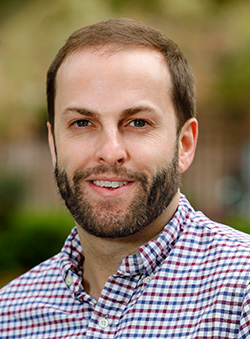
Consortium Promotes Knapp to Asst. Director for Research and Partnerships
Landon Knapp has been promoted to assistant director for research and partnerships. In his new role, Knapp is responsible for:
· Building and maintaining collaborative relationships with Consortium member institutions, faculty, students, and partners to align research priorities with coastal and community needs.
· Identifying and securing funding opportunities, communicating competitive grant and fellowship programs, and supporting projects that advance coastal science and align with institutional missions.
· Working with the executive director to guide the Consortium’s strategic direction through activities such as organizing the biennial research symposium, developing the four-year strategic plan, and incorporating stakeholder input into program development.
Knapp has been working for the Consortium since 2019, most recently as the coastal resilience program manager.
| |
Engaging Local Residents in PFAS Research
As researchers aim to understand the impacts of PFAS (per- and polyfluoralkyl substances) on environmental and public health, they are developing partnerships with local residents in Augusta, Georgia.
The project, “Develop a Community-Based Participatory Approach to Evaluate the Dietary Exposure of Per- and Polyfluoroalkyl Substances (PFAS) in an Underrepresented Community,” is led by Principal Investigator Xiaoyu Xu, Ph.D., an assistant research scientist at the University of Georgia’s Savannah River Ecology Laboratory (SREL). This project is one of four funded by the NOAA National Sea Grant Office, and partners on the grant include the Consortium, University of Georgia Marine Extension and Georgia Sea Grant, and National Sea Grant Law Center.
The researchers used a community-based participatory research model to investigate non-occupational PFAS exposure through food and water consumption in downtown Augusta, which is located in Richmond County. Despite the findings of previous environmental assessments of elevated PFAS levels in soil and groundwater across Richmond County, little local research on PFAS and even less community awareness existed before Xu and her team began this project.
To reach participants, the team worked through trusted community organizations, including the University of Georgia’s Richmond County extension office, public library, Family YMCA of Greater Augusta, and local churches. Tyjaha Steele, science content strategist at the SREL, played a key role in building relationships with families and leading outreach efforts.
As part of the study, 18 families contributed hair samples, water samples, food logs, and food items they regularly consumed. This data is being used to build a probabilistic exposure model that estimates daily PFAS intake across the region. The project team also is working closely with residents to co-develop outreach tools that reflect the community’s needs. Final project deliverables will include individual exposure reports, regional PFAS modeling, and tailored recommendations for local families, health professionals, and policymakers across the Southeast U.S.
Learn more about this project in the full version of the article. For more information, contact Xiaoyu Xu, principal investigator, at (803) 725-7913 or Brooke Saari, Coastal Environmental Quality and Extension Services specialist, at (843) 953-6406.
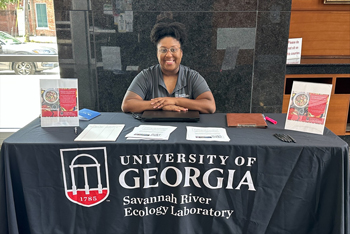
Tyjaha Steele, SREL Science Content strategist, recruits study participants at the Augusta-Richmond County Public Library in 2024. Photo: University of Georgia Savannah River Ecology Laboratory.
Special thanks to Mary Lide Wallace, 2025 Community Engaged intern, for providing this research and outreach update.
| |
Seafood Apprenticeship Program Registration Opens December 1, 2025
The Consortium’s Commercial Seafood Apprenticeship Program (CSAP) will be accepting applications from December 1, 2025, through February 13, 2026. Interested people are encouraged to join the prospective applicant email list to receive updates. CSAP will offer one month of paid job training in May 2026 that provides the knowledge and skills needed to start a career in commercial fishing or mariculture.
As part of the program, apprentices will be AMSEA Safety Drill Conductor certified, CPR and First Aid certified, and will complete over 120 hours of classroom and on-the-job training in safety, seamanship, and navigation; boat and gear operation and maintenance; fisheries science, management, and engagement; and seafood business operations.
CSAP, funded by the NOAA National Sea Grant Office and the USDA Rural Business Development Grant Program, is the first such apprenticeship program in the Southeast, and this is the third year it has been presented. CSAP is designed in partnership with Clemson University and offered by the Consortium in collaboration with commercial fishing operations and mariculture growers in McClellanville, S.C. In 2024, five individuals graduated, and one former apprentice now runs her own charter fishing company. Eleven apprentices graduated in 2025, six of whom have secured part-time positions with local oyster farms and seafood businesses.
Visit the CSAP website or contact Jocelyn Juliano, Living Marine Resources specialist, at (843) 953-2098 for more information.
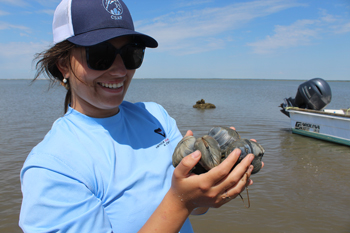
2025 CSAP apprentice Abigail Krug holds a half-dozen wild clams while standing in a tidal creek. Photo: Hailey Murphy, S.C. Sea Grant Consortium.
| |
Educator Loaner Kits Make Learning Fun
The Consortium’s Education Program offers a variety of loaner kits available free-of-charge to formal, nonformal, and homeschool educators in South Carolina. The following kits currently are available for checkout:
· Fish Printing Kits: A freshwater and saltwater fish printing kit provides educators with a lesson plan on fish adaptations and the rubber fish molds necessary to create gyotaku-inspired fish prints with students.
· Wetlands Enviroscape© Model: The Wetlands Enviroscape© Model provides a hands-on demonstration of how watersheds can be affected by development, pollution, and other human-made and natural impacts. Included as part of the demonstration are ways in which potential pollution impacts can be mitigated (e.g., riparian buffers and salt marshes).
· The Watershed Game: This activity uses a hands-on simulation to educate groups about how land-use impacts water quality and a community’s resilience to flooding. While making land-management decisions, players learn about practices, plans, and policies that can improve and protect water quality and increase resilience to flooding. Two versions of this kit are available: the coastal classroom model and the coastal local leader model.
· Ocean Odyssey Kits: These two kits focus on science-technology-engineering-math (STEM) disciplines while incorporating various career paths. Choose from building an ROV or a weather buoy.
For more information or to checkout a kit(s), contact Elle Pestorius, Education graduate assistant, at (843) 953-2078.
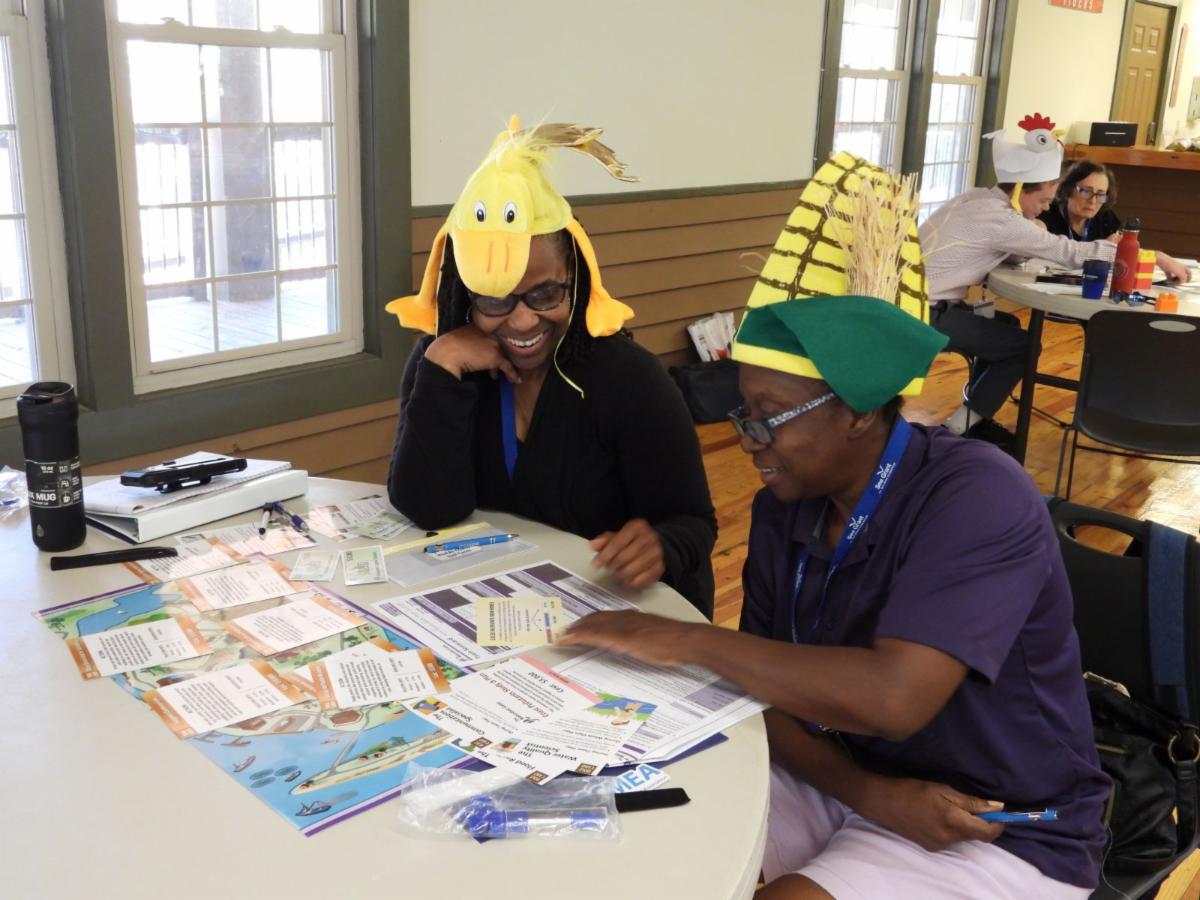
Wiltress Felder (left), a teacher at Ridge View High School, and Angela Kennedy, a stormwater permit coordinator at S.C. Dept. of Environmental Services, play The Watershed Game during a workshop in Columbia, S.C., in 2025. Photo: Morgan Treon, S.C. Sea Grant Consortium.
| | |
Upcoming Conferences and Events
· American Association for the Advancement of Science Annual Meeting, February 12-14, 2026, Phoenix, AZ.
· Aquaculture America Conference, February 16-19, 2026, Las Vegas, NV.
· S.C. Association for Hazard Mitigation Annual Conference, March 18-20, 2026, Greenville, S.C.
| | |
Interested in coastal research, education, and outreach? Join our email list to receive Consortium news, publication announcements,
and upcoming events!
|
Feel free to forward this email to a friend or colleague.
Thank you!
|
| | | |