|
CoastalScience@Work
Updates from the S.C. Sea Grant Consortium - Issue 32
August 31, 2022
| |
Statewide Litter Cleanup Set for September 17
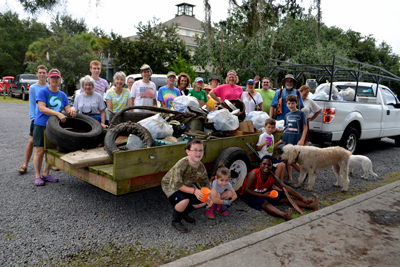
The Consortium, in partnership with the S.C. Department of Natural Resources (SCDNR), organizes the statewide Beach Sweep/River Sweep litter cleanup, which is scheduled for Saturday, September 17, 2022. The 33rd annual Sweep is South Carolina’s largest, volunteer-driven cleanup of beaches, marshes, and waterways.
To volunteer on the coast, visit the Consortium’s website or email Susan Ferris Hill. To volunteer inland, visit the SCDNR’s website or email Bill Marshall.
| |
|
Water Chats Webinars Focus on Source Water Protection
Water Chats, a virtual webinar series, was created to share emerging water quality research and demonstrate how that research can be applied to inform natural-resource management decisions. The Consortium, in partnership with Clemson Cooperative Extension and Clemson University’s South Carolina Water Resources Center, created the program, which debuted in June and wraps-up in September.
Source Water Protection is the focus of the last two webinars. On September 20, 2022, participants will learn about current research and the September 22, 2022 webinar will cover application of that research to inform management decisions. Both webinars are from 1:00-3:00 p.m. and participants must register.
For more information about Water Chats, email Brooke Saari, Coastal Environmental Quality Program specialist, or call (843) 953-6406.
| |
|
Nominees Chosen for 2023 Knauss Fellowship
Consortium nominees Chloe VanderMolen and Maggie Carson have been selected for the prestigious Dean John A. Knauss Marine Policy Fellowship, providing them the opportunity to spend a year living, working, and learning in the Washington, D.C., area. This competitive fellowship is offered by the NOAA National Sea Grant College Program. Recipients are matched with host organizations in the legislative and executive branches of government, and the fellowship begins in February 2023.
Chloe earned a B.S. in biology from Montana State University. She currently is a candidate for a Master of Science in environmental and sustainability studies/public administration concurrent graduate degrees at the College of Charleston. During her fellowship, Chloe would like to advance a public-service perspective that allows science to positively impact people, communities, and the environment.
Maggie holds a B.S. in psychology from Presbyterian College and a Master of Public Health in health promotion, education, and behavior from University of South Carolina (USC). She currently is a candidate for a Ph.D. in environmental health sciences from USC. During her fellowship, Maggie hopes to translate scientific data into usable information for the public and policymakers.
More information about the Knauss and other fellowship opportunities is available on the Consortium’s website or contact Susannah Sheldon, Research and Fellowships manager, at (843) 953-2083.
| |
|
Project Examines Extreme Heat in Gadsden Green Community
A study conducted in 2021 by the Charleston Heat-Health Resilience Project (CHHRP) identified the Gadsden Green neighborhood as a “hot spot” – an area with consistently higher temperatures than nearby locations. Now, Gadsden Green residents have joined a community-science effort alongside local scientists, health professionals, climate experts, and city planners to examine how different factors, such as building and landscape materials, influence the extreme temperatures. This two-phase project is funded by the National Oceanic and Atmospheric Administration and is led by the S.C. Sea Grant Consortium, City of Charleston, The Citadel, and Climate Adaptation Partners. Additional project partners include the Gadsden Green Community, Charleston Housing Authority, University of South Carolina, and Medical University of South Carolina.
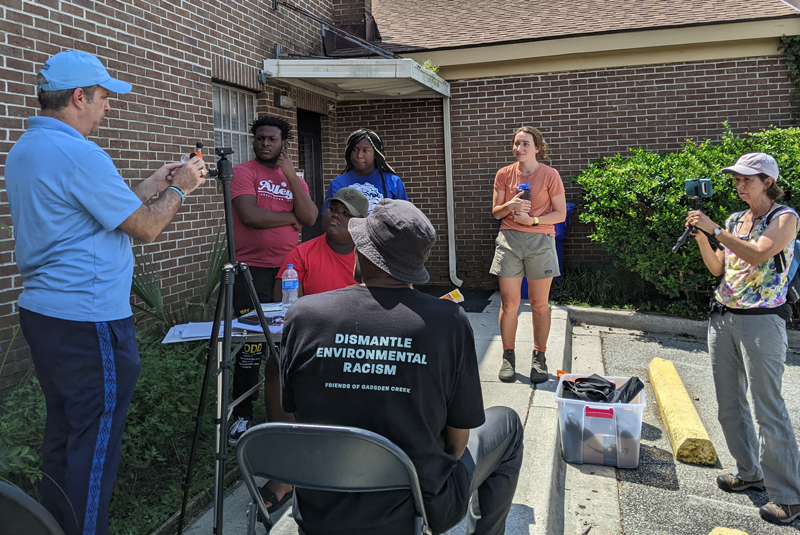
On August 27, 2022, during phase one of CHHRP, Gadsden Green community volunteers were trained on techniques to capture air temperature, humidity levels, wind speed and direction, and heat emitted from building and landscape materials throughout the neighborhood. The weekend of September 3, 2022—weather permitting—community volunteers and researchers will take measurements on a variety of building and landscape surfaces three times during the day. Phase two of the project will occur in late 2022 at a workshop for the Gadsden Green community. Researchers will present results of the CHHRP effort, share impacts of extreme heat on the environment and personal health, and identify avenues to educate residents about the risks of, and protective measures for, mitigating extreme heat conditions. Following the community workshop, CHHRP researchers will hold an exercise with health professionals, climate scientists, city planners, and community members to develop recommendations for investments to reduce heat risk.
To learn more, visit the CHHRP website, email Susan Lovelace, Consortium executive director, or call her at (843) 953- 2078.
| | |
Interested in coastal research, education, and outreach? Join our email list to receive Consortium news, publication announcements,
and upcoming events!
|
Feel free to forward this email to a friend or colleague.
Thank you!
|
| | | | |