 | |
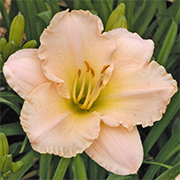
Daylily 'Lullaby Baby'
|
All Daylilies
ON SALE NOW!
20% OFF
Both potted daylilies and bare root orders!Choose from more than 80 different varieties of daylilies in pots. If you don't see what you like in pots, pick up a copy of our Daylily List and wander through the display gardens. Mark the ones you like and then place an order in our garden center or over the phone. We will dig them fresh for you beginning in mid August. Your fresh dug daylilies can be picked up at our garden center or we can ship them right to you.
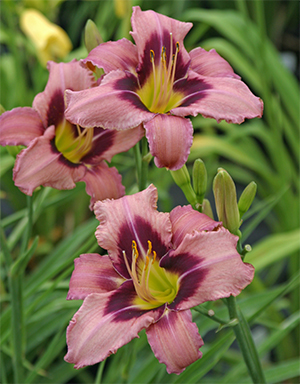 | |
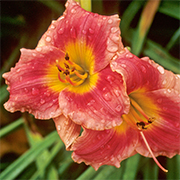
'Lady Rebecca Staunton'
|
 | |
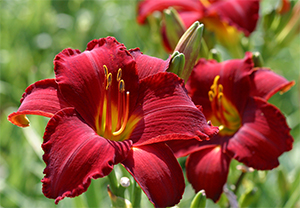
'Cherry Carnival'
|
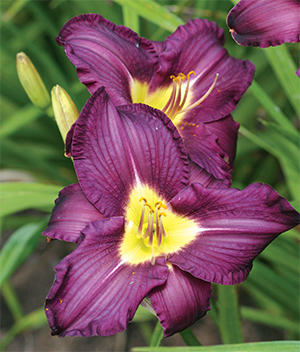 | |
'Black Friar'
|
Find these and MANY more fantastic daylilies
ON SALE NOW
at Viette's!
Can't make it to Viette's during
daylily time?
No worries!
Browse our complete
Daylily Catalog and visit the daylily photo galleries on our website. It's almost as good as being here (but not really!)
Choose the ones you want and give us a call
at 800-575-5538.
We will be happy to take your order and give you the 20% discount! Your daylilies can be shipped to you or you can pick them up here.
|
| Plant of the Month |
 | | Hemerocallis 'Dunrobin' |
Have color all season!
Color all season with daylilies? How can that be possible when each daylily bloom lasts only one day? The answer is in good breeding!When you purchase quality daylilies, each plant sends up multiple flower stems, each stem has multiple branches, and each branch produces several flower buds. Voila! One quality hybrid daylily can produce many, many blooms which will open over a 3-8+ week period. 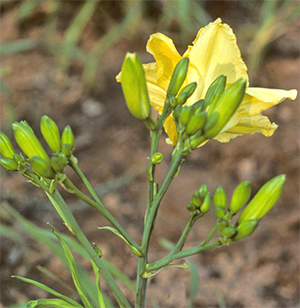 | | Viette hybrids have excellent branching and bud production |
Choose the BestLook for hybrids that have heavy stem production, good branching, and good bud production. The Viette hybrids have been selected for these very traits. For over 50 years, the Viette family has carefully chosen the best producers as parents for their new hybrids and then thoroughly evaluated the seedlings before choosing the best performers to propagate. Therefore, you know you will get a superior daylily when you choose a Viette hybrid - we've taken the guess work out of shopping for daylilies! Color Your SummerDaylilies have different blooming seasons. There are early bloomers, midseason bloomers, and late season bloomers. To create your full season daylily garden, choose a few early bloomers which typically begin blooming in early June. Combine some early-midseason bloomers with these to extend your daylily bloom into mid July. Then add some midseason bloomers, mid-late season, and late season bloomers and presto! You have a beautiful succession of color from June through September with lovely vibrant daylilies.
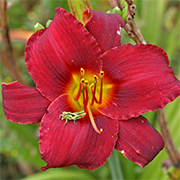 | |
Daylily 'Viette's Cranberry Red' is a good rebloomer that blooms in the midseason and again in late season.
|
There are literally thousands of daylily cultivars to choose from. With careful planning and selection, you can easily create a long blooming daylily garden. Click here to view our daylily photo galleries. Continuous color can also be achieved by planting some everblooming daylilies like 'Stella de Oro', 'Ruby Stella', 'Stella Supreme', or Andre's 'Lemon Cap', 'Viette's Lavender Mist', or 'Viette's Tangerine Stella'. 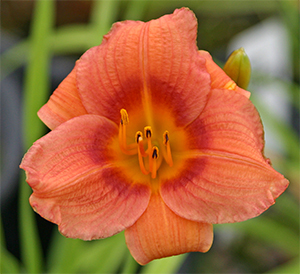 | | 'Viette's Tangerine Stella' is a wonderful everblooming tangerine-pink daylily. |
We have many different daylily cultivars available in our garden center or take our daylily catalog, wander through the gardens and mark your favorites! 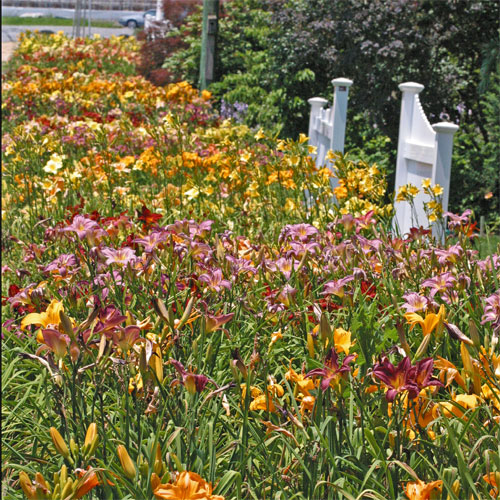 | | Daylily display bed |
CultureDaylilies are easy to grow and care for. They tolerate almost any kind of growing condition without sacrificing their beautiful flowers. Daylilies bloom in sun or bright shade and under wet or dry conditions. In addition, they can tolerate almost any soil type, including clay or sand. They are at home in the heat or cold, and can even tolerate seaside conditions. Of course, like humans, daylilies perform best when given the proper nutrients. It is a good idea to add organic matter such as peat moss, humus, or compost along with an organic fertilizer like Plant-tone, Greensand, and Rock Phosphate. Daylilies perform best when planted in full sun in the northern U.S. and high shade in the more southern regions.
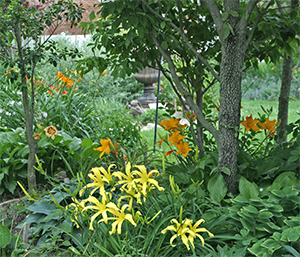 | |
Daylilies can tolerate some shade.
|
|
|
Join Our List
|

|
| Gardening Questions? |
Listen to Andre
on the radio every Saturday morning from 8:00-11:00 on
"In the Garden with Andre Viette"
|
Viette Discussion Board
|
Having trouble
getting through on
the radio?
Visit our Discussion Board for answers to your gardening questions. Use the convenient search key to see if we have already addressed your problem! Don't see the answer? Post your question! It's EASY, just register as a member. Please provide your city and state so we are better able answer your question.
|
|
|
|
Tip of the Month
|
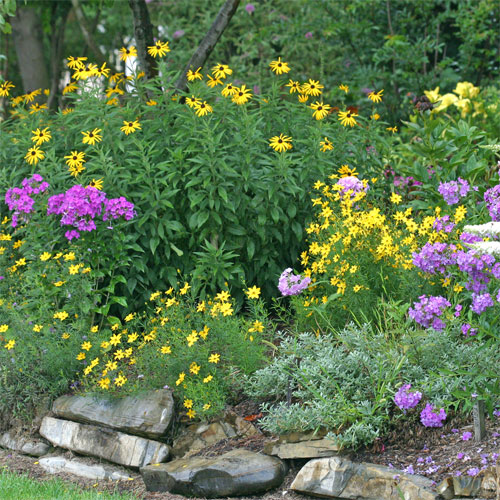 | |
A gorgeous rock wall garden at Viette's blooms all summer with
Rudbeckia, tall summer phlox, and Coreopsis 'Zagreb'.
|
The Colorful Summer Garden
With over 6 acres of gardens, you will always find something in bloom at Viette's. Aside from the millions of daylily blooms, there are many other colorful summer bloomers nestled in the Viette gardens.
If you plan your perennial garden carefully, you can easily achieve color all season long - from spring through summer and well into fall. Even winter can be colorful with beautiful berried shrubs like Ilex verticillata (winterberry) and Callicarpa (Beautyberry).
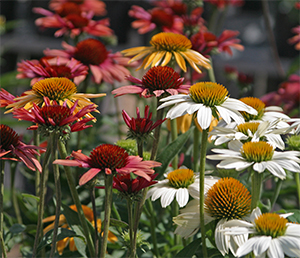 | |
Colorful new varieties of Echinacea
are a delight in the garden
|
Invite colorful pollinators to your summer garden! Your summer gardens can be specially planned to provide nectar for hummingbirds, butterflies, and honeybees. With honeybee populations on the decline across the country, this is especially important.
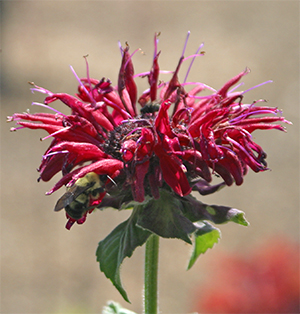 | |
Shaggy monarda flowers attract
many different pollinators
|
For the full sun garden, Crocosmia, Echinacea, Monarda, Nepeta, and Scabiosa are favorites of these wonderful summer visitors.
Other hummingbird favorites, are the giant, long lasting blooms of the hardy hibiscus which create a stunning sight in midsummer. Just take a walk in Andr�'s berm gardens to see how these awesome perennials brighten the garden!
Combine colorful summer blooming Phlox paniculata with the deep purple Salvia nemorosa 'May Night' and the bright colors of different Coreopsis cultivars to create an attractive butterfly magnet.
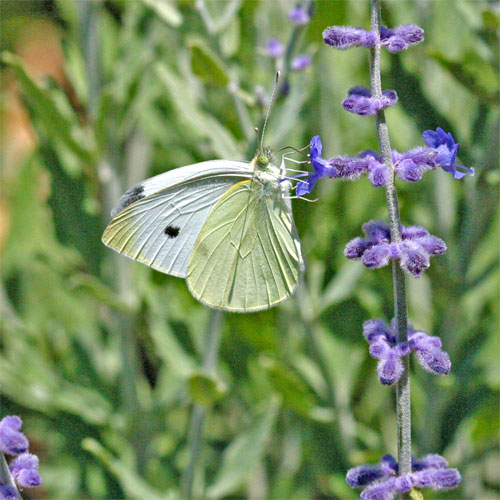 | |
Sulfur Butterfly on Perovskia
|
Add a vertical dimension to your colorful summer butterfly garden with the tall spiky blooms of Liatris, Kniphofia, lavender, and Agastache. Perovskia (Russian Sage) also adds a unique vertical effect in the sunny summer garden with its aromatic silvery foliage and spikes of long-blooming lavender-blue flowers (also favorites of the butterflies). For the shady garden, Astilbe and Lobelia provide long-lasting color and nectar for the hummingbirds and butterflies.
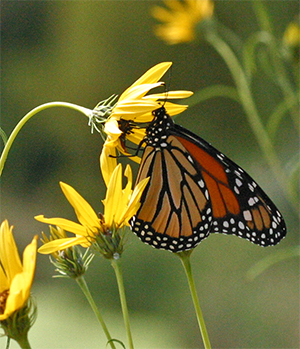 | |
Butterflies flock to Helianthus blooms in the fall.
|
The beautiful sedums, asters, and Helianthus provide color, texture, and sweet nectar for the butterflies and honeybees in the late summer and fall.
Butterfly Shrubs
There are also many beautiful summer blooming shrubs that provide long-lasting color. The butterfly bush, Buddleia, thrives in full sun, blooms from June-frost, and its fragrant trusses of colorful flowers are irresistible to both butterflies and hummingbirds. The long blooming shrub, Caryopteris has lovely fragrant silvery blue foliage and lovely flowers that are a favorite of butterflies and honeybees.
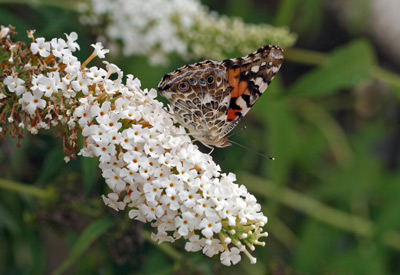 | |
Fritillary butterfly on Buddleia 'White Profusion'
|
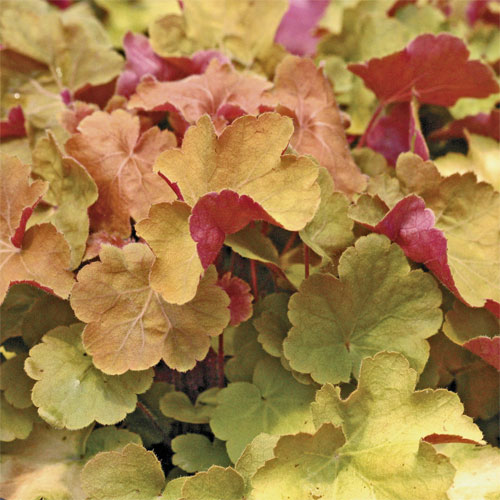 | |
Heuchera 'Caramel'
|
Don't forget that color comes from foliage as well. Add splashes of continuous color from the silver leaved Artemisia and Stachys or the stunning reds, silvers, and peach colors of some of the "hot" new Heuchera cultivars. Hummingbirds love the flowers of Heuchera, too! For the shade, there are some fantastic new varieties of Pulmonaria with beautiful foliage that is spotted and slashed with varying degrees of white or silver making the plant sparkle even in the shadiest corner of the garden. And don't forget the glorious Hosta with their wide variety of foliage textures and colors!
This list includes the best shrubs, annuals, perennials, and bulbs to attract these wonderful creatures.
Long Blooming Perennials (blooming from 2-5 months)
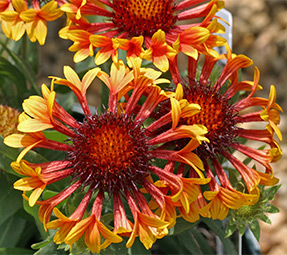 | |
Gaillardia 'Fanfare'
|
Achillea, Agastache, Armeria, Buddleia, Caryopteris, Centaurea, Ceratostigma, Coreopsis, Delosperma, Echinacea purpurea, Gaillardia, Gaura lindheimeri, Geranium sanguineum, Helianthemum, Helianthus, Hemerocallis (everbloomers), Hypericum 'Hidcote', Kniphofia, Lavender spp., Leucanthemum, Lobelia cardinalis, Miscanthus, Monarda didyma, Nepeta, Perovskia, Phlox paniculata, Platycodon grandiflorus, Rudbeckia, Salvia nemerosa, Scabiosa columbaria, Sedum, Solidago spp., Stokesia laevis, Tradescantia, Verbena 'Homestead Purple, Veronica spp. Favorite Butterfly and Hummingbird Perennials
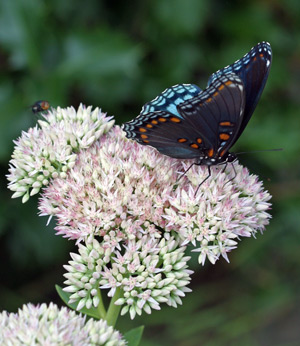 | |
Black swallowtail on a
young sedum flower
|
Achillea, Agastache, Aquilegia, Armeria maritima, Aster spp., Astilbe, Aurinia, Buddleia spp., Caryopteris 'Dark Night', Ceratostigma plumbaginoides, Coreopsis spp., Crocosmia 'Lucifer', Dianthus, Digitalis mertonensis, Echinacea, Gaillardia, Helianthus salicifolius, Heuchera, Hibiscus (hardy hybrids), Lavendula, Liatris, Lobelia, Nepeta, Phlox paniculata, Rudbeckia, Salvia 'May Night', Scabiosa spp., Sedum spp., Stokesia, Verbena 'Homestead Purple' |
|
July Lectures at Viette's
|
Join us at the farm for these informative lectures ...
Saturday, July 12 at 1:30 pm
The Wonderful World of Daylilies
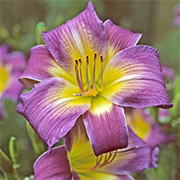 | |
Daylily 'Late Plum'
|
Learn Learn why the daylily is described as the "perfect perennial". Andre will discuss the best varieties for your garden and how to incorporate daylilies into an existing garden. Discover all the other wonderful summer perennials which combine well with daylilies and add color and interest to your garden.
Andre will take you on a personal tour of his beautiful summer gardens after his talk. See his gorgeous daylilies and all the other wonderful summer bloomers! Free lecture
Saturday, July 19 at 1:30 pm
The Summer Garden: Great Summer Combos
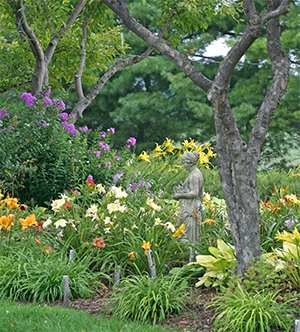 | |
Beautiful summer gardens
|
Diversify your garden!
Learn about some great plants for the summer garden that will provide you with a variety of blooms, texture, and color for an outstanding summer show! We'll show you how to select and combine different plants to create long-lasting visual interest in your garden all season long. Don't miss this great seminar complete with a tour through the beautiful Viette gardens.
Free lecture
|
If you enjoy our newsletter, please pass it along to your gardening friends!
|
From the Viette's Views Blog ...
| |
|
|
Did You Know?
|
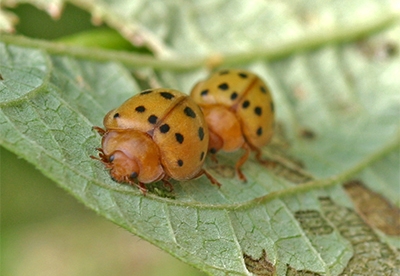 | | Mexican bean beetles can be devastating to bean crops. |
Mexican Bean Beetles!
Mexican bean beetles are one of the most destructive pests of many types of beans. Both adult beetles and larvae cause major damage to bean crops by feeding on the leaves and sometimes the bean pods themselves. In severe infestations, the tissue between the leaf veins may be completely chewed away leaving a leaf "skeleton".
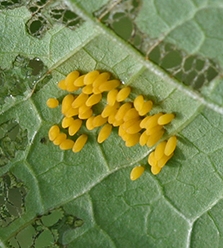 | |
Bean beetles lay their eggs on the underside of the foliage.
|
Life Cycle The adult beetles are pale yellow or copper colored with 16 black spots on their wing covers. Other than the copper coloring, they sort of resemble a ladybug. In the early summer, the adults lay clusters of yellow eggs on the underside of the leaves. The eggs soon hatch into yellow larvae that are covered with black-tipped spines. 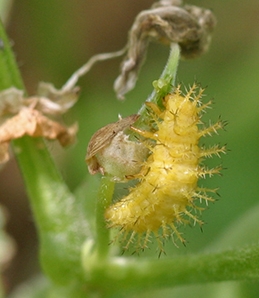 | |
Bean beetle larvae do extensive damage to bean foliage
|
The larval stage, which includes four separate instars, is responsible for the greatest damage to bean crops. They feed on the underside of the leaves for up to five weeks before they pupate. Adult beetles usually emerge within a week. 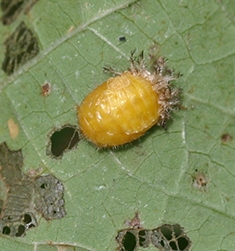 | |
Bean beetle pupa
|
Damage
The worst damage from these ravenous pests occurs during July and August. When Mexican bean beetle infestations are particularly bad, all life stages can be found on the plants at any one time. Check the underside of the leaves for eggs, larvae, pupae, and adult beetles. The loss of leaf tissue due to their feeding, eventually leaves just the veins and gives a lacy appearance to the foliage.
Cultural Control Practices
- Planting crops early in the season or later in the summer and choosing early maturing varieties may help reduce damage since these beetles do the most damage in July and August.
- Select varieties that are more resistant to bean beetle attack. Pole bean varieties often tend to be more resistant than bush beans.
- Floating row covers placed over bush bean seedlings up to flowering will prevent adult beetles from laying eggs on the foliage.
- Remove and destroy bean plants that are heavily damaged to prevent proliferation of new generations.
- Rake up and remove plant debris from the garden at the end of the season to reduce overwintering sites for the adult beetles.
Other Control Measures
- Hand picking the adult beetles and larvae is sometimes effective during light infestations. They can either be crushed or dropped into soapy water to destroy them. In addition, it is important to crush any egg clusters that you find attached to the underside of the leaves. When populations become higher, this method of control is not really effective.
- When populations are higher or if there is a history of bean beetle damage, other means of control may be necessary. These products are most effective if applied at the first sign of beetles or their damage.
- Horticultural oil or insecticidal soap may help to control the larvae. Follow label directions.
- Bonide Eight or Bonide Captain Jack's Deadbug Brew may be used in cases of severe infestations. Always read and follow the label directions and pay close attention to the pre-harvest interval.
|
|
Aloha - Join Mark on a Trip to Hawaii
|
Hawaii Four-Island Agricultural Tour
Departing Wednesday, January 21st, 2015
 Join Mark Viette on this unique tour of Oahu, Kauai, Maui, Hawaii
Tour highlights include:
Oahu - Honolulu, Waikiki Beach, Punchbowl Crater, Iolani Palace, Pearl Harbor, USS Arizona Memorial with shuttle boat ride
Kauai - Opaekaa Falls, Wailua Riverboat Cruise, Fern Grotto, Steel Grass Farm
 Maui Maui - Iao Valley State Park and Iao Needle Lookout Point, Old Whaling Capital of Lahaina, Maui Gold Pineapple Plantation
Hawaii - Hilo, Volcanoes National Park, Mauna Loa & Kilauea Volcanoes, Jaggar Museum, Giant Ferns, Thurston's Lava Tube, Mountain Thunder Coffee Plantation, NELHA, fish farm PLUS two gardening presentations given by Mark Viette.
|
|
|




 06-19-2014 14:56:08 PM
 06-12-2014 12:02:20 PM