|
Commissioner Miller's Preparedness Newsletter
September 2026
Looking back on Echo Mountain
When I reflect on the Echo Mountain Fire Complex, I remember how vulnerable we all are.
About three days after the fire, we toured the damage on a side-by-side. It was heartbreaking. One house stood untouched. The next one burned to almost nothing.
In the days that followed, FEMA arrived. They helped, but it takes time for teams to mobilize. You know people are trying to do good for you yet it's hard because everything is upside down.
We learned that no agency can make you completely whole after a disaster. I don't think I fully understood that until we went through it. Many of us assume that somehow things will eventually be made right. But recovery doesn't work that way. It takes time, and coming to terms with what has been lost is part of that process.
It was a hard time. People stayed in hotels, with family and friends and in their cars. It wasn't easy, and it didn't get easier for a long time. That's the part to remember. You can't imagine how long recovery takes until you live through it. Many days are a struggle. Friends, family, maybe even you, lose everything.
That's why Preparedness Month matters. Do what you can to prepare, even if it's just a little. Every step makes a disaster that much easier to face.
We know it can happen here. On the Oregon coast, we face tsunamis, thunderstorms, wildfires, ice storms, landslides and more. Make a commitment to do something now, even one small thing. Winter is near. Prepare your family. Prepare your mind. Make a plan. We may not know what the next emergency will be or when it will happen, but being prepared can make a difficult situation easier to face.
Look back with us. KLCC gathers its Echo Mountain Fire stories on one page. You can follow Otis's recovery from the first anniversary to a new tiny home village for survivors this summer. You'll also find stories on the fire's cause and how leaders responded.
Read them here: https://www.klcc.org/tags/echo-mountain-complex-fire
Thank you for coming to this year's Readiness Fair at the Newport Recreation Center. Thank you to our Emergency Management Department, Sam Buckley, and Susan Traxel for your dedication to keeping our community ready. And thank you to all our emergency partners. We appreciate you so much.
Take care, do what you can, and have a safe winter.
Casey Miller
County Commissioner
| |
Be 2 Weeks Ready: Small Steps Toward a More Prepared Community
When the power goes out, the water stops running, or an evacuation interrupts daily life, the preparations we make beforehand can make a difficult situation more manageable. Oregon’s Be 2 Weeks Ready program encourages every household to work toward a practical goal: an emergency plan and enough supplies to meet basic needs for at least 14 days after a disaster.
Two weeks of preparation may sound daunting, especially when budgets are tight or storage space is limited. But preparedness can begin with what you already have. An extra can of food, a stored supply of water, and a conversation with your household are meaningful steps toward being ready. The toolkit encourages people to build gradually, at a pace that fits their circumstances.
A good place to start is imagining an ordinary day without the services we depend on. How would you prepare meals, stay warm, use the bathroom, or reach loved ones? What would children, older adults, pets, or someone who relies on medical equipment need? Thinking through those routines helps turn an overwhelming subject into a practical plan.
Bring everyone in your household into that conversation. Choose a meeting place in case you become separated, identify an out-of-area contact, and discuss how you would communicate if local service were disrupted. Plan more than one route out of your neighborhood and consider where you could stay if home became unsafe. Write down the plan, keep it accessible, and practice it so everyone understands what to do.
As your plan takes shape, begin building supplies around the food your household already eats. Choose shelf-stable items that accommodate dietary needs and include options that require little or no preparation. A manual can opener belongs with those supplies. Adding a few items when your budget allows, then rotating them into everyday meals and replacing them, can make building a reserve more manageable.
| |
Water deserves the same attention. The toolkit recommends storing one gallon per person per day, which adds up to 14 gallons per person for two weeks. Plan for pets as well, and consider additional needs related to food preparation, health, or hot weather. Store water in suitable containers where household members can safely reach and move it. If space is limited, build your supply gradually and use several accessible storage locations.
Preparing for daily needs also means thinking beyond food and water. If plumbing is unavailable, your household will need a plan for sanitation, handwashing, and waste. Include hygiene supplies, sturdy waste bags, and any diapers or menstrual products your household uses. Gather flashlights, spare batteries, blankets, charging supplies, and an emergency radio, starting with items you already own. Keep first-aid supplies organized, consider first-aid training, and discuss medication and medical equipment needs with your health care provider before an emergency occurs.
While home supplies can help during an extended disruption, an evacuation calls for essentials you can carry. Prepare an accessible go-bag with necessary medications, copies of important documents, contact information, cash, chargers, clothing, and personal supplies. Include provisions for pets and a familiar comfort item for children. Think through transportation and any assistance someone may need to leave safely.
Staying informed connects these preparations to the situation unfolding around you. Sign up for local emergency alerts, keep your contact information current, and identify trusted sources of official information. Practice your plan periodically and update it as your household’s needs change.
That preparation becomes stronger when it extends beyond your front door. Get to know your neighbors, discuss how you might check on one another, and learn who may need assistance or have useful skills to share. During a widespread disaster, help may be delayed, and those nearby can be an important source of support.
Choose one step to take this week: store some water, update an emergency contact, or talk through your evacuation plan. Each action builds on the last, helping your household, and your community, face an emergency with greater confidence.- Casey
| |
2026: Recovery, businesses, and everyday readiness
In March, I shared the ribbon cutting for Coast Vineyard Village in Lincoln City, highlighting partnerships supporting housing and wildfire recovery. It was a reminder that emergencies are inevitable and that recovery recovery takes time.
In May, I highlighted county support for Oregon Coast Community College’s Small Business Development Center and the Economic Development Alliance of Lincoln County. Their work helps local businesses develop skills, access resources, and build stronger operations.
That connection became especially clear this September when SBDC Director Gregory Price reached out after seeing my community preparedness message.
Greg identified his role as the national chair of or the disaster planning and recovery intersection group. He shared our local SBDC business-preparedness workbooks, recovery resources and noted his team’s contribution to the Oregon SBDC Disaster Recovery Guide.
His outreach added an important perspective: businesses also need to practice for disruption. Can employees reach one another? Are financial records accessible? What happens if a supplier cannot deliver or the doors must remain closed?
The SBDC’s confidential, no-cost advising and resilience curriculum gives business owners a place to begin working through those questions.
My September 11 post announcing the following day’s Lincoln County Readiness Fair brought many of these themes together: community partners, emergency communications, water. sanitation, and practical response skills all together in a supportive expereince.
Across these years, the common thread is preparation through participation. People give their time, share expertise, test assumptions, and help others take the next step.
I’m grateful for that work throughout Lincoln County. Looking back helps reminds us to keep preparing together and connect with local resources.
Explore Lincoln County Emergency Management and Lincoln Alerts.
Business owners can contact the Oregon Coast SBDC at 541-994-4166 or visit the center’s website to ask about advising, business continuity, and disaster preparedness.
| |
When Businesses Prepare, Lincoln County Gets Stronger
Oregon Coast’s Small Business Development Center brings local support and national disaster-recovery expertise to our community.
If a wildfire, severe storm, power outage, or earthquake interrupted your business tomorrow, what would it take to reopen? Could you reach your employees? Access your financial records? Replace essential equipment? Keep paying bills while revenue stopped?
These questions are part of community preparedness—and Lincoln County has a resource to help business owners work through them.
Oregon Coast Community College’s Small Business Development Center offers confidential, no-cost business advising and affordable training to entrepreneurs throughout the county. Its work includes helping people start businesses, improve financial management, reach customers, and plan for growth. It also includes preparing for disruptions and navigating recovery.
That last capability deserves more attention.
After seeing my recent community preparedness message, SBDC Director Gregory Price reached out to share resources and introduce an important dimension of his work.
Greg serves as the national chair of America’s SBDC disaster planning and recovery intersection group. Through that role, he gathers tools for small businesses and the people and organizations that help them prepare and recover.
His message brought that national experience directly into our local preparedness conversation. Greg shared planning workbooks, business checklists, wildfire resources, and recovery guides. He also noted that his team helped develop the Oregon SBDC Disaster Recovery Guide.
| |
What stood out to me was how practical these materials are. They help owners identify the things their businesses depend on: people, records, equipment, inventory, buildings, and everyday operations. They ask what could interrupt those essentials and what arrangements could reduce the damage.
For a restaurant, that might mean planning for refrigeration failures or interrupted deliveries. For a retailer, it could mean protecting inventory and keeping sales records accessible. For a contractor, it might involve equipment, transportation, and communication with customers. Each business has different needs, which makes access to individual advising especially valuable.
The SBDC’s regular courses help build that foundation. Its fall lineup includes retail, restaurant, and traditional Small Business Management programs, along with bookkeeping, spreadsheets, marketing, and other business skills.
Understanding cash flow, maintaining reliable records, and communicating with customers matter every day. During a disruption, those capabilities can become essential to survival.
Dedicated disaster resources take the planning further. The Oregon SBDC recovery guide helps owners assess their situation, reconstruct financial information, estimate reopening costs, and consider their options. It also recognizes that recovery involves difficult personal decisions. The coursework begins with people’s safety and well-being and encourages owners to seek help as they work through the process.
This emphasis fits the broader mission of the U.S. Small Business Administration, which supports business development and disaster recovery. The SBDC provides local advising and connections; SBA administers federal disaster-assistance programs, including loans for eligible applicants.
For Lincoln County, the connection is straightforward. Our businesses provide jobs, goods, services, and places where community life happens. Their ability to withstand disruption affects employees, families, customers, and neighboring businesses.
I appreciate Greg bringing this expertise and these resources into the conversation. His outreach is a reminder that preparedness becomes more useful when we connect people with someone who can help us take the next step.
Business owners do not need to wait for an emergency to make that connection.
Contact the Oregon Coast SBDC at 541-994-4166 or visit its website to explore advising and classes. Ask about business continuity and disaster preparedness and start with the parts of your business you can least afford to lose.
| |
Neighbors Preparing to Help Neighbors
A closer look at North Lincoln County CERT
Sometimes a conversation leads you to discover something valuable happening right in your community.
That is how I found my way to a North Lincoln County Community Emergency Response Team meeting in 2024. While volunteering at the Barrel to Keg Relay, I stopped at the Sawyers Landing checkpoint and talked with Auxiliary Communications Service amateur radio operators. One of them, Gerry, described his involvement with CERT. His enthusiasm made me curious.
I began receiving the group’s meeting announcements and was impressed by their organization and the range of subjects they covered. Eventually, I went to see for myself.
As I wrote in my November 2024 post: “They are fun and serious about this discipline.” Their leader makes it's it feel easier than it should.
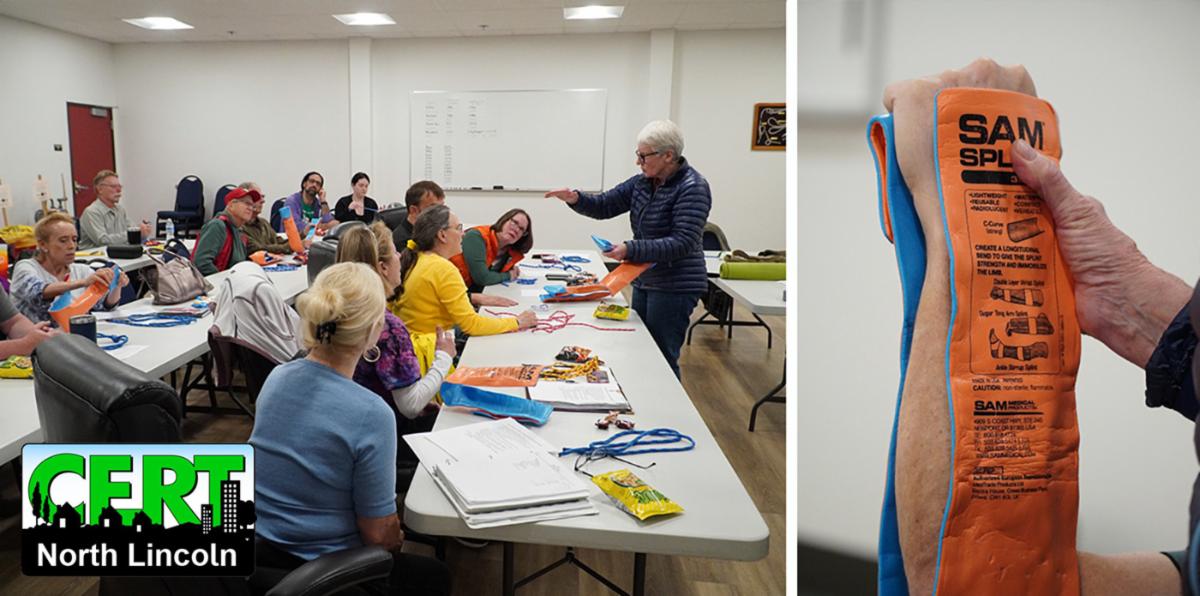
That evening, David Jamieson led a busy, practical learning session. We practiced the Alpine Butterfly Bend knot. Dr. Marie Long demonstrated uses of a SAM Splint, with Gerry participating in the demonstration. Members contributed ideas for the following year’s programming, discussed why they were involved, and finished with a radio communications exercise.
It was an opportunity to practice skills, ask questions, and get to know people who are making time to prepare.
What CERT contributes
CERT helps residents learn how to care for themselves, their families, and their neighbors when disaster interrupts everyday life. Training includes disaster preparedness, fire safety, disaster medical operations, light search and rescue, and team organization. Local sponsoring agencies determine how their teams serve the community. Oregon’s CERT program
North Lincoln County CERT is sponsored by North Lincoln Fire & Rescue. Its training
materials emphasize hands on learning and applying skills in a disaster simulation.
That approach helps connect classroom information with the decisions people may face during an emergency. Local program overview
| |
An important part of CERT is understanding the limits of your training.
FEMA’s guidance puts personal and family safety first and describes team response as an organized effort under the sponsoring agency. Knowing when to seek help and how to work within a coordinated response is part of being prepared. CERT Basic Training manual
I saw that commitment to learning during my visit. The knot practice, splint demonstration, and radio exercise each gave participants something specific to work on. Just as valuable were the conversations and connections developing around the room.
Preparedness begins at home. You can begin preparing while you explore CERT.
Oregon’s “Be 2 Weeks Ready” program encourages households to develop an emergency plan and work toward enough supplies for at least two weeks following a disaster. Its toolkit breaks the process into manageable topics: food, water, hygiene, shelter, first aid, and communications and planning needs. You can work through it at your own pace. Be 2 Weeks Ready toolkit
Start with a conversation about how your household would communicate if you were separated. Consider medications, mobility needs, pets, and other circumstances that make your plan personal. Build supplies gradually and practice the parts of the plan you can test.
My visit with CERT reinforced how helpful it can be to learn alongside others. Someone else may ask a question you had not considered or help you identify a practical next step.
How to get started
North Lincoln Fire & Rescue currently lists North Lincoln County CERT meetings on the first Wednesday of each month at 6 p.m., in the training room at Bob Everest Station, 2525 NW Highway 101 in Lincoln City.
The entrance is on the south side, and meetings are open to the public. Each meeting features a training theme aligned with the CERT Basic Training Program.
Check the fire district’s CERT page before attending for any updates.
At a meeting, ask about the next Basic Training course, registration requirements, and ways to participate. Share your interests and any accessibility needs so organizers can explain the available opportunities.
A guest meeting is a useful introduction; the full training provides the foundation for team participation.
After training, continued practice helps keep skills familiar and relationships strong. I appreciate the people who give their evenings and weekends to this work. They are building knowledge, confidence, and connections that can benefit all of us.
If you have been wondering how to become more prepared or how to contribute. North Lincoln County CERT offers a place to begin.
|
When Every Minute Counts: Declarations Keep Government Working
When a major storm, wildfire or earthquake affects our community, people understandably want to know: Who is making decisions? How do we get more help? And what happens if the people normally responsible cannot be reached?
Two parts of Lincoln County’s emergency planning help answer those questions: emergency declarations and lines of succession. They serve different purposes, but both help us act promptly when circumstances are anything but normal.
As a county commissioner, I believe residents deserve to understand these preparations before we need to use them.
What does an emergency declaration do?
An emergency declaration is a formal action recognizing that conditions require an extraordinary response. It documents what is happening, where people and property are at risk, and what resources or assistance are needed.
Depending on the applicable law and the declaration’s terms, it can help government direct available resources toward urgent needs, authorize emergency measures and request assistance beyond local capacity. Oregon’s guidance explains how declarations support that process.
Oregon Emergency Declaration Guidelines
Lincoln County’s Emergency Operations Plan calls for a declaration to describe the affected area, known or anticipated damage, people at risk, assistance needed and expected duration. Officials use the best information available and can update it as conditions change.
That preparation helps expedite the response. Instead of trying to establish responsibilities and document needs from scratch during a crisis, we have a process ready to use.
Emergency response does not have to wait for a declaration. Our county plan specifically states that a declaration is not required to implement the plan or activate the Emergency Operations Center.
Does a declaration automatically bring federal funding?
A local declaration helps establish the need for assistance, but it does not automatically produce a presidential declaration or guarantee reimbursement.
Local, state and federal declarations are separate decisions. For the county, requests for state support are coordinated through Oregon’s emergency management system. When federal disaster assistance is needed, the Governor may request a presidential declaration. The assistance ultimately available depends on the approval and the requirements of each program.
There is also a distinct pathway for federally recognized Tribal Nations. FEMA’s guidance recognizes their ability to request their own presidential declaration or receive assistance through a state declaration. Respecting Tribal sovereignty is part of understanding how emergency assistance works in our region.
What is succession planning?
Succession planning answers another practical question: If the person responsible is unavailable, who can carry out the necessary responsibilities?
A disaster may interrupt communications, block roads or affect officials and their families. Government still needs to function.
| |
Lincoln County’s 2026 Emergency Operations Plan identifies two separate lines of succession:
- Emergency coordination: the Emergency Manager or designee, followed by the Administrative Lieutenant and then the on-duty Sheriff’s Sergeant.
- Emergency policy and governance: the Board Chair, followed by the Vice-Chair, the remaining commissioner, the County Administrator and additional designated officials.
These are emergency continuity arrangements, carried out within applicable legal authority.
They help clarify responsibility when normal leadership is unavailable. The plan also requires individual county departments and offices to identify their own succession arrangements and prepare staff to maintain essential services.
That means more than putting names on a list. Backups need to understand their responsibilities and have access to the records, communications and procedures necessary to do the work.
Moving quickly while remaining accountable
Our 2026 agreement between the Board of Commissioners and the Sheriff further defines emergency management responsibilities.
It assigns day-to-day supervision through the Sheriff’s Office while preserving specific Board authorities, including contracts and financial obligations. When an emergency declaration is under consideration or in effect, the agreement provides for the Emergency Manager to report directly to the Board, consistent with the incident command structure.
Those details matter. People need to know who coordinates the response, who makes policy decisions and who has authority to commit public resources.
Imagine a severe storm that closes roads, interrupts power and leaves an official unreachable. Emergency personnel begin responding. The county assesses unmet needs and considers a declaration. Established succession arrangements help keep necessary decisions moving, while staff document costs and requests for additional support.
Each part supports the others
For residents, the purpose is practical: essential services must continue, decisions must have a clear legal basis, and requests for help must reach the right people quickly.
We cannot predict every emergency. We can prepare our government to keep working through one.
The best emergency response starts before the emergency. Plans, radios, people, supplies, partnerships, and public information all have to be ready before ordinary systems fail.
That’s been the through line of my time in this office, and it’s the standard I hold this work to going into 2027.
| | |
Commissioner Casey Miller
Lincoln County — Position 1
Mobile: 541-270-6796
Address: 225 W Olive St., Room 110, Newport, OR 97365
Website: www.CaseyMillerCommissioner.com
| | |
"The mission of Lincoln County is to provide essential public services–both legally
required and locally desired–in an efficient, effective and respectful manner."
–Lincoln County Mission Statement
| | | | |