Weekly Newsletter:

April 15, 2026

Communication Rewind:

A Caregiver’s Guide to More Effective Communication

Communication is tricky. Our distant ancestors learned that gestures and verbal sounds were crucial, potentially meaning life or death at the hands of saber-toothed tigers or fellow tribesmen. Whole societies formed based on the collective agreement and meaning of these verbal sounds. Effective communication enabled the formation of mutually supportive societies with common welfare goals. Without a common language, estrangement and confusion were assured. I remember a childhood memory: My parents' favorite couple, Roberta and Hurley, hosted a couple from the Philippines one evening. The couple spoke no English; their hosts spoke no Tagalog. Hurley, in a burst of hospitality, passed a dish to them. In his loudest, most fervent voice, he shouted, "WOULD YOU LIKE MORE MASHED POTATOES?" So it is with communication. Without agreed-upon language, your fervor doesn't matter. It isn't going to translate.

Supporting a loved one with dementia involves more than performing daily tasks; it's about fostering moments of connection and comprehension. We will examine the challenges that caregivers and their loved ones often struggle to overcome.


Understanding communication challenges: Dementia affects each person differently, leading to various challenges, including:

  • Difficulty finding words: Individuals may struggle to recall names or terms, leading to frustration.
  • Repetition: Repeated phrases, stories, or questions, possibly as a coping mechanism.
  • Disorganized thoughts: Formulating coherent sentences can become challenging, making conversations difficult to follow.
  • Non-verbal cues: Understanding body language and facial expressions may also decline, complicating interactions.


As dementia and cognitive decline increase, our ability to communicate effectively declines exponentially. At first, perhaps substitute a descriptive word for the word itself, e.g., "Can I have a water holder?" for a glass. Later, more words are substituted, then gradually lost interacting with a loved one who has dementia can be difficult. Dementia impacts memory, language, and cognitive abilities, making it challenging for individuals to comprehend and respond. Nonetheless, with patience, empathy, and appropriate techniques, one can enhance the positivity and significance of conversations. 

Here are 10 tips for effective communication, along with insights on how to make the journey smoother:


TIP 1: KEEP IT SIMPLE AND DIRECT

Use simple words and short sentences to avoid overwhelming your loved one. Steer clear of lengthy or complex explanations. Keep sentences clear and direct. If they don't understand initially, try rephrasing rather than repeating. Simplifying language and adapting communication style addresses one's current cognitive abilities.


TIP 2: BE PATIENT AND ALLOW EXTRA TIME

Dementia may reduce processing speed. Allow your loved one ample time to think and reply; resist any urge to hurry them. Silence is acceptable as it helps them collect their thoughts. This encourages calm and respectful communication.


TIP 3: AVOID CORRECTING OR CRITICIZING

Disputing or correcting them can cause frustration and confusion. If their recollection differs, it's usually best to let it go unless the difference is significant. It is important to acknowledge feelings and emotions, even when details are incorrect. They can provide guidance on handling conversations smoothly.


TIP 4: FOCUS ON FEELINGS, NOT FACTS

Often your loved one's emotions are more important than the specific words they use. Instead of focusing on correcting any mistakes, acknowledge the feelings they express and respond to those. Emotional signals allow you to understand better and address your loved one's needs.


TIP 5: USE NONVERBAL COMMUNICATION

Sometimes, a soft touch or a friendly smile communicates more effectively than words. Nonverbal methods can foster a sense of connection and support for all involved.


TIP 6: MINIMIZE DISTRACTIONS

Background noise from a television or a crowd can be overwhelming. Aim to communicate in a quiet, serene setting to help them concentrate more effectively on the conversation. Establishing a communication-friendly environment can be achieved by rearranging rooms or adjusting routines, which makes interactions less stressful.


TIP 7: BE POSITIVE AND REASSURING

Individuals with dementia frequently experience anxiety or insecurity. A positive tone and reassuring language can significantly impact their sense of safety and worth. Developing positive communication habits helps ensure better connection and an enhanced sense of safety.


TIP 8: ASK ONE QUESTION AT A TIME

Asking multiple questions at once can be confusing. It's better to ask one question at a time, simplifying responses, particularly with yes or no questions when feasible. It allows for smoother and less frustrating conversations for all parties involved.


TIP 9: EMBRACE THEIR REALITY

Individuals with dementia frequently recall events differently or may not recognize present situations. Rather than arguing, try to engage with them within their reality. This approach can facilitate stress-free bonding. Accepting a loved one's perspective enhances their comfort and well-being.


TIP 10: PRACTICE SELF-CARE AND SEEK SUPPORT

Assisting a loved one with dementia can be emotionally and physically demanding. It's essential to prioritize your well-being and seek assistance when necessary. The caregiver's health and well-being are essential to the loved one's health and well-being. (Recalling that the mother's oxygen mask on the plane is essential before she can care for her little one.)

A word to the caregiver: "Self-love changes everything. When you truly invest in yourself, a quiet strength emerges. Each moment you choose to nourish your mind, care for your body, and honor your spirit, you grow stronger. Life responds to this energy—your confidence deepens, your presence brightens, and your path becomes clearer. This isn't about perfection. It's about recognizing that the love you give yourself shapes every other relationship in your life. Because when you understand your own worth, everything else aligns. Start with you. Always, with you!" 

The Inner Light by Etheric Echoes

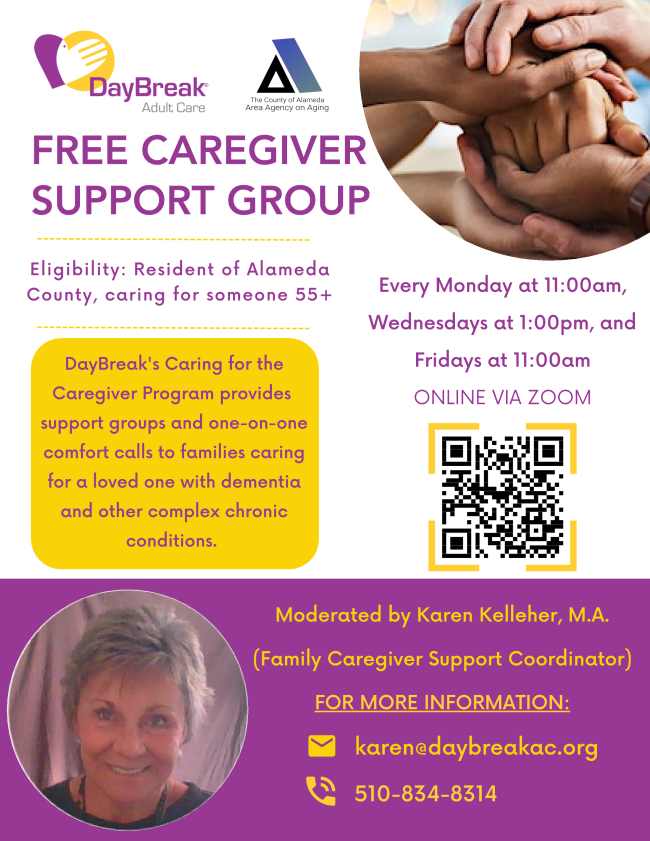
— Karen Kelleher, MA

Family Caregiver Support Coordinator at DayBreak

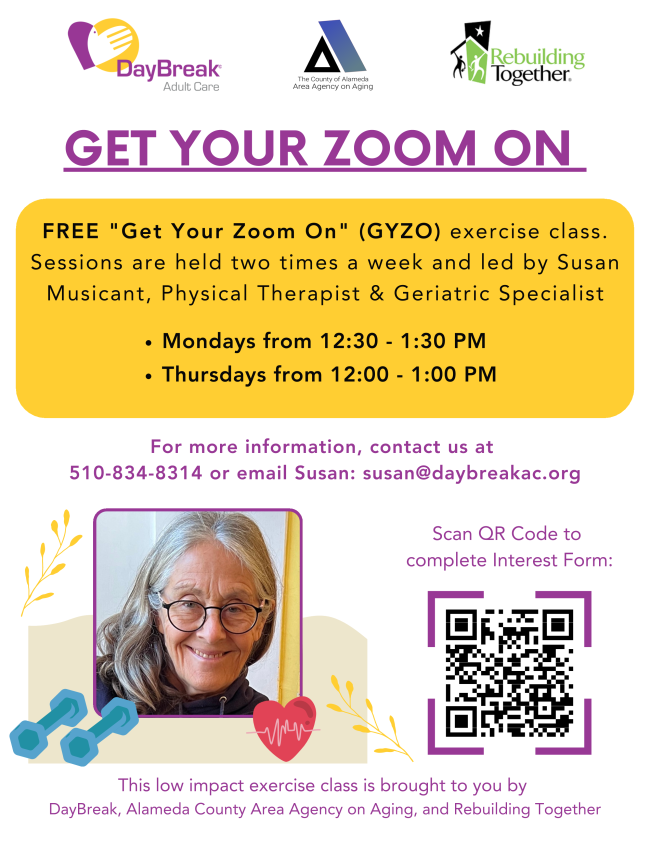
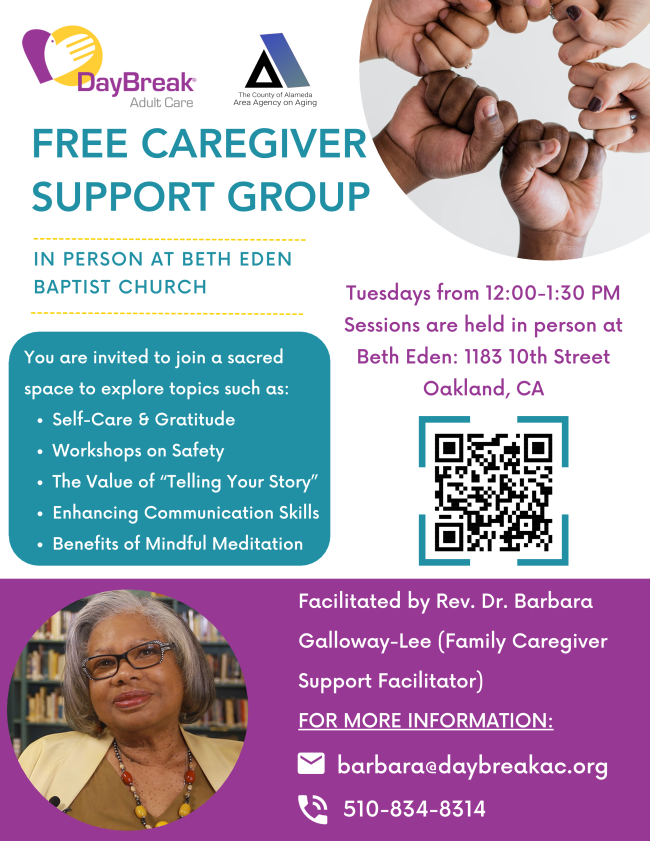
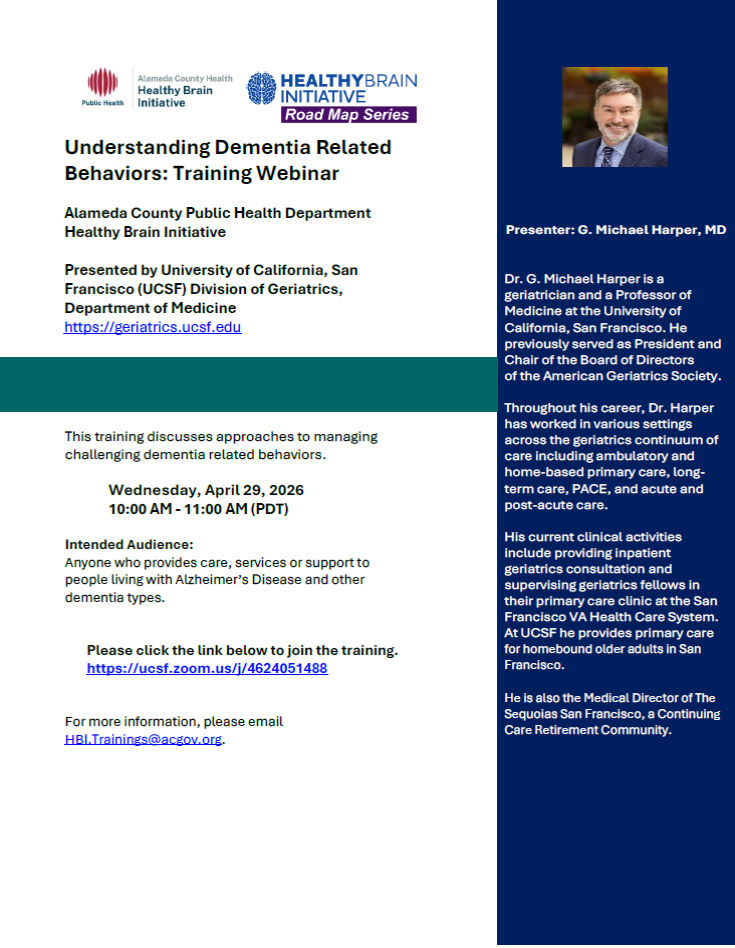
Upcoming Events & Workshops 📣

Help Us Reach Our Goal! 💜

Your gift helps ensure seniors have the safety of a secure home and the support they need to age with dignity. Thank you for being part of our mission to provide stability, care, and peace of mind to those who need it most.

If you know an elder in need of our care and coordination services, or a caregiver seeking support, please encourage them to reach out to us at: 

510-834-8314

Web  LinkedIn  YouTube  Facebook  Instagram