|
Autism Acceptance Month: Understanding, Supporting, and Celebrating Neurodiversity
by Meagan Rico
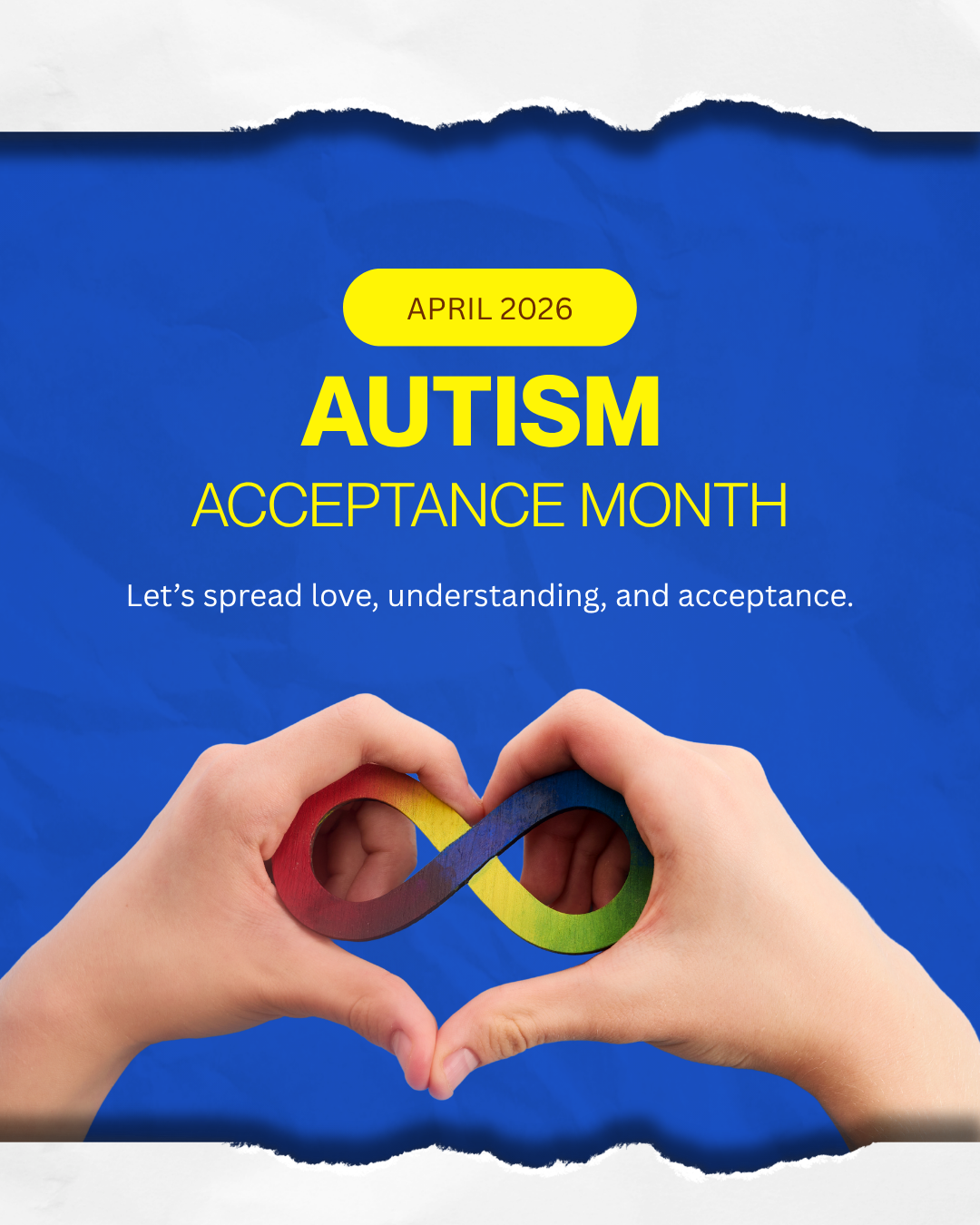
April is Autism Acceptance Month. This is a time to move beyond awareness and focus on understanding, including, and respect for people with autism.
What is Autism?
Autism, also known as autism spectrum disorder (ASD), is a developmental condition that affects how a person communicates, interacts with others, and experiences the world around them (Centers for Disease Control and Prevention [CDC], 2023; National Institute of Mental Health [NIMH], 2023). It is called a “spectrum” because autism looks different for everyone.
Some people with autism may:
- Communicate differently (some may be nonverbal or use assistive devices).
- Prefer routines and enjoy predictability.
- Have strong interests or focus deeply on specific topics.
- Experience sensory sensitivities (to sounds, lights, textures, or crowds) (NIMH, 2023)
Autism is not a disease or something that needs to be “fixed.” It is a natural variation in how the brain develops and functions (World Health Organization [WHO], 2023).
Why Acceptance Matters
For many years, the conversation focused on “awareness.” However, awareness alone is not enough. Most people have heard of autism, but what is needed most now is acceptance.
Acceptance means:
- Creating environments where people with autism feel safe and included
- Respecting different ways of communicating and interacting
- Valuing neurodiversity: this is the idea that differences in brain function are part of normal human variation
From a public health perspective, acceptance serves multiple purposes, including improving mental health, reducing stigma, and supporting healthier communities overall (U.S. Department of Health and Human Services [HHS], 2020).
What Causes Autism?
Autism does not have a single known cause. Research shows that it is influenced by a combination of genetic and environmental factors that affect early brain development (Hyman et al., 2020). The bigger picture is this: autism is not caused by one gene, one exposure, or one parenting choice.
One thing we know clearly: vaccines do not cause autism.
This myth began with a now-debunked study that has been retracted and discredited. Extensive research involving large populations of children has found no connection between vaccines and autism (Taylor et al., 2014; CDC, 2023).
Autism in Kansas: Why This Matters Locally
Autism is more common than many people realize. According to the CDC, about 1 in 36 children in the United States has been identified with autism (CDC, 2023).
Here in Kansas, thousands of children receive special education services for autism through public schools each year. Autism is one of the fastest-growing categories of developmental disabilities in school systems across the state (Kansas State Department of Education [KSDE], 2023).
At the same time, many Kansas families, especially in rural areas, face challenges accessing diagnostic services, specialists, and ongoing support. This can lead to delays in identification and care, which are critical during early childhood.
The Importance of Early Support
Early identification and support can make a big difference. Services like speech therapy, occupational therapy, and behavioral supports can help children build skills and confidence (Hyman et al., 2020).
Parents and caregivers know their children best. If there are concerns about development, talking with a healthcare provider is an important first step (CDC, 2023).
You do not have to be an expert to make a difference. Small actions matter:
- Be patient and open to different communication styles
- Avoid making assumptions about someone’s abilities
- Support inclusive spaces in schools, workplaces, and the community
- Listen to and learn from people with autism and their families
References
Centers for Disease Control and Prevention. (2023). Autism spectrum disorder (ASD). https://www.cdc.gov/autism/index.html
Hyman, S. L., Levy, S. E., & Myers, S. M. (2020). Identification, evaluation, and management of children with autism spectrum disorder. Pediatrics, 145(1), e20193447. https://doi.org/10.1542/peds.2019-3447
Kansas State Department of Education. (2023). Special education child count data. https://www.ksde.org
National Institute of Mental Health. (2023). Autism spectrum disorder. https://www.nimh.nih.gov/health/topics/autism-spectrum-disorders-asd
Taylor, L. E., Swerdfeger, A. L., & Eslick, G. D. (2014). Vaccines are not associated with autism: An evidence-based meta-analysis of case-control and cohort studies. Vaccine, 32(29), 3623–3629. https://doi.org/10.1016/j.vaccine.2014.04.085
U.S. Department of Health and Human Services, Office of Disease Prevention and Health Promotion. (2020). Healthy People 2030: Developmental disabilities. https://health.gov/healthypeople
World Health Organization. (2023). Autism. https://www.who.int/news-room/fact-sheets/detail/autism-spectrum-disorders
|