City of Miami represents Southeast Florida climate action on global stage at London Climate Week | | |
In June, City of Miami Mayor Eileen Higgins attended London Climate Week 2026, joining Mayor Kate Gallego of Phoenix and Mayor Barbara Buffaloe of Columbia, Missouri, as one of only three American mayors invited by Climate Mayors and C40 Cities to participate in the global convening. London Climate Action Week is one of the world’s leading gatherings focused on climate solutions, bringing together mayors, government leaders, business executives, climate experts, and international partners to accelerate action on resilience, clean energy, public health, sustainable infrastructure, and economic opportunity.
Mayor Higgins had the opportunity to represent Miami on the panel Powering Progress: Climate Leadership in an Age of AI, and participated in discussions at Innovation Forum 2026, Future Health 2026, the C40 Mayoral Masterclass, and the America is All In Business Roundtable where she highlighted Miami’s experience as a coastal city working towards a more resilient future by strengthening neighborhoods and modernizing infrastructure. She spoke about how Miami is financing projects to alleviate flooding and extreme heat through expanding green infrastructure, pump stations, cooling centers, permeable pavements, living seawalls, and tree canopy. Additionally, she shared how Miami is reducing food waste through a residential compost drop-off pilot and eliminating plastics in city concessions.
Her participation provided an opportunity to showcase leading resilience solutions being advanced in south Florida and share lessons learned from years of work on the front lines of climate change, while also learning from and bringing back novel ideas from other cities confronting similar challenges.
| | Photo: City of Miami Mayor Eileen Higgins attends London Climate Week, fourth from the right. Credit: Linkedin | |
Inventory of flood observation programs—your input is needed!
| | The Florida Flood Hub, in partnership with Florida Silver Jackets (the U.S. Army Corps of Engineers, Florida Department of Emergency Management, and the Water Management Districts), have created a survey to gather information on different flood observation tools and reporting programs across the state in order to create a publicly accessible inventory of all existing programs. To provide information on a program/observation tool, please fill out the survey, which takes approximately five to ten minutes to complete. The survey closes July 17, 2026. Contact floodhub@usf.edu with any questions. | | Broward County and SFWMD jointly sign Final Integrated Feasibility Report and Environmental Assessment for the C&SF Flood Resiliency Study | | |
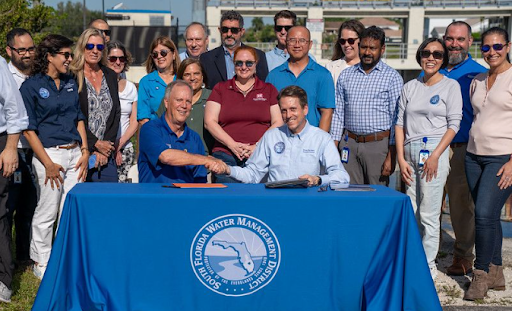
This spring, Broward County reached a major milestone in partnership with the South Florida Water Management District (SFWMD) with the joint signing of the Final Integrated Feasibility Report and Environmental Assessment for the Central and Southern Florida (C&SF) Flood Resiliency (Section 203) Study. Led by the District and supported by Broward County through a $5 million investment, the study will now be transmitted to U.S. Army Corps of Engineers (USACE) Headquarters for approval and subsequent congressional authorization.
The Section 203 Study represents the first step in a long-term, multi-phased effort to address increasing flood risk across Broward County. By evaluating the impacts of sea-level rise, population growth, and the aging regional flood control system, the study identifies critical infrastructure improvements needed to protect communities, sustain economic growth, and strengthen the county's resilience for decades to come.
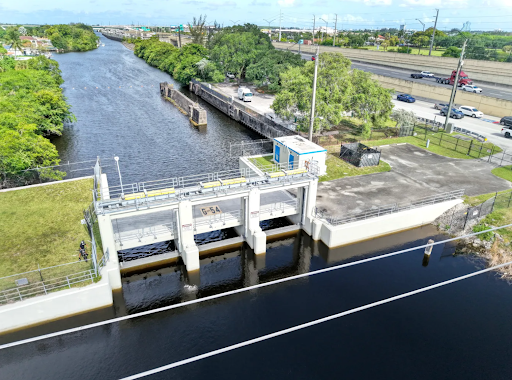
South Florida's flood protection depends on an extensive network of canals and water control structures managed by the SFWMD. In Broward County alone, this system includes approximately 1,800 miles of canals that move water from the Everglades and western communities eastward to the Atlantic Ocean. Much of this infrastructure was designed and constructed beginning in 1948 and relies on gravity to function effectively, requiring water levels east of each structure to remain lower than those to the west.
As sea levels continue to rise, this fundamental operating principle is increasingly compromised. During storm surge events and even some king tides, water levels on both sides of certain structures become nearly equal, preventing stormwater drainage from western Broward. As a result, rainfall that once flowed efficiently to the coast may instead remain trapped, increasing the risk of flooding in inland communities.
| | Photo: The G-54 gated spillway at the Sewell Lock between Plantation and Davie is one of five proposed pump sites in an ambitious plan to keep Broward County from flooding as seas rise. Credit: Carline Jean/South Florida Sun Sentinel | | |
The vulnerability of this aging infrastructure has been recognized for years. In 2009, the SFWMD concluded that 18 of South Florida's 28 major water control structures were highly vulnerable to failure under projected sea-level rise conditions, including six located in Broward County. Since much of western Broward's development occurred with the expectation that the canal system would continue providing reliable drainage, the consequences of reduced system performance are significant. With sea levels projected to rise an additional five to 20 inches in the coming decades, implementing the recommendations of the Section 203 Study has become increasingly urgent.
If approved by USACE and authorized by Congress, the recommended improvements would be funded through a cost-share partnership among the federal government (65 percent), the state of Florida, and local governments. The program is estimated to cost approximately $1.8 billion and would be implemented over roughly 12 years, with construction targeted to begin in 2028 and conclude around 2040. Once completed, the improvements are expected to provide flood protection through 2060 and maintain the intended level of service for Broward County's western metropolitan region while accommodating an additional two feet of projected sea-level rise.
The long-term benefits extend well beyond flood protection. The project is expected to prevent approximately $2.6 billion in property damage, generate an estimated $264 million in economic output during construction through job creation, reduce septic and sewer overflows, help prevent saltwater intrusion into freshwater resources, and lower flood insurance costs by an estimated $146 million.
| | Photo: Broward County Commissioner Beam Furr and SFWMD Executive Director Drew Bartett, credit: Jennifer Jurado, Linkedin | | Boca Raton deploys first vertical oyster garden | |
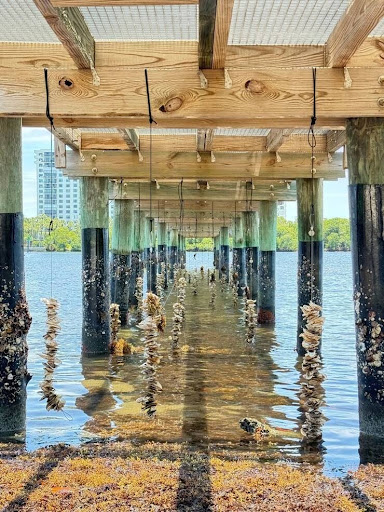
 | | To help improve water quality, the City of Boca Raton has installed a vertical oyster garden made of recycled oyster shells at Rutherford Park, located along the intracoastal waterway. The Office of Sustainability partnered with Tom Twyford, Executive Director of the Palm Beach Fishing Foundation, and his team, who collect discarded oyster shells from several north county restaurants, including The Breakers Palm Beach. The Palm Beach Fishing Foundation cures the shells for several months at MacArthur Beach State Park before providing the prepared shell to groups running vertical oyster garden workshops. Volunteers assemble the cured shells into three-foot vertical strands during the workshops before they are installed beneath local docks. The shells recruit spawned oyster larvae that must find a suitable clean substrate to adhere to in order to survive. Oysters reach maturity within one to three years and are able to filter up to 50 gallons of water per day, dramatically improving water quality by removing pollutants and sediments while also creating habitat for other marine organisms.
Following the success of this first project, the sustainability office is planning a second workshop in the fall. The City is seeking to increase the number of vertical strands within Rutherford Park, as well as evaluating other city property along the intracoastal waterway and the potential of expanding the initiative to include residential properties that have docks.
| | Photo: Oyster strands installed at Rutherford Park in Boca Raton, credit: City of Boca Raton. | | Miami-Dade County launches World Cup heat campaign and mitigation efforts | | In preparation for hosting seven FIFA World Cup matches and welcoming an estimated 600,000 to one million visitors—many of whom may be unaccustomed to Miami’s extreme heat and humidity—Miami-Dade County worked closely with Miami Stadium and Fan Fest organizers to help protect the health and safety of fans, employees, and volunteers. In an effort to reduce heat-related illnesses and emergency calls during the FIFA World Cup, The County’s Department of Environmental Resources Management (DERM) and Department of Emergency Management (DEM) collaborated to make the following resources available: | |
-
Four cooling stations at Miami Stadium: Air-conditioned spaces where fans and employees can cool down. Each station was staffed by physicians from Jackson Memorial Hospital.
-
Countywide cooling sites: More than 60 libraries, parks, and government buildings across Miami-Dade County offer free, air-conditioned spaces for residents and visitors. These sites were open throughout the World Cup to provide convenient places to cool off, particularly for those attending outdoor watch parties and other fan activities. A complete list of cooling site locations and operating hours is available here.
-
Free hydration stations: Two Miami-Dade Water trailers were stationed outside Miami Stadium, along with eight new free HydroStations™ at public transit stops along the Metrorail and Metromover corridors in Downtown Miami. Installed in partnership with HOPE Hydration, these stations allowed fans to refill reusable water bottles and stay hydrated throughout the event.
Additionally, the County launched the “Heat Is Not a Game” campaign to raise awareness regarding heat-related risks and share information on resources available to residents and visitors. Promoted through social media and major transportation hubs, the campaign encourages those outdoors to recognize symptoms of heat stroke, stay hydrated, and take advantage of available cooling resources.
| | Monroe County completes design phase for $136m road elevation projects in residential neighborhoods | | |
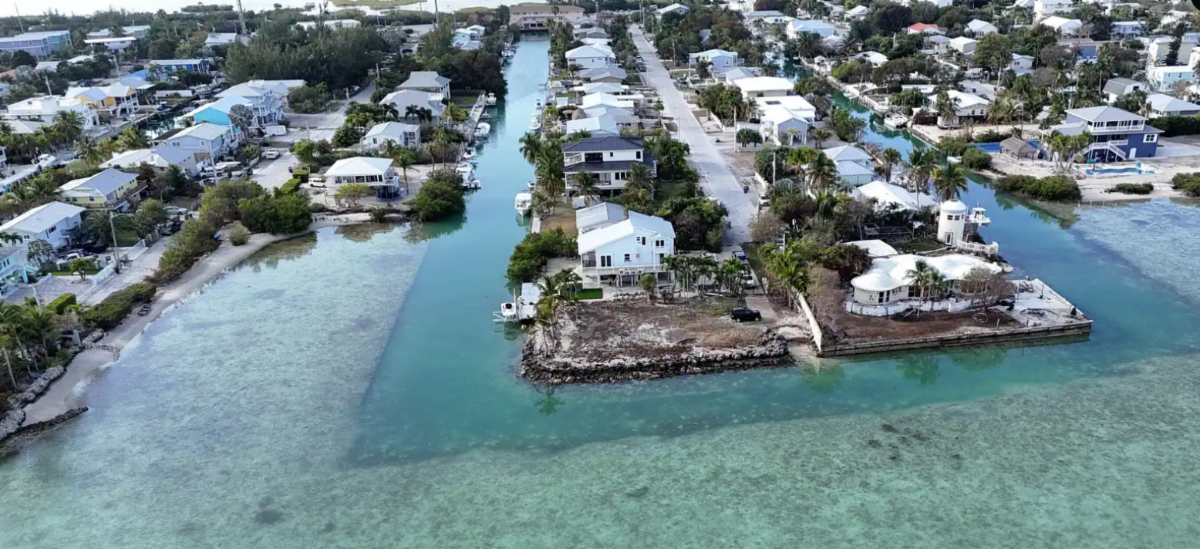
In Monroe County, flooding at several residential neighborhood hotspots—including Big Coppitt Key and Winston Waterways in Key Largo—is already regularly impacting quality of life and access to these communities. To preserve long-term access to homes and help maintain home values, Monroe County has prioritized road elevation and drainage improvements that alleviate roadway flooding. State-of-the-art engineered drainage systems are planned to collect rainfall and mitigate king tides. The new systems will replace existing gravity infiltration that is failing and will continue to worsen as groundwater continues to rise. These projects provide long‑term solutions designed to work under current and future conditions.
In the case of Big Coppitt, the project includes elevating portions of 19 roads between one and 18 inches to meet the minimum design elevation of 2.26 ft. NAVD 88. The Winston Waterways project will elevate portions of 17 roads between one and 23 inches to meet the same NAVD criteria. Both projects will also include construction of a stormwater management system of inlets, pipes, a water treatment unit, pump station with backup generator, and pressurized injection wells for disposal.
Big Coppitt is estimated to cost $85,867,616; and Winston Water Waters is projected to cost $51,076,085. Provided the projects pass FEMA’s Benefit Cost Analysis, the county will receive $84.5 million and $51.5 million in federal and state funds, respectively, to fund these projects.
County staff are working to develop cost-effective operations and maintenance estimates to calculate the annual assessment needed to maintain the enhanced stormwater system. The county is also in the process of finalizing the “Residential Neighborhood Improvement Program,” which provides residents the opportunity to vote on whether to move forward with the project or not. A “Financial Hardship Deferral Program” is also being developed, allowing deferral of an assessment for those meeting the income and asset guidelines.
| Photo: Aerial image of Big Coppitt Key, Key Largo, Florida, credit: Zillow.com | | New Florida law establishes clear statewide permitting process for nature-based resilience projects | | |
During the 2026 Legislative Session, the Florida legislature passed Senate Bill 302, establishing a framework for the expansion of nature-based coastal resilience projects, and allowing for living shorelines in aquatic preserves. The Legislation, which had bipartisan support, took effect July 1, 2026. The bill specifically allows nature-based solutions to improve coastal resiliency, including living seawalls; shoreline and seagrass plantings; beach renourishment; dune, wetland and reef restoration; green and hybrid stormwater infrastructure; and wave attenuation devices. The bill directs the Florida Department of Environmental Protection to develop statewide design guidelines for green and hybrid infrastructure, and a clear, consistent permitting process by January 1, 2027. That process must cover everything from permit criteria and emergency procedures to incentives for local governments and new technologies like 3-D printed reef structures.
In June, the Compact hosted an implementation workshop entitled, “Green Infrastructure & Innovative Approaches for Alternative Stormwater Management” where SB302 was covered in detail. Watch the workshop recording, view the agenda, and all presentations on the Compact’s website.
| | |
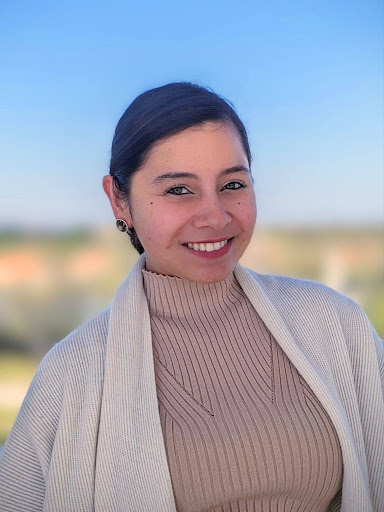
Stessy Cocerez
Interim Division Director, Built Environment Risk Reduction, Palm Beach County
In May, following the departure of Megan Houston, Director of Palm Beach County’s Built Environment Risk Reduction (BERR) Division, Stessy Cocerez stepped in as Interim Director. Stessy has worked for Palm Beach County for over a decade, previously working with the Department of Community Services as a Strategic Planner and Program Evaluator, and has been engaged with the Compact since she joined the BERR division. She has a background in strategic planning, data analysis, program evaluation, and report development. Stessy holds a B.S. degree in Geography, with a concentration in Environmental Studies, from Florida State University and a M.S. degree in Geographic Information Systems from Johns Hopkins University.
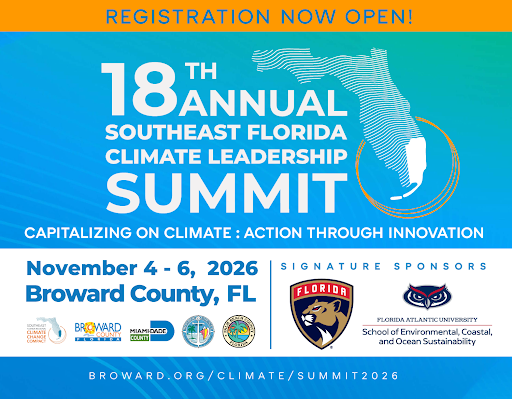
| | Registration is Open! 18th Annual Climate Leadership Summit | | | | |