The Compact releases regional greenhouse gas inventory report | | Photo credit: Miami-Dade County | | |
When the Compact was established in 2009, Broward, Miami Dade, Monroe, and Palm Beach counties committed to reduce the region’s emissions and develop an emissions baseline for Southeast Florida. The Compact’s Regional Climate Action Plan 3.0 established a region-wide goal to reach net zero emissions by 2050, and the Compact is developing a regional greenhouse gas reduction plan through the Environmental Protection Agency’s Climate Pollution Reduction Grant, which will be completed in December 2025. A regional greenhouse gas emissions inventory is integral to developing informed emissions reduction strategies, providing a baseline against which local governments can compare future performance and monitor the region’s progress over time.
The Compact worked with ICLEI USA to conduct a comprehensive regional greenhouse gas inventory, which provides a summary of community-wide emissions trends across Broward, Miami-Dade, Monroe, and Palm Beach counties for 2019 and 2021. The inventory includes emissions from commercial, residential, and industrial stationary energy; transportation and mobile sources; solid waste; water and wastewater; and agriculture and land use. The inventory assesses all major greenhouse gases: carbon dioxide (CO₂), methane (CH₄), and nitrous oxide (N₂O), and also includes sulfur hexafluoride (SF6), hydrofluorocarbons, and perfluorocarbons emissions.
Over the two-year period, the region demonstrated a 7.4% decrease in overall emissions while population growth was less than 1.0%. In both 2019 and 2021, the largest sources of emissions in the region are transportation (50% in 2019; 48% in 2021), commercial buildings (14% in 2019 and 2021), and residentials buildings (14% in 2019; 15% in 2021). The decrease in overall emissions over this two-year period is likely a result of the impact of the COVID-19 pandemic on transportation patterns.
| | Broward County hosts Global Forum on Financing Climate Resilience | | Caption: Attendees at the Resilience Finance Convening, hosted by Broward County. Photo credit: Broward County | | |
Broward County welcomed leaders from across the globe for a Resilience Finance Convening held March 25–27, 2025, in partnership with the Resilient Cities Network (R-Cities). The event brought together city officials, finance experts, and private sector partners to develop strategies to unlock large-scale capital for local climate resilience efforts.
The event focused on capital planning, risk reduction, and innovative financing models with the aim to empower communities with the tools needed to better prepare for and respond to climate related challenges. Key themes included advancing a portfolio-based approach to resilience investments, strengthening governance frameworks to enhance financial readiness, and utilizing risk-informed investment tools to guide strategic decisions.
In addition to Broward and Miami-Dade counties, representatives from the cities of Miami Beach, Miami, and Hollywood, Florida; New York City, New York; San Francisco and Oakland, California; and Cape Town, South Africa joined resilience finance leaders from Howden, Arup, and Tokio Marine to share best practices and explore new approaches to fund resilient infrastructure.
The convening also emphasized the importance of the Resilience City Framework (CRF) 2024, highlighting how it can help shape informed and targeted urban investment strategies. Participants examined common barriers to resilience financing, including legal complexities, funding gaps, and a shortage of bankable projects, and worked through actionable solutions. Discussions explored the potential of public-private partnerships, creative tools like tax increment financing (TIF), and the alignment of public sector goals with private sector investment opportunities.
Through the event, a clear message emerged: strong governance, compelling economic cases, and overarching long-term financial planning are essential to attract sustained investment in climate resilience. As the climate risks intensify, Broward County’s convening served as a timely and urgent call for global collaboration, innovation, and financial agility to build more resilient communities.
| | Broward releases countywide Resilience Plan | | Photo: Extensive flooding in Broward County from the April 2023 rainfall event. Credit: Broward County | | |
In March, Broward County released its countywide Resilience Plan, the culmination of a two-year planning effort, focused on building community resilience to the impacts of climate change predicted over the next half-century, with a primary focus on flood and heat mitigation. The plan’s multi-decade blueprint for adaptive planning includes strategies that account for on-the-ground conditions like a lack of stormwater storage, dense development, and older infrastructure, all of which contribute to climate risks. The plan lays out two tiers of adaptation strategies—looking at planning horizons of 2050 and 2070.
- Tier 1 (By 2050): Focuses on preparing for a 2-foot rise in sea level by 2050. This phase includes constructing seawalls up to 5.0 feet NAVD to mitigate storm flooding, enhancing drainage systems to manage heavy rainfall, adding pumping stations, upsizing culvert crossings, modifying control structures, and implementing green infrastructure such as swales and expanded green spaces to absorb water and reduce urban heat.
- Tier 2 (By 2070): Addresses the challenges of a projected 3.3-foot rise in sea levels by 2070. In addition to the adaptations under Tier 1, this phase involves raising seawalls to 7.0 feet NAVD for enhanced coastal protection and adding advanced drainage systems, including pumping and collection systems, to manage increased stormwater volumes behind seawalls. Tier 2 also expands green spaces further to mitigate urban heat and enhance biodiversity.
| | |
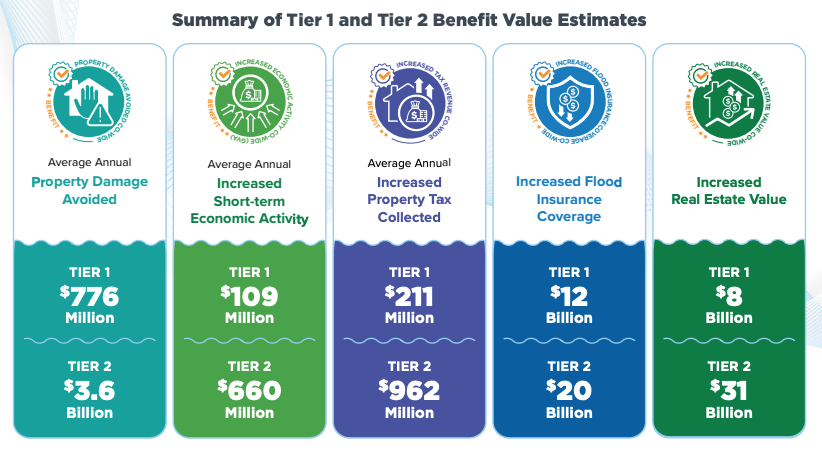
Taken together Tier 1 and 2 have an estimated cost of $28 billion. The public portion—a shared investment among the county, municipalities, and water control districts, that will also leverage state and federal resources—is estimated at $9 billion, with private property improvements accounting for the remainder of the need.
By investing in these infrastructure upgrades, the plan significantly reduces flood risks, preventing billions in potential property damage. Measures identified in the plan protect homeowner investments and property tax values, and make flood insurance more accessible and affordable. Additionally, implementation of the plan will support the local economy by minimizing business disruptions and safeguarding jobs, contributing hundreds of millions annually in economic activity and tax revenue. Beyond economic gains, these adaptations will enhance quality of life by reducing urban heat and expanding green spaces.
This memorandum summarizes the economic benefits of conceptual adaptation suites within the plan. The economic impacts under each suite were compared to the impacts from a no-action baseline condition to understand how effective the adaptation suites would be in mitigating the economic losses from flooding, accounting for expected sea level rise, rainfall, and storm surge.
| | Miami-Dade County names new CRO and restructures Office of Environmental Risk and Resilience | |
| |  | Miami-Dade County Mayor Daniella Levine Cava has appointed former Chief Bay Office, Loren Parra, as the new Chief Resilience Officer for the county, restructuring the office, now called the Office of Environmental Risk and Resilience. Julie Dick has been named the Deputy Chief Resilience Officer under Parra’s leadership. The streamlined team will focus on the protection of people, property, and prosperity, according to Mayor Cava’s announcement. Parra’s appointment consolidates three positions—the Chief Resilience Officer, Chief Bay Officer, and Chief Heat Officer—into one role, and many of the staff formerly within the office of resilience are now integrated into various other departments across the county, including the airport, water and sewer, and planning. Jane Gilbert, who has served as the county’s first ever Chief Heat Officer, is retiring this month. Patricia Gomez, who served as interim CRO for nearly a year, is now leading energy and resilience initiatives within the county’s aviation department.
As the Chief Bay Officer, Parra accelerated solutions to protect Biscayne Bay, including securing $5 million from the U.S. Army Corps of Engineers to restart the Biscayne Bay Southern Everglades Ecosystem Restoration (BBSEER) project. Parra has helped integrate the county’s siloed work around flood reduction and improved water quality, championing more efficient investments that protect our neighborhoods and public dollars. Parra has also formerly led environmental programs at the Everglades Foundation and Miami Foundation.
| | Miami-Dade releases urban forestry plan, setting course for 30% tree canopy goal | | |
In June 2022, the Miami-Dade Board of County Commissioners directed Mayor Danielle Levine Cava to develop a comprehensive plan for the county’s urban tree canopy. This spring, Miami-Dade released the Urban Forestry Plan, reaffirming the county’s long-held goal of reaching a minimum of 30% tree canopy by 2030, a target set forth in the Comprehensive Development Master Plan (CDMP) since 2006. Many challenges make this an ambitious target, including disease and storms that drive loss of tree cover, rapid urbanization, and the fact that the county has direct jurisdiction over only a portion of the land where tree canopy expansion is needed. Between 2008 and 2016, the county’s tree canopy grew from 12% to 20%. However, from 2016 to 2021, the urban tree canopy remained flat at 20%. Maintaining 20% canopy during this period required significant inputs in the face of rapid development, multiple major storms, and a state exemption allowing the removal of trees without any replacement.
| | |
Reaffirming the 30% tree canopy CDMP goal means adding 50% more tree canopy than currently exists in Dade’s urban areas. While achievable, this goal presents difficulties, particularly due to urban development, which limits available planting space especially in communities most in need of tree canopy expansion.
The Urban Forestry Plan addresses the inequities in urban tree canopy coverage currently experienced in low-income communities, prioritizing those communities within county-controlled land, and sets out five strategies necessary to achieve the 30% tree canopy goal:
- Accelerate tree and forest preservation, growing, and maintenance on county land and on all public lands via leases and agreements
- Expand and strengthen private, municipal, and institutional partnerships to accelerate canopy metrics and public education and engagement
- Advance planning, policy, and regulatory opportunities to require and incentivize urban reforestation countywide
- Support growth of forestry jobs and business opportunities, particularly arborist and landscape businesses, in the urban core and nursery businesses in South Dade
- Integrate systems for tracking tree canopy, inventorying, and identifying current and future vulnerabilities and that can account for tree canopy progress
Critically, the plan calls for the establishment of a dedicated funding source for reforestation capacity in order to support these critical strategies.
| | Palm Beach supports its municipalities in advancing standardized flood and sea level risk report | | The Palm Beach County (PBC) Office of Resilience recently kicked off the Municipal Flood and Sea Level Rise Vulnerability Assessments project. The goal of this project, funded by the Resilient Florida Grant Program, is to help six PBC municipalities produce a standardized flood and sea level rise risk report that complies with Section 380.093, Florida Statutes. This will make them eligible for future implementation funding through the Resilient Florida Grant Program. These municipalities include the Town of Cloud Lake, the Town of Glen Ridge, the Village of Golf, the Town of Haverhill, the Town of Hypoluxo, and the Village of Palm Springs. In February 2025, the project team assembled a steering committee comprised of representatives from the county and each of the municipalities. In April 2025, the team held the first round of community workshops in each jurisdiction. The next step in this project is finalizing the community assets that will be considered in the flood and sea level rise assessment. Visit this page for more information about this project. | |
2025 Legislative Update
Written by: Janet Bowman, Senior Policy Advisor/Climate Policy, The Nature Conservancy in Florida
| | Photo credit: Broward County | | |
As of this writing, the Florida Legislature is in an extended 2025 session working on the one bill they must pass—the Appropriations Bill—therefore the budget will not be covered in this wrap-up. During the regular session, the legislature filed 1959 bills, passing only 257, and many of these bills are awaiting signature by the Governor. This session, many of the bills related to resilience address mitigation of flooding hazards and hurricane preparation and recovery. The below outlines bills related to climate resilience and mitigation.
CS/CS/SB 948 — Flooding Disclosure, requires a landlord of residential rental property or a mobile home park owner to disclose certain information regarding flood risks and past flooding of the property to prospective tenants. A tenant who does not receive the disclosures and who incurs substantial losses or damages due to flooding may terminate the lease and may be entitled to refund of advance rents paid if certain conditions are met. In addition, flood disclosure requirements for the sellers of residential property have been expanded to require the seller to disclose whether they are aware of any flood damage that occurred during ownership and whether they have received assistance from any source for flood damage to the property, as opposed to just federal sources.
CS/CS/HB 393—My Safe Florida Condominium Pilot Project extends the My Safe Florida grant program for hurricane hardening improvements to condominiums. The pilot program allows qualifying condominiums to participate in the My Safe Florida Home Program for the purposes of applying for hurricane mitigation grants for roof repairs and storm hardening improvements. Participation in the pilot program is limited to condominiums that are three stories or more in height and include at least two-single family dwellings.
| | The Compact releases guidance document on energy benchmarking | | The Compact provides avenues to transfer knowledge and support capacity-building among local government practitioners to advance local climate solutions. In the spirit of coordinated efforts to reduce greenhouse gas emissions in the region, the Compact hosted a Benchmarking Peer Learning Exchange in November 2024. Municipal and county staff gathered to learn from subject matter experts and one another about designing and implementing a benchmarking program. Designed to facilitate cross-pollination of learnings and best practices from existing benchmarking programs across the region, as well as share external examples, speakers at the workshop included representatives from Institute for Market Transformation (IMT), Miami-Dade County Office of Resilience, City of Miami Building Department, City Boston Environment Department, and Cadmus (a contractor to the U.S. Environmental Protection Agency). As part of the Compact's ongoing efforts to build the capacity of practitioners and stakeholders in Southeast Florida to advance regional climate action, the Compact has developed a guidance document summarizing and building upon the learnings and tools discussed during the exchange. The document covers the landscape of benchmarking programs within Southeast Florida and nationally, as well as outlines key resources, tools, and best practices for program development and implementation. | | Help Shape the Region's Comprehensive Climate Action Plan! | | The Compact is currently soliciting input via a stakeholder survey regarding the various benefits of the emission reduction measures included in the Comprehensive Climate Action Plan, a deliverable under the EPA’s Climate Pollution Reduction Grant. This survey will take about 10-15 minutes to complete. Stakeholder feedback is essential to understand local concerns, priorities, and the relative importance of various benefits of the strategies included in the plan, such as reducing air pollution and energy bills, improving public health, and supporting workforce development. Click here to learn more about and begin the survey. This survey will close June 30, 2025. | | Register for the 17th Annual Southeast Florida Regional Climate Leadership Summit: December | | |
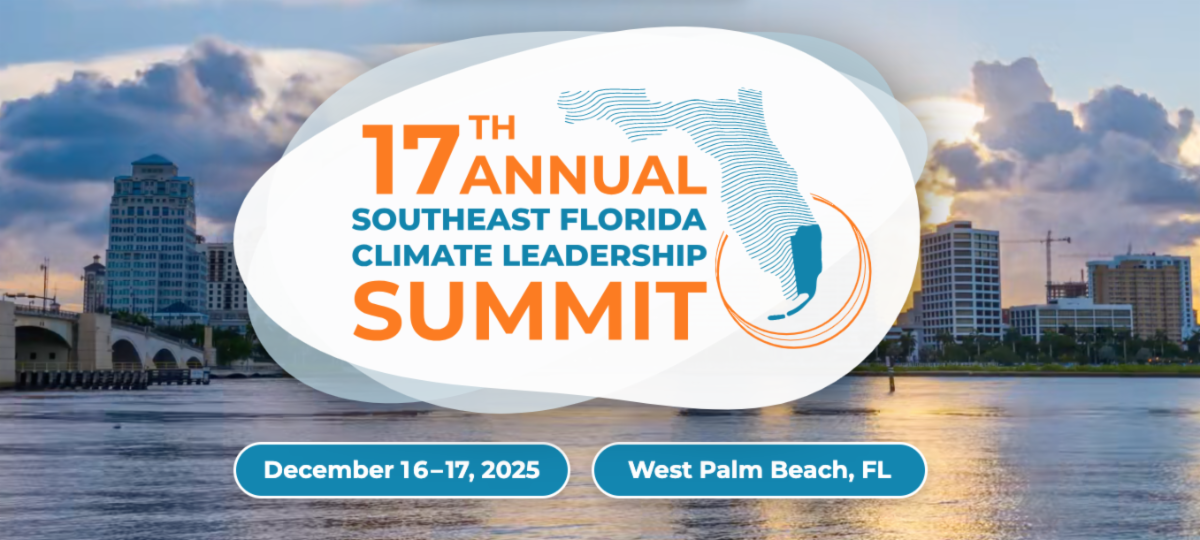
Registration is now open for the 17th Annual Climate Leadership Summit, hosted at the Palm Beach County Convention Center, on December 16th and 17th, 2025.
Keynotes of this year’s event include best-selling author and a widely acclaimed journalist, Michael Grunwald, who has covered government policy and politics as a staff writer for The Washington Post, Time Magazine, and Politico Magazine. He has won the George Polk Award for national reporting, the Worth Bingham Prize for investigative reporting, the Society of Environment Journalists award for in-depth reporting, and many other honors. Grunwald authored the widely acclaimed book, The Swamp: The Everglades, Florida, and the Politics of Paradise.
The Compact is also pleased to announce that Ashon Nesbitt, CEO of the Florida Housing Coalition, and professor, author, and Principal of Brooks + Scarpa, Jeffrey Huber, will also provide keynotes at the event.
| | Recapping the Compact’s May Implementation Workshop: Advancing Private Property Resilience, Risk Reduction, and Sustainability | | |
On May 28th, the Compact hosted an implementation workshop focused on private property adaptation and risk mitigation. This workshop highlighted:
- Residential private property retrofits and improvements to reduce property damage and fortify against extreme events
- Best practices and lessons learned for community and residential outreach, education, and engagement as it relates to climate risks
- Case studies from across the region on private property risk mitigation, as well as adaptation grants and technical assistance programs, to advance residential adaptation and mitigation
- Climate-informed zoning and other best practices that local government can use to limit risk to private property
- Updates to Florida Statutes related to using PACE financing for flood protection
The workshop agenda, recording, and presentations can be found here.
| | | | |