Broward County Launches $20 Million Resilient Broward Grant Program Supporting Flood Mitigation Projects | | |
Applications are open for the Resilient Broward Grant Program through October
31, 2026. In April 2026, the Broward County Board of County Commissioners voted to allocate $20 million to fund resilience implementation through the Resilient Broward Grant Program, accelerating the advancement of projects identified in the Countywide Resilience Plan. The Resilient Broward Plan identified a range of infrastructure adaptations to address the impacts of climate change and rising sea levels, with infrastructure improvements totaling $28 billion.
This Program provides cost share to local partners for eligible projects, and aims to deliver immediate, measurable flood risk reduction through targeted stormwater conveyance improvements across the county. It marks a major milestone in the County’s efforts to prepare for rising flood risk and conditions anticipated by 2050. Funded projects will contribute to:
- reduced property damage and losses;
- preservation of property values;
- reduced flood insurance premiums; and
- protection of critical infrastructure.
The program will provide up to 25% cost share for eligible stormwater conveyance projects, with a long-term goal of achieving an overall 5:1 leveraging of County funds over 15 years, generating an estimated $1.5 billion in resilience infrastructure investment county-wide. Broward County municipalities, dependent and independent Water Control Districts, Special Districts, and County Agencies are encouraged to apply. Awardee announcements are anticipated in the Spring of 2027.
This action by the Broward County Commission marks a significant milestone in building a more resilient future for Broward. For more information, please visit the Resilient Broward Grant Program webpage to access the application portal, view the kick-off webinar recording, and scoring criteria.
| | Record King Tides Inundate South Florida Coastal Communities | | |
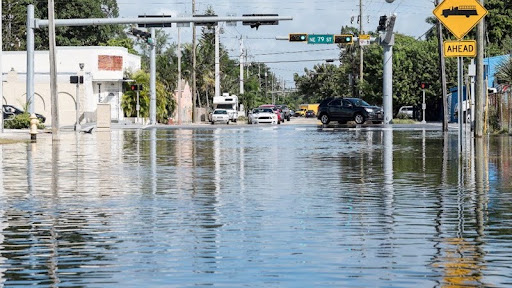
This fall, seasonal king tides in South Florida have brought extensive coastal flooding to communities across much of the Compact region. In September, the higher than usual tides combined with heavy rains submerged many streets and even put the region under a coastal flood advisory.
King tides are the highest high tides of the year and are a natural phenomenon. In South Florida, king tides tend to occur in the fall. As sea levels rise as a result of climate change, the impacts of king tides are becoming more severe. Sea levels are about eight inches higher than they were three decades ago. In low-lying communities across South Florida, that increase means that king tides often overtop docks, come up through waterfront drains, and submerge streets and sidewalks.
South Florida local governments have invested tens of millions of dollars into infrastructure improvements to keep streets and residents dry in the face of encroaching tides, and the Compact counties continue to work collaboratively to address the challenge of rising sea levels. Notable efforts in adaptation initiatives from across the Compact regions include Monroe County’s investment of hundreds of millions of dollars in road elevation, Broward County’s ordinance mandating minimum seawall and top-of-bank elevation standards in flood-prone areas, and Miami-Dade installing stormwater pump stations to fight gravity and push water back into canals. Many of the municipalities in the South Florida region are taking similar steps.
However, the king tides are just a taste of what everyday life could be like in many South Florida communities in just fifty years time without more significant investments in adaptation projects. To learn more about the observed and projected high tide flooding in the Compact region, visit the Compact’s Climate Indicators Report.
| | Photo: A Miami street floods during the king tides. Credit: Miami-Dade County | | Monroe County Makes Progress on Resilient Breakwater and Living Shoreline Projects | | |
Over the summer, Monroe County’s resilience staff updated the County Commission on several breakwater repair and living shoreline projects designed to protect vulnerable coastal communities and infrastructure throughout the Florida Keys.
The projects include the Duck Key Breakwater and Living Shoreline Project and the Rock Harbor Breakwater Repair Project. Both projects are important investments in protecting Monroe County neighborhoods, public infrastructure and waterways from future storm impacts and sea-level rise.
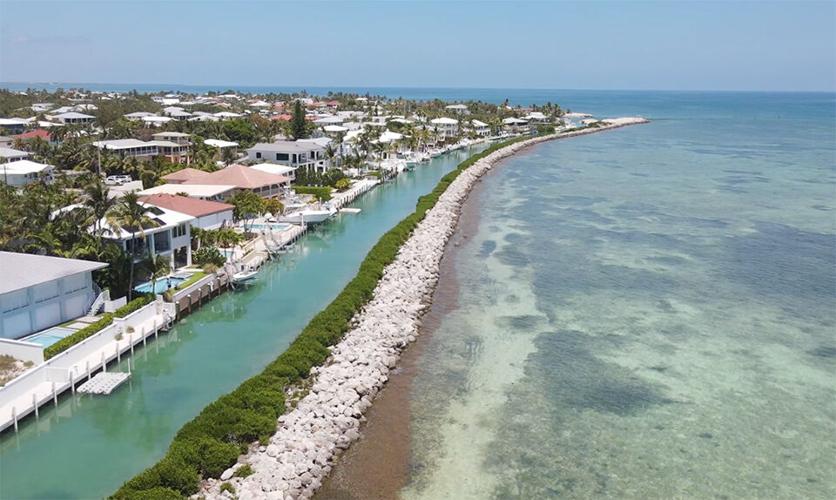
The Duck Key Breakwater and Living Shoreline Project includes repairs to approximately 10,000 linear feet of jetty span damaged during Hurricane Irma, along with the addition of a living shoreline component to further enhance storm protection and coastal resilience.
The Rock Harbor Breakwater Repair Project in Key Largo includes repairing approximately 500 linear feet of jetty span damaged during Irma and installing an air curtain system to reduce the amount of vegetative debris entering canals during storm events.
The county also provided updates on the Long Key Living Shoreline project which includes construction of a 1,282-foot living shoreline with 480 wave attenuation devices and native plantings to help protect the Long Key Transfer Station, a solid waste facility, from storm surge flooding.
In Tavernier, the county is repairing approximately 1,500 linear feet of breakwater damaged by Irma and to install an air curtain, which is an invisible, underwater wave-dampening system that uses a continuous wall of rising air bubbles to suppress wave energy. It works via fluid dynamics to attenuate wave action without disrupting maritime traffic.
All of the projects are fully funded by grants from the Florida Department of Environmental Protection and the Florida Department of Commerce.
| | Photo: The Duck Key Breakwater and Living Shoreline project includes repairs to approximately 10,000 linear feet of jetty span damaged during Hurricane Irma, along with the addition of a living shoreline component. Credit: Monroe County | | U.S. Army Corps and Miami-Dade County Advance the Miami-Dade Back Bay Coastal Storm Risk Management Feasibility Study | | |
In September, Miami-Dade County’s Department of Environmental Resources Management (DERM) partnered with the U.S. Army Corps of Engineers (USACE) Norfolk District to release the Phase II Draft Report for the Miami-Dade Back Bay Coastal Storm Risk Management Feasibility Study (“Back Bay Study”).
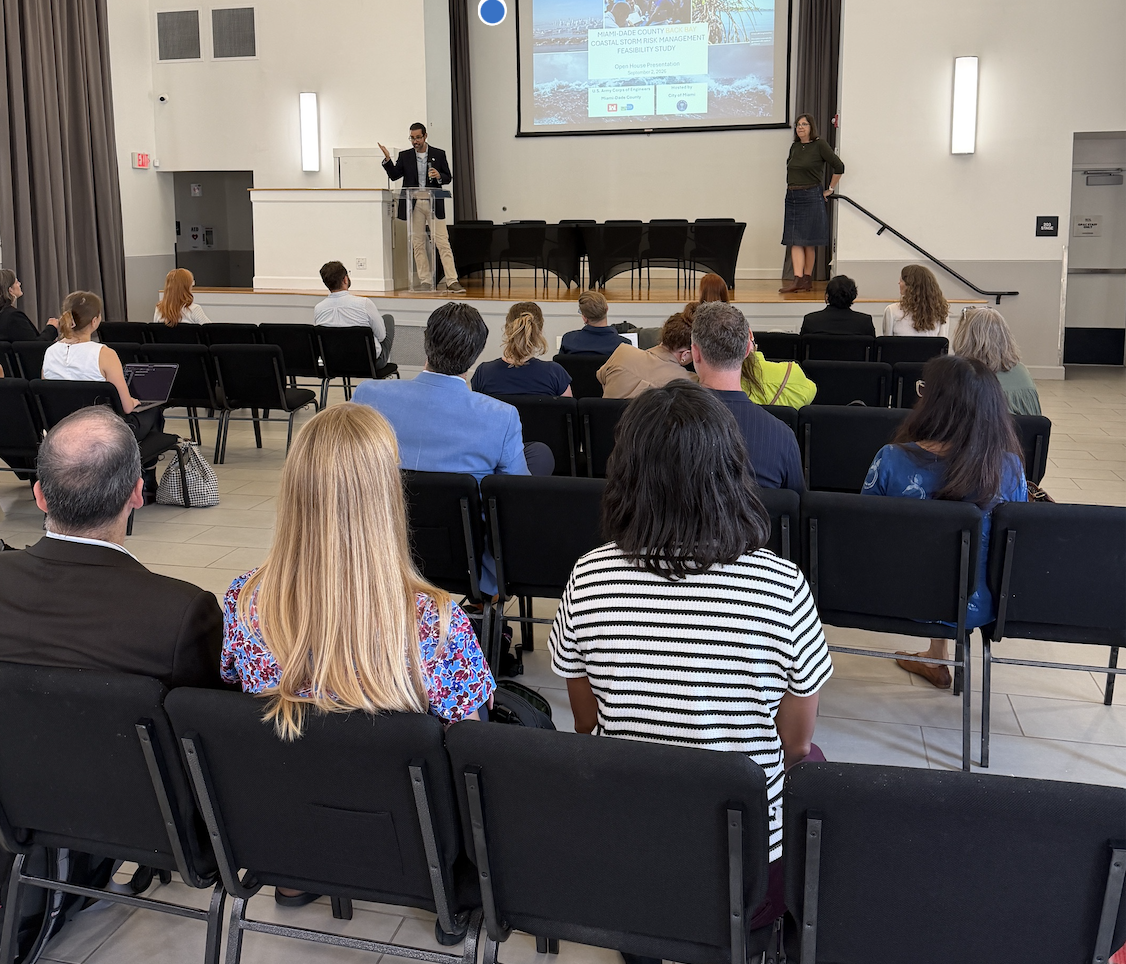
In a series of public meetings, USACE and DERM presented details of the Phase II Draft and invited the public to review and provide feedback. Residents, community organizations, and stakeholders offered insightful comments, both in-person and through email and online submissions.
The objective of the Back Bay study is to ensure human health and safety, increase resilience of critical infrastructure, and reduce damages to buildings as a result of coastal storms in vulnerable communities in Dade County.The Phase II Draft Report recommends additional measures to manage hurricane storm surge risks, including floodproofing critical facilities and nonresidential buildings, and elevating homes above projected flood levels.
New in this phase of the project, the Army Corps and Miami-Dade County identified eight high frequency inundation areas to focus on for funding projects. The eight focus areas were determined taking into account future sea level rise, future capital project planning, areas of lower disaster preparedness, and areas with potential for nature-based solutions.
Click here to learn more .
| | Miami-Dade residents attend a stakeholder meeting to learn more about the Phase II Draft Report of the Back Bay Study. Credit: Miami-Dade County | | Resilient by Design: Boynton Beach Launches City’s First Urban Heat Strategy | | |
In July 2026, the City of Boynton Beach completed Resilient by Design: An Urban Heat Strategy for Boynton Beach, a landmark initiative that establishes a comprehensive roadmap to mitigate urban heat islands and protect residents from the health risks of extreme heat. Supported by a grant from the Climate Smart Communities Initiative (CSCI), Boynton Beach partnered with ICLEI USA, Community Greening, EcoAdapt, and American Forests to develop the strategy.
The strategy outlines 31 actions to improve citywide heat resilience, which are grounded in residents’ lived experiences, municipal staff expertise, and a comprehensive review of existing city plans and regional efforts. Using surface temperature data, the strategy divides Boynton Beach neighborhoods into different “heat resilience priority zones”, with the hottest areas of the city considered high priority for cooling interventions like tree plantings, water features, and shade structures. To jumpstart implementation, the local community-based organization Community Greening ran a tree drop-off program that delivered 168 trees to Boynton Beach residents.
Moving forward, the city is dedicated to tackling extreme heat through a multi-pronged approach that combines green infrastructure, nature-based solutions, code updates, partnerships, and internal capacity-building to establish heat resilience as a long-term goal and a core municipal service. To read the full strategy, visit the Boynton Beach Heat Resilience webpage.
| | FEMA Awards $5 Million in Pre-Disaster Mitigation Grants in the Compact region | | |
Federal disaster money is flowing into the Southeast Florida region. In September, FEMA announced it is awarding Florida more than $50 million for projects that will prevent, eliminate or reduce future disaster-related damage, via its Hazard Mitigation Grant Program. Through this program, state, local or territory governments and Tribal Nations are awarded funds to take proactive mitigation measures such as acquiring hazard-prone homes and businesses, adopting and enforcing building codes and standards, protecting against floods through elevations and drainage improvement projects, building safe rooms and upgrading utilities and infrastructure. While the Hazard Mitigation Grant Program is federally funded, it is administered by the Florida Department of Emergency Management.
In the Compact region, FEMA is awarding nearly $5 million through the Hazard Mitigation Grant Program to the Florida Keys Aqueduct Authority to harden drinking water pipelines for the Snake Creek transmission system in Islamorada. The proposed project will retire and replace approximately 2,200 linear feet of existing 30" ductile iron transmission line pipe with 42" high-density polyethylene transmission line pipe. The existing line is reaching the end of its useful life, accelerated by the corrosive saltwater environment and other environmental factors driven by climate change, including increasing sea level and water temperatures, more frequent and severe storm events and coastal erosion. The proposed project is crucial to ensure a stable and secure supply of potable water. To increase reliability, reduce system vulnerability and accommodate increasing demand for clean, safe drinking water, the new transmission line will be installed via horizontal directional drilling (HDD) below seabed of the Snake Creek channel under the Snake Creek Bridge.The Snake Creek award is part of a broader effort to protect Monroe County's drinking water infrastructure from aggressive soils and subterranean tidal flows.
Other notable Hazard Mitigation Grant Program projects within the Compact region include:
- More than $761,000 for Miami-Dade County to strengthen six fire stations against hurricane winds by protecting building openings and upgrading roofs to current high-wind standards.
- More than $634,000 for the University of Miami to provide a generator for emergency backup power for the McKnight Building in Coral Gables.
| | University of Miami Researchers and Partners Expand Hybrid Reef Project Off Miami Beach | | |
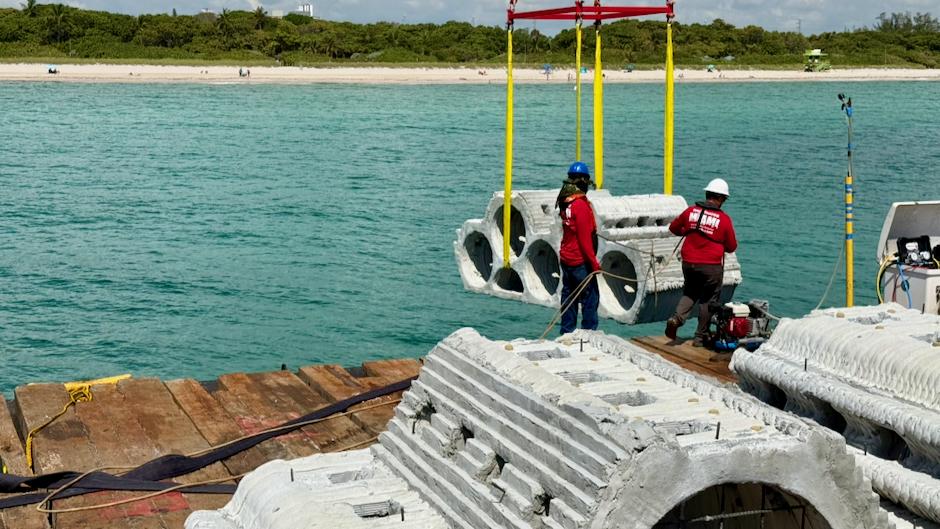
University of Miami researchers and their partners have added three new 3D-printed reef structures to an offshore reef and resilience project near Miami Beach. The project aims to restore coral reefs, protect coastlines, and provide homes for marine life.
The project, called ECoREEF, combines specially designed structures called SEAHIVE with living corals. Together, they may help reduce wave energy and lower the risk of coastal flooding during storms.
The new structures were placed about 750 feet offshore near 81st Street in Miami Beach. They are made of concrete and have openings that allow water to flow through them. Research shows that this design can reduce wave energy better than solid structures of a similar size.
Scientists have attached 205 adult corals from seven native species to the new structures. They have also added thousands of tiny coral larvae, which may settle on the structures and grow into new corals.
Initiated by a seed grant from the University of Miami Laboratory for Integrative Knowledge (U-LINK), ECoREEF represents nearly a decade of interdisciplinary collaboration among engineers, marine scientists, and coral restoration practitioners. Unlike traditional artificial reefs, ECoREEF’s are deployed in shallow water near vulnerable shorelines and include stony corals that have been specifically produced to thrive in these tough, wave-impacted environments.
The research team is testing different ways to help corals survive in challenging ocean conditions as the climate changes. These include using heat-tolerant corals, coral hybrids, and strong corals rescued from seawalls and construction sites.
Laboratory tests in 2021 found that combining staghorn corals with the SEAHIVE structures helped reduce wave energy. In some shallow-water tests, the hybrid reef reduced incoming wave energy by up to 98 percent. However, researchers will need to continue testing the system in the ocean to understand how well it works over time.
Researchers will track coral growth and survival, study the marine life that moves into the area, and measure how well the structures perform.
By combining engineering with coral restoration, scientists hope to develop new ways to protect coastal communities while helping damaged reefs recover. The project could also guide future efforts to protect shorelines in South Florida and other coastal areas.
| Phase 2 of the ECoREEF (Engineering Coastal Resilience Through Hybrid Reef Restoration) project expands an offshore living laboratory off Miami Beach where University of Miami researchers and collaborators are testing whether 3D printed reef structures and restored corals can work together to reduce coastal flooding, create marine habitat, and strengthen shoreline resilience. Photo: Diana Udel, University of Miami. | | | | |