November 17, 2025

Columbus, Ohio

Note: Direct any questions on the content of this message to OHFA’s Compliance and DevCo Helpdesk.

Important Reminders!


On June 13, 2025, OHFA published an Industry Message regarding XML uploads. The Message outlines that due to the operational and technical difficulties of XML, the XML Upload option will no longer be available to submit tenant events. 


On May 5, 2025, OHFA published a revised HOTMA TIC with the mandated NAHMA 8.0 standards. Guidance on the revised TIC can be found in this previous Industry Message and OHFA's DevCo Resources. Importantly, any tenant events entered into DevCo prior to May 5, 2025, will need to be re-entered, because events entered into the old TIC version do not transfer to the revised TIC.  

OHFA TIC and Net Assets Under HUD’s Threshold


Should all net family assets be listed on the OHFA TIC even if they are under HUD’s threshold amount? If so, what value of each asset should be listed on the TIC?


Effective immediately, if all net family assets are less than the threshold amount, $0 must be listed as the value of each asset on the TIC. If the net family assets are greater than the HUD threshold, then owners/management agents must list the actual value of each asset on the TIC. Importantly, income from an asset(s) is always counted regardless of whether it is under/over HUD’s threshold amount.


Example #1:

Mary has a checking account balance of $800, and a savings account value of $900, which has a 1.5% interest rate. Since the value of the assets is less than the threshold amount ($800 + $900 = $1,700), owners/management agents will list both assets on the TIC but the value will be $0 for each. The income from the savings account interest accrued, $13.50 (i.e., $900 x .015), will be counted as income and listed on the TIC.


Example #2:

Chris has a checking account balance of $1,000, a savings account value of $2,000 with a 2% interest rate, and a plot of land worth $49,000. Total net family assets are $52,000 (i.e., $1,000 + $2,000 + $49,000). Owners/management agents must list and show the actual value of each asset on the TIC because the net family assets are over the current HUD threshold amount, which is $51,600. The asset income amount of $40 ($2,000 x .02) from the savings account must also be listed on the TIC.


Important Key Steps: Because actual income cannot be determined on the plot of land and checking account, owners/management agents must impute income for the plot of land and checking account. 


Total Imputed Income: $265

  • $50,000 (checking account + plot of land) x .0045 (current passbook rate) = $225
  • The $225 then must be added to the income from the savings account ($225 + $40) = $265. This amount will be listed on the OHFA TIC as asset income.

Determining Net Family Assets


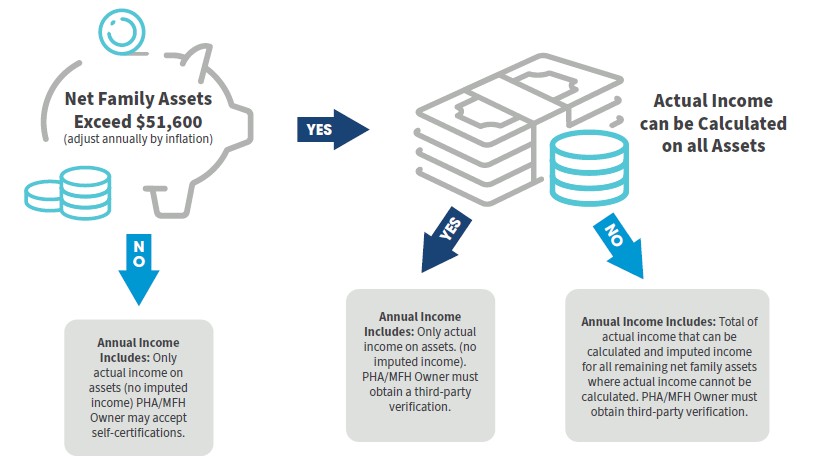
OHFA has developed charts to help owners/management agents determine the value of net family assets. The following chart outlines four steps to help determine assets, and the second chart shows how to calculate asset income.  

Step 1

Step 2

Step 3

Step 4

Categorize Assets

All assets can be divided into:

Determine NNPP

Determine Real Property

Verify and Impute*

Necessary Personal Property is furniture, cars used for transportation or other excluded assets. These are always excluded.

Applications/
Questionnaires should be detailed to allow for identifying NNPP. The value for each asset will initially be self-declared.

Real property is always counted toward net family income.

To determine net family assets:

  1. ADD the value of the NNPP ($0 or actual amount).
  2. ADD value of the real property.
  3. DEDUCT federal tax refund received in the last 12 months.

TOTAL is net family assets.

Non-Necessary Personal Property (NNPP) is bank accounts, digital payments, investments, etc.

If the total value of NNPP for the family exceeds the threshold, the actual amount for each asset will be carried to Step 4.

Real property would be the amount after deducting reasonable costs that would be incurred in disposing of the real property.

Net family assets that exceed the annual threshold must be verified.

Real Property is things like land or real estate.

If the family NNPP amounts do not exceed the threshold, NNPP is considered $0, and regardless to what happens in Step 4, the self-declared amounts will not be counted toward new family assets.

Regardless of the amount, carry the value to Step 4 when determining net family assets.

*If net family assets exceed the threshold, impute only on assets where asset income cannot be determined. All asset income, actual or imputed, is counted.


In either case, asset income will always be counted.


CALCULATING ASSET INCOME DECISION CHART

Compliance Tip — Pay Stubs


The HUD HOTMA Rule states owners/management agents must use a minimum of two consecutive paystubs to determine employment income. Please note: HOTMA does not prohibit owners/management agents from using more than two pay stubs. 

Stay Informed! 


Subscribe to OHFA’s email distribution list, which allows you to receive important notifications concerning regulatory and policy changes, development updates, and much more. Please forward the subscription link to any of your staff who may benefit from this type of information.


Reminder to all 811 project owners/management agents: Stay in the know! You can now receive 811 updates through OHFA’s email distribution list. Be sure to select Ohio 811 PRA under Email Lists on the sign-up form. 

Facebook  X  Instagram  Youtube  Linkedin