|
Tell us about your research project and why it is important to you?
My research focuses on the Willingness To Communicate (WTC) of bilingual pre-service teachers. This research is important to me because, after 16 years of experience as a foreign languages and bilingual teacher in different countries, I have realized that both students and teachers need to have greater confidence to communicate in languages they learned or are developing.
I have often observed that, even though a person takes language classes and has the places and resources to practice and develop their skills, for various reasons they tend not to want to communicate in the language. In my research, I explore precisely those reasons: what makes a person willing or unwilling to communicate in a language they are learning or developing, whether it is a heritage language, a native language, or a second language.
I believe that bilingual teachers need to be willing to communicate in the language they are developing, not only to use it with assurance, but also to motivate their students to use it more naturally and confidently. The purpose of my research is to promote the use of the language being learned or developed (heritage language, native language, or second language) within the educational setting and to contribute to improving the training of bilingual teachers from an emotional, social, and pedagogical perspective.
Have you presented or published your research anywhere? Tell us about the experience.
I have presented work from a project in which I participated as a Graduate Research Assistant (GRA). Although this work was not on the subject of my dissertation research, but on mathematics and computer sciences within education, it was very interesting to be part of the research and give the presentation. I am very grateful to my advisor and her entire team for allowing me to be part of this research and present at the National Science Foundation (NSF) Advisory Board Meeting. I learned about different research methods, which was very helpful for my own research process.
In addition, I published a book review on Becoming Bilingual Readers by B. Kabuto in the International Journal of Bilingual Education and Bilingualism. This publication was the result of work I did in one of my classes. It was very interesting to be able to publish a review of this book. It is great that some of the assignments we do in class can culminate in a publication. I am grateful to my professors for all the feedback and help they have given me to develop and strengthen my work and publications.
I will soon be presenting two projects at the Scholarly Consortium of Innovative Psychology in Education (SCIPIE) in Oklahoma about my research on Pre-Service Bilingual Teachers’ Willingness to Communicate. The application process has been a very exciting experience, and I am delighted to be able to contribute to the continued appreciation and expansion of the importance of bilingual education in different academic spaces. I firmly believe that giving visibility to this type of research not only strengthens the training of future teachers, but also opens more doors to bilingual education and the promotion of world languages, such as Spanish, in the United States.
What would you say is something interesting about your area of study that most people don't know?
An interesting aspect of my field of study is that when a person begins to forget a language, it is not always simply because they have not practiced it. Often, the root of the problem is that the person has not been willing to use it. WTC does not depend solely on linguistic knowledge, but on several factors that often go unnoticed. Social, cognitive, and emotional aspects, such as insecurity, anxiety, fear of judgment, or even the lack of an environment that supports the use of the language, can directly affect that willingness. In other words, even if someone knows the language, they may not feel capable or motivated to use it, and this greatly influences its development and maintenance. I think this is key, especially in the case of bilingual teachers, who need to feel confident when communicating in order to convey that same confidence to their students.
Tell us about your academic or professional collaborations with Mexico.
I have had the opportunity to teach in various educational contexts in Mexico, which has been a significant part of my training as an educator. I have worked as an English, Spanish, and bilingual teacher in public and private schools, universities, technological institutes, and language academies. As part of my applied research, I also developed a psychomotor program for social and emotional development. Similarly, I was the founder and director of the first Gavel Club for public speaking in Chihuahua for children and adolescents aged 10 to 18.
Throughout 16 years as a teacher, I have had the opportunity to directly support three areas that I am passionate about: teaching of second languages, bilingual education, and educational psychology. My academic training in these three areas has helped me to develp a more comprehensive view of education, and understand that teaching a language not only involves linguistic knowledge, but also addressing the emotional, cognitive, and social context of the student. Thanks to this training, I have been able to design individualized and effective strategies to support students with different backgrounds, as well as to guide other teachers in their educational work.
What attracted you to Texas and The University of Texas at Austin?
Texas is one of my favorite states in the United States, not only because of its history and diversity, but also because it clearly represents what it means to live in a bilingual and bicultural context. That is part of why I was motivated to pursue a Doctorate in Education focused on bilingualism and biculturalism, a subject I am deeply passionate about because it integrates education, language, and culture. When I discovered that UT Austin offered a specialized PhD in this area, and being one of the most renowned universities in the country, I didn't hesitate for a minute. Its academic focus, prestige, and commitment to linguistic and cultural diversity made applying to this program something that not only excited me, but also confirmed that it was the ideal place to continue my professional and personal development.
What have been some good things you didn't expect from Texas or UT Austin?
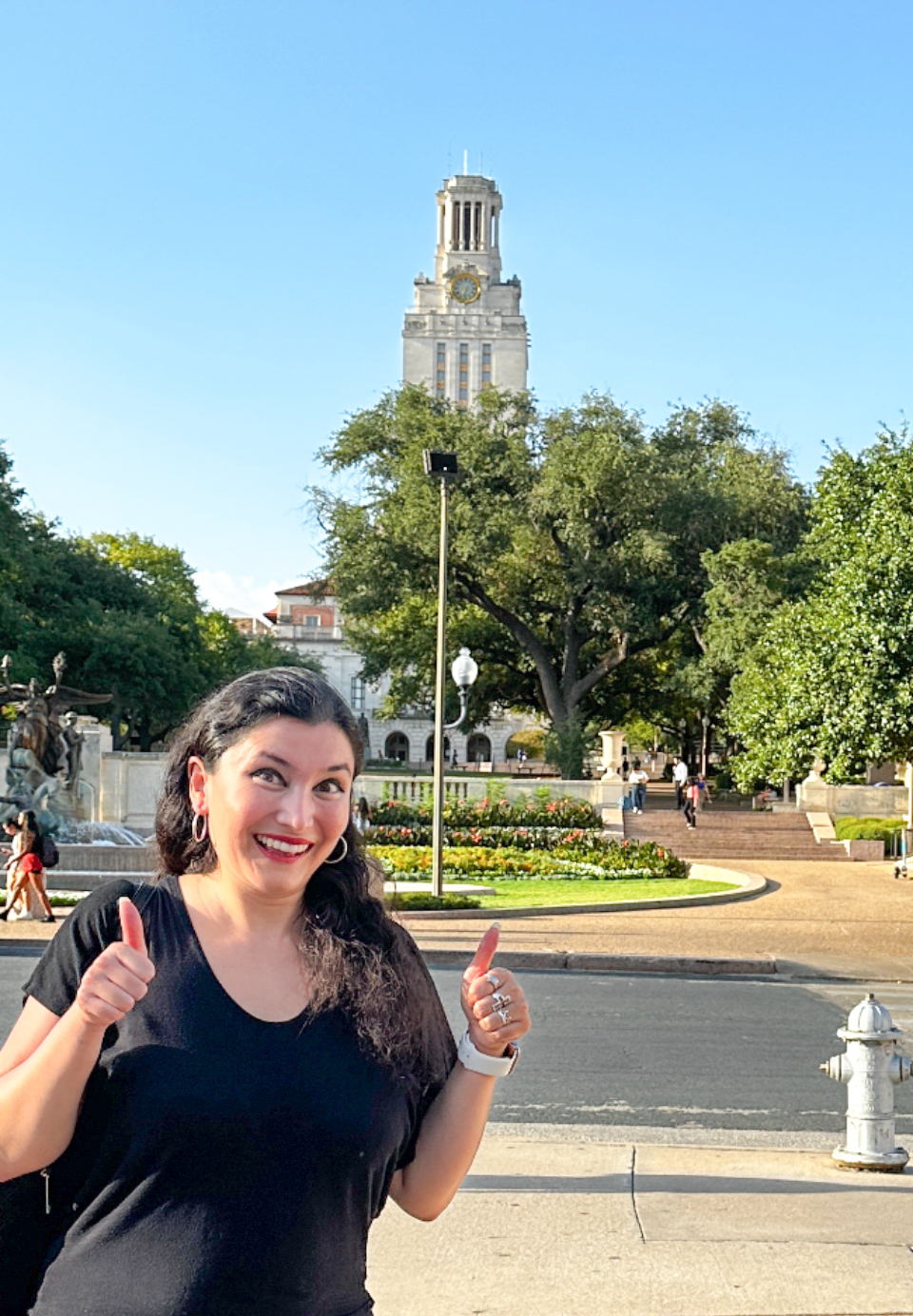
I knew UT Austin was one of the best universities in the United States, but honestly, I didn't imagine it would exceed my expectations so much. UT Austin offers many opportunities for professional development, and its academic programs are very comprehensive. Plus, it's a huge and beautiful university! I love that both the campus and the city center feel like one big student community, with students everywhere! That has made me feel more secure and supported, seeing that there are so many of us with the same goals. I like that in Austin I get a lot of practice of English as my second language because, although there is a considerable number of Latinos, being a multicultural city, English is usually spoken more! On the other hand, having so many means of transportation, which is not easy to find in other states, has made my life much easier. I haven't needed a car!
I was also very excited that UT Austin offered me job opportunities as a Teaching Assistant (TA), Graduate Research Assistant (GRA), and Assistant Instructor (AI) in different academic departments, not just my own. All of this has helped me strengthen my resume, and I owe it to the great support I have received from both my professors and the rest of the academic team. UT Austin is not only educating me academically, but also opening professional doors that I never imagined.
What have been the biggest challenges of studying at UT Austin and living in the United States?
One of the biggest challenges I have faced while studying at UT Austin and living in the United States has been communication, especially cross-cultural communication. I have learned that something that may sound natural, harmless, or even friendly in my country can be interpreted very differently in another cultural context. This has led me to be more conscious and careful with what I say, both in everyday conversations and in academic settings.
Furthermore, at this level of education, as doctoral students, it is no longer just a matter of being careful with what we write academically, because it will be published as research, but also with what we say. How we use our words on a daily basis is very important, because many people may trust us as future academics or leaders in education. That is why it is essential to avoid generalizations, express ourselves with respect and sensitivity, be careful with our vocabulary, and clarify the meaning of the terms we use. This experience has helped me develop greater intercultural awareness and to grow, both personally and profesionally, to function effectively in diverse multilingual and multicultural environments.
How has the support of ConTex and Secihti impacted you?
The support from ConTex and Secihti has been essential for me, and I am extremely grateful to both. Their support has allowed me to cover my expenses during my doctoral studies. When you decide to study in another country, it requires a significant investment of time, effort, and financial resources. Many students, like me, are willing to invest the time and effort required, but what often ends up being the biggest obstacle is the financial aspect.
Studying abroad requires covering not only tuition, but also rent, transportation, food, school supplies, and many other basic expenses. With the support of ConTex and Secihti, I have been able to pay part of those essential expenses and continue to focus on my studies and research. In addition, an important element of doctoral training is attending academic conferences and publishing in scientific journals, which also involves transportation, lodging, registration, and publication costs. This type of support makes a big difference, not only because it allows you to continue studying and living abroad, but also because it enables you to grow professionally and actively participate in the academic community.
Similarly, knowing that both my country, Mexico, and one of my favorite states in the United States, Texas, are placing their trust in me and supporting me so that I can contribute academically and professionally in the future motivates me to give my best, perform with excellence, and repay that support with commitment, dedication, and results.
What kind of work do you hope to do in the future, and how do you hope your research will benefit people in the U.S. and Mexico?
In the future, my main goal is to work as a university professor and researcher, focusing on topics related to education, especially in the areas that are part of my training: teaching of second languages, bilingual education, and educational psychology. I am passionate about training future teachers and researchers, while continuing to develop educational programs that have a real impact in the classroom.
I hope that my research on Willingness to Communicate can be of benefit in both the United States and Mexico by providing tools that help to better understand why some people, even though they know a language, do not feel confident using it. This knowledge can be useful in creating more respectful and effective educational environments, where students and teachers feel confident to communicate and grow academically.
I believe that both Mexico and the United States need to continue strengthening bilingual education from a more comprehensive perspective, taking into account not only academic issues, but also emotional, linguistic, and cultural ones. I hope that my work can contribute to this goal by supporting students, teachers, and educational programs in both countries.
What advice would you give to other Mexican students considering studying in Texas?
Texas is one of the states where Mexican students can feel most at home, as it is a bilingual and bicultural state with a big Latino presence. In many cities, both Spanish and English are spoken, and there are even places where the population communicates equally in both languages. In others, such as Austin, English predominates, but even so, you can feel the cultural richness and support for those of us who come from bilingual or bicultural backgrounds. It all depends on your goals and the type of experience you are looking for.
An important advantage of Texas is that, compared to other states in the US, it is not as expensive. But what I love most is that Mexican students are given valuable opportunities, and it often feels as if Texas and Mexico were truly united. I am deeply grateful to ConTex and Secihti for believing in me and supporting my education.
If you are reading this and considering studying here, I encourage you to give it a try. Although studying abroad may sound like a daunting challenge, it can also be one of the most transformative experiences of your life. Never give up, and never forget God along the way.
|