ConTex Conversations

May 2026


To celebrate the achievements of the ConTex family, we periodically feature insightful conversations with some of our doctoral fellows. They talk to us about their research, goals, and enthusiasm for binational collaboration.


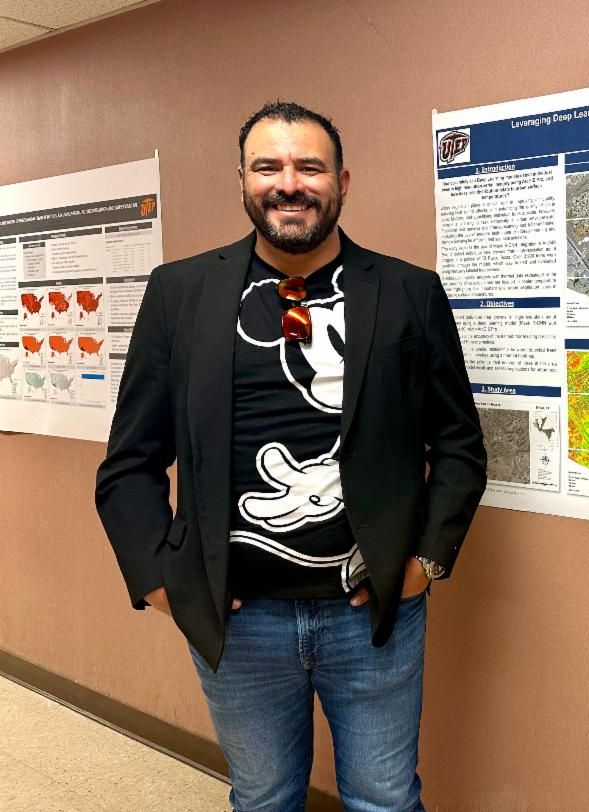
Miguel Ángel Méndez Alvarado

Hometown:

San Francisco del Oro, Chihuahua 


Degree Program:

Ph.D. in Civil Engineering


Institution:

The University of Texas at El Paso


Advisor:

Dr. Alex Mayer  


Tell us about your research project and why it is important to you.  


My research examines how urban vegetation helps regulate heat, how this connects to a city's climate, and how these factors relate to the socioeconomic conditions of the people who live there. I focus on the border region of El Paso and Ciudad Juárez, where urban heat islands (UHI) have intensified, as has happened in other cities facing the effects of climate change. Each year, these cities experience increasing temperatures, altered precipitation patterns and urban growth, which together can have significant environmental impacts, increase health risks, and deepen vulnerabilities among certain population groups.


To address this problem, I am developing Geospatial Artificial Intelligence (GeoAI) models (Deep Learning) that evaluate how effectively vegetation coverage helps regulate urban temperatures. I begin by generating an inventory of vegetation cover using remote sensing (RS). Then, I estimate the land surface temperature (LST). Combining this information allows me to identify urban heat islands and establish their relation with the vegetation patterns, which helps pinpoint the most affected areas and guide targeted reforestation efforts.


The objective of AI-driven models is to evaluate the use of different tree species and to estimate irrigation needs, ensuring that water, an invaluable resource in this arid zone, is used efficiently in restoration efforts. Finally, with the use of socioeconomic indicators it is possible to determine if there is a relation between the levels of economic and social development of a neighborhood and the presence or absence of vegetation and, therefore, of UHIs.


This topic is extremely relevant in the current context, as many cities suffer under similar conditions due to the effects of climate change. At a personal level, this research is important because it gives me the opportunity to strengthen my skills in the use of Geographic Information Systems (GIS) and GeoAI, which, in turn, will positively impact both my future students and my research.


Have you presented or published your research anywhere? Tell us about the experience.  


I have not yet had the opportunity to publish my research, since I joined the program only over a year ago. Nevertheless, I already have a draft of the first chapter of my work and plan to share this progress in various forums. Moreover, every year the School of Geology organizes a poster competition showcasing final projects from courses associated with the Geographic Information Systems and Technology (GIST) certificate. I had the opportunity to present my work in one of the editions of this competition, where I obtained 2nd place ─the White Award─, and a monetary prize.


Share with us something interesting about your research that most people don't know.


Civil engineering is a highly versatile discipline whose experts can work in many of the fields that contribute to improving people's lives. As a doctoral student in Civil Engineering, I am fortunate to work on environmental issues such as water and soil management. Implementing tools such as GIS, which involves multiple disciplines, has allowed me to conduct studies not only in construction or transportation, but also in integrated watershed management and aquifer recharge.


Tell us about your academic or professional collaborations with Mexico.  


Before beginning my doctoral studies, I worked as a researcher and professor in the School of Engineering at the Autonomous University of Chihuahua (UACH). To this day, I maintain close collaboration with colleagues, students, and mentees at UACH, supervising theses in the bachelor's degree program in Civil Engineering and the master's degree program in Hydrology Engineering, as well as reviewing the work of students in the master's degree in Land Transportation Engineering.


Furthermore, in 2025, I had the opportunity to collaborate on a project with a group of researchers and consultants from the Autonomous University of Ciudad Juárez (UACJ), the National Institute of Climate Change and Ecology (INECC), and the Mexican Fund for the Conservation of Nature (FMCN). The objective of the project was to lay the groundwork for the Action Plan for Integrated Watershed Management (PAMIC) for the Closed Watersheds of the North, with a focus on Hydrological Region 34. This collaboration was highly enriching, as it gave me the opportunity to work closely with outstanding researchers from Ciudad Juárez and Ciudad Cuauhtémoc, Chihuahua. 


What attracted you to Texas and The University of Texas at El Paso?  


As a professor, I had the opportunity to participate in a committee composed of academics from UACH and UTEP tasked with evaluating the collaboration between the two universities and the alignment of their undergraduate and graduate programs. As a result of that meeting, the first Research Sandpit was held in the summer of 2023 in El Paso, TX. This event brought together researchers from UACH and UTEP to generate solutions to interdisciplinary problems in the areas of water, clean energy, soil, and remote sensing. At the symposium, I met Dr. Carlos Ferregut and Dr. Alex Mayer, who later invited me to join the doctoral program in Civil Engineering at UT El Paso. This was a unique opportunity to continue growing academically and personally, and I embraced it fully.


What have been some good things you didn't expect from Texas or UT El Paso? 


Something that has surprised me is the kindness of most of the people I have had the opportunity to interact with during this process, from the consulate staff where I applied for my visa to the people at the UTEP international student office, the university staff, and the residents of El Paso. For example, when I was looking for an apartment, people were very friendly. I honestly thought that as foreigners we would be treated differently, but we have been warmly welcomed both in the city and at the university.


In the case of UTEP, I am impressed by the structure of the university, the organization of its colleges, and the way in which students are treated. In addition to the high quality of its facilities, UTEP has a wide availability of resources to support students in all aspects, including personal, moral, technological, and nutritional. For example, the university provides access to licenses, computer equipment, and repositories, which are tools that ensure students are always at the forefront. Clearly, students are a priority for UTEP.


What have been the biggest challenges of studying at UT El Paso and living in the United States?  


The greatest challenge became evident when I took the exams to be admitted to UTEP, because I had not been a student for several years. Although you never stop learning, the transition back to being a student was not easy. Over time, however, I have readjusted, and today I am proud of the results.


Another challenge is the pace of work that is necessary as a doctoral student to progress toward obtaining the degree. Each semester requires attending classes, doing homework, submitting assignments for each subject, fulfilling responsibilities as a research or teaching assistant, and advancing my research. Because I am aware that I represent my home university and my country, and above all, because of the example I want to set for my children, I committed myself to earning an “A” in every subject, which demands excellent work and, therefore, effort and dedication.


The main challenge of living in the US has been, at least in part, the shift in social and cultural context. Although we have made new friends here, my family and I left behind relatives and friends in Mexico whom we would like to still have close by. During the first few months, my youngest son struggled to adapt to his new school and once told me that he missed his friends in Mexico. For a moment, it was painful to think that the change we made to fulfill my dream might affect them emotionally; however, before long, they were already well adapted and happy. It really is a matter of adapting.     


How has the support of ConTex and Secihti impacted you?  


The relationship with ConTex has been excellent from the beginning. When my scholarship application was approved, I had the pleasure of speaking with Olivia Mogollón, who welcomed me and gave me some advice. I immediately felt supported and confident about facing any challenges that might arise in the future.


The support provided by Secihti is truly valuable. It is one of the pillars that makes it possible for us to study and live abroad. While UTEP also offers similar support, the truth is that every month we look forward to receiving the financial assistance from Secihti; it gives us breathing room and the certainty we need to continue our studies.


What kind of work do you hope to do in the future, and how do you hope your research will benefit people in the U.S. and Mexico? 


Upon graduating with my Ph.D., I hope to continue working as a professor and researcher. Some of my goals are to develop larger research projects in Mexico, generate knowledge, and join the Mexican National System of Researchers. I also hope to continue training students.


As for my research, I hope to be able to replicate it in other cities in the United States and Mexico. In particular, I would like to reproduce this study in the city of Chihuahua, Mexico.  


What advice would you give to other Mexican students considering studying in Texas?  


I would advise them to pursue their dreams, to persevere, and to be restless and curious. There is a well-known saying in teaching: “There is no such thing as a stupid question.” Never stop asking questions; never stop preparing yourselves; read, preferably in English, and keep practicing. If you want to study for a master's or doctorate, there are thousands of opportunities. If you think it's difficult, it is, but it's even harder to stay put and live with regret. The hardest part is taking the first step, but once you do, everything starts to flow. In the end, success is a combination of preparation, perseverance, and a little bit of luck.


Conversaciones ConTex

Mayo de 2026


 Para celebrar los logros de la familia ConTex, periódicamente publicamos conversaciones con algunos de nuestros becarios de doctorado. Ellos nos hablan de sus proyectos de investigación, sus metas y su entusiasmo por la colaboración binacional.


Miguel Ángel Méndez Alvarado

Lugar de Nacimiento: San Francisco del Oro, Chihuahua


Programa de Estudios: Doctorado en Ingeniería Civil 


Institución:

La Universidad de Texas en El Paso


Asesor:

Dr. Alex Mayer


Cuéntanos acerca de tu proyecto de investigación y por qué es importante para ti.


Mi trabajo de investigación analiza la relación que existe entre la vegetación urbana como fuente reguladora de calor, el clima de una ciudad, y las condiciones socioeconómicas de sus habitantes. Me enfoco en la región fronteriza de El Paso y Ciudad Juárez, territorio en donde las islas de calor urbanas (UHI por sus siglas en inglés) se han intensificado, así como en otras ciudades ubicadas en el desierto que enfrentan los efectos del cambio climático. Cada año estas ciudades registran temperaturas cada vez más extremas, lo que, aunado a la alteración de los patrones de precipitación y el crecimiento urbano, puede tener impactos ambientales, generar problemas de salud y aumentar la vulnerabilidad en ciertos grupos de la población.


Con la finalidad de atender este problema, estoy desarrollando modelos de Inteligencia Artificial Geoespacial (GeoAI) (Deep Learning) que permitan evaluar la capacidad de la cobertura vegetal de regular la temperatura urbana. Para ello, primero realizo un inventario de la cobertura vegetal y arbórea utilizando sensores remotos (RS). Posteriormente, determino la temperatura en la superficie terrestre (LST). En conjunto, esta información permite ubicar las islas de calor y establecer su relación con la cobertura vegetal, lo que facilita la identificación de las zonas más afectadas y el desarrollo de propuestas de reforestación.


El objetivo de los modelos impulsados con IA es evaluar el uso de diferentes especies arbóreas y estimar la necesidad de riego para que las zonas de restauración hagan un uso eficiente del agua, recurso invaluable en esta zona árida. Finalmente, mediante el uso de indicadores socioeconómicos es posible determinar si las condiciones de desarrollo económico y social de un vecindario influyen en la ausencia o presencia de vegetación y, por lo tanto, de islas de calor urbanas.


Este tema es sumamente relevante en el contexto actual, en el que múltiples ciudades padecen de condiciones similares debido a los efectos del cambio climático. En lo personal, esta investigación es importante porque me da la oportunidad de reforzar mis habilidades en el uso de Sistemas de Información Geográfica (GIS) y GeoAI, lo que, a su vez, tendrá un impacto positivo en mis futuros estudiantes y mi trabajo de investigación.


¿Has presentado o publicado tu investigación en algún lugar? Cuéntanos sobre la experiencia.  


No he tenido aún la oportunidad de publicar sobre mi investigación, dado que me incorporé al programa hace apenas año y medio. Sin embargo, completé el borrador del primer capítulo de mi trabajo y planeo compartir estos avances en diferentes espacios. Por otro lado, cada año la Escuela de Geología organiza un concurso de pósters para presentar los resultados de proyectos finales de las materias relacionadas con el certificado de Sistemas de Información Geográfica y Tecnología (GIST). Tuve la oportunidad de presentar mi trabajo en una de las ediciones de este concurso, donde obtuve el segundo lugar ─White Award─, además de un premio monetario.


Compártenos algo interesante sobre tu investigación que la mayoría de la gente desconoce. 


La ingeniería civil es una disciplina muy versátil cuyos expertos pueden trabajar en cualquiera de las áreas que contribuyen a mejorar la vida de las personas. Como estudiante del programa de doctorado en Ingeniería Civil, tengo la fortuna de trabajar en temas ambientales, como el manejo del agua y el suelo. Implementar herramientas como el GIS, cuya aplicación involucra distintas disciplinas, me ha permitido llevar a cabo estudios relacionados no solo con la construcción o el transporte, sino también con el manejo integrado de cuencas y recarga de acuíferos.


Cuéntanos sobre tus colaboraciones académicas o profesionales con México.  


Antes de comenzar con mis estudios de doctorado me desempeñé como profesor investigador en la Facultad de Ingeniería de la Universidad Autónoma de Chihuahua (UACH). A la fecha, mantengo una estrecha colaboración con colegas, estudiantes y tutorados de la UACH, dirigiendo tesis de estudiantes en la licenciatura en Ingeniería Civil y en la Maestría en Ingeniería en Hidrología, además de ser revisor de trabajos de la Maestría en Ingeniería en Vías Terrestres.


Asimismo, en 2025 tuve la oportunidad de colaborar en un proyecto con un grupo de investigadores y consultores de la Universidad Autónoma de Ciudad Juárez (UACJ), el Instituto Nacional de Ecología y Cambio Climático (INECC) y el Fondo Mexicano para la Conservación de la Naturaleza (FMCN). El propósito del proyecto era generar un marco preliminar para el Plan de Acción para el Manejo Integrado de Cuencas (PAMIC) de las Cuencas Cerradas del Norte, Región Hidrológica 34. Trabajar de la mano de grandes investigadores de Ciudad Juárez y Ciudad Cuauhtémoc, Chihuahua, fue una experiencia muy enriquecedora.


¿Qué te atrajo a Texas y a la Universidad de Texas en El Paso?  


Como profesor, en una ocasión tuve la oportunidad de participar en una comisión integrada por académicos de la UACH y UTEP, cuya finalidad fue evaluar la colaboración entre las dos universidades y la alineación de los programas de licenciatura y posgrado. A raíz de esa reunión, durante el verano de 2023 se desarrolló el primer Research Sandpit, evento que reunió a investigadores de la UACH y UTEP en El Paso, TX, con el objetivo de generar soluciones a problemas interdisciplinarios en materia de agua, energías limpias, suelo y sensores remotos. Durante el simposio conocí al Dr. Carlos Ferregut y al Dr. Alex Mayer, quienes después me invitaron a incorporarme al programa de doctorado en Ingeniería Civil de UT El Paso. Esa fue una oportunidad única para seguir creciendo académica y personalmente, y la aproveché al máximo.    


¿Cuáles han sido algunas cosas buenas que no esperabas de Texas o de UT El Paso?  


Algo que me ha sorprendido es la amabilidad de la mayoría de las personas con las que he tenido oportunidad de interactuar en este proceso, desde el personal del consulado en donde realicé el trámite para obtener la visa hasta las personas en la oficina de estudiantes internacionales de UTEP, el personal de la universidad y los habitantes de El Paso. Por ejemplo, en el momento de buscar departamento, la gente fue muy amable. Sinceramente, pensé que por ser extranjeros seríamos tratados de manera diferente, pero hemos sido muy bien recibidos tanto en la ciudad como en la universidad.


En el caso de UTEP, me sorprende la estructura de la universidad, la organización de los colegios y el trato hacia los estudiantes. Además de la gran calidad de sus instalaciones, UTEP cuenta con muchos recursos para apoyar a sus alumnos en todos los aspectos, incluyendo el personal, el moral, el tecnológico y el alimenticio. Por ejemplo, nos brindan acceso a licencias, equipos de cómputo y repositorios; y estas son herramientas que hacen que un alumno de UTEP esté siempre a la vanguardia. Es claro que para UTEP sus estudiantes son muy importantes.


¿Cuáles han sido los mayores desafíos de estudiar en UT El Paso y vivir en los Estados Unidos?  


El principal desafío se hizo evidente al presentar los exámenes de admisión a UTEP, pues hacía años que había dejado de estudiar. Y aunque nunca terminas de aprender, la transición a ser nuevamente estudiante no fue fácil. Sin embargo, he ido readaptándome y hoy me siento orgulloso de los resultados.


Otro desafío es el ritmo de trabajo que se debe asumir como estudiante de doctorado para ir avanzando hacia la obtención del grado; cada semestre hay que asistir a clases, hacer tareas, presentar trabajos de cada materia, cumplir con las responsabilidades asignadas como asistente de investigación o docencia y avanzar en tu investigación. Consciente de que represento a mi universidad de origen y a mi país y, sobre todo, del ejemplo que quiero darles a mis hijos, me propuse obtener “A” en cada asignatura, lo que implica desempeñar un trabajo de excelencia y, por lo tanto, mayor esfuerzo y dedicación.


El principal desafío de vivir en Estados Unidos se relaciona, al menos en parte, con el cambio de contexto social y cultural. Aunque aquí hemos hecho nuevos amigos, mi familia y yo dejamos familiares y amigos en México a quienes desearíamos seguir teniendo cerca. Para mi hijo menor, al principio fue difícil adaptarse a su nueva escuela, y en una ocasión me dijo que extrañaba a sus amigos en México. Por un momento me dolió pensar que el cambio que hicimos por cumplir un sueño mío podría afectarles emocionalmente; sin embargo, de un momento a otro ya estaban muy bien adaptados y contentos. En realidad, es cuestión de adaptarse.


¿De qué manera te ha impactado el apoyo de ConTex y Secihti?  


La relación con ConTex ha sido magnífica desde el primer momento. Cuando me aprobaron la solicitud de la beca, tuve el placer de hablar con Olivia Mogollón, quien me dio la bienvenida y me dio algunas recomendaciones. Inmediatamente me sentí apoyado y seguro ante cualquier reto que pudiera surgir más adelante.


El apoyo que brinda Secihti es de gran valor. Es uno de los pilares que hace posible estudiar y vivir en el extranjero. Aunque UTEP nos brinda un apoyo similar, lo cierto es que mes a mes esperamos ver reflejado el apoyo económico de Secihti; nos da un respiro y la certeza que nos permite continuar con nuestros estudios.


¿Qué tipo de trabajo esperas hacer en el futuro? ¿De qué manera esperas que tu investigación beneficie a las personas en los Estados Unidos y México?  


Al obtener el grado de doctor, espero continuar con mis actividades de profesor investigador. Algunos de mis objetivos son desarrollar en México proyectos de investigación de mayor alcance, generar conocimiento e incorporarme al Sistema Nacional de Investigadores. Además, espero seguir formando estudiantes.


En cuanto a mi investigación, espero que pueda replicarse en otras ciudades de Estados Unidos y México. En particular, me gustaría reproducir esta investigación en la ciudad de Chihuahua.


¿Qué consejo le darías a otros estudiantes mexicanos que estén considerando estudiar en Texas?  


Les aconsejaría que busquen alcanzar sus sueños, que luchen, que sean inquietos y curiosos. Hay un dicho muy conocido en la docencia: “No hay pregunta más tonta que la que no se hace”. Nunca dejen de hacer preguntas, de prepararse; lean, de preferencia en inglés, practiquen. Si quieren estudiar maestría o doctorado, hay miles de oportunidades. Si piensan que es difícil, sí lo es, pero es más difícil quedarse en el mismo lugar y después arrepentirse. Lo más complicado es dar el primer paso, pero una vez que lo haces, todo comienza a fluir. Al final de cuentas, el éxito es una combinación de preparación, constancia y una pizca de suerte.   


Facebook  Twitter