|
Tell us about your research project and why it is important to you?
My research project aims to develop an effective electrochemical protocol to adhere gallium nitride to the surface of a conductive material by means of potentiostatic or galvanostatic electrochemical depositions. The conductive substrates I have used are indium doped tin oxide and fluorine doped tin oxide, but given the significant electrodeposition rates I have achieved, I decided to work exclusively with the latter substrate. The idea is to achieve the best possible mastery of the proposed technique so that it can be used in future applications within the semiconductor industry.
This project is important to me because I want to be part of the group of scientists who will lay the foundations for the transformation of our current technology. The planet is crying out for change, so sustainability must be the guiding principle for current research. Unfortunately, so far no material has been found to replace silicon. It is important to clarify that I am not the only scientist working on this, but between all of us we need to do something to reach a collaborative solution. And I reiterate, I intend to be part of that global solution.
Have you presented or published your research anywhere? Tell us about the experience.
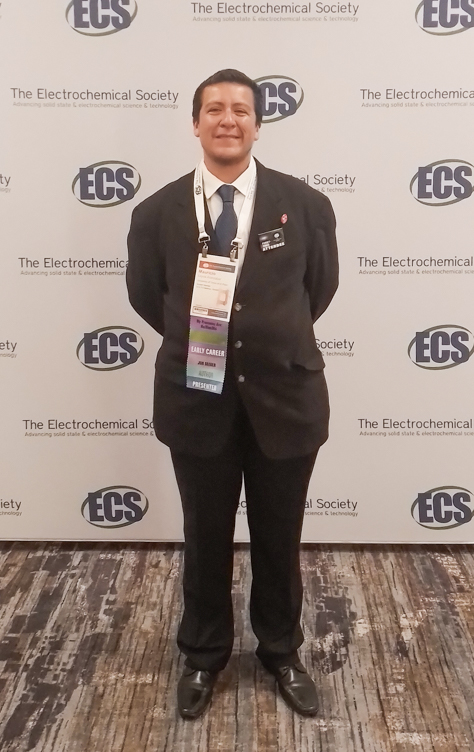
Yes, I have had the opportunity to do both. This year I have been very active presenting at as many conferences as possible. I have five presentations so far, three at the University of Texas at El Paso, one in San Francisco, California, and one in Honolulu, Hawaii, for the Society for Electrochemistry.
The Department of Chemistry and Biochemistry at UTEP organized the first conference I attended. This internal conference is held once a year and is titled Chemistry Day. There, all graduate students who feel ready to present something significant from their research projects share what they have done in the year, looking for dissemination and feedback. Also, I was selected by the Electrochemical Society to present my research progress in Honolulu, Hawaii, October 6-11, 2024, at the PRiME conference held in conjunction with the Electrochemical Society of Korea and Japan. It was a great conference where I learned a lot and made new connections. As a result of all these participations, the Electrochemical Society included in their journal ECS Transactions a short article that complements the poster I presented in San Francisco, California.
What would you say is something interesting about your area of study that most people don't know?
Most people know technological or electronic terms, but they have no idea about everything that goes on behind them to make it easier for them to enjoy their TikTok videos every day, for example. Today's technologies would not be viable without semiconductors, which is the reason for this project. Without them, an electronic device would not be complete. Semiconductors work on the basis of chemical reactions of different durations, which gives them a certain lifetime depending on their purpose. So, in my opinion, the semiconductor, a material with conductive and insulating properties, is the most important component of today's electronic devices.
Tell us about your academic or professional collaborations with Mexico.
At the moment I do not have any collaboration with Mexico. It is not that I am not interested, but I have not yet had the opportunity to establish any collaboration with Mexican researchers who share academic affinities with me. I have realized that, sadly, there are not many Mexican researchers attending international conferences. I have only met two. One of them is at the University of Reno and the other at Princeton, and although all three of us work in electrochemistry, our research projects are different. I don't rule out, however, that someday we may work on a common project. The scientific world is very small.
Mexican science is in development and internationalization. Our visibility is still low and, honestly, I am not surprised, since it is necessary to dedicate a lot of time to motivate students to follow in our footsteps. Nevertheless, it seems to me that the number of Mexicans interested in studying STEM careers in the future will continue to increase, as I hope that the current president of Mexico will keep her promise to encourage the national growth of science.
What attracted you to Texas and The University of Texas at El Paso?
When I applied to the Ph.D. in Materials Science at the University of Texas at El Paso I was going through a difficult time because my dreams had been stalled for several years due to financial issues. I had no money to pay for my graduate studies and, to be honest, when I applied I did not have high expectations that I would be accepted. I was not worried about my level of English or knowledge, because I knew I had the ability, but I was afraid that I would not be accepted because of my age, as I was 32 years old at the time. I felt at a disadvantage compared to younger applicants. In addition, I was already carrying the burden of how much it cost me to study for my bachelor's degree.
Since I was 19 years old, I have had to work to pay for my studies, which slowed down my time at the university since I had to take breaks at times. With a lot of effort and hard work I managed to graduate from both the Universidad Tecnológica de Ciudad Juárez and the Universidad Abierta y a Distancia de México in Renewable Energies and Biotechnology, but I was not satisfied. I had a good job in the human resources department of a maquiladora in Ciudad Juarez, but I felt that the job was not for me because I did not feel professionally fulfilled. I despaired that I was trying so hard to apply for jobs related to what I had studied, and no one would talk to me. That's why I decided to explore the possibility of graduate school. El Paso was the perfect place to undertake this project, as it was not so unfamiliar to me because I grew up on the border strip. I was sure that because of the large number of Hispanic students in the city, the academic environment at UTEP would have advantages for students like me. And I wasn't wrong.
What have been some good things you didn't expect from Texas or UTEP?
UTEP has helped me in many ways that I didn't expect. I have encountered professors and support staff who truly work for and with students. My first experience was precisely when I was accepted to the doctoral program. The first thing I was told was that, because I was Mexican, thanks to the PASE program, I would be able to pay resident tuition. Even so, it was not enough to cover my expenses, so I explained my situation to Dr. Quiñonez, the director of my department, and asked her if there was any way I could not lose my place and could delay one or two semesters later to be able to save money. At that time, I did not have the support of ConTex-Conahcyt. She told me that it was possible, but that she would prefer if I started that semester and that the department was willing to consider me for an additional scholarship that would cover 50% of the tuition. As best I could, I saved the rest, and thanks to the payment plans offered by UTEP, I was able to pay for the first semester of my doctorate. Without the help of my department, I would not have been able to successfully begin my studies.
What have been the biggest challenges of studying at UTEP and living in the United States?
In terms of the challenges of studying at UTEP, it can be difficult to get funding to cover the expenses of the research project. Sometimes reagents, instruments, publication costs or attending conferences are out of budget. For example, it has happened to me that I am performing the characterization of a sample, and suddenly, the microscope stops working because the filament is no longer working. In cases like that, there is nothing left to do but wait for it to be repaired.
As far as living in the United States is concerned, it is a challenge to meet all my daily goals while looking out for the welfare of my family. My family is not physically with me, which complicates my participation in activities where my presence is required, as I am not always available. Doctoral studies are highly demanding, so it is necessary to dedicate a lot of time to them.
How has the support of ConTex and Conahcyt impacted you?
There are simply no words. The day I received the news I cried with happiness because I was finally going to be able to get rid of the enormous worry of how to pay my tuition semester by semester. It wasn't until the fourth time I applied that I received the scholarship. So, in a few words, you changed my life and my family's life forever because I know that I will be able to reach the end of my studies. So, thank you very much for all the support you are giving me.
What kind of work do you hope to do in the future, and how do you hope your research will benefit people in the U.S. and Mexico?
I want to continue working in the semiconductor area. I would like nothing more than to make gallium nitride my career. I have really enjoyed working on my thesis topic. However, I am not closed to venturing into other projects that have to do with renewable energies, to mention another of my areas of interest. Likewise, I do not rule out staying in academia. Currently, in the state of Chihuahua there is a great demand and interest in inviting semiconductor companies to set up in the state. Both educational institutions and the state government itself are launching calls to support studies in the area.
All human beings deserve a good quality of life and one of the best tools to achieve this purpose is precisely through technology. It would be fantastic to contribute to fulfilling the vision of Nikola Tesla, the scientist I admire the most, to provide free energy for all. Particularly in Mexico, people deserve to be lifted out of poverty. It is sad to see that there are still neighborhoods with lousy street lighting and no electricity connections; that there are people cut off from communication because they cannot afford basic services; that there are people who lose their lives in hospitals because of defective machinery. So, I am convinced that the development of more powerful semiconductors at lower cost can help improve the quality of life of Mexicans.
What advice would you give to other Mexican students considering studying in Texas?
I would tell them not to think twice, to take the risk of applying. Texas is an excellent place to make a career, and UTEP is a university interested in its students. You couldn't come to a better place. If you don't get selected the first time, don't give up. Keep trying until you make it, because successful people had to go through thousands of failures first. We need more scientists. Mexico is full of talent. We need to create a force of researchers to push for the development of our country in all areas. We have a lot of natural resources and, therefore, we all deserve better, not just a few.
|