|
Tell us about your research project and why it is important to you.
As a student at UT San Antonio, I have participated in various research projects that utilize electronic microscopy, a technique that enables the observation of materials at a level of detail unattainable with conventional optical microscopy. The first of these projects involved incorporating silver nanoparticles to guayule fibers to obtain a material with antibacterial properties that could have medical applications. In addition to its technological potential, this project sought to make use of natural resources from our region, as guayule is a plant native to the Coahuila Desert, a vast region shared by Mexico and Texas.
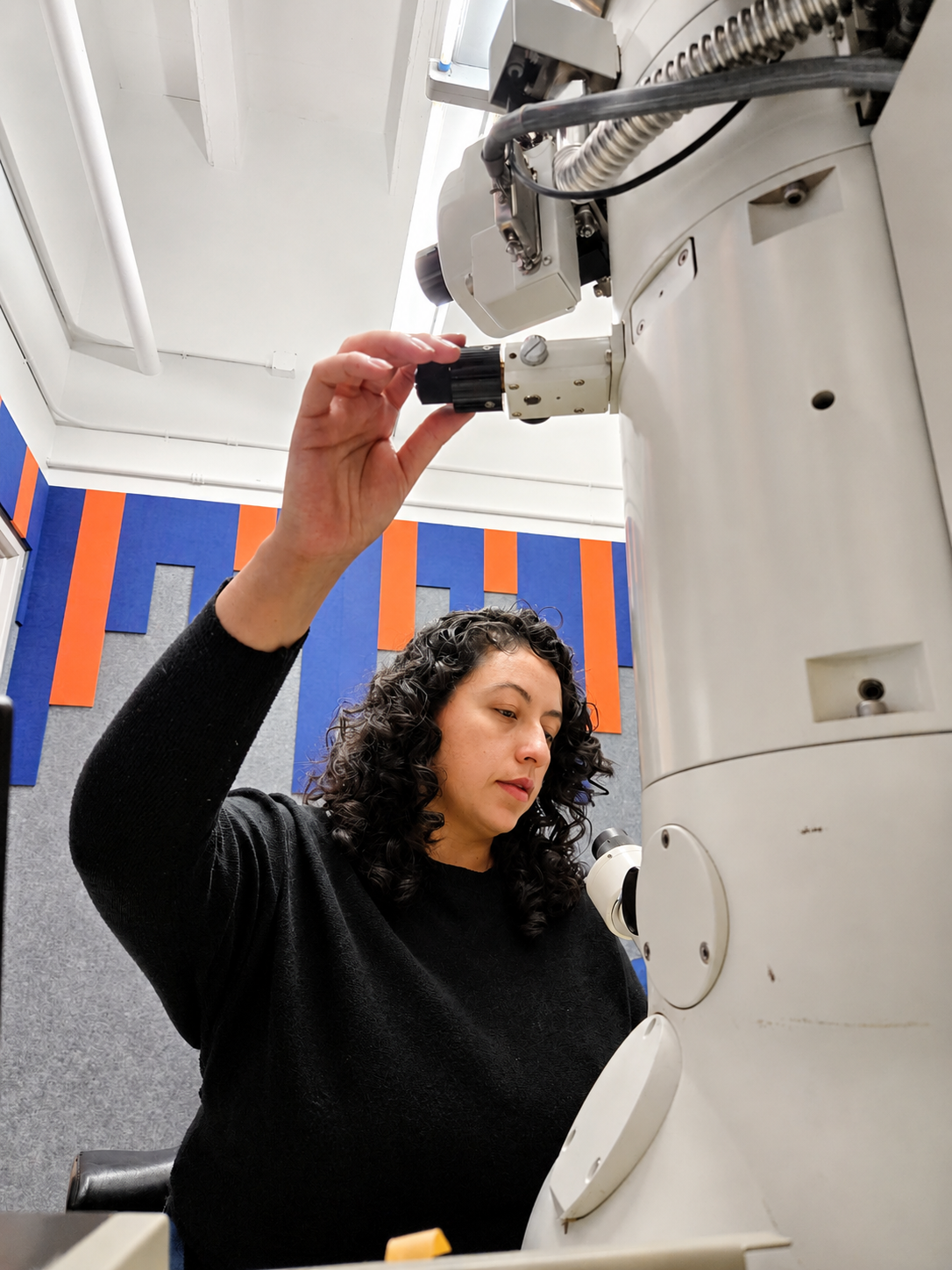
My research project focuses on the study of nanostructures using scanning transmission electron microscopy coupled with electron energy loss spectroscopy (STEM-EELS). Additionally, I am engaged in the development of tools to analyze the data generated by this technique. As part of this project, I recently completed a research fellowship at Oak Ridge National Laboratory (ORNL) in Tennessee, where I had the opportunity to study vibrations in nanomaterials with one of the world’s most advanced electron microscopes. This experience allowed me to collaborate with specialists in the field and learn new experimental and analytical methodologies that now enrich my research.
This project is especially meaningful to me because it combines two areas that I truly enjoy: microscopy and data analysis. Furthermore, I believe that understanding a material at the nanoscale level is the first step toward modifying its properties and designing materials with enhanced performance for technological applications.
Have you presented or published your research anywhere? Tell us about the experience.
This year, I had the opportunity to present my research at the College of Science Symposium at UT San Antonio, at the Texas Society for Microscopy Meeting at UT Austin, and at the UBP Research Symposium. These events provided an opportunity for me to share the progress I have made and receive feedback from other researchers. This feedback has been instrumental in enhancing my analysis of the results and identifying novel perspectives for the advancement of my project.
Share with us something interesting about your research that most people don't know.
I believe that many people are unaware that there are room-sized electron microscopes capable of observing individual atoms. Every time I use one, it still amazes me that we’re observing matter on that scale. Thanks to this tool, we can understand how materials are structured and why they have certain properties.
The most interesting thing is that this knowledge doesn’t stay in the lab. Materials science is behind many of the technologies we use every day, from cell phones and semiconductors to medical devices and energy-generation technologies.
Tell us about your academic or professional collaborations with Mexico.
Collaboration with Mexico has been an important part of my doctoral training. Thanks to the close relations my advisor maintains with institutions and research groups in Mexico, I have had the opportunity to participate in joint projects related to both my work with guayule and my dissertation project.
Recently, I completed a research stay at the Center for Nanoscience and Micro- and Nanotechnologies at the National Polytechnic Institute in Mexico, where I conducted measurements using the ARM 200CF microscope. The experience was particularly valuable because it allowed me to make progress on my research experiments and establish a collaboration with Dr. Raúl Borja, who will now serve on my dissertation committee. These kinds of collaborations strengthen our research projects, facilitate the exchange of knowledge, and promote the creation of ties between institutions in Mexico and the United States.
What attracted you to Texas and The University of Texas at San Antonio?
UT San Antonio appealed to me because of its strong reputation as a leading research institution in the United States. It was important for me to pursue my doctoral studies at a university where I could engage in high-level scientific research, have access to state-of-the-art facilities, and benefit from a collaborative academic environment.
Texas stood out to me because of its proximity to Mexico. This closeness facilitates interaction with Mexican universities and research groups, creating valuable opportunities for academic collaboration and scientific exchange. In addition, the presence of a large Latino community has made it easier for me to adapt to the academic and cultural environment of UT San Antonio and Texas.
What have been some good things you didn't expect from Texas or UT San Antonio?
One of the things that surprised me most about UT San Antonio was the wealth of resources and opportunities it makes available to students. In addition to academic development, the university supports professional growth through workshops, seminars, events, leadership programs, and initiatives that foster the creation of collaborative networks among researchers and students from different disciplines.
I was also pleasantly surprised by the supportive and collaborative culture among graduate students. Throughout my doctoral journey, I have had the opportunity to connect with peers from various fields of study, which has enriched the exchange of ideas and experiences.
What have been the biggest challenges of studying at UT San Antonio and living in the United States?
In addition to adjusting to life in a new country, one of the biggest challenges was adapting to a different academic and research system. This transition required learning new work dynamics, navigating unfamiliar administrative processes, and becoming comfortable in an environment different from what I was used to in Mexico.
Another significant challenge was venturing into a new academic field. I earned my undergraduate degree in chemical engineering in Mexico and later completed a master’s degree in materials science. However, my Ph.D. at UT San Antonio is in physics, with a concentration in materials science. During my first year, I took several physics-intensive courses, which required dedication and considerable effort to build a strong foundation in subjects that were new to me.
Over time, this combination of disciplines has proven to be highly beneficial for my work. Today, I am able to integrate concepts from chemistry, materials science, and physics to approach problems from an interdisciplinary perspective, which expands the possibilities for my research.
How has the support of ConTex and Secihti impacted you?
The support from ConTex has been invaluable throughout this journey. In addition to the guidance and assistance they have provided, I am grateful for opportunities like this one, which allow me to share my work and my experiences. These opportunities make me feel supported and remind me that we’re not alone on this journey. Furthermore, meeting other ConTex fellows and being able to support one another has been especially meaningful.
And, of course, none of this would have been possible without the support of Secihti. Thanks to this support, I have been able to pursue my doctoral studies and conduct research at UT San Antonio.
What kind of work do you hope to do in the future, and how do you hope your research will benefit people in the U.S. and Mexico?
My main area of interest is transmission electron microscopy, and I hope to continue developing my expertise in this field. Moving forward, I would like to pursue research and collaborate on projects that advance our understanding of materials and the development of innovative technologies and applications.
I firmly believe that scientific development is a key driver of a country’s growth. This is why participating in scientific collaborations between Mexico and the United States is important to me; it is a way to contribute to the scientific development of both nations. I hope that the knowledge generated through these efforts will, over time, translate into advancements that create lasting benefits for society.
What advice would you give to other Mexican students considering studying in Texas?
First off, don’t give up! Keep pushing forward and keep trying until you get it right. When you’re chasing a dream, you’re bound to hit some bumps in the road, but when you finally hear that “yes” that gets you closer to your goals, you’ll see that all the hard work paid off.
My second piece of advice is to build a support network of people who share similar interests. Connecting with other students facing similar experiences not only makes it easier to adapt to a new academic environment, but also creates opportunities to collaborate, share knowledge, and grow as a person.
|