Conflict Concepts
The Five Stages of Conflict
Conflict has predictable stages
We become aware of conflicts in a wide variety of ways.
- "That conflict came out of the blue. Boom!"
- "It was brewing for a long time. Like a slow-motion train wreck.."
- "We have never seen eye to eye."
- "All seemed to be going well, but under the surface.."
- "I genuinely had no idea we had a problem..."
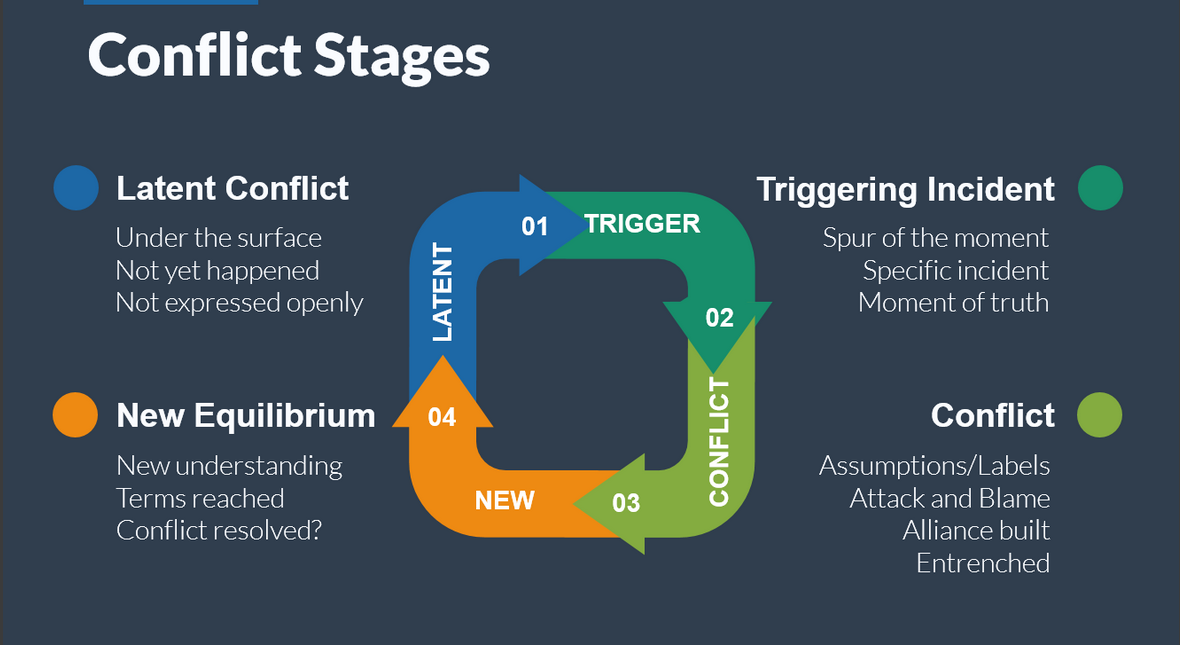
In whichever way they begin, conflicts tend to have similar paths going through five distinct stages.
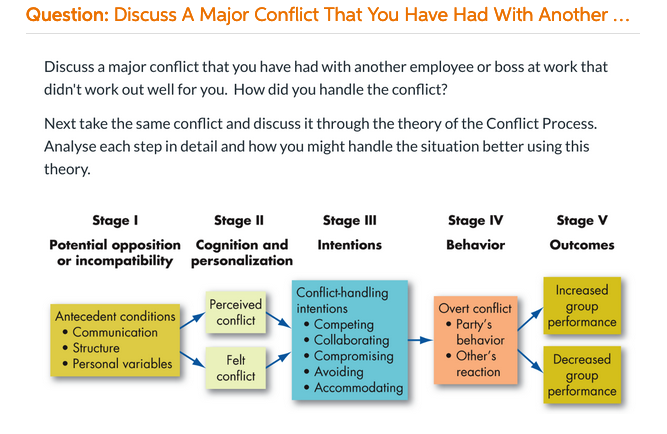
Stage One- Latent
A conflict has an early quiet stage. In conflict resolution theory it is called the
latent stage
, meaning the participants are not yet aware of the conflict, but there may be hidden frustrations and they may surface at any time. Sometimes these brewing or buried conflicts never find their way to the open air. Other times the conflict is looming and evident. And sometimes conflicts come without warning.
Stage Two- Perceived and Felt
Once a conflict develops and it is known, it goes through the
perceived and felt stage
. Parties may go through this stage simultaneously or at different times, depending upon events. Once they are aware that a conflict exists, individuals begin to feel stress, anxiety and/or hostility.
Stage Three- Conflict Approach
Next each person involved in the dispute adopts an approach. These are based upon their conflict style choice and their own intention for handling the conflict. In Day 2 we learned about the basic conflict styles of Compete, Avoid, Accommodate, Compromise, and Collaborate/Creative Problem Solve. These approaches make a difference in what happens next.
Stage Four- Stalemate or Negotiate
Depending on what strategy is used in Stage 3, the conflict will either move forward, negotiate toward an agreement; or the dialogue will be shut down and a standoff will develop.
Stage Five- Aftermath
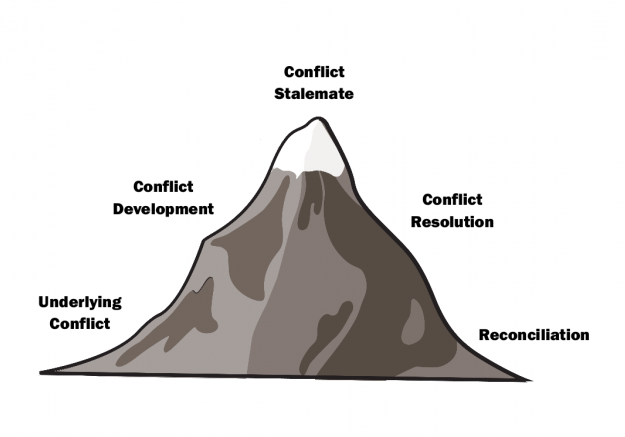
The outcome of the conflict can range from a fully positive resolution to the alternate; a relationship dissolution. In conflicts that are a one time event, this may be the end. For those with ongoing relationships this process looks less like a singular mountain, like the figure above and more like an ongoing loop.