|
The Vantage Point
Glenda Humiston
Vice President
UC Agriculture and Natural Resources
It has been a very busy February, highlighted by this week’s meetings in Washington, D.C. for the CARET (Council for Agricultural Research, Extension and Teaching) and Association of Public & Land-Grant Universities Board on Agriculture Assembly (BAA) conference.
In addition to swapping impact stories and strategizing with peers from land-grants across the country, another important part of this annual D.C. trip is visiting congressional offices on Capitol Hill, where we shared how our research is making a difference. Through the tireless efforts of Anne Megaro, UC ANR government and community relations director (as well as her counterparts across the UC), our delegation met with elected officials and staffers in more than 30 offices.
We thanked them for supporting the Research Facilities Act in H.R. 1 (One Big Beautiful Bill Act), which includes $125 million in mandatory spending each fiscal year for grants to help universities upgrade agricultural research facilities. Robust investment in modernizing that infrastructure must remain a top priority, and we encouraged our congressional members to continue funding – at the highest levels – research and extension in wildfire resilience, youth development, agriculture and more.
As highlighted in this recently published UC ANR report, agriculture and working lands propel economic growth in many congressional districts across California. We urged our representatives to fully support, for FY2027 and beyond, the National Institute of Food and Agriculture and the vital research programs that it funds. NIFA grants are essential to advancing research that generates new technologies, creates jobs, provides solutions to pests and diseases, and brings prosperity to all communities.
As always, I am deeply grateful to Ish Herrera and Mike Mellano, members of the President’s Advisory Commission on Agriculture and Natural Resources, for generously giving their time and lending their insights on this trip. Our UC Cooperative Extension academics also did a phenomenal job sharing their expertise during the congressional visits – UCCE advisors Josh Davy and Laura Vollmer, and UCCE specialists Ali Hill (UC Berkeley) and Georgios Vidalakis (UC Riverside).
Rounding out our teams were Darren Haver, interim associate vice president for research and Cooperative Extension with UC ANR; Peter Atkinson, dean of the College of Natural and Agricultural Sciences at UC Riverside; Stacy Philpott, dean of the Agricultural Experiment Station (AES) at UC Santa Cruz; Patricia Springer, divisional dean of the College of Natural and Agricultural Sciences at UC Riverside; and Ashley Stokes, dean of the College of Agricultural and Environmental Sciences at UC Davis. Special thanks also go out to Kamala Lyon of UC Federal Government Relations and her team of interns who made sure we had the packets, information and logistics all shipshape to support our efforts.
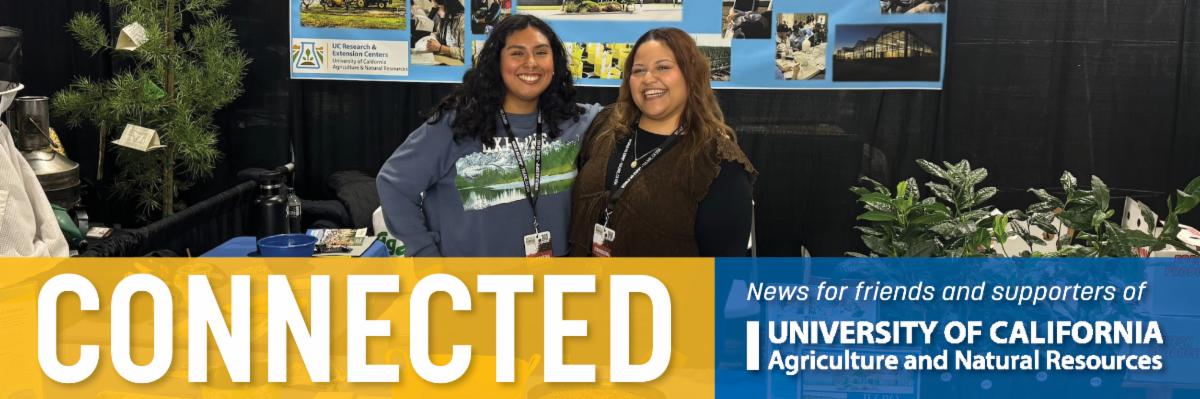
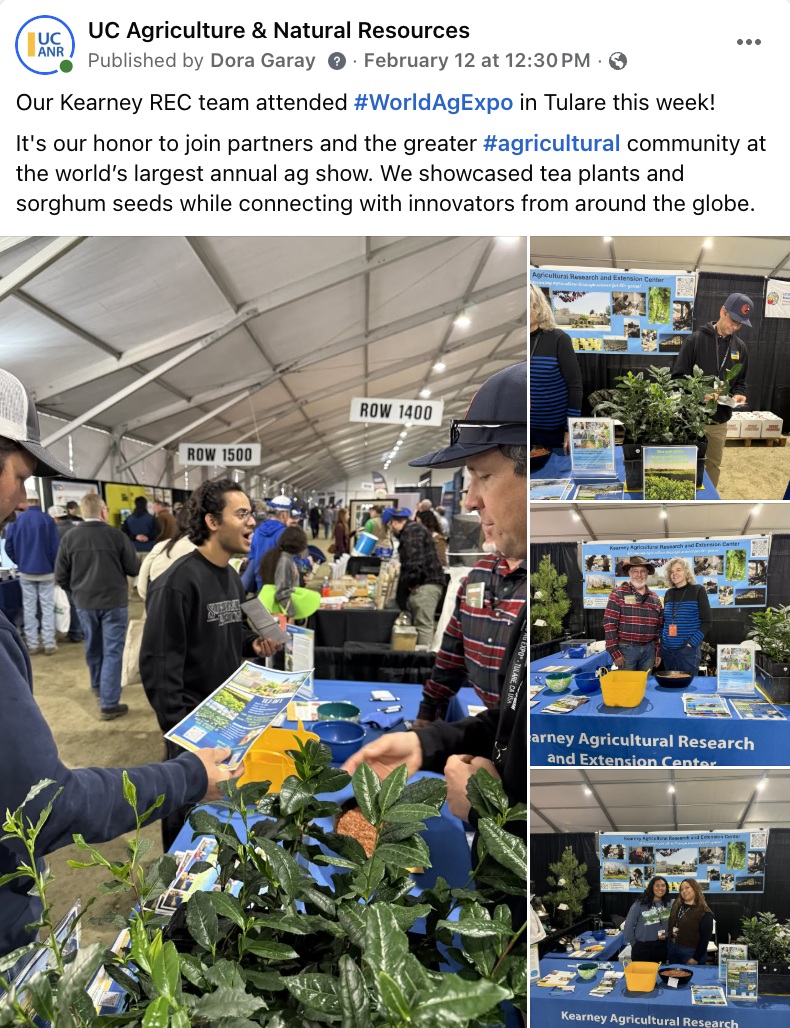
I also want to extend my appreciation to the incredible contingent of UC ANR folks at the World Ag Expo (Feb. 9–11) in Tulare. A big shout-out to our Cooperative Extension and AES academics and UC ANR staff for their excellent presentations: Jim Adaskaveg, Sharif Aly, Jorge Angeles, Mary Lu Arpaia, Jackie Atim, Rubia Branco Lopes, Ellen Bruno, Lucie Cahierre, Bodil Cass, Nick Clark, Jennifer Heguy, Milt McGiffen, Deanne Meyer, Moneim Mohamed, Sara Ohadi, Luis Peña-Lévano, Alexander Putman, Heidi Rossow, Danelle Seymour, Amir Verdi, Houston Wilson and Jiue-in Yang, among others.
Seeing the staff and academics at our booths in the expo hall filled me with pride as they showed some of the work being done at Kearney, Lindcove and West Side Research and Extension Centers, as well as by UCCE Tulare County, the Sustainable Agriculture Research and Education Program (SAREP), UC ANR Innovate and our UC partners. I especially want to thank Leonel Jimenez and the Tulare office team for graciously hosting the Feb. 10 California State Board of Food and Agriculture meeting. Gabe Youtsey did a fantastic job discussing UC ANR’s role in scaling up the latest ag tech innovations and bringing those practical solutions from lab to field.
Another personal highlight of the expo was attending a special celebration of the International Year of the Woman Farmer. Nearly two-thirds of California farms are run by women, and women make up 38% of the state’s agricultural producers – with many, many more in roles that support and guide the ag sector. I encourage you to visit the commemorative site put together by our partners at California Grown, as well as our own page spotlighting throughout the year the contributions of women at UC ANR. To all the women in agriculture – and everyone who supports their work – I salute and thank you!
|