|
|
|
Connecting
April 3, 2023
Click here for sound of the Teletype
| |
|
Colleagues,
Good Monday morning on this April 3, 2023,
AP Executive Editor Julie Pace appeared last week on the Business Extra podcast of The National, and among highlights were the AP's expansion in digital advertising, e-commerce and fact checking...and that AP considers itself a digital news company to help its customers meet the demands of a new type of audience.
We lead with the podcast.
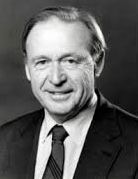
Many of us fondly remember and worked with Jim Mangan – an early Connecting colleague until his death in 2015 at the age of 87. He was vice president in charge of Newspaper Membership when I knew him, as an AP bureau chief. He served in that position until his retirement Jan. 1, 1989.
| |
|
Mangan had rich experiences in his 36-year AP career – starting in San Francisco as a newsman, then Dallas as assistant bureau chief in 1963 and among those who covered President Kennedy’s assassination, then bureau chief in New Orleans and Dallas, and then to Frankfurt to head AP operations in Germany, Switzerland and Eastern Europe.
But perhaps no experience greater than work he did in a reporting role in Dallas in 1977 that produced a blockbuster story involving President Lyndon Johnson when he was running for the Senate.
Mangan’s family donated in August 2022 to the LBJ Presidential Library and Museum cassette tapes containing interviews Mangan did that led to a 1977 story in which a Texas voting official detailed how three decades earlier, votes were falsified to give Lyndon Johnson a slim victory in a U.S. Senate primary. Last week, the audio recordings were posted on the library’s archival website, Discover LBJ.
We bring you that story in today’s Connecting.
Our call for your experiences in filing Flashes on major stories produced comment from several colleagues, and I invite your own story to be told.
Here’s to a great week ahead – be safe, stay healthy!
Paul
Business Extra: AP's top editor on AI, fact-checking and journalism
Podcast, by The National
The senior vice president and executive editor of Associated Press, Julie Pace, joins Business Extra host Kelsey Warner this week to talk about the transformation of the news industry in the age of artificial intelligence.
Ms Pace was appointed to this position in September 2021. She leads AP’s global news operations and oversees news content and all formats from journalists across the world, with 250 locations in more than 100 countries.
Moving from text only to a multi-format platform, AP is expanding in digital advertising, e-commerce and fact checking, Pace said.
She said AP now considers itself a digital news company to help its customers to meet the demands of a new type of audience.
In this episode:
AP's business model and its mission (0m 45s)
Fact-checking and social media (6m 25s)
Evolving media and the revolution of AI (11m 48s)
Covering the US election and the future of work in media (17m 28s)
Read more here. Shared by Jon Gambrell.
‘Window into history’: Tapes detail LBJ’s stolen election
| |
|
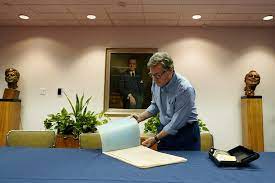
Peter Mangan flips through a large folder of newspaper clippings at the Lyndon B. Johnson's presidential library as he prepares to make a donation to the library, Wednesday, Aug. 31, 2022, in Austin, Texas. The family of the late Associated Press reporter James W. Mangan has donated to the library cassette tapes containing interviews the reporter did that led to a 1977 story in which a Texas voting official detailed how three decades earlier, votes were falsified to give Johnson a slim victory in a U.S. Senate primary. (AP Photo/Eric Gay)
By JAMIE STENGLE
DALLAS (AP) — The story was a blockbuster: A former Texas voting official was on the record detailing how nearly three decades earlier, votes were falsified to give then-congressman Lyndon B. Johnson a win that propelled the future president into the U.S. Senate.
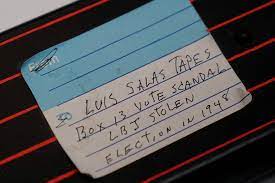
The audio recordings from Associated Press reporter James W. Mangan’s interviews for the 1977 story were posted this week on the LBJ Presidential Library and Museum’s archival website, Discover LBJ. After Mangan’s death in 2015 at the age of 87, his family found the labeled cassette tapes at his San Antonio home and donated them last summer to the library on the campus of the University at Texas at Austin.
Luis Salas, the former South Texas election judge, told Mangan for the story: “Johnson did not win that election; It was stolen for him. And I know exactly how it was done.”
The story, which made front pages across the country, pulled back the curtain on the razor-thin victory that had drawn suspicions ever since election officials in rural Jim Wells County announced the discovery of uncounted votes in a ballot box known as Box 13 in the days after the 1948 Democratic primary Senate runoff. And now, at a time when election fraud is rare but former President Donald Trump and his allies amplify baseless allegations blaming it for his 2020 loss, the tapes and story show what compelling evidence of actual fraud looks like.
Mangan’s son, Peter, said listening the tapes was like getting “a little window into history.”
On one cassette, he said, it sounds like his father is in his car, reciting what he’d just been told.
“You can hear cars going by and he’s kind of, you can tell he’s a little excited, because I think he finally got the goods,” Peter Mangan said.
Mark Lawrence, the library’s director, said the recordings are “deeply connected to one of the big mysteries and controversies that’s hung around LBJ for decades.” In a 1984 oral history that Salas gave to the library, he said one of the reasons he finally decided to talk was because he had been quite ill.
Read more here. Shared by Andy Lippman.
AP WAS THERE: Uncovering Lyndon B Johnson’s stolen election
By JAMES W. MANGAN
ALICE, Texas (AP) — In 1977, Associated Press reporter James W. Mangan’s exclusive interview with a South Texas election judge who detailed certifying false votes for Lyndon B. Johnson nearly three decades earlier made headlines across the country.
| |
With the win by an 87-vote margin in the 1948 Democratic primary runoff, Johnson, then a congressman, easily defeated his Republican opponent to take a seat in the U.S. Senate, and he eventually ascended to the presidency.
Mangan spent three years pursuing the story, which pulled back the curtain on the victory that had drawn suspicions ever since election officials in rural Jim Wells County announced the discovery of uncounted votes in ballot box known as Box 13.
Headlines across the U.S. that accompanied the story included: “Polling Official: Phony Votes Stole ’48 Runoff for LBJ”; “LBJ’s election to Senate ‘stolen’”; “Texan Claims Fix in LBJ Election.”
Here’s the story that ran July 31, 1977:
___
A former Texas voting official seeking “peace of mind” says he certified enough fictitious ballots to steal an election 29 years ago and launch Lyndon B. Johnson on a path that led to the presidency.
The statement comes from Luis Salas, who was the election judge for Jim Wells County’s notorious Box 13, which produced just enough votes in the 1948 Texas Democratic primary runoff to give Johnson the nomination, then tantamount to election, to the U.S. Senate.
Read more here.
Your experiences with Flashes
Hal Bock - In my 40 years at the AP, I never was involved in a Flash. That was a function of being a sportswriter. But I had plenty of Bulletins--writing and editing-- and I remember the adrenaline rush I felt whenever I encountered them.
That leads me to wonder why the company would eliminate the Bulletin notification. Bulletins always got my attention and I suspect the attention of the members. That's members, not customers.. Why replace a perfectly good word? If it ain't broke don't fix it.
-0-
Peggy Walsh - Although I never filed a Flash, I still remember the adrenaline rush when the bells went off on the old printers. Technology is wonderful. My question is how do editors know there's a flash?
And…Our personal history of Flash
| |
|
Ann Blackman - Thanks for the history of the AP usage of Flash.
Our first Golden retriever was named Flash. We wanted a newsy name and tried out several. We went out on our back porch and yelled Urgent. Didn’t like the connotation. So we tried Bulletin. Too bulky. Then we yelled Flash. That worked. Flash, the news hound, travelled back and forth across the Atlantic in the belly of a plane six times while we were in Moscow. He was the first Golden in the USSR. That was 36 years ago. We’re on our fifth Golden, Leo (shown above).
Watching new Netflix series, an alert son spots his dad
| 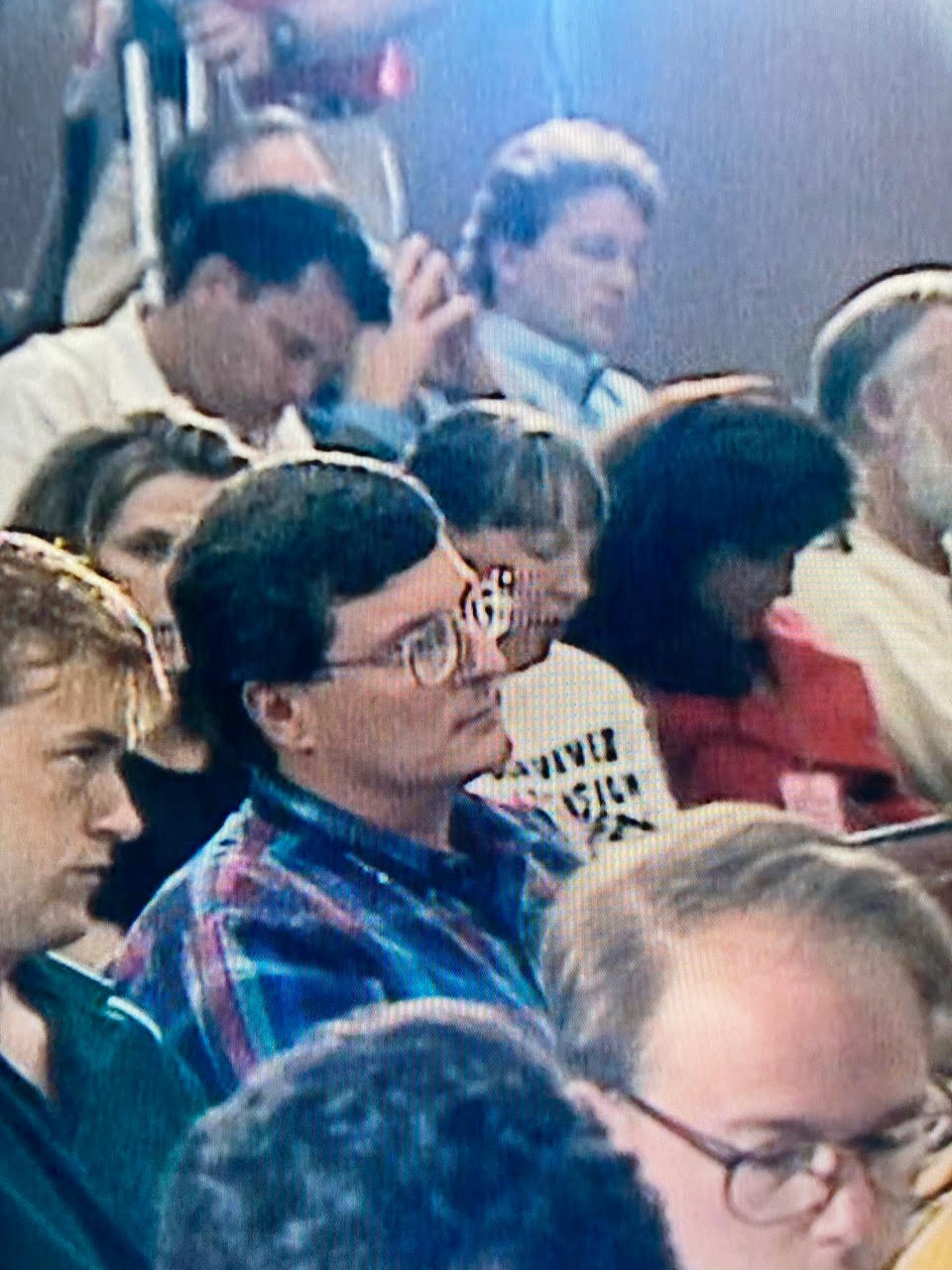 | |
Mike Holmes - As Austin correspondent, I was at the Branch Davidian siege (1993) on the first day, the last day, and many of the days in between. Early on, we had 20+ reporters and photographers in Waco for round-the-clock coverage. Figuring that I'd lived it, I've ignored the occasional documentaries done since. So I was a little surprised this past week when I started getting screen grab photos from my son, who was watching the new Netflix series about the tragedy. "Is this you?" he asked of the first, blurry image. Then came a couple more and the text, "It is you." What a weird feeling to be consigned to history.
(In this shot, that’s former Austin bureau sports writer Chip Brown looking skeptical on my right, and maybe Pauline Arrillaga, then a newswoman on the Texas staff, in red to my left.)
A Return to Tradition
| |
|
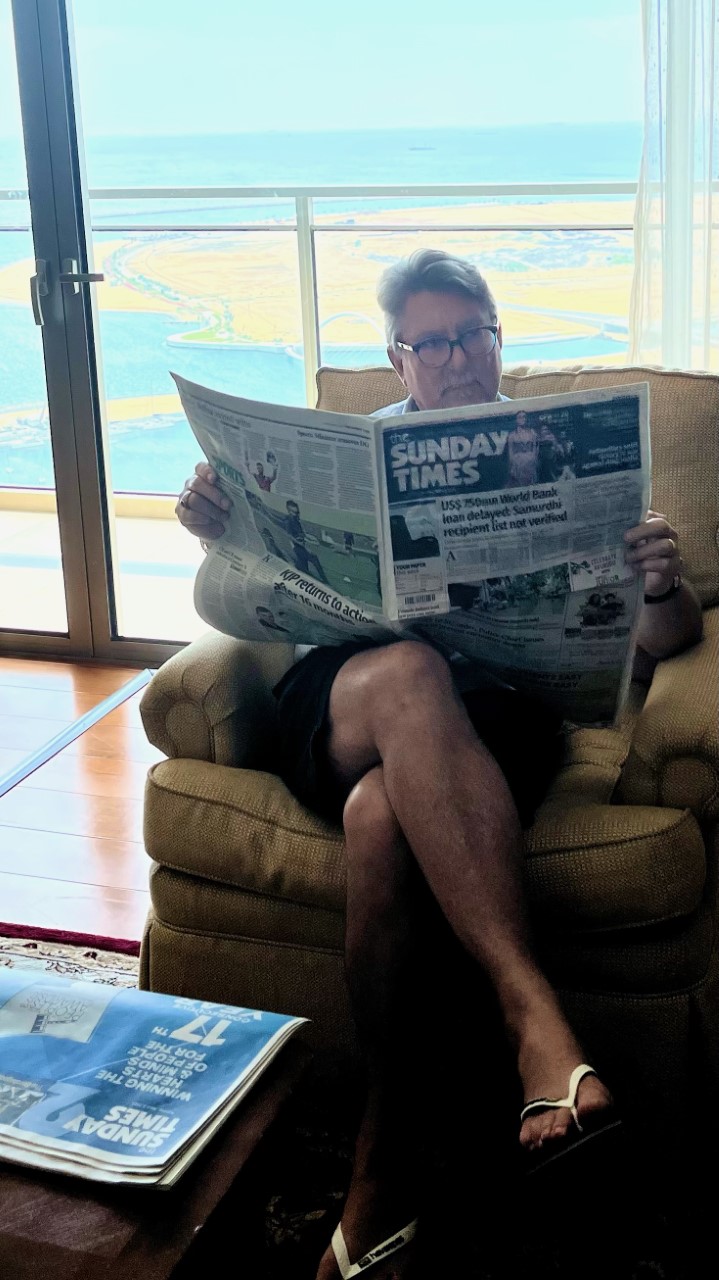
Jim Reindl - It’s been so long since I’ve been able to sit and read a newspaper in my hands that I had to commemorate the experience today. Colombo (Sri Lanka) has a vibrant newspaper market, though many are of dubious political bents. Journalists’ salaries are low and that affects quality. But at least they are publishing. And the Sunday Times has gained a subscriber. (For anyone wondering, that is a Chinese land reclamation project behind me in the Indian Ocean called Port City.)
Honoring the season’s best college basketball stars
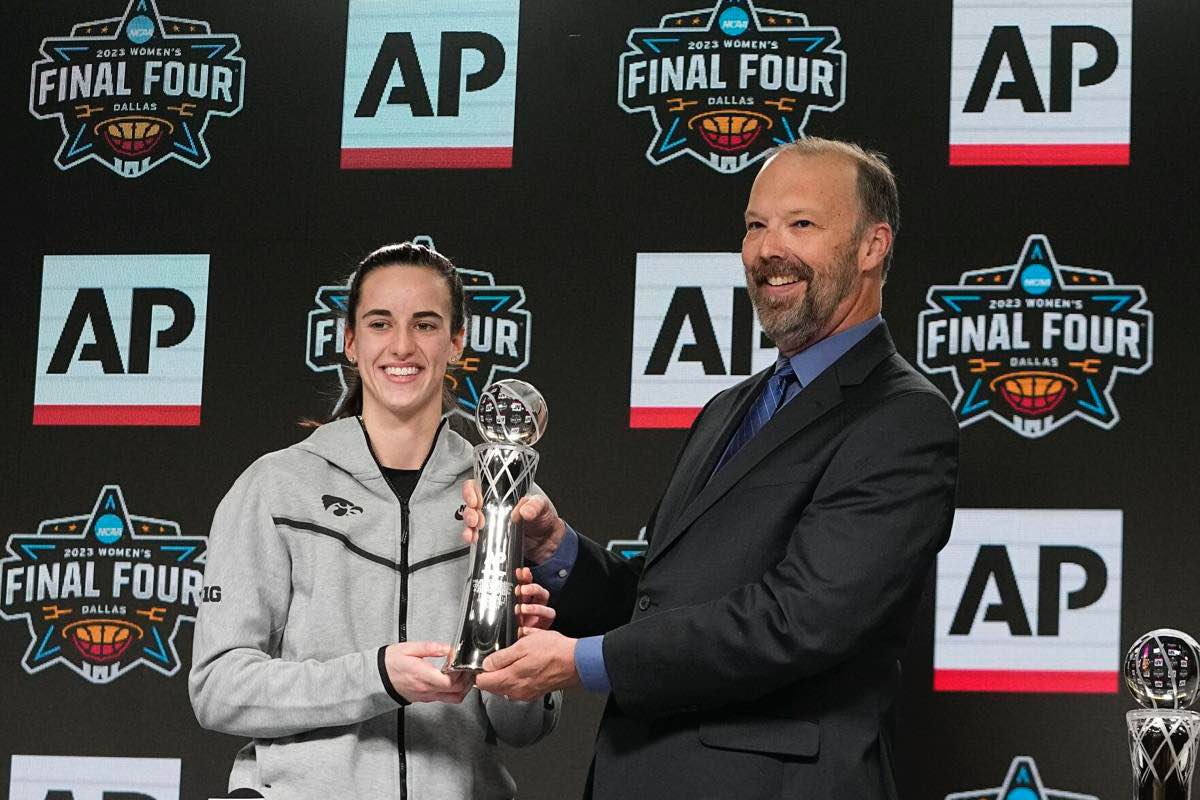
Barry Bedlan – Dallas-based sports products director - Here's what I got to do at work last week.
| |
On Thursday, it was my first time presenting the AP awards at the women's Final Four. It was great to meet Caitlin Clark, one of the greatest college players of all time, and Coach Terri Moren, who has turned Indiana into a national power. The day also was extra special because one of my best friends at AP, Darron Cummings, took the photos. AP doesn't allow the use of Photoshop so I greatly appreciate Darron's magic behind the lens to make me look mostly presentable. | |
|
On Saturday, I got to watch the Naismith Hall of Fame news conference with Coach Shaka Smart, Marquette University, AP Men's Coach of the Year, and he leaned over to me and whispered: "This is soooo cool." Meanwhile, when Zach Edey of Purdue University first walked up to me, I knew then I should have worn my cowboy boots. At 7-foot-4, he is the tallest player to received the AP Player of the Year Award since Ralph Sampson in 1993.
Last taste of spring training
| |
|
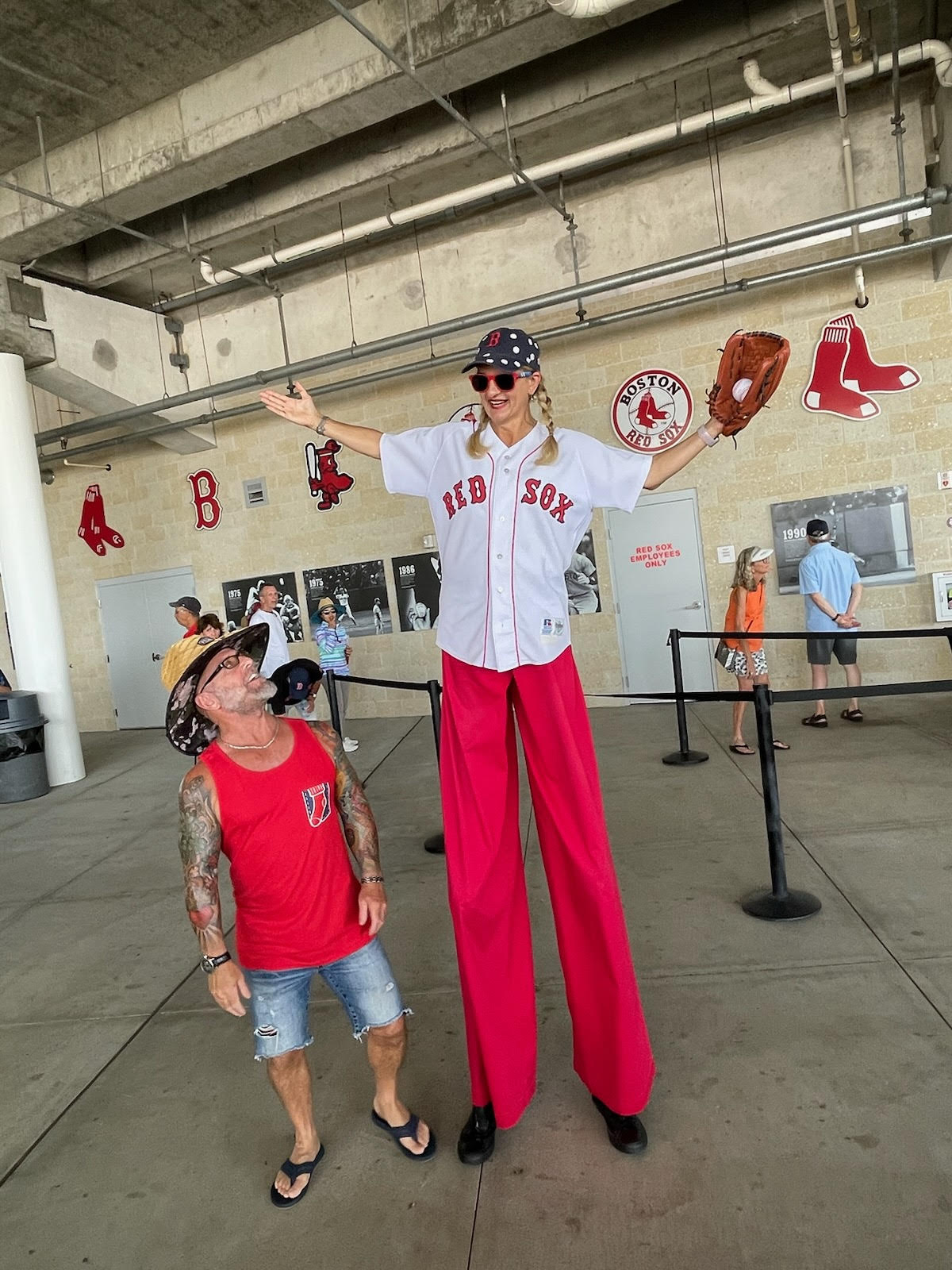
Our colleague Hank Ackerman got a last taste of baseball spring training before the 2023 Major League Baseball season began - and shares these photos, the first showing the manual scoreboard at the Red Sox’ jetBlue Park in Fort Myers, Fla., and the second showing a pair of Red Sox fans.
| |
Connecting wishes Happy Birthday | |
|
Charles Arbogast
Connecting '80s/'90s/100 Club
(EDITOR'S NOTE: Connecting publishes this list at the beginning of each month. If you are qualified for one of the age groups and would like to be listed, drop me a note. Please let me know of any errors.)
100s:
Fred Hoffman
90s:
Norm Abelson
Henry Bradsher
Hal Buell
Joseph Carter
Albert Habhab
George Hanna
Hoyt Harwell
Gene Herrick
Gene Lahammer
Joe McGowan
Charlie Monzella
Bob Petsche
Arlon Southall
Sal Veder
Doris Webster
Joe Young
Arnold Zeitlin
80s:
Paul Albright
Rachel Ambrose
Peter Arnett
Harry Atkins
Frank Aukofer
Jim Bagby
Malcolm Barr
Myron Belkind
Ed Bell
Dan Berger
Adolphe Bernotas
Brian Bland
Lou Boccardi
Hal Bock
William Roy Bolch Jr.
Ben Brown
Charles Bruce
Ford Burkhart
Harry Cabluck
Sibby Christensen
Shirley Christian
Norm Clarke
Steve Crowley
Don Dashiell
Bob Daugherty
Don Deibler
Mike Doan
Bob Dobkin
Otto Doelling
Phil Dopoulos
John Eagan
Claude Erbsen
Mike Feinsilber
Dodi Fromson
Joe Galu
Bill Gillen
Steve Graham
Bob Greene
Jerry Harkavy
Paul Harrington
Chick Harrity
Merrill Hartson
Monte Hayes
Doug Kienitz
Dean Lee
Pierce Lehmbeck
Warren Lerude
Carl Leubsdorf
Bruce Lowitt
David Liu
Jim Luther
Larry Margasak
John Marlow
Dave Mazzarella
Chuck McFadden
Yvette Mercourt
Reid Miller
Karren Mills
Peggy Mooney
Bill Morrissey
Harry Moskos
Bruce Nathan
Ray Newton
Greg Nokes
Larry Paladino
Jay Perkins
Lyle Price
Charles Richards
Bruce Richardson
Denis Searles
Richard Shafer
Susanne Shaw
Mike Short
Rick Spratling
Ed Staats
Karol Stonger
Marty Thompson
Hilmi Toros
Kernan Turner
Jeffrey Ulbrich
Jack Walker
Mike Waller
Bob Walsh
Dean Wariner
Don Waters
Lew Wheaton
Jeff Williams
Byron Yake
Johnny Yost
Kent Zimmerman
| |
|
Stories of interest
Journalist Detained by Russia Was Reporting Stories That ‘Needed to Be Told’ (New York Times)
By Katie Robertson
The reporting job in Moscow had everything Evan Gershkovich was looking for, his friends said: experience in a far-flung location with the chance to connect with his Russian roots.
Mr. Gershkovich, 31, an American journalist born to Soviet émigrés, moved from New York to Russia in late 2017 to take up his first reporting role, a job at The Moscow Times and, his friends and co-workers said, he quickly embraced life in Moscow.
“He had no hesitation; he was really ready to try something totally new,” said Nora Biette-Timmons, a friend from college and the deputy editor of Jezebel, adding, “I remember so distinctly how much he loved what he was doing.”
In January 2022, he was hired as a Moscow-based correspondent for The Wall Street Journal, a dream job, his friends said.
Read more here. Shared by Dennis Conrad.
-0-
Twitter pulls check mark from main New York Times account (AP)
By The Associated Press
Twitter has removed the verification check mark on the main account of The New York Times, one of CEO Elon Musk’s most despised news organizations.
The removal comes as many of Twitter’s high-profile users are bracing for the loss of the blue check marks that helped verify their identity and distinguish them from impostors on the social media platform.
Musk, who owns Twitter, set a deadline of Saturday for verified users to buy a premium Twitter subscription or lose the checks on their profiles. The Times said in a story Thursday that it would not pay Twitter for verification of its institutional accounts.
Early Sunday, Musk tweeted that the Times’ check mark would be removed. Later he posted disparaging remarks about the newspaper, which has aggressively reported on Twitter and on flaws with partially automated driving systems at Tesla, the electric car company, which he also runs.
Read more here. Shared by Howard Goldberg.
-0-
What’s the Point of Reading Writing by Humans? (New Yorker)
By Jay Caspian Kang
One of the stultifying but ultimately true maxims of the analytics movement in sports says that most narratives around player performance are lies. Each player has a “true talent level” based on their abilities, but the actual results are mostly up to variance and luck. If a player has, say, the true talent to hit thirty-one home runs in a season, the timing of those home runs is mostly random. If someone hits a third of those in April, that doesn’t really mean he’s a “hot starter” who is “building off a great spring”—it just means that if you take thirty-one home runs and toss them up in the air to land randomly on a time line, sometimes ten of them float over to April. What does matter, the analytics guys say, are plate appearances: you have to clock in enough opportunities to realize your true talent level.
For much of my career, I was the type of journalist who only published a handful of magazine pieces a year. These required a great deal of time, much of which was spent on minor improvements to the reporting, structure, and sentences. I believed that long-form journalism, much like fiction or poetry, possessed a near-mystical rhythm that could be accessed through months of intensive labor. Once unlocked, some spirit would sing through the piece and touch the readers in a universal, truthful way.
Read more here. Shared by Len Iwanski.
-0-
How public radio can help solve the local news crisis: A response to Thomas Patterson (What Works)
By Dan Kennedy
Could public radio help solve the local news crisis? Perhaps. But first we have to determine what we mean by local news, and whether the folks who bring you national programs such as “All Things Considered” and “Morning Edition” are suited to that mission.
In late January, Thomas Patterson, the Bradlee Professor of Government and the Press at the Harvard Kennedy School, published a “discussion paper” exploring that very question. The purpose of discussion papers, according to the introduction, is “to elicit feedback and to encourage debate.” Consider this my small contribution. (Patterson, I should disclose, was acting director of Kennedy School’s Shorenstein Center during my 2016 fellowship there and provided me with valuable advice for my 2018 book “The Return of the Moguls.”)
At the outset, Patterson writes that he seeks to answer two questions:
Read more here. Shared by Richard Chady.
The Final Word
King County Council votes unanimously for the Oxford comma (Seattle Times)
By David Gutman
Seattle Times staff reporter
The Metropolitan King County Council listened for hours Tuesday, as members of the public took time in the middle of a weekday to offer public testimony on a matter of grave importance.
Then, the County Council voted unanimously to endorse the use of the Oxford comma.
That was a trick, right there — a bit of rhetorical tomfoolery to make you think the impassioned public testimony and the Oxford comma were connected. And it’s just the sort of ambiguity and confusion (sort of) that the County Council seeks to avoid by legislatively declaring the Oxford comma “the standard for King County ordinances and motions.”
Nobody, in fact, testified about the Oxford comma. They testified about a proposal to move people out of King County Jail and into a regional jail in Des Moines. But the County Council was conflicted on that proposal and so it delayed a vote and moved on to the rest of its agenda.
The council voted to designate two “no shooting” zones in unincorporated areas between Maple Valley and Kent. It voted to endorse a federal legislative agenda for 2023.
Read more here. Shared by Steve Graham.
| |
Today in History - April 3, 2023 | |
|
Today is Monday, April 3, the 93rd day of 2023. There are 272 days left in the year.
Today’s Highlight in History:
On April 3, 1973, the first handheld portable telephone was demonstrated for reporters on a New York City street corner as Motorola executive Martin Cooper called Joel S. Engel of Bell Labs.
On this date:
In 1865, Union forces occupied the Confederate capital of Richmond, Virginia.
In 1882, outlaw Jesse James was shot to death in St. Joseph, Missouri, by Robert Ford, a member of James’ gang.
In 1936, Bruno Hauptmann was electrocuted in Trenton, New Jersey, for the kidnap-murder of 20-month-old Charles Lindbergh Jr.
In 1942, during World War II, Japanese forces began their final assault on Bataan against American and Filipino troops who surrendered six days later; the capitulation was followed by the notorious Bataan Death March.
In 1944, the U.S. Supreme Court, in Smith v. Allwright, struck down a Democratic Party of Texas rule that allowed only white voters to participate in Democratic primaries.
In 1948, President Harry S. Truman signed the Marshall Plan, designed to help European allies rebuild after World War II and resist communism.
In 1968, civil rights leader Martin Luther King Jr. delivered what turned out to be his final speech, telling a rally of striking sanitation workers in Memphis, Tennessee, that “I’ve been to the mountaintop” and “seen the Promised Land. I may not get there with you. But I want you to know tonight that we, as a people, will get to the Promised Land!” (About 20 hours later, King was felled by an assassin’s bullet at the Lorraine Motel.)
In 1974, deadly tornadoes began hitting wide parts of the South and Midwest before jumping across the border into Canada; more than 300 fatalities resulted from what became known as the Super Outbreak.
In 1978, at the Academy Awards, Woody Allen’s “Annie Hall” was named best picture of 1977; its co-star, Diane Keaton, won best actress while Richard Dreyfuss was honored as best actor for “The Goodbye Girl.”
In 1996, Unabomber Theodore Kaczynski (kah-ZIHN’-skee) was arrested at his remote Montana cabin.
In 2012, Mitt Romney tightened his grip on the Republican presidential nomination, sweeping primaries in Wisconsin, Maryland and Washington, D.C.
In 2014, David Letterman announced during a taping of the “Late Show” on CBS that he would retire as host in 2015. (Stephen Colbert (kohl-BEHR’) was named as his replacement a week later.)
In 2020, President Donald Trump announced new federal guidelines recommending that Americans wear face coverings when in public to help fight the spread of the coronavirus, but Trump immediately said he had no intention of following that advice himself; he said he could not envision himself covering his face while sitting in the Oval Office greeting world leaders.
Ten years ago: The White House announced President Barack Obama would return 5 percent of his salary each month to the Treasury in a show of solidarity with federal workers smarting from government-wide spending cuts. Palestinian militants launched several rockets into southern Israel and Israeli aircraft struck targets in the Gaza Strip in the heaviest exchange of fire between the sides since a cease-fire ended a major flare-up the previous year. Oscar-winning screenwriter and award-winning novelist Ruth Prawer Jhabvala, 85, died in New York.
Five years ago: A woman opened fire with a handgun in a courtyard at YouTube headquarters in San Bruno, California, wounding three people before fatally shooting herself; family members said she was upset with the company’s handling of her videos and believed she was being deprived of income and views. President Donald Trump said he wanted to use the military to secure the U.S.-Mexico border until his promised border wall was built.
One year ago: Ukrainian authorities found bodies with bound hands, close-range gunshot wounds and signs of torture scattered in a city on the outskirts of Kyiv after the withdrawal of Russian troops. They said that to that point they had found the bodies of 410 civilians in Kyiv-area towns that resembled “a scene from a horror movie.” In Sacramento, California, six people were killed and 10 injured in a shootout as bars and nightclubs were closing in the city’s downtown. At the Grammy Awards in Las Vegas, Jon Batiste won album of the year for “We Are,” Silk Sonic won record and song of the year for “Leave the Door Open,” and Olivia Rodrigo won best new artist.
Today’s Birthdays: Conservationist Dame Jane Goodall is 89. Actor William Gaunt is 86. Songwriter Jeff Barry is 85. Actor Eric Braeden is 82. Actor Marsha Mason is 81. Singer Wayne Newton is 81. Singer Tony Orlando is 79. Comedy writer Pat Proft is 76. Folk-rock singer Richard Thompson is 74. Country musician Curtis Stone (Highway 101) is 73. Blues singer-guitarist John Mooney is 68. Rock musician Mick Mars (Motley Crue) is 67. Actor Alec Baldwin is 65. Actor David Hyde Pierce is 64. Rock singer John Thomas Griffith (Cowboy Mouth) is 63. Comedian-actor Eddie Murphy is 62. Rock singer-musician Mike Ness (Social Distortion) is 61. Rock singer Sebastian Bach is 55. Rock musician James MacDonough (Megadeth) is 53. Olympic gold medal ski racer Picabo Street is 52. Actor Jennie Garth is 51. Actor Jamie Bamber is 50. Actor Adam Scott is 50. Christian rock musician Drew Shirley (Switchfoot) is 49. Comedian Aries Spears is 48. Actor Matthew Goode is 45. Actor Cobie Smulders is 41. Rock-pop singer Leona Lewis is 38. Former actor Amanda Bynes is 37. Actor-comedian Rachel Bloom is 36. Actor Hayley Kiyoko is 32. Rock musician Sam Kiszka (Greta Van Fleet) is 24.
| |
Got a story or photos to share? | |
Connecting is a daily newsletter published Monday through Friday that focuses on retired and former Associated Press employees, present-day employees, and news industry and journalism school colleagues. It began in 2013 and past issues can be found by clicking Connecting Archive in the masthead. Its author, Paul Stevens, retired from the AP in 2009 after a 36-year career as a newsman in Albany and St. Louis, correspondent in Wichita, chief of bureau in Albuquerque, Indianapolis and Kansas City, and Midwest vice president based in Kansas City.
Got a story to share? A favorite memory of your AP days? Don't keep them to yourself. Share with your colleagues by sending to Ye Olde Connecting Editor. And don't forget to include photos!
Here are some suggestions:
- Connecting "selfies" - a word and photo self-profile of you and your career, and what you are doing today. Both for new members and those who have been with us a while.
- Second chapters - You finished a great career. Now tell us about your second (and third and fourth?) chapters of life.
- Spousal support - How your spouse helped in supporting your work during your AP career.
- My most unusual story - tell us about an unusual, off the wall story that you covered.
- "A silly mistake that you make"- a chance to 'fess up with a memorable mistake in your journalistic career.
- Multigenerational AP families - profiles of families whose service spanned two or more generations.
- Volunteering - benefit your colleagues by sharing volunteer stories - with ideas on such work they can do themselves.
- First job - How did you get your first job in journalism?
- Most unusual place a story assignment took you.
Paul Stevens
Editor, Connecting newsletter
paulstevens46@gmail.com
| | | | |