|
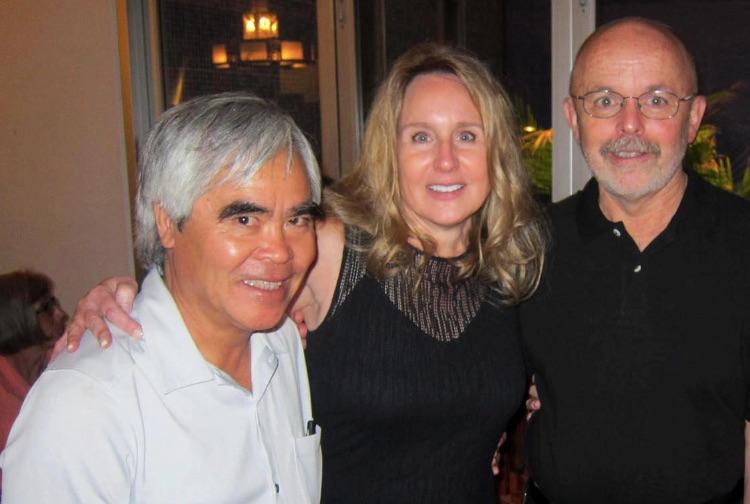
Nick Ut with Sally Stapleton and Richard Drew, at an AP tribute gathering for Horst Faas and George Esper Aug. 12, 2012, at Eddie Adams' photo studio, Bathhouse Studios in New York City.
Sally Stapleton, whose career included 13 years with AP Photos, is among four award-winning photojournalists who will be inducted into the Missouri Photojournalism Hall of Fame in Columbia on Oct. 19.
This will be the 19th group of inductees since the founding of the Hall of Fame in 2005. Other inductees are the late Randy Cox; Dennis Crider of West Plains, and Jill Toyoshiba of Kansas City.
“It's an honor and factual to say I've lived my entire life - from birth to the present - in newsrooms,” Stapleton told Connecting. “What a gift to work alongside, build friendships and learn from so many talented journalist colleagues.”
From a news release:
Stapleton is a third-generation visual journalist who spent her childhood in small-town newsrooms at opposite ends of the state. Before her teens, she learned to develop film in the darkroom of the Daily Dunklin Democrat in Kennett, then run by her father, and she remembers watching her grandfather write stories on Linotype machines in the Stanberry Headlight and Albany Ledger newsrooms.
Between earning her undergraduate degree and returning to pursue her master’s from the Missouri School of Journalism, Stapleton spent eight months working for her father in Kennett. In that time, she launched a weekend magazine and spent months photographing life in Hayti Heights, a tiny town that separated itself from a nearby community because its Black residents weren’t being provided basic services.
She has held newsroom leadership roles covering the most far-reaching stories, including the ouster of Chilean dictator Augusto Pinochet, funerals for international figures, the terror attacks of September 11, the Sandy Hook Elementary School massacre and the 1994 genocide against the Tutsi in Rwanda, which received the 1995 Feature Photography Pulitzer Prize for an Associated Press staff entry.
She was with AP Photos from 1990 until the end of 2003. In the 1990s, her role was as the senior photo editor for Latin America and Africa. In 1999, the AP won a second Africa-based Pulitzer Prize in Spot News Photography for its coverage of the simultaneous al-Qaida bombings of U.S. embassies in Kenya and Tanzania. Later, as deputy executive photo editor, she was responsible for all editorial aspects of the U.S. and international photo operation, which included more than 400 staff photographers and editors.
In 2016, Stapleton was named the Pollner Distinguished Professor at the University of Montana School of Journalism and taught multimedia storytelling. She was managing editor of the Pittsburgh Post-Gazette from 2017 until April 2019. The Post-Gazette staff received the 2019 Pulitzer Prize in Breaking News Reporting for coverage of the Tree of Life synagogue massacre.
Stapleton currently lives in Columbia where she said she is working on journalism initiatives globally and reconnecting with the Missouri J School. In a couple of weeks, she is heading to Bolivia to lead workshops on journalists' security in La Paz and Santa Cruz with photojournalists, reporters and news editors.
Photographs made by the inductees will be on display during the 4 p.m. ceremony and reception in the Sam B. Cook Hall at the Center for Missouri Studies, the State Historical Society of Missouri’s location in downtown Columbia. Those photographs will join the Hall of Fame’s collection of work by inductees.
The Photojournalism Hall of Fame was founded at the urging of Bill Miller Sr., publisher of the Washington Missourian newspaper, to recognize outstanding contributors to visual communication with ties to Missouri.
Information about the Photojournalism Hall of Fame and previous inductees can be seen at photojournalismhalloffame.org. RSVP for the induction ceremony online at bit.ly/mophotoj or by email at mharper@mopress.com.
Sally’s email – sallystapleton@gmail.com
Connecting mailbox
Noreen Gillespie – an innovator who made AP faster and better
Brian Carovillano - Noreen Gillespie, who resigned last week after 21 years with AP, held a variety of roles, including deputy sports editor, national editor and most recently, global business editor. Earlier in her career, she was critical to the success of the regional reorganization in two regions. In every one of those roles, she has been an innovator who made AP faster and better while driving her teams to do some of their most ambitious journalism. Her contributions to AP over two-plus decades are, in my opinion, second to none.
-0-
Jim and Ellen
Frank Eltman - Loved seeing the photo in Tuesday’s Connecting from the wedding of Jim Fitzgerald and Ellen Nimmons. Jim was a good friend as we patrolled the NYC suburbs for the AP for many years (he in Westchester and me on Long Island). I still think of him often and miss his kindness and good humor.
-0-
Nate’s granddaughter begins journalism school
Daniel Polowetzky – son of legendary AP foreign editor Nate Polowetzky - In follow up to an earlier email, I am happy to report that my daughter, Daisy Polowetzky, started her freshman year at the SI Newhouse School of Public Communications at Syracuse University Monday.
She is majoring in Magazine, News and Digital Journalism.
Her grandfather would have been so pleased.
-0-
Daughter of Lindel Hutson opens second Boston area eatery
Lindel Hutson shares the news that his daughter Sarah Wade is opening her second restaurant in the Boston area.
This story from Boston.com notes:
A renowned chef who achieved television fame several years ago is debuting a new eatery in Allston, serving up comfort food with an original twist.
Sloane’s, chef Sarah Wade’s second restaurant, is opening on Aug. 7 in the North Harvard Street space that formerly belonged to Our Fathers, a Jewish deli and bistro. Wade named the spot after her first daughter and will bring customers hearty fare. In the tradition of her first restaurant, Stillwater, which she opened in 2019 after winning Food Network’s Chopped Gold Medal Games competition, she will deliver on comfort food with flair.
Dear Lover of Good Writing and Believer in Education,
We are gearing up for the 9th Annual College Application Essay Workshop and hoping you’ll join us as an on-line mentor. Last year we had fewer than usual mentors sign up. We hope you can support a student this year!
What: The County Office of Education is offering graduating high school seniors an opportunity to help them conceive, write and edit their college essays. The College Application Essay Workshop will again be online this year, offering students one-on-one support from you: generous people willing to volunteer your time to help a prospective college student.
When: October 16 to October 30, 2023
Cost: FREE to students
Time: There will be four Zoom meetings over 10 days, arranged one-on-one between a trained writing mentor and the student.
· 1st meeting: brainstorm, leave with outline (1-2 hours)
· 2nd meeting 3 days later: bring in rough draft, read and edit – (under an hour)
· 3rd meeting, 2-3 days later: bring second draft, read and edit – (under an hour)
· 4th meeting, 2-3 days later: bring final draft, edit – (half hour)
How this works: You and your student will set meeting times and dates for the first four meetings. Following the fourth meeting, if you and your student want to continue working, you can arrange that. A Zoom training on either Weds., Oct. 11 at 4 p.m. or Sat. Oct. 14 at 10 a.m. will be available for all new volunteers and anyone who wants a refresher.
Who: We are Young Writers Program former director, and poet and writer Julia Chiapella and Pulitzer Prize-winning journalist Martha Mendoza. Formerly a project of the Young Writers Program, the workshop is now sponsored by the Santa Cruz County Office of Education.
To sign up as a writing mentor, please register here:
And, please forward this email to friends and family you think might be interested. As always, thank you, thank you, THANK YOU! If you have questions, please email us:
Julia Chiapella Martha Mendoza
Former Director, YWP Journalist
jchiapella@santacruzcoe.org mmendoza@ap.org
AP sighting
Dick Lipsey - Here is another AP sighting, this one from "Bellamy Park," memoirs by Brigadier General Bradford Chynoweth, published in 1975. In the early 1920s, Chynoweth was assigned to the War Department General Staff's Military Intelligence Division, which included the Press Relations Section.
Chynoweth writes:
"The Press Relations Section had daily intimate contact with the two Associated Press men, Kirk Simpson and Steve Early. Kirk won the Pulitzer Prize. Steve won fame when President Harding died in a San Francisco hotel. Lurking in the hall, Steve spied an attendant rushing out of the President's room. Steve took a chance and rushed to the phone to report to his editor the flash news that the President was dying. His story "scooped" the newspaper world. Simpson and Early were of inestimable help to us -- until the Billy Mitchell case erupted. Steve was an all-out partisan for Mitchell. ... Steve Early never looked at both sides of a question. He later won distinction in Press Relations for President Roosevelt."
Early had been the AP reporter covering the Navy Department from 1913-17, when Franklin D. Roosevelt was assistant secretary of the Navy and was White House press secretary from 1933-45 during FDR's presidency. Simpson won a Pulitzer Prize in 1922 for articles on the burial of the Unknown Soldier.
This is a fascinating memoir of the pre-World War II army. Chynoweth was a West Point class of 1912 graduate, three years ahead of Eisenhower and Bradley, and he provides a warts-and-all view of them and Douglas MacArthur and many others. Chynoweth and George Patton, class of 1909, saw eye-to-eye on the importance of decentralized training and the use of tanks as a strike force, rather than simply for infantry support. Their views were largely out of step with prevailing Army doctrine. Chynoweth was sent to the Philippines in 1941, two weeks before the Japanese invasion, and commanded Army forces on the islands of Panay and Cebu. He organized guerilla forces to resist the invasion but, like the rest of US forces, was ordered to surrender by the US commander, Gen. Wainwright. Chynoweth gives a detailed account of MacArthur's failure to prepare for the coming war and survived three years of captivity in Japanese prison camps.
Connecting sky shot
|