|
Colleagues,
Good Friday morning on this Dec. 5, 2025,
Today’s Connecting brings you a link to the panel discussion held Tuesday by the Foreign Correspondents Club of Thailand on the documentary film, “The Stringer,” which contends a photographer other than the AP’s Nick Ut took the 1972 Pulitzer-winning photo of the Napalm Girl.
The panelists appearing on Zoom included two key figures in the making of the film, photographer Gary Knight and former AP Saigon photo editor Carl Robinson, and Matt Growcoot of PetaPixel, a photography website. The on-site moderator was Dominic Faulder, Nikkei Asia associate editor and FCCT board member.
Click here to view – and thanks to Connecting colleague Denis Gray for sharing.
Today’s issue brings you more comments from your colleagues on the film, leading with the observations of one with firsthand knowledge of the AP's Saigon bureau back then - Neal Ulevich, a photographer on the AP Saigon staff from 1970-75.
At the end of the war, he moved to Bangkok, where he as AP's regional photographer he won the Pulitzer Prize for Spot News Photography in 1977 for photos made during a political upheaval in Bangkok. AP assignments in Japan and China followed. He returned to the United States in 1990 and retired from the AP in 2002.
Cranial Cardio: Time for math and logic again - An explorer found a silver coin marked 7 BC. He was told it was a forgery. Why? (Answer in Monday’s issue; created by Doug Pizac)
Have a great weekend – be safe, stay healthy, live each day to your fullest.
Paul
The current imbroglio
Neal Ulevich - A few notes on the current imbroglio.
A. Carl Robinson's extravaganza is on Netflix now and AP Connecting comment seems split between those convinced by the movie and those who are skeptical. None of the comments are made by colleagues or others who had firsthand knowledge of the Saigon AP bureau. I haven't seen The Stringer. I don't do Netflix.
Yesterday I decided to view another film to remind myself that Carl's narrative is rather...Carl. A Home Movie: This Was AP Saigon, a silent film of about 20 minutes I cobbled together in 2005 from 8mm movie footage I made as a hobbyist interwoven with stills and Polaroid portraits. I hadn't looked at my creation in years.
Besides the gritty work of shooting the war I was always photographing press corps life. Movies. Polaroids. Single use cameras, medium format. This amused Horst Faas. "He is in the wrong job. He likes photography," said Faas.
I was struck by the realization my film is a record, probably like no other, of what it was like to work in that office in the war. Everyone is there. Now many are dead including those who witnessed the events of Burned Girl picture day. As the years roll on, This Was AP Saigon increasingly seems a living history flick, a home movie but more.
The film begins with an office party in honor of Huynh Thanh My, elder brother of Nick Ut, wounded and then murdered by the Viet Cong while covering the war for AP. Everyone is animated. The beer flows and all help themselves to the plates of Vietnamese delicacies. The guest of honor, deceased, observes from a wall in the newsroom. He is in honorable company. Adjacent are portraits of AP Photographers Oliver Noonan and Bernard Kolenberg who also gave their lives to the war.
The movie shows work in the photo department, on news side, even Traffic, as communications was then called.
In a way the movie is chilling. On screen everyone lives, even the dead. The film is a narrative.
B. I wasn't there that famous day. I was near the end of a brief visit to the United States and, with the world, gasped when I saw the famed image, eight columns above the fold.
Within days I was back in Saigon where the Burned Girl story was the only story. Carl and all others present - Horst Faas, Jackson Ishizaki, Tran Mong Tu among them - said not a word casting doubt on the authorship of the image. It is unlikely - I think extremely unlikely - word of a switch of credit would have evaded my attention. It would have circulated among the Vietnamese staff instantly. Gossip rules. And Jackson, a friend, had no reason to keep this one a secret from me.
I relied on, and still do, the words of respected journalists who were with Nick that day, particularly David Burnett. He and others have no doubt Nick made the image.
C. Carl's credibility is not an ad hominem issue. He has not presented conclusive evidence to bolster his account. Everyone in the photo department that day is dead. Carl says he was ultimately moved by conscience to spill after a half century. Having worked for years with both Carl and Nick Ut in that AP Saigon photo department, I have to say Carl's hatred of AP and Horst Faas made a deeper impression on me than his conscience cri de coeur.
A personal journal which I kept during the war includes reference to Carl expressing his hatred for Horst Faas.
Character matters. It is not ad hominem to note Carl's hatred for Faas, who hired him. Or Carl's hatred for AP. It is not ad hominem to note Carl's heroin addiction.
Years ago at a correspondents reunion in Saigon, long after the war, Carl took me aside and insisted Nick Ut never made the image. I asked for proof. He had none to offer. "Then you ought to forget about it," I said. "That's what my wife says," was his reply. I told Carl he should listen to his wife.
D. A post in Thursday’s Connecting bizarrely smears Horst Faas. It quotes a long-dead reference to Faas telling a reporter "Vot I like is boom boom." What this is supposed to represent I have no idea.
In any case the story has long been misinterpreted and was a subject of mirth to those who knew Faas. A woman journalist intruded on Faas' long lunch at the Hotel Royal. She was a pest. She asked him if he liked covering combat. Those who were there agree Horst's "boom boom" quote was said in jest, referred to sex, not combat.
Further, during my tenure in Saigon Photos (1970-1975) there were no atrocity images on the wall or art work mocking combatants. My movie (and many of my still pictures) show those walls quite clearly. Photographs show wounded AP staff, some in agony, being brought in from the field. One image of Dang Van Phuoc, who lost an eye in combat, is especially moving.
(We received from time to time stringer photos of horrendous war wounds and atrocities. They did not go on the wall. In a few cases I recall the images were simply shipped onward to New York, which invariably spiked them as being too awful to circulate to members.).
AP called Horst Faas "legendary." Having worked for him and learned much, I would agree.
Statement from Nick Ut’s attorney on Netflix showing
James Hornstein – attorney for Nick Ut, summarizing comment made to Time Magazine - The note sets the record straight as to the history and evidence that is missing from “The Stringer” which compel the conclusion that Nick Út took the famous picture.
Technical hypotheses cannot substitute for first-hand observation by multiple independent journalists who either saw Nick Út taking the photograph or reviewed the film with him shortly thereafter.
No new documentary evidence — no negative, no contact sheet, no print, no contemporaneous note, and no photographic archive — has surfaced to support an alternative authorship.
It is also important to note that the thesis advanced by the documentary — that someone other than Nick Út took the photograph — is supported only by a very narrow circle of individuals.
Aside from Carl Robinson and his wife, who put forward a 50-year delayed and uncorroborated account of events in the AP bureau, the only other proponents of the alternative thesis are Nguyễn Thanh Nghệ himself, and certain members of his family.
Not a single independent journalist present at Trảng Bàng supports this view. No AP staff members who worked in Saigon on the day of the attack support it.
No documentary evidence — no negative, no print, no contemporaneous contact sheet — supports it. And no historian, archivist, or photographic expert with access to the AP archives has ever endorsed it.
The absence of broader support is striking, given the extensive coverage the photograph has received over the past half-century. If credible evidence existed to challenge Nick Út’s authorship, it would not have remained confined to a handful of individuals whose accounts emerge five decades after the fact and contradict the overwhelming body of contemporaneous testimony.
In conclusion, the retrospective testimony introduced in the documentary nor the speculative technical reconstructions it relies upon provide a factual basis to overturn the established record.
The consistent accounts of independent journalists, the testimony of AP staff, the historical documentation of the Associated Press, and Nick Út’s own contemporaneous actions all compel the same conclusion:
Nick Út took the photograph known as “The Terror of War” on June 8, 1972.
More of your views on ‘The Stringer’
Al Behrman - One more thought on the documentary. If the accusations in the documentary are true, Nick Ut didn’t seek credit for a photo taken by a stringer that day. Carl Robinson is the person who gave Nick Ut credit when he typed the caption and transmitted the photo. Faas ordered Robinson to do it? That excuse didn’t work at Nuremberg and doesn’t work here. I’ve tried to google why Robinson was fired from the AP and haven’t found the reason. I think it’s important. If Robinson knowingly gave Ut credit for a photo he knew was taken by a stringer, he should have been fired on the spot.
-0-
Molly Gordy - Paul, thank you for creating the space to have an uncomfortable discussion about an uncomfortable subject. I am in no way qualified to judge who is right in this controversy. But one thing bothers me tremendously: that Carl Robinson waited to speak up for more than a half-century until Horst Faas was conveniently dead and no longer around to present his version of events. As a journalist I find that severely damages his credibility.
-0-
Marc Humbert - I must compliment you on your handling of the controversy over the “Napalm Girl” photo. And, for those of us who grew up respecting the iconic status of Nick Ut, we should always remember that the famous photo aside, he has long demonstrated what an excellent shooter he is. For that, he deserves the respect that has followed him throughout his career.
-0-
Ed McCullough - Speaking with no more authority than that of a foreign CoB with 3rd World experience and danger zone reporting from back in the day, I can understand - easily - the hierarchical, economic and other chasms between staffers and stringers, "locals" and fly-ins with credit cards and expense accounts, risk and safety, CoBs and everyone else, and on-the-spot decisions made which right or wrong would rarely, if ever, be challenged.
Did Nick take that shot? I don't know and never did.
Would he ever admit otherwise? I doubt it. He signed the reproduction given to me (and others) at 50 Rock at our 30th AP employment anniversary.
Could the (mis)credit be a mistake, fluke or ... the truth? Would seem to have to be one or the other, but which?
Is there enough information, history and follow-up to Carl's question to raise doubt? In my view, yes.
However, does "The Stringer" prove its case to my satisfaction? No.
The narrative of an indigestible error gnawing at the conscience of a good person, a wrong-righting that seemed impossible yet nonetheless was undertaken, etc., I find unmoving. But the reenactment of what must or might have happened and the contrary conclusion of people I worked alongside, know and value - Santi Lyon, for example - cannot be summarily discarded.
What's the next step? I don't know - and possibly nothing. Maybe that's fair. I don't believe in a world, or journalism, where everything has to be periodically torn down. We all should just strive to get better.
-0-
Sheila Norman-Culp - I wonder if we are all looking at “The Stringer” controversy through the wrong lens, so to speak.
In this “he said, he said” situation, I think it is important to consider the power dynamics going on here.
Horst Faas was, by all accounts, a force of nature who was determined to make sure AP beat Reuters, The New York Times and all other competitors out there. He was a singularly powerful manager in one of AP’s most critical bureaus at the time. The AP headquarters in New York was not telling him what to do, he was telling them what he and his bureau had decided to do.
Nick Ut was a 21-year-old Vietnamese man whose country was being torn apart by war and whose older brother had been killed by that war. Horst Faas had given him an economic lifeline — a job — as well as a vital sense of purpose, to document the hell that his country was going through.
Carl Robinson was a photo editor employed in a region where you could be fired at any moment for no reason at all. He had no union protection. AP management was going to back Horst Faas fully in whatever he wanted to do with his bureau’s staffing.
Neither Ut nor Robinson had any power at the time to stand up to anything Faas decided to do. And even if they did speak up later when Faas was still alive, they would be quickly dismissed when Faas rejected their comments. Like Chris Torchia, I immediately noticed AP’s earlier characterization of Robinson as a “disgruntled ex-employee” and felt that was unfair, an organization smearing someone who could be considered a whistleblower.
I do not have the photographic expertise to weigh in on who took the Pulitzer-winning photo. Maybe AI in the future can better determine that.
But I could envision a scenario in which Faas accidentally put Ut on a runaway train to fame that eventually neither one of them could control. I could see a person like Robinson wanting to correct the record before he died. And I could see AP folks in a chaotic wartime situation like the one Ut was in being unsure themselves of exactly what was shot.
Despite being on opposite sides of the controversy, both Ut and Robinson could be considered the victims of unequal power dynamics at work.
A bit of snark in AP coverage?
Mark Mittelstadt - "Officials also declined to reveal any specific breakthrough led them to Cole, but at a self-congratulatory Justice Department news conference ..."
This is a bit of snark I would not previously imagine from the AP. I wonder if this will be the standard now whenever law enforcement officials hold news conferences in which they point out the cooperation of other agencies? Sigh.
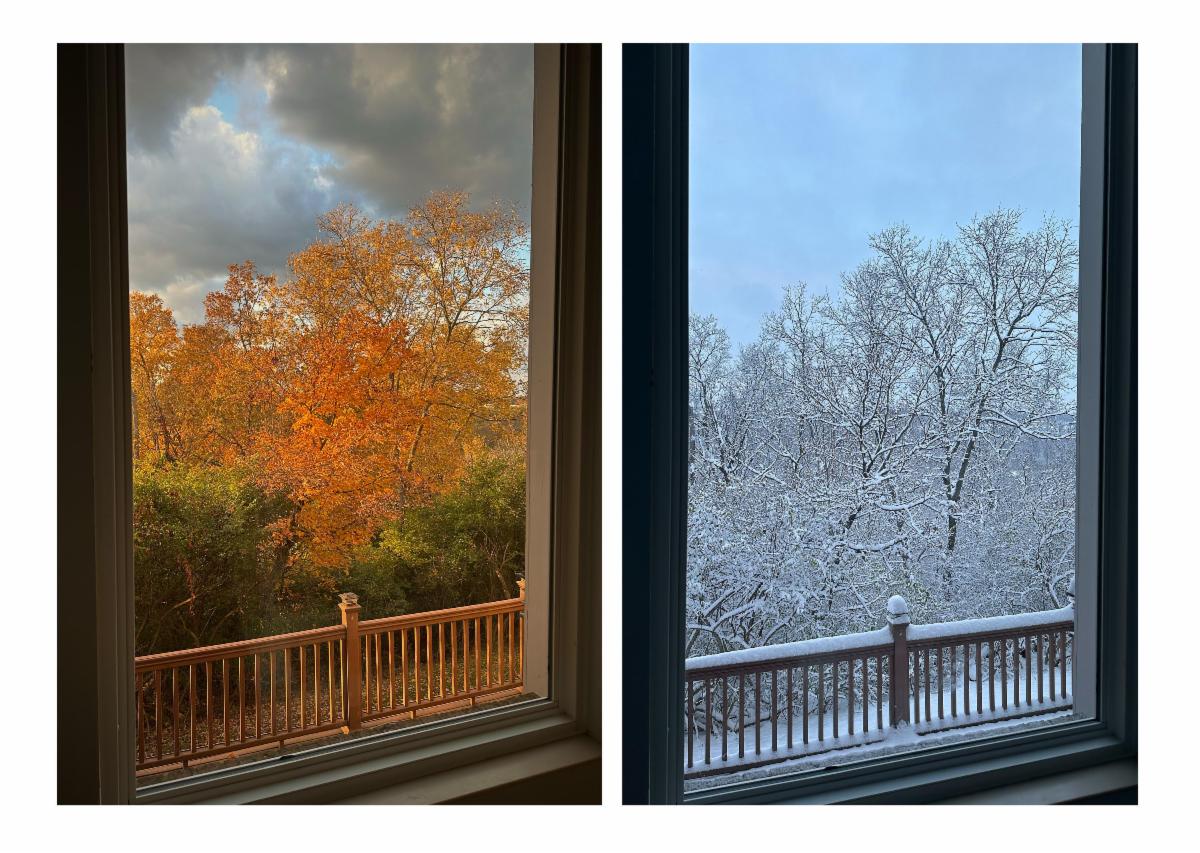
Two Scenes from the same window
|