Connecting

Dec. 23, 2024


Click here for the sound of the Teletype

Top AP News

Top AP Photos

AP Merchandise

AP Emergency Relief Fund

Connecting Archive

AP Newsletters

AP Books

AP News Tips

Colleagues,


Good Monday morning on this Dec. 23, 2024,


When the fledgling Associated Press established a bureau in St. Louis in 1853, in the middle of the Civil War, it installed Charles Osborn as its first correspondent.


He went on to serve in that position for 49 years, according to an AP World profile done years ago, in what was likely the AP’s first bureau west of the Mississippi. And 26 correspondents were to follow until Jim Salter took the reins in 1998.


In early January, Salter joins a number of AP staffers who will retire after accepting a buyout – part of an 8 percent reduction in staff that is also being achieved by job eliminations. His tenure as correspondent was exceeded only by Osborn.


Connecting profiles Salter and his remarkable career in today’s issue.


Many of us, whether active or retired, know someone who was affected by the staff reductions, impacting an unknown number of people, and Connecting offers any colleague who was impacted to write a Retirement Profile to share and put on record – and in the AP Archive – their accomplishments over long careers.


If you took the buyout or lost your job through staff reductions, and would like to submit a Connecting profile, drop me a note. Several more are in the works.


NEW TO THE 90s – Congratulations to Sibby Christensen, the newest member of Connecting’s 90s Club. Sibby was AP World editor for many years during her AP career in New York.


THANK YOU, NORM – from Francesca Pitaro, who writes, “As usual, Norm's poem in Friday’s Connecting gets to the heart of the matter, elegantly and eloquently. Thank you, Norm, for reminding us what the holidays are all about. Good wishes to Norm and all of my Connecting colleagues for a happy and healthy 2025!”


Here’s to a great day – be safe, stay healthy, live it to your fullest.


Paul


Connecting retirement profile:

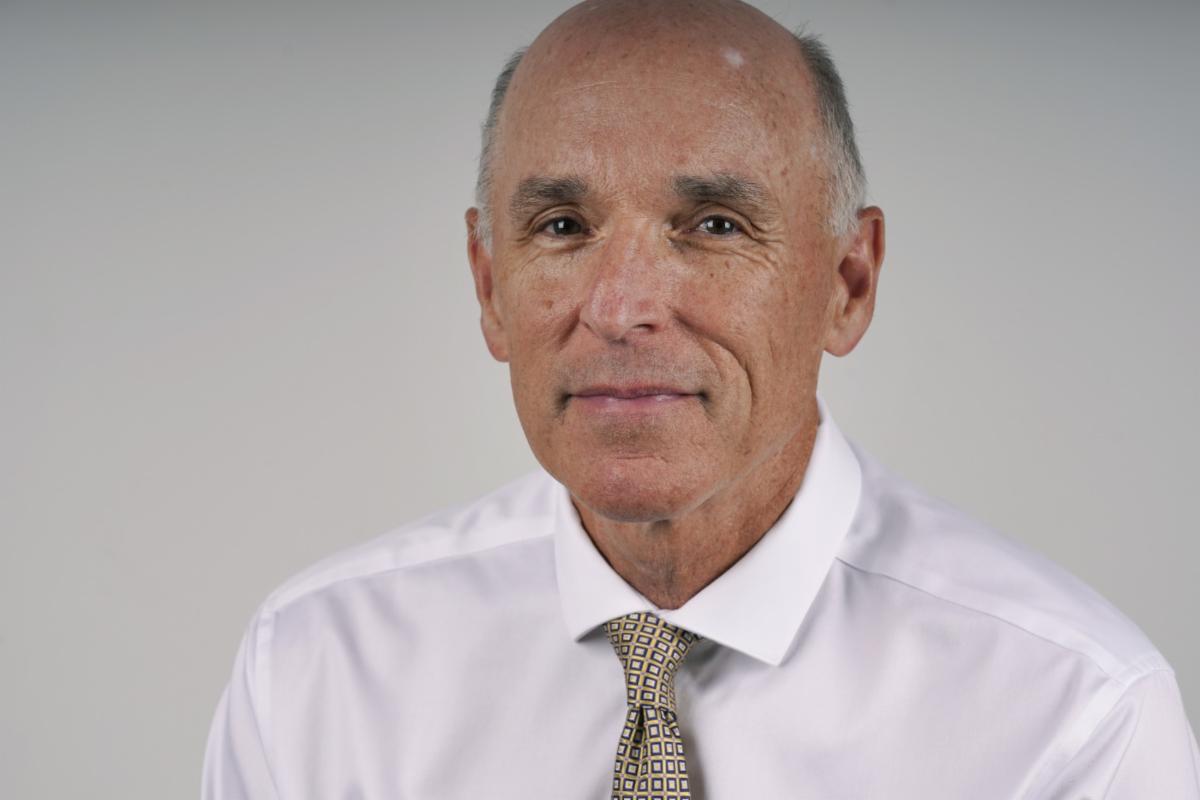
Jim Salter to retire as second-longest-serving AP correspondent in St. Louis bureau’s 171-year history

Jim Salter - Thirty-one years ago, I was the assistant editor at my hometown daily when I decided to dream big and fired off applications to Missouri’s three largest newspapers, and The Associated Press.  


Editors from the newspapers responded with terse “thanks, but no thanks” letters. Paul Stevens, chief of the AP’s Missouri-Kansas bureau, wrote a lovely note saying how much he admired the work we did at the Hannibal Courier-Post, and sure, he’d love to have me in for the AP writing test.


I made the trip to KC and took the test, faked my way through the spelling section, and got hired for the St. Louis office. I became correspondent in 1998.


As it turns out, I may be the last St. Louis correspondent. I was among the dozens of AP employees who took the buyout offer, and I’m not sure I’ll be replaced after I depart on Jan. 3. I’ll take that to mean that I’m irreplaceable (wink wink).


Kathy and I have three grown kids and three grandsons with a fourth on the way, so you can probably guess my plans for retirement.


I can’t describe how much my career with AP has meant to me. Working with the best journalists in the world? It doesn’t get any better than that. Beyond the journalism, I’ve been blessed to work alongside some of the finest people imaginable. I won’t list names for fear of inadvertently leaving someone out, but I must thank Paul, Kent Zimmerman and the late Fran Richardson Mears for hiring me and their never-wavering support.


And the experiences. I’m a baseball nut and a lifelong Cardinals fan, so covering four World Series and countless playoff games was thrilling. I got paid to sit in the front row of a Rolling Stones concert, the first after the death of drummer Charlie Watts. AP sent me for various reasons to New York, Dallas, Nashville, Albuquerque, Las Vegas, Washington, D.C., and many other places.


It wasn’t all fun, but I never lost sight of our obligation to tell the difficult and sad stories, too. I’ve lost track of how many executions I’ve covered, but it’s probably in the 70s. I arrived in Joplin, Missouri, hours after the 2011 tornado struck, and the images of devastation are seared in my memory. I spent months on the streets of Ferguson after the police shooting of Michael Brown in 2014.


I’m often asked about my favorite stories. These two come to mind.


Not long after the Joplin tornado, I learned about a guy named Mark Lindquist, whose job was to supervise a home for adult men with Down Syndrome. Mark was off on the day of the tornado, but raced across town to make sure his guys were safe. The tornado was too strong: The house was obliterated and everyone died but Mark, who was tossed hundreds of yards away. He was in a coma for months. Remarkably, he recovered, but was stuck with a $2.5 million medical bill because the insurance wouldn’t pay. That seemed wrong, so we wrote about it. Click here. 


A day later, the insurance company agreed to pay. 


The other began as a tale that was hard to believe – the last surviving widow of a Civil War veteran died in Missouri in 2021. Think about that: The wife of a guy who fought in a war that ended in 1865 died in 2021. But the story of Helen Viola Jackson was so much deeper and richer than a simple oddity. The final quote will have you dabbing your eyes. 


Jim Salter’s email - Salter357@hotmail.com


EDITOR'S NOTE: When Salter retires, the AP will have two employees in the St. Louis area – longtime photojournalist Jeff Roberson, who succeeded two Hall of Fame photographers, James Finley and before him Fred Waters, and Mike Phillis, part of the AP’s climate team with a focus on water issues. 


St. Louis Correspondents


Charles Osborn, 1853-1902

S.B. Hench, 1902-09

Melvin Colman, 1909-10

H.T. Ashbaugh, 1910-12

Ernest Calvin, 1912-17

O.R. Kyle, 1917-19

James Hamilton, 1919-20

I.J. Scully, 1920-24

Kenneth Clark, 1924-32

W. Norris Paxton, 1932-37

James Anderson, 1937-43

Gilbert Mayo, 1943-45

Tom Yarborough, 1945-50

Al Dopking, 1950-59

Charles Capaldo, 1959-62

Irwin Frank, 1962-63

Tom Pendergast, 1963-65

Wick Temple, 1965-66

Ben Brown, 1966-68

Mercer Bailey, 1968-70

Daniel Hamrick, 1970-71

Kent Zimmerman, 1971-74

Roger Jolley, 1974-80

Eric Newhouse, 1980-84

Mark Peterson, 1984-89

Randy Picht, 1989-92

Lori Rose, 1992-98

Jim Salter, 1998-present


Stories of your volunteer efforts


Jim Limbach - I currently volunteer at the Sentara Northern Virginia Surgical Center, welcoming patients as they arrive the day of surgery, lead them through the pre-op surgical procedures, and generally try to make them comfortable in what surely is a stressful day for them.


I also volunteer at the USO at Marine Corps Base Quantico, providing (mostly young) Marines with an environment in which they can relax, play videogames, use computers and enjoy snacks as they take a break from their sometimes long day of duty.


-0-

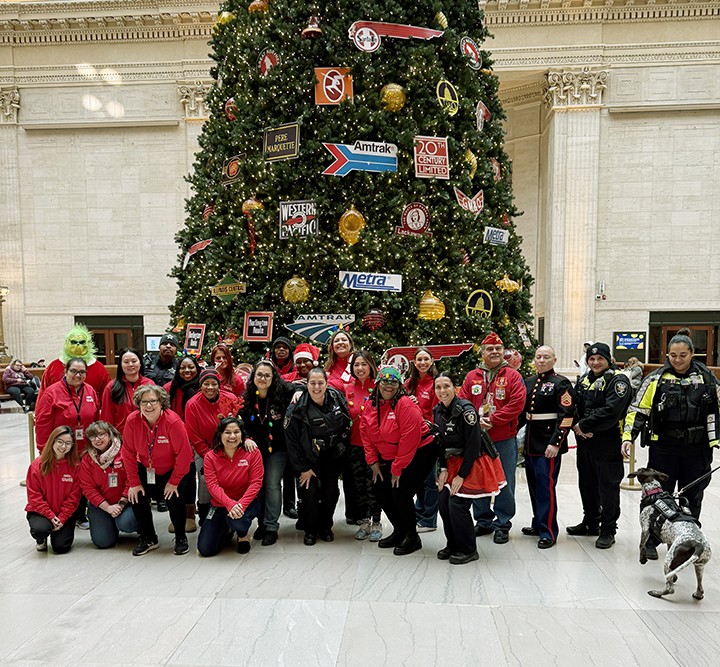
ABOVE: The Metra volunteers who worked the drive at Chicago Union Station and myself celebrated at the end by posing in front of the Christmas tree in the station's Great Hall.


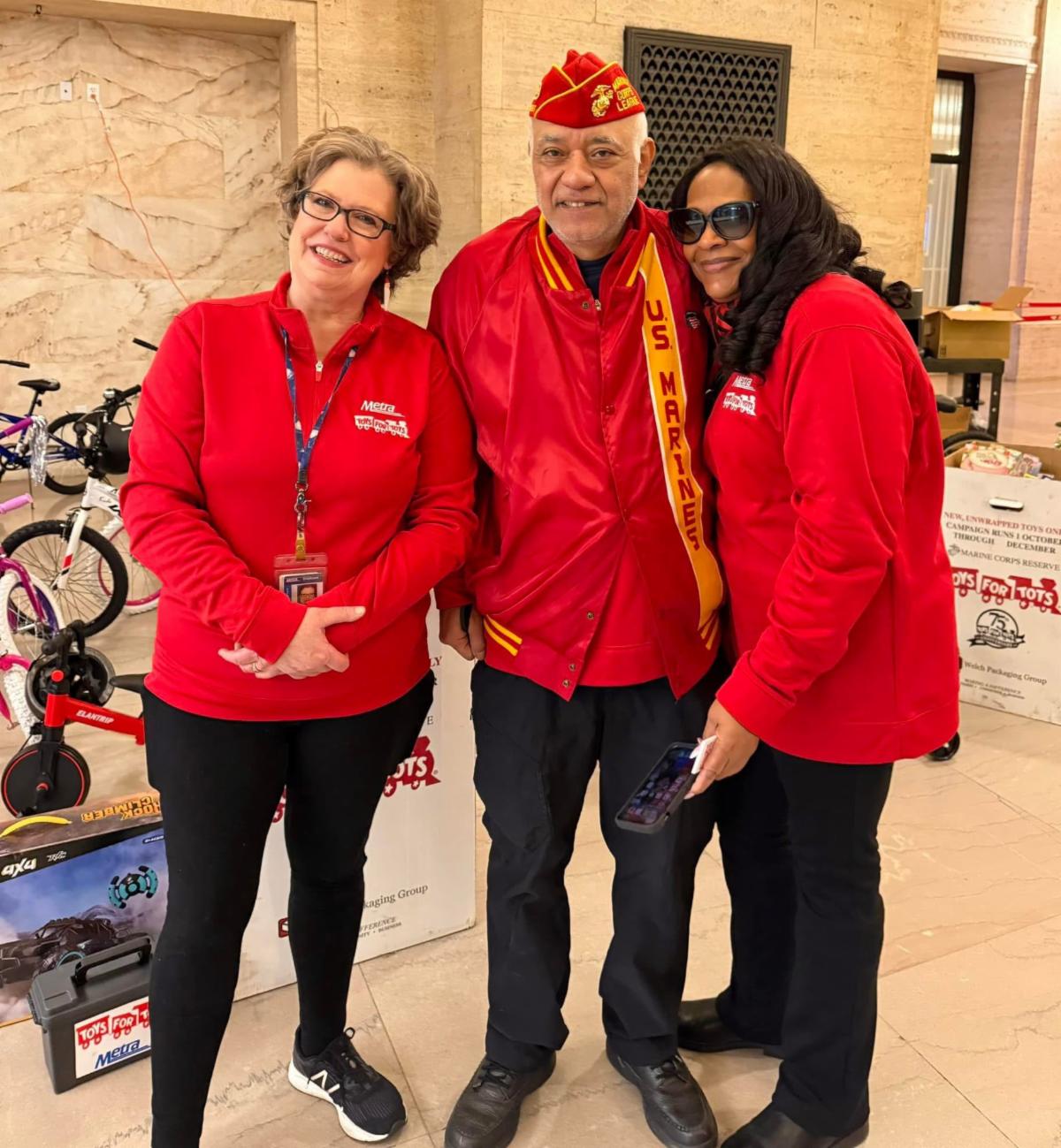
RIGHT: From left, myself, Jose Nateras, a former Marine who works in our Mechanical Department, and Donna Anderson, who works as a Claims Manager in our Law Department.


Meg Thomas-Reile - I'm the public relations manager at Metra, Chicago's commuter railroad, and for the past decade or so, I've been coordinating our Toys for Tots drive. with the U.S. Marine Corps Reserve's Chicagoland branch. The job involves enlisting the volunteers, supplying our yards and downtown stations with the materials and support they need, overseeing the creation and implementation of all the promotional materials and acting as spokesperson during events, which generates coverage from all the local television stations.


On Dec. 10, from 6 a.m. to 9 a.m., about 60 Metra employees, the Marines and I were at our downtown stations collecting toys and money from passengers. Our outlying yard and maintenance facilities brought the toys they collected to the stations to add to the haul, including 18 bikes donated by our machinists. Amtrak employees and the Federal Reserve Police also brought toys to donate. This year we managed to collect 2,857 toys, 80 books and $9,499.43. It's safe to say that in the 13 years we've been hosting this drive that we've collected at least 25,000 toys and raised more than $100,000.


It's a big task and I couldn't do it without the enthusiasm of the group of employees I've managed to assemble. I very proud of what we've been able to do and how we've created a holiday season tradition for our employees and our customers while helping ensure that children across Chicago receive a gift at Christmas time.


An Unforgettable Christmas 40 Years Ago


Bill Kaczor - Wednesday will be the 40th anniversary of my most unforgettable Christmas. I was six months into 21 years as Pensacola correspondent and had stayed up past midnight assembling a pink, pastel blue and white "My Little Pony" Big Wheel trike for our 3-year-old daughter, Anna Rose. I got three or four hours of sleep before the phone rang shortly before 5 a.m. It was the managing editor of the afternoon Pensacola News who told me that bombs had gone off at an abortion clinic and the offices of two gynecologists who performed the procedure. I immediately drove off in search of the crime scenes, all within a couple miles of each other. It was still dark and so foggy that I could barely see much beyond the hood of my car. Fortunately, there wasn't much traffic. The muted blue and red flashing lights of police cars and fire engines helped me find each bombing site in the murk. No one was hurt, but one of the doctor's offices was destroyed and the other seriously damaged. The clinic had only slight damage.


So began the longest continuing story of my AP career. The bombings were only the beginning of anti-abortion violence coverage that played out over the next three decades. It included the murders of two doctors and a clinic volunteer -- the first three people to die from anti-abortion violence in the United States -- and the deaths in prison of one of the killers and another militant.


Police and ATF quickly tracked down four bombers: two 21-year-old men, the wife of one of them and the fiancé of the other, both 18. All attended an Assembly of God church that preached against abortion. They called their conspiracy "The Gideon Project" after the Bible character called upon by God to destroy pagan altars where babies were sacrificed. One of the women held a news conference and said the bombings were "a gift to Jesus on his birthday." A prosecutor called the bombers “terrorists." A defense lawyer said they were "fools for Christ." They were convicted on federal charges of making and using the pipe bombs and conspiracy. Although facing a maximum of up to 65 years, the two men were sentenced to just 10 and released after serving about half that time. The women got probation.


Eight years and a couple months later in March 1993, Dr. David Gunn of Eufaula, Alabama, was gunned down as he arrived at another Pensacola clinic by a 31-year-old chemical plant worker who received a life sentence. About 16 months after that slaying, defrocked Presbyterian minister Paul Hill killed Dr. John Bayard Britton of Jacksonville and retired Air Force officer Jim Barrett while wounding Barrett's wife, June, with blasts from a shotgun as they drove up to the clinic bombed on Christmas Day 1984. The Barretts, both clinic escorts, had driven Britton from the airport. Hill was convicted of murder and sentenced to death.


I was at Florida State Prison's Death Row with AP photographer Mark Foley to interview Hill just two weeks after his sentencing in 1994 and five days before the 10th anniversary of the Christmas bombings, It was a surreal scene. We were in a small, windowed cubicle with an unrepentant murderer while cheery multi-colored lights of a Christmas tree glimmered through the glass. Hill constantly smiled and sometimes laughed, a demeanor that clashed with his chilling words. He said he would be more useful to his cause dead than alive and predicted his martyrdom would incite more violence against abortion providers. He said he hoped his mandatory appeal would fail and that he would be executed. It took nearly another nine years, but he got his wish in September 2003.


One of the people I interviewed on Christmas Day 1984 was John Burt, a burly, bearded, gruff ex-Marine and former Klansman, who was the one constant throughout Pensacola's anti-abortion violence. He led protests and a clinic invasion that injured the facility's director and a volunteer. He helped another would-be bomber case a clinic, unknowingly he claimed and a judge believed him. Burt also ran Our Father's House, which began as a haven for unwed mothers before morphing into a boarding school for troubled teenage girls. Five months before Hill's execution, Burt was arrested on charges of molesting one of his students. He then was convicted and died in prison about three weeks after I retired in 2013.


Forty years after the bombings, there are no abortion clinics left in Pensacola and Florida has outlawed the procedure beyond six weeks after conception, which is before many women realize they are pregnant. Fifty-seven percent of Florida voters in November favored a ballot proposal that would have allowed abortion until viability -- about 20 to 25 weeks -- but it fell short of the required 60 percent. The Chiristmas bombers finally have their wish -- at least until the next election. My daughter's Christmas trike is long gone. She now tools around in a red Buick Verano. Most other Christmases have faded from my memory, but I'll never forget the tinkling of a phone bell and racing to see what was the matter on that foggy winter's morning in 1984.


Your blogs and columns


Steve Paulson - I’m not sure this qualifies as a blog, per se, because I do not often update it. I set up the web page stevenpaulson.com after some folks on Facebook said no one could have had all the experiences I had as a journalist. It is long and boring, but I wanted to document dates, times, places and photos so readers could check it out for themselves. I have a lot of people to thank for this: former Orlando Sentinel photo chiefs and AP alums Frank Russell and Gene Blythe (Connecting Members) who gave me months with pay to travel the world for the Orlando Sentinel, and former AP correspondent Jim Clark, a former Sentinel editor, who helped me get a job at the AP (long story short, I took the test in Miami, told them I was going to Raleigh, the Miami bureau chief said it did not work that way, I was going on the circular, and two weeks later I was in Raleigh after General Manager Keith Fuller approved me as a level five salary reporter to replace a level 2). I also want to thank the late AP Vice President Wick Temple for guiding me through the AP bureaucracy (don’t do paper!). And former AP President and CEO Lou Boccardi, who gave me the job on my bucket list as foreign correspondent in Japan. Lou thanked me for writing my own AP newsletter for the Raleigh staff as news editor, but gently reminded me when I tried to point out that affect was a verb and effect was a noun. He noted effect could also be a verb, as in “Steve Paulson is trying to effect a change in the Raleigh report.” Yes, Lou, I still remember and I still have your letter. When I posted a photo on Facebook of a photo of me getting down from a jet after a flight with the Blue Angels, one person posted, ``You lucky bastard.’’ Yes, I have been one ``lucky bastard.’’


-0-


Jim Carrier - I was busy in 2024 writing about the nuclear arms race in The Progressive magazine. This issue has received very little coverage, except in the NYTimes oped section.


Here are links to two of the four pieces: click here and here.


-0-


Jim Hood - Here's something your many bloggers and working "retirees" might be interested in. Whenever there is a breaking story that affects consumers, I take the opportunity to give APNews.com a plug.


"You can keep up to date with the latest developments here," our story on the government shutdown advises. The "here" link of course, goes to APNews.com.


Doesn't cost anybody anything and maybe drives a few clicks AP's way.


Connecting sky shots

Diana Heidgerd - Spectacular sunset Thursday at Panama City Beach, Florida. Taken from our hotel room's 14th floor balcony. 

Nick Ut - Sunset in Huntington Beach; very beautiful weather this weekend.

Marc Wilson - Sunset Sunday at Manasota Key, Florida. 

Connecting wishes Happy Birthday

Donna Bryson


Mitch Stacy

Stories of interest


Trump signals plans to use all levers of power against the media (Washington Post)


By Sarah Ellison and Jeremy Barr


For many years, Donald Trump repeatedly threatened to sue the press but often didn’t follow through. When he did, he almost always lost.


But Trump’s recent settlement with ABC News and a cascade of lawsuits and other complaints against media entities from him and his allies signal a ramped-up campaign from the president-elect. Together, the action has spurred concerns that his efforts could drastically undermine the institutions tasked with reporting on his coming administration, which Trump has promised will take revenge on those he perceives as having wronged him.


“The law in this country hasn’t really changed, but what has changed is that the atmosphere and hostility to the press is intense, and that emboldens plaintiffs of all kinds,” said David Korzenik, a media defense lawyer at the boutique Miller Korzenik Sommers Rayman LLP.


The pressure from Trump and his allies on the media is already growing and will continue to intensify, according to two Trump aides who spoke on the condition of anonymity to share sensitive internal deliberations.


Read more here. Shared by Myron Belkind, Dennis Conrad.


-0-


Ukrainians Mourn the Loss of a Young Journalist and Her Stories (New York Times)


By Maria Varenikova

Reported from Kyiv, Ukraine


Viktoria Roshchyna reported from places most other Ukrainian journalists would not go. She was one of the last to report openly from the territory in Ukraine forcibly taken by Russian troops. And then she went further and entered Russia.


Ms. Roshchyna, known as Vika, was arrested her father said, and died in September, more than a year later. The circumstances of her death remain unclear, as is what she intended to do in Russia. Some have suggested she planned to travel through Russia into occupied Ukraine. She was 27.


Ukrainians have widely mourned Ms. Roshchyna’s death, for the tragic loss of a young life, but also because of the stories she wrote from parts of the country where many had been forced to flee, losing everything. Her stories had been an important lifeline for them.


Ms. Roshchyna was known as a brave, stubborn and driven journalist. Soon after Russia’s full-scale invasion of Ukraine in February 2022, she joined a humanitarian convoy and tried to cross into the besieged southeastern port city of Mariupol, as almost everyone else was trying to leave. Russian forces captured her in March. They released her a week later, after beating her, she said.


Read more here. Shared by Richard Chady.


-0-


What Broadway Gets Right and Wrong About Journalism (New York Times)


By Sarah Bahr

Sarah Bahr has never seen an editor conga line in a newsroom, but she enjoyed the one in the 2019 Broadway production of “Ink.”


One can hardly blame people for believing journalists have questionable ethics.


The portrayal that is ubiquitous across pop culture isn’t flattering: A striving workaholic who sleeps with a source (“Richard Jewell”). A narcissist willing to put people’s lives on the line to get a story (“Die Hard”). A nosy witch who relies on gossip instead of fact (Rita Skeeter in “Harry Potter”).


Four stage productions I saw this year in New York City have piled on to this less-than-flattering depiction of my profession.


The reporters onstage were in desperate need of a course in journalistic ethics. They were manipulative (“Yellow Face”). They had an agenda (“McNeal”). They didn’t identify themselves as journalists (“Safety Not Guaranteed,” a musical based on the film of the same name), and they misrepresented their reporting experience (“Breaking the Story”).


Any one of these characters would be fired, or, at least, one would hope, disciplined for their behavior. For me, watching fictional journalists scheme their way to scoops is akin to what I imagine it must feel like for doctors to watch “Grey’s Anatomy.”


Read more here. Shared by Lou Boccardi.


-0-


A Solstice of the Soul - For his next trick, your cosmic correspondent for the past quarter-century will (try to) retire. (New York Times)


By Dennis Overbye


As the day shrinks into its annual darkness, here’s what I know about the cosmos — so far.


For an instant of cosmic time you are the center of the universe, wondering where everybody is going and why, as trillions of galaxies, smudges of light and possibility, recede. You trust that the steady rise and fall of stars heralds order, only to be ambushed by surprise and confusion.


For the last quarter-century, I have been privileged to ride on a vertiginous wave of awe and terror. Armed with the coolest business card in journalism, identifying me as the “cosmic affairs correspondent” of The New York Times, I descended into the bowels of the Large Hadron Collider in Geneva, froze on stormy mountaintops in Mexico and drank in glittery star fields on peaks in Chile and Hawaii. I lectured about Albert Einstein in Hong Kong and Berlin and despaired as I wandered the muddy rubble of the World Trade Center after Sept. 11.


Now, I am retiring from The Times and must relinquish that business card, although not the mission behind it. I will continue to appear in these pages from time to time and work on a book trying to marry the personal and the cosmic.


This gig provided me with a thrilling vista of history and science. Researchers and the rest of us heard black holes colliding, spreading ripples through the fabric of space-time, and saw them staring like smoke rings from the hearts of galaxies — trap doors into the end of time. After 50 years and $10 billion, physicists finally discovered the Higgs boson (or “God particle”). It was the missing key to physicists’ best, but still unsatisfying, theory of nature yet, called the Standard Model.


Read more here. Shared by Michael Rubin, Len Iwanski.


AP classes, by the year...


(EDITOR'S NOTE: This is a listing of Connecting colleagues who have shared the year and the bureau where they started with the AP. If you would like to share your own information, I will include it in later postings. Current AP staffers are also welcome to share their information.)


1951 - Norm Abelson (Boston)


1953 – Charles Monzella (Huntington, WVa)


1955 – Henry Bradsher (Atlanta), Paul Harrington (Boston), Joe McGowan (Cheyenne)


1957 - Louis Uchitelle (Philadelphia)


1958 – Roy Bolch (Kansas City)


1959 – Charlie Bruce (Montgomery)


1960 – Claude Erbsen (New York), Carl Leubsdorf (New Orleans)


1961 – Peter Arnett (Jakarta, Indonesia), Strat Douthat (Charleston. WVa), Warren Lerude (San Diego), Ed Staats (Austin)


1962 – Paul Albright (Cheyenne), Malcolm Barr Sr. (Honolulu), Myron Belkind (New York), Dave Mazzarella (Newark), Peggy Simpson (Dallas), Kelly Smith Tunney (Miami)


1963 – Hal Bock (New York), Jeff Williams (Portland OR)


1964 – Rachel Ambrose (Indianapolis), Larry Hamlin (Oklahoma City), John Lengel (Los Angeles), Ron Mulnix (Denver), Lyle Price (San Francisco), Lew Simons (New York), Arlene Sposato (New York), Karol Stonger (Indianapolis), Hilmi Toros (New York)


1965 – Bob Dobkin (Pittsburgh), Harry Dunphy (Denver), John Gibbons (New York), Bob Greene (Kansas City), Jim Luther (Nashville), Larry Margasak (Harrisburg), Rich Oppel (Tallahassee)


1966 – Shirley Christian (Kansas City), Mike Doan (Portland, OR), Edie Lederer (New York), Nancy Shipley (Nashville), Mike Short (Los Angeles), Marty Thompson (Seattle), Nick Ut (Saigon), Kent Zimmerman (Chicago)


1967 – Dan Berger (Los Angeles), Adolphe Bernotas (Concord), Lou Boccardi (New York), Linda Deutsch (Los Angeles), Don Harrison (Los Angeles), Frank Hawkins (New York), Doug Kienitz (Cheyenne), David Liu (New York), Bruce Lowitt (Los Angeles), Chuck McFadden (Los Angeles), Martha Malan (Minneapolis), Bill Morrissey (Buffalo), Larry Paladino (Detroit), Michael Putzel (Raleigh), Bruce Richardson (Chicago), Richard Shafer (Baltimore), Victor Simpson (Newark), Michael Sniffen (Newark), Kernan Turner (Portland, Ore)


1968 – Lee Balgemann (Chicago), John Eagan (San Francisco), Joe Galu (Albany/Troy), Peter Gehrig (Frankfurt), Charles Hanley (Albany), Jerry Harkavy (Portland, Maine), Herb Hemming (New York), Brian King (Albany), Samuel Koo (New York), Karren Mills (Minneapolis), Michael Rubin (Los Angeles), Rick Spratling (Salt Lake City), Barry Sweet (Seattle)


1969 - Ann Blackman (New York), Ford Burkhart (Philadelphia), Harry Cabluck (Pittsburgh), Dick Carelli (Charleston, WVa), Dennis Coston (Richmond), Ron Frehm (New York), Mary V. Gordon (Newark), Daniel Q. Haney (Portland, Maine), Mike Harris (Chicago), Brad Martin (Kansas City), David Minthorn (Frankfurt), Cynthia Rawitch (Los Angeles), Bob Reid (Charlotte), Mike Reilly (New York), Doug Tucker (Tulsa), Bill Wertz (Minneapolis), Bill Winter (Helena)


1970 – Richard Boudreaux (New York), David Briscoe (Manila), Sibby Christensen (New York), Richard Drew (San Francisco), Bob Egelko (Los Angeles), Steve (Indy) Herman (Indianapolis), Tim Litsch (New York), Lee Margulies (Los Angeles), Chris Pederson (Salt Lake City), Brendan Riley (San Francisco), Larry Thorson (Philadelphia)


1971 – Harry Atkins (Detroit), Jim Bagby (Kansas City), Larry Blasko (Chicago), Jim Carlson (Milwaukee), Jim Carrier (New Haven), Chris Connell (Newark), Bill Gillen (New York), Bill Hendrick (Birmingham), John Lumpkin (Dallas), Kendal Weaver (Montgomery)


1972 – Hank Ackerman (New York), Rod Davis (Dallas), Bob Fick (St. Louis), Joe Frazier (Portland, Ore.), Terry Ganey (St. Louis), Mike Graczyk (Detroit), Denis Gray (Albany), Lindel Hutson (Little Rock), Brent Kallestad (Sioux Falls), Tom Kent (Hartford), Nolan Kienitz (Dallas), Kent Kilpatrick (Detroit), Andy Lippman (Phoenix), Ellen Miller (Helena), Mike Millican (Hartford), Bruce Nathan (New York), Ginny Pitt Sherlock (Boston), Lew Wheaton (Richmond)


1973 - Jerry Cipriano (New York), Susan Clark (New York), Norm Clarke (Cincinnati), Marty Crutsinger (Miami), Steve Fox (Los Angeles), Joe Galianese (East Brunswick), Merrill Hartson (Richmond), Mike Hendricks (Albany), Tom Journey (Tucson), Steve Loeper (Los Angeles), Jesus Medina (New York), Tom Slaughter (Sioux Falls), Jim Spehar (Denver), Paul Stevens (Albany), Jeffrey Ulbrich (Cheyenne), Owen Ullmann (Detroit), Suzanne Vlamis (New York), John Willis (Omaha), Evans Witt (San Francisco)


1974 – Norman Black (Baltimore), David Espo (Cheyenne), Dan George (Topeka), Robert Glass (Philadelphia), Steve Graham (Helena), Tim Harper (Milwaukee), Elaine Hooker (Hartford), Sue Price Johnson (Charlotte), Dave Lubeski (Washington), Janet McConnaughey (Washington), Lee Mitgang (New York), Barry Shlachter (Tokyo), Bud Weydert (Toledo), Marc Wilson (Little Rock) 


1975 – Peter Eisner (Columbus), Charles Hill (Charlotte), Jim Limbach (Washington), Bill McCloskey (Washington), David Powell (New York), Eileen Alt Powell (Milwaukee)


1976 – Brad Cain (Chicago), Judith Capar (Philadelphia), Dick Chady (Albany), Steve Crowley (Washington), David Egner (Oklahoma City), Marc Humbert (Albany), Steven Hurst (Columbus), Richard Lowe (Nashville), Mike Mcphee (Boston), John Nolan (Nashville), Guy Palmiotto (New York), Charlotte Porter (Minneapolis), Chuck Wolfe (Charlotte)


1977 – Bryan Brumley (Washington), Robert Burns (Jefferson City), Charles Campbell (Nashville), Carolyn Carlson (Atlanta), Dave Carpenter (Philadelphia), Solange De Santis (New York), Jim Drinkard (Jefferson City), Ken Herman (Dallas), Mike Holmes (Des Moines), Brad Kalbfeld (New York), Larry Kilman (Atlanta), Scott Kraft (Jefferson City), John Kreiser (New York), Peter Leabo (Dallas), Kevin LeBoeuf (Los Angeles), Ellen Nimmons (Minneapolis), Dan Sewell (Buffalo), Estes Thompson (Richmond), David Tirrell-Wysocki (Concord)


1978 – Vinnie D'Alessandro (Hartford), Tom Eblen (Louisville), Ruth Gersh (Richmond), Monte Hayes (Caracas), Doug Pizac (Los Angeles), Charles Richards (Dallas), Reed Saxon (Los Angeles), Steve Wilson (Boston)


1979 – Jim Abrams (Tokyo), Peter Banda (Albuquerque), Brian Bland (Los Angeles), Scotty Comegys (Chicago), John Daniszewski (Philadelphia), Frances D’Emilio (San Francisco), Pat Fergus (Albany), Brian Friedman (Des Moines), Sally Hale (Dallas), Susana Hayward (New York), Jill Lawrence (Harrisburg), Warren Levinson (New York), Barry Massey (Kansas City), Phillip Rawls (Nashville), John Rice (Carson City), Linda Sargent (Little Rock), Joel Stashenko (Albany), Robert Wielaard (Brussels)


1980 – Alan Adler (Cleveland), Christopher Bacey (New York), Diane M. Balk (Indianapolis), Jeff Barnard (Providence), Mark Duncan (Cleveland), Bill Kaczor (Tallahassee), Mitchell Landsberg (Reno), Kevin Noblet (New Orleans), Lee Perryman (Tampa), Jim Rowley (Baltimore), David Speer (Jackson), Hal Spencer (Providence), Jo Steck (Los Angeles), Carol J. Williams (Seattle)


1981 – Paul Davenport (Phoenix), Dan Day (Milwaukee), John Flesher (Raleigh), Debra Hale-Shelton (Little Rock), Len Iwanski (Bismarck), Ed McCullough (Albany), Drusilla Menaker (Philadelphia), Kim Mills (New York), Mark Mittelstadt (Des Moines), Roland Rochet (New York), Lee Siegel (Seattle), Marty Steinberg (Baltimore), Bill Vogrin (Kansas City)


1982 – Dorothy Abernathy (Little Rock), Al Behrman (Cincinnati), Tom Cohen (Jefferson City), John Epperson (Chicago), Ric Feld (Atlanta), Kiki Lascaris Georgio (New York), Nick Geranios (Helena), Mike Gracia (Washington), Howard Gros (New Orleans), Dan Juric (East Brunswick), Robert Kimball (New York), Rob Kozloff (Detroit), Bill Menezes (Kansas City), David Ochs (New York), Eric Risberg (San Francisco), Cecilia White (Los Angeles)


1983 – Elise Amendola (Boston), Edward L. Birk (Boston), Donna Cassata (Albany), Scott Charton (Little Rock), Sue Cross (Columbus), Mark Elias (Chicago), Doug Fisher (Columbus), Alan Fram (Newark), David Ginsburg (Washington), Lisa Hamm-Greenawalt, Diana Heidgerd (Miami), Sheila Norman-Culp (New York), Carol Esler Ochs (New York), Jim Reindl (Detroit), Amy Sancetta (Philadelphia), Rande Simpson (New York), Dave Skidmore (Milwaukee), Barbara Worth (New York)


1984 – David Beard (Chicago), Owen Canfield (Oklahoma City), Wayne Chin (Washington), Jack Elliott (Oklahoma City), Candice Hughes (Dallas), Danny Johnston (Little Rock), Kelly P. Kissel (New Orleans), Joe Macenka (Richmond), Eva Parziale (San Francisco), Walt Rastetter (New York), Malcolm Ritter (New York), Keith Robinson (Columbus), Cliff Schiappa (Kansas City), David Sedeño (Dallas), Andrew Selsky (Cheyenne), Patty Woodrow (Washington)


1985 – George Garties (Los Angeles), Beth Grace (Columbus), Betty Kumpf Pizac (Los Angeles)


1986 – Joni Baluh Beall (Richmond), David Beard (Jackson), Tom Coyne (Columbia, SC), Dave DeGrace (Milwaukee), Alan Flippen (Louisville), Jim Gerberich (San Francisco), Howard Goldberg (New York), Mark Hamrick (Dallas), Sandy Kozel (Washington), Arlene Levinson (Boston), Robert Meyers (London), David Morris (Harrisburg), Susan Ragan (New York), Bob Seavey (Lima), Barbara Woike (New York)


1987 – Donna Abu-Nasr (Beirut), Jim Anderson (Mexico City), Dave Bauder (Albany), Bob Bellafiore (Albany), Chuck Burton (Charlotte), Beth Harris (Indianapolis), Lynne Harris (New York), Steven L. Herman (Charleston, WVa), Elaine Kurtenbach (Tokyo), Rosemarie Mileto (New York), John Rogers (Los Angeles)


1988 – Chris Carola (Albany), Peg Coughlin (Pierre), Frank Eltman (New York), Kathy Gannon (Islamabad), Steve Hart (Washington), Melissa Jordan (Sioux Falls), Bill Pilc (New York), Kelley Shannon (Dallas)


1989 – Charlie Arbogast (Trenton), Susan Boyle (New York), Ted Bridis (Oklahoma City), Paul Randall Dickerson (Nashville), Ron Fournier (Little Rock), Ann Gibson (Richmond)


1990 – Frank Fisher (Jackson), Dan Perry (Bucharest), Steve Sakson (Baltimore), Sean Thompson (New York)


1991 – Amanda Kell (Richmond), Santiago Lyon (Cairo), Lisa Pane (Hartford), Wayne Partlow (Washington), Ricardo Reif (Caracas), Bill Sikes (Buffalo)


1992 – Emery P. Dalesio (Trenton), Jennifer Garske (Washington), Kerry Huggard (New York)


1993 – Jim Salter (St. Louis)


1994 - Glen Johnson (Boston)


1995 – Elaine Thompson (Houston), Donna Tommelleo (Hartford)


1996 – Patricia N. Casillo (New York), John Khin (New York)


1997 – J. David Ake (Chicago), Martha Bellisle (Carson City), Pamela Collins (Dallas), Rachel La Corte (Miami), Madhu Krishnappa Maron (New York), Jim Suhr (Detroit), Jennifer Yates (Baltimore)


1998 – Alan Clendenning (New Orleans), Guthrie Collin (Albany), David Koenig (Dallas), Mitch Stacy (London)


1999 – Melinda Deslatte (Raleigh), Laura Rauch (Las Vegas), Terry Spencer (Miami)


2000 – Carrie Antlfinger (Milwaukee), Gary Gentile (Los Angeles), Tom Tait (Las Vegas)


2001 - Mike Weissenstein (New York)


2003 - Valerie Komor (New York)


2004 - Jim Baltzelle (Dallas)


2005 – Ric Brack (Chicago), Frank Jordans (London)


2006 – Jon Gambrell (Little Rock)


2008 - Steve Braun (Washington)


2011 - Joseph B. Frederick (New York)


2013 - Alex Sanz (Atlanta)

Today in History - Dec. 23, 2024

By The Associated Press

Today is Monday, Dec. 23, the 358th day of 2024. There are eight days left in the year.


Today in history:


On Dec. 23, 1972, in an NFL playoff game between the Pittsburgh Steelers and the Oakland Raiders, Steelers running back Franco Harris scored a game-winning touchdown on a deflected pass with less than 10 seconds left in the game. The “Immaculate Reception,” as the catch came to be known, is often cited as the greatest NFL play of all time.


Also on this date:


In 1823, the poem “Account of a Visit from St. Nicholas” was published anonymously in the Troy Sentinel of New York; the verse, more popularly known as “The Night Before Christmas,” was later attributed to Clement C. Moore.


In 1913, the Federal Reserve System was created as President Woodrow Wilson signed the Federal Reserve Act.


In 1941, during World War II, American forces on Wake Island surrendered to Japanese forces.


In 1948, former Japanese Premier Hideki Tojo and six other Japanese war leaders were executed in Tokyo.


In 1968, 82 crew members of the U.S. intelligence ship Pueblo were released by North Korea, 11 months after they had been captured.


In 1986, the experimental airplane Voyager, piloted by Dick Rutan and Jeana (JEE’-nuh) Yeager, completed the first nonstop, nonrefueled round-the-world flight as it returned safely to Edwards Air Force Base in California.


In 2003, a jury in Chesapeake, Virginia, sentenced teen sniper Lee Boyd Malvo to life in prison, sparing him the death penalty.


Today’s Birthdays: Former Emperor Akihito of Japan is 91. Actor-comedian Harry Shearer is 81. Retired U.S. Army Gen. Wesley K. Clark is 80. Actor Susan Lucci is 78. Distance runner Bill Rodgers is 77. Football Hall of Famer Jack Ham is 76. Political commentator William Kristol is 72. Author Donna Tartt is 61. Rock musician Eddie Vedder of Pearl Jam is 60. Actor Finn Wolfhard is 22.


Got a photo or story to share?

Connecting is a daily newsletter published Monday through Friday that reaches 1,900 retired and former Associated Press employees, present-day employees, and news industry and journalism school colleagues. It began in 2013. Past issues can be found by clicking Connecting Archive in the masthead. Its author, Paul Stevens, retired from the AP in 2009 after a 36-year career as a newsman in Albany and St. Louis, correspondent in Wichita, chief of bureau in Albuquerque, Indianapolis and Kansas City, and Central Region vice president based in Kansas City.


Got a story to share? A favorite memory of your AP days? Don't keep them to yourself. Share with your colleagues by sending to Ye Olde Connecting Editor. And don't forget to include photos!


Here are some suggestions:


- Connecting "selfies" - a word and photo self-profile of you and your career, and what you are doing today. Both for new members and those who have been with us a while.


- Second chapters - You finished a great career. Now tell us about your second (and third and fourth?) chapters of life.


- Spousal support - How your spouse helped in supporting your work during your AP career. 


- My most unusual story - tell us about an unusual, off the wall story that you covered.


- "A silly mistake that you make"- a chance to 'fess up with a memorable mistake in your journalistic career.


- Multigenerational AP families - profiles of families whose service spanned two or more generations.


- Volunteering - benefit your colleagues by sharing volunteer stories - with ideas on such work they can do themselves.


- First job - How did you get your first job in journalism?


- Most unusual place a story assignment took you.


Paul Stevens

Editor, Connecting newsletter

paulstevens46@gmail.com