|
|
|
Connecting
Jan. 29, 2024
Click here for sound of the Teletype
| |
|
Colleagues,
Good Monday morning on this Jan. 29, 2024,
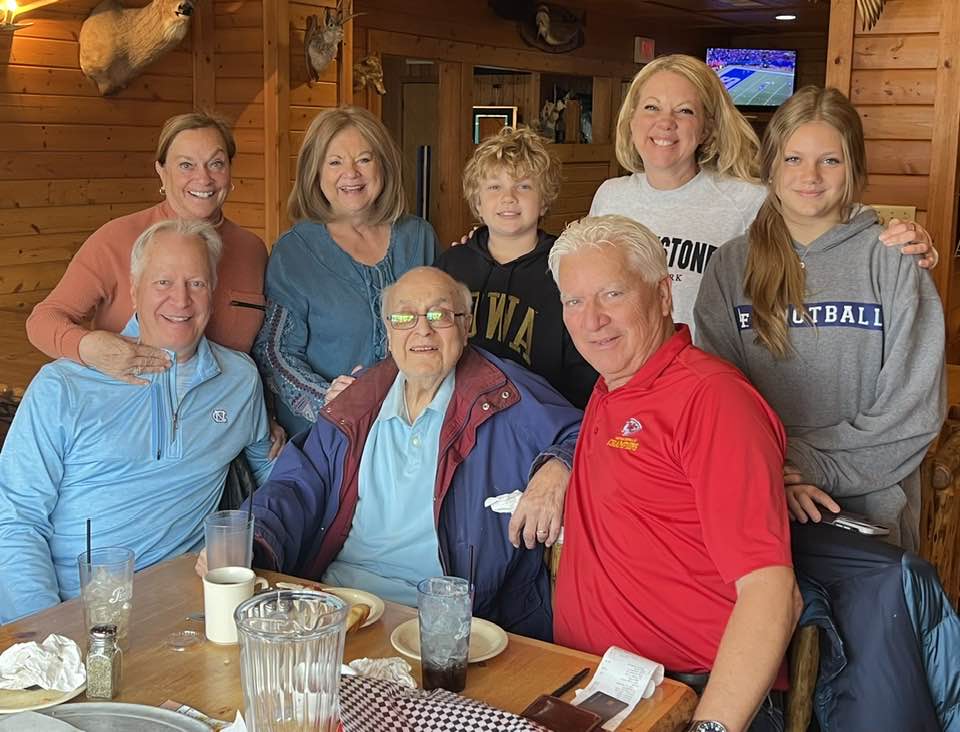
It saddens me to report that Albert Habhab, who was a Connecting colleague and member of our 90s Club, died Saturday night in hospice care at 98. He was part of the Stevens family for 70 years.
| |
At 18, he fought in the Battle of the Bulge and won a Bronze Star for saving a fellow soldier. He was mayor of my hometown, Fort Dodge, Iowa, for 14 years. He was a district court judge and chief judge of the Iowa Court of Appeals.
But to the Stevens clan, he was FAMILY. That’s why I chose this photo of our last meeting with him in October 2022 at Community Tavern. He and his departed wife Janet were great friends to my mom and dad. Al knew my dad since we moved to Fort Dodge in 1954 when dad became managing editor of The Messenger, and Al was the last to visit dad before his death in 2013.
Al was optimistic until the very end - he had made reservations for a 100th birthday celebration at Community Orchard for Sept. 6, 2025. He’ll be there in spirit - we’ll be there in person, the Lord willing.
CHARLES OSGOOD: Doug Pizac -- Yesterday the CBS News Sunday Morning show was a tribute to Charles Osgood who just passed away at age 91. One segment touched on his terrific writing skills. How did he do it? He said, “All words are wrong… except the right one.” Amen.
We lead with memories of two outstanding Associated Press photographers in Africa who recently retired. Combined, Sayyid Azim and Khalil Senosi served the AP for almost 74 years.
Here’s to a great week ahead – be safe, stay healthy, live each day to your fullest.
Paul
Sayyid Azim, Khalil Senosi brought much to AP photo report for decades
| 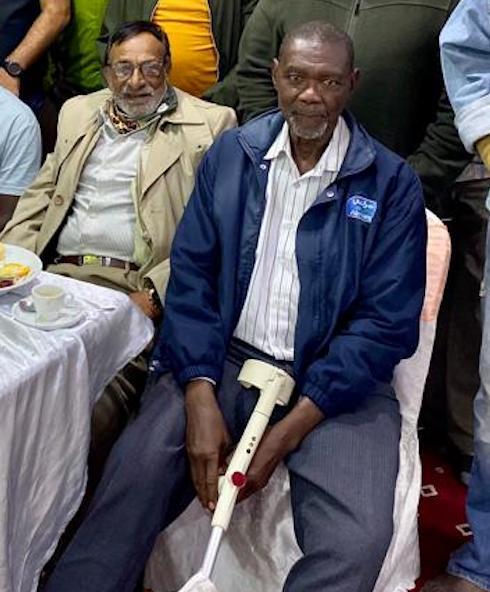 | |
Sayyid Azim, who had 37 years and nine months of AP service, at left, and Khalil Senosi, who had 36 years service.
Sally Stapleton - If the 1980s was the decade when Latin America was frequently on the front pages across the U.S., the '90s belonged to Africa. And I noted the story in week's Connecting, that two of AP's finest visual journalists based in Nairobi, Sayyid Azim and Khalil Senosi retired in January.
They brought so much to the AP report for decades. They both had the ability to access situations others couldn't. And they both produced a body of work that is historically important not only from Kenya but the continent.
Azim and Khalil knew everybody, or at least it seemed so when it really mattered in extreme situations. They both worked through chaos calmly.
Khalil took what to this day is the epic photo of a wounded woman reaching out to another as people scrambled to recover anyone alive at the U.S. embassy in Nairobi following the nearly simultaneous al-Qaida attacks in Dar-es-Salaam, Tanzania and Kenya on Aug. 7, 1998.
Years later, the U.S. Ambassador to Kenya at the time, Prudence Bushnell, reached out to Azim on Facebook asking if she could use photos as "you took stunning photos of the impact of the bombing" she wrote. Azim's response to her made me smile as it's the mantra we were all taught: She'd have to reach out to New York to get permission.
The photo caption and credit:
| 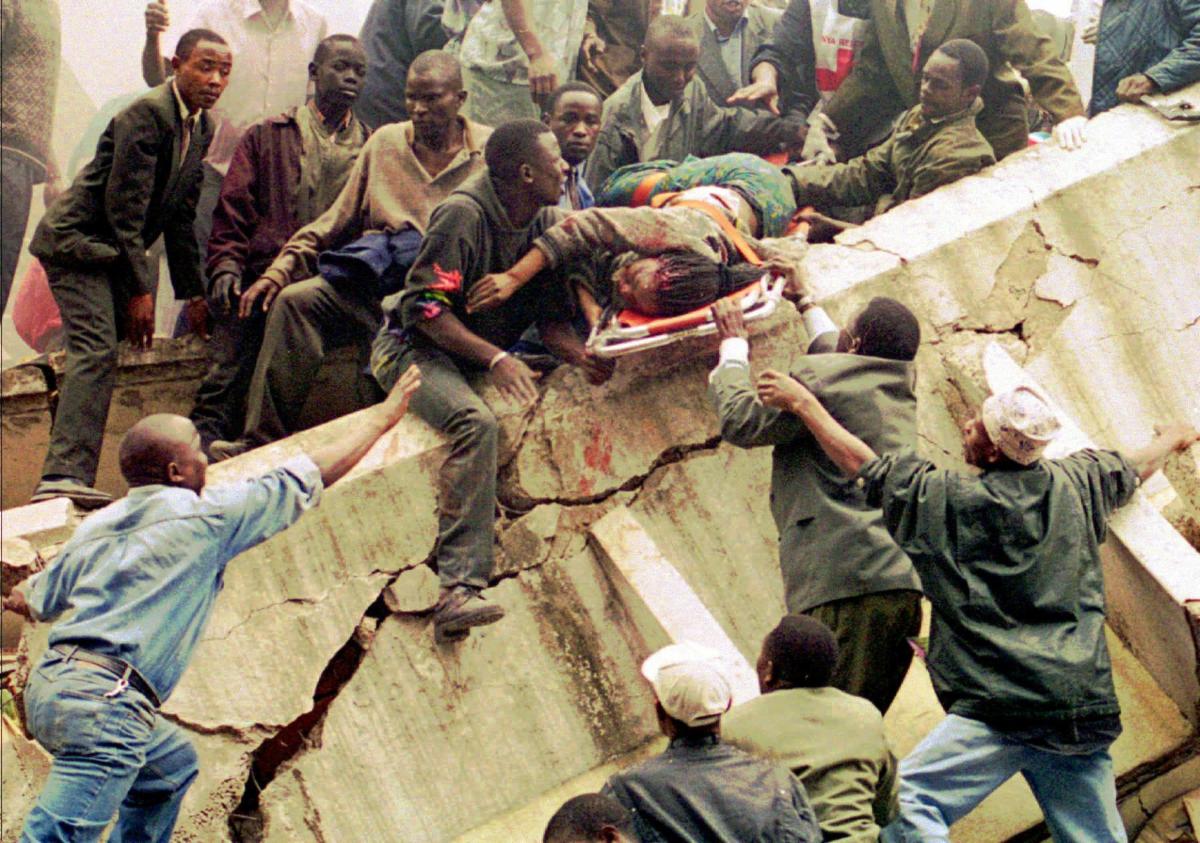 | |
NAIROBI, Kenya, Aug. 7, 1998 -- Rescue workers hoist a woman, rescued from the U.S. Embassy, over the rubble of a collapsed building next to the embassy. (Khalil Senosi/Associated Press)
Azim and Khalil deserve the best in retirement. And the AP deserves credit for being smart enough to hire them.
And this from Jerome Delay, AP Chief Africa Photographer:
“I first met Azim, also known as “Major” by most of his peers, in Addis some 33 years ago. We were covering the fall of the Mengistu regime, Major was working for AP, I was working for AFP. I met Khalil shortly after.
During the years since I joined them in the AP family, we have crossed path on every single major East African story. And never did these two brave AP soldiers fail us. To the contrary, they were instrumental in getting the stories out, either with their massive contacts, invaluable logistical help, and yes, their impressive talent as photojournalists. The invasion of Somalia, the Nairobi Bombings, Rwanda, the Westgate attack, the Dusit D2 attack, post electoral violence, these are just some of front pages the NBO duo scored over the years.
With their departure, AP loses two key figures in its East African operation. Shoes hard to fill.
On datelines - More than a place on a map
Jim Spehar - Here are the opening few graphs of my Sunday column.
Journalism, like most other professions, has its little idiosyncrasies. One of the ways reporters and editors keep themselves entertained is by taking advantage of interesting datelines, the geographic reference at the beginning of a story.
In New Mexico, they might seek out some way to connect their piece to Pie Town or Truth or Consequences. Over in Arizona, the dateline might read Show Low and include an explanation of that town’s moniker. Next door in Utah, Virgin would not be inviolate. Up in Wyoming, it might be Bar Nunn or Ten Sleep. Neighboring Kansas has Osawatomie and Tonganoxie (Daily Sentinel publisher and Kansas native Jay Seaton can double-check the spellings) and there’s Broken Bow in Nebraska.
I’ve passed through many of those burgs, either as a tourist or during my days as a road warrior in various professions. As a recovering journalist I have some appreciation for creative efforts regarding datelines. One just last week brought a fresh chuckle.
Associated Press writer Jesse Bedayn could have chosen 4th Congressional District locales such as Joes or Peetz as the dateline for his story about Rep. Lauren Boebert’s retreat to Colorado’s eastern plains in an attempt to keep Congresswoman as one descriptor among some others that also apply. Instead it was Last Chance, a small community west of Denver at the intersection of highways 36 and 71. (For those of you reaching for a map or Google, Last Chance is a few miles west of Joes on 36 and just south of Woodrow on 71.)
Coincidence? I wonder. Appropriate? Certainly."
Praise for Indiana Hall of Famer Steve Herman
Mike Harris - I was very pleased to hear that Steve Herman was elected to the Indiana Sports Editors Hall of Fame. Steve and I worked together from May of 1970 to July of 1975, with me as state sports editor and Steve as my No. 2. I knew from that start that he could do the job as well or better than I and, when I left for Cleveland in 1975, I knew the job was in good hands for years to come.
We spent many hours working together at the Indianapolis Motor Speedway. There were long, fun sessions coming up with feature ideas for the month of May, great social lunches at the Speedway Motel - the best club sandwiches - and even competitions to see who could complete the crossword in the Indianapolis Star the fastest - we were both pretty good at it.
Steve was one of the best at taking dictation by phone in the days when we had to send stories via computer consoles in the office.
Beyond all that, Steve was a great friend and I have missed hanging out with him over the intervening years. Judy and I send our congratulation to Steve and Sally on this great honor.
-0-
Andy Lippman - I wanted to add my congratulations to Steve Herman, on his selection to the Indiana Hall of Fame for sports writers and sportscasters.
Steve was a "secret weapon" in several of my campaigns to sign up papers in Indiana. His weekly polls were much coveted by sports editors who used UPI, and their pressure often went right to the top of the editorial chain.
Steve's polls were so widely read and discussed that I remember Lou Boccardi calling me to relay a demand to know the reason why a team in his city wasn't listed in the AP high school basketball ranking for that week.
I had no clue, but Lou said, "I'll hold." So I had to put Lou on hold and find Steve who calmly explained his rationale. That worked for me, and for Lou, and apparently for the publisher (As Dr. Seuss famously exclaimed, "Oh the places we go and the people we meet.")
Steve Herman was the law when it came to high school rankings and he came to the position through a lot of poring over scores - a skill highly in demand in basketball-crazed Indiana.
Hank Lowenkron and later Beth Harris were his partners in covering Indiana sports, and they teamed well.
Steve, thanks and congratulations from a grateful former chief of bureau.
What happened at the nation’s first nitrogen gas execution: An AP eyewitness account
| |
BY KIM CHANDLER
ATMORE, Ala. (AP) — As witnesses including five news reporters watched through a window, Kenneth Eugene Smith, who was convicted and sentenced to die in the 1988 murder-for hire slaying of Elizabeth Sennett, convulsed on a gurney as Alabama carried out the nation’s first execution using nitrogen gas.
Critics who had worried the new execution method would be cruel and experimental said Smith’s final moments Thursday night proved they were right. Alabama Attorney General Steve Marshall, however, characterized it on Friday as a “textbook” execution.
Here is an eyewitness account of how it unfolded. Times, unless otherwise noted, are according to a clock on the execution chamber wall at the William C. Holman Correctional Facility.
MASK CHECK
The curtains between the viewing room and the execution chamber opened at 7:53 p.m. Smith, wearing a tan prison uniform, was already strapped to the gurney and draped in a white sheet.
A blue-rimmed respirator mask covered his face from forehead to chin. It had a clear face shield and plastic tubing that appeared to connect through an opening to the adjoining control room.
Read more here.
Remembering Roger Donlon
| |
|
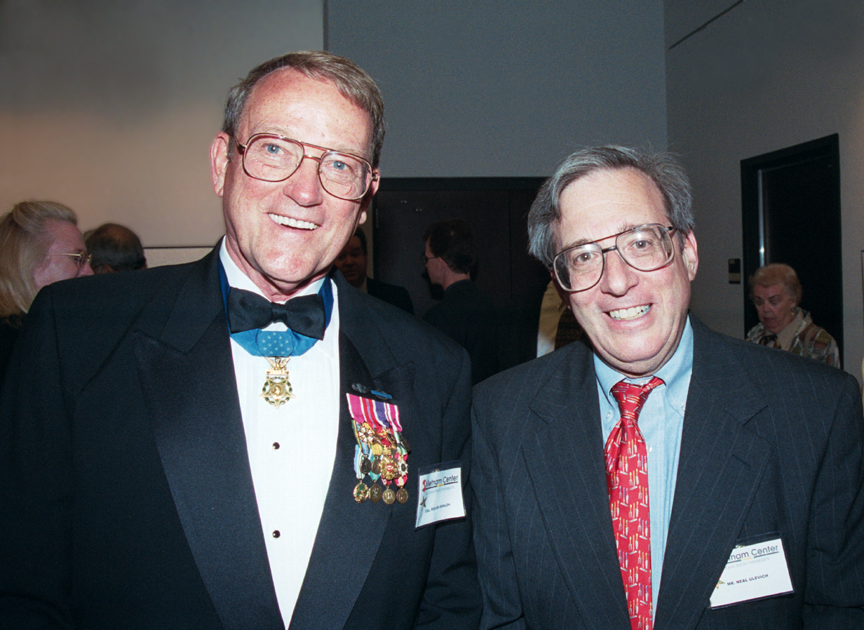
Neal Ulevich - Roger Donlon, a Special Forces officer and the first American to win the Congressional Medal of Honor in the Vietnam War, died January 25. He was 89. Donlon won the Medal of Honor for leading his men and supporting aircraft in a defense of a rural outpost near the Laos border in 1964. He suffered multiple wounds in repelling the attack. I met him at a Vietnam Center conference at Lubbock in 2002.
AP sighting - in New York Public Library
| |
|
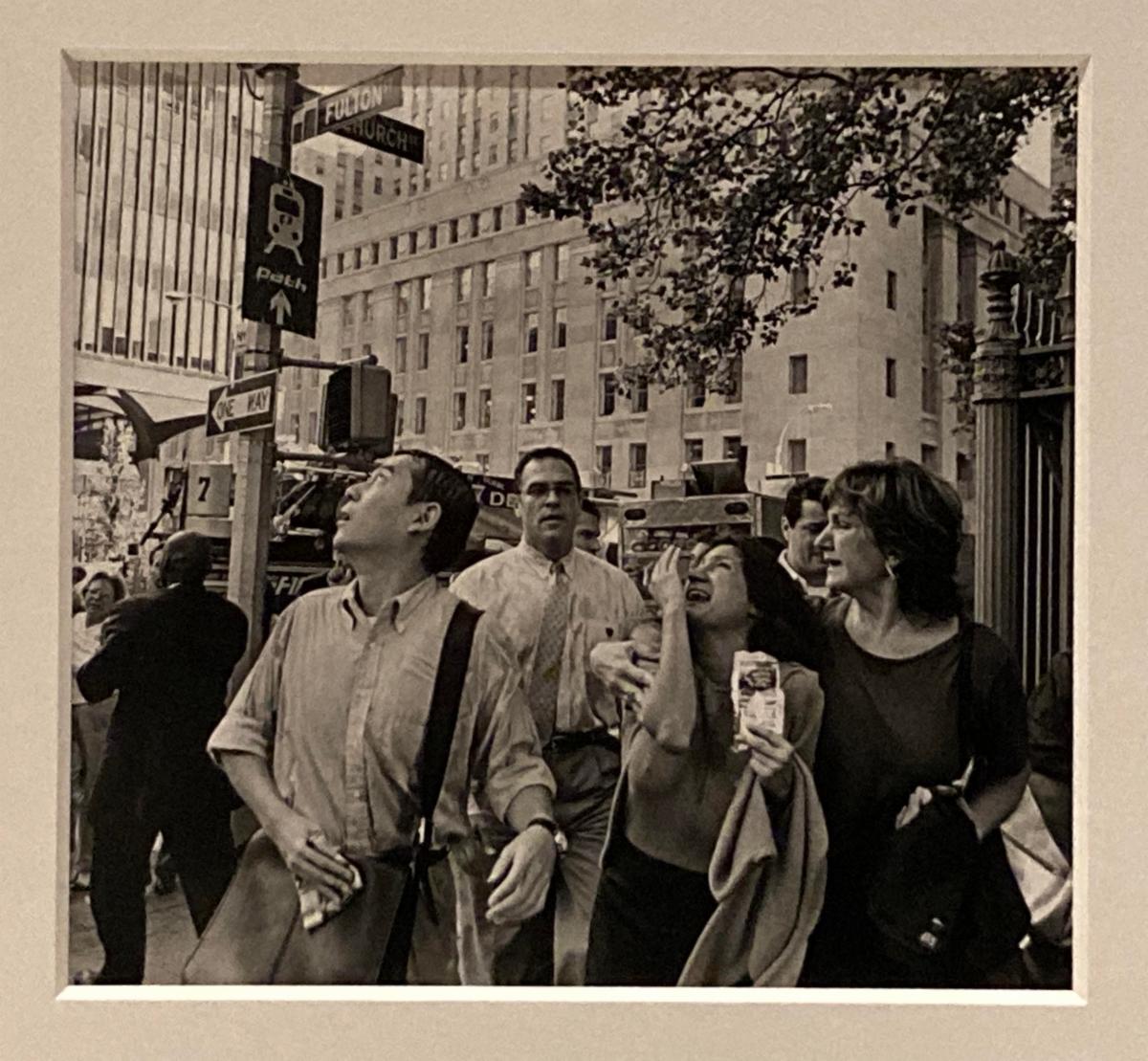
Malcolm Ritter - The New York City Public Library is exhibiting some of its treasures, including a writing desk used by Charles Dickens, pages of musical scores handwritten by Mozart and Beethoven, the stuffed toys that inspired the Winnie the Pooh stories … and an AP photo.
The 9/11 scene was shot by Gulnara Samoilova, who worked as an AP photographer from 1994 to 2003. Her 9/11 work won a prestigious World Press Photo award.
BEST OF THE WEEK — FIRST WINNER
Modi opens Hindu temple built on ruins on razed mosque, in political triumph for prime minister
| |
|
AP’s team in India provided visually compelling, richly reported, all-format coverage of one of the country’s most defining and contentious events, the opening of a controversial Hindu temple built on a razed mosque.
When Indian Prime Minister Narendra Modi opened a controversial Hindu temple, it marked a political triumph for the populist leader under whose watch the line between religion and state has largely eroded in the constitutionally secular country. The temple, dedicated to Hinduism’s most revered deity Lord Ram, sits on a site where Hindu mobs tore down a mosque three decades ago, its fraught history still an open wound for many Muslims.
The challenge before the India team was to capture the enormous political and religious significance, and social sensitivity, of the event ahead of the upcoming national elections. AP’s cross-format team in Delhi and on ground in Ayodhya provided visually rich and nuanced coverage that was both thoughtful and insightful. Smart planning and seamless execution helped the AP deliver a comprehensive package of spot stories, analysis and an explainer that captured not only the pomp-filled ceremony that signified a key moment in India’s history, but also the critical context.
Photographer Rajesh Kumar Singh was the only international photographer who managed to secure access to the high-security temple complex to exclusively cover the select gathering of invitees and arrival of Modi. AP was first among the global agencies to file self-shot images of the event while other agencies had to rely on handout images.
Read more here.
BEST OF THE WEEK — SECOND WINNER
Global audiences ride aboard secretive Ukraine war surveillance flight thanks to Only-on-AP exclusive
| 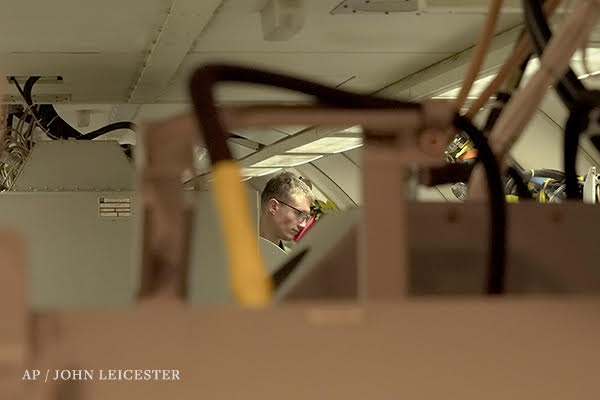 | |
Dogged source-building by Paris Chief Correspondent John Leicester secured rare and exclusive access for AP aboard a secretive French military surveillance flight to the frontiers of the Ukraine war. Over a 10-hour flight, as the only journalist on board, Leicester crafted an extraordinary all-formats report to illustrate how the NATO military alliance is watching Russian aggression like a hawk and scooped even France’s government-supported national news agency in the process.
Leicester’s previous trust-building reporting with the French military, including competition-beating coverage of France’s secretive training of Ukrainian troops, helped him negotiate with French officers, convincing them to let him work freely in the tight confines of the aircraft where surveillance equipment marked “secret” and classified documents couldn’t be shown. In difficult conditions for shooting — cramped, extremely noisy, with challenging lighting and French military security concerns — Leicester filmed video, took photographs and conducted interviews for text, serving all AP clients and audiences and even managing a to-camera stand-up for digital video, shot with a GoPro in his flight suit from 34,000 feet.
Read more here.
Stories of interest
The News Business Really Is Cratering (Politico Magazine)
By JACK SHAFER
Journalists across the country burst into flames of panic this week, as bad news for the news business crested and erupted everywhere all at once.
Patrick Soon-Shiong, the billionaire publisher of the Los Angeles Times, laid off 20 percent of his newsroom. Over at Time magazine, its billionaire owners, Marc and Lynne Benioff, did the same for 15 percent of their unionized editorial employees. This latest conflagration had ignited at Sports Illustrated the previous week as catastrophic layoffs were dispensed via email to most staffers. Business Insider (whose parent company Axel Springer also owns POLITICO) jettisoned 8 percent of its staff while workers at Condé Nast, Forbes, the New York Daily News and elsewhere walked out to protest forthcoming cuts at their shops.
The news business has always been cyclical, dipping during economic downturns and then improving on the upswing. But not so anymore, as our economy has been surprisingly strong of late. Nearly everywhere you look — the Washington Post, NPR, Vice, Vox, NBC News, Texas Tribune, WNYC, Barstool Sports, just to name a few — companies have axed huge swathes of staff. Newsroom employment is down more than 26 percent since 2008. Buzzfeed News is dead. The magazine business has atrophied, too, as newsstand revenues have fallen from $6.8 billion in 2006 to $1 billion in 2022. Looking on as the media business bleeds out, journalism professor Jeff Jarvis, a man who once evangelized for the industry’s electronic future, folded his hands in his lap like a mortician and asked in his blog if it was time to give up on old news. Citing the dark layoff news, Jarvis tidied the corpse-in-the-making. Trust in journalism has melted, he noted, and private equity shops like Alden Global Capital are cannibalizing their newspapers.
Read more here. Shared by Doug Pizac, Bill Sikes, Mark Mittelstadt.
-0-
Oregon weekly newspaper to relaunch print edition after theft forced it to lay off its entire staff (AP)
BY CLAIRE RUSH
PORTLAND, Ore. (AP) — An Oregon weekly newspaper that had to lay off its entire staff after its funds were embezzled by a former employee will relaunch its print edition next month, its editor said, a move made possible in large part by fundraising campaigns and community contributions.
The Eugene Weekly will return to newsstands on Feb. 8 with roughly 25,000 copies, about six weeks after the embezzlement forced the decades-old publication to halt its print edition, editor Camilla Mortensen said Saturday.
“It has been both terrifying and wonderful,” Mortensen told The Associated Press, describing the emotional rollercoaster of the last few weeks. “I thought it was hard to run a paper. It’s much harder to resurrect a paper.”
Read more here. Shared by Doug Pizac, Adolphe Bernotas.
-0-
How Fighting Monopoly Can Save Journalism (Washington Monthly)
By PHILLIP LONGMAN
Hey Journalists, Nobody Is Coming to Save Us.” So reads the headline of a recent opinion piece in Nieman Reports, a venerable publication affiliated with Harvard University that describes itself as “covering thought leadership in journalism.”
Just within the past year, the article reports, major layoffs and buyouts have occurred in every type of media organization under every form of ownership and business model. Examples range from the billionaire Jeff Bezos’s Washington Post to nonprofits like The Texas Tribune; from public media outlets like New York Public Radio to scrappy, entrepreneurial, multimedia web publications like Buzzfeed News and Vox Media. Despite the many innovative attempts over the past quarter century to “save journalism,” seemingly the only news in the news business is that it continues to shrink away at an accelerating pace. On our current course, by the end of 2024 the country will have lost a third of its newspapers since 2005. In more than half of all U.S. counties, people either have no access to local news from any source or have to rely on a single surviving outlet, usually a weekly newspaper.
So, what’s to be done? The Nieman Reports opinion piece advises journalists to adopt a four-part personal plan that includes developing more marketable skills, stepped-up networking, and staying abreast of industry trends like i
Read more here. Shared by Sonya Zalubowski.
-0-
Ruth Ashton Taylor, Early Radio and TV Newswoman, Dies at 101 (New York Times)
By Richard Sandomir
Ruth Ashton Taylor, who was the only woman on the CBS newsman Edward R. Murrow’s postwar radio documentary unit and was widely believed to be the first female newscaster in Los Angeles, died on Jan. 11 in San Rafael, Calif. She was 101.
Her daughter Laurel Conklin confirmed the death, at an assisted living facility.
“Ruth showed what women could do,” Liz Mitchell, who worked with Ms. Taylor as a production assistant and writer at KNXT-TV in Los Angeles, said in a phone interview. “She could cover small events and huge events — all different subjects — and nothing stopped her.”
As one of the few women in television news in the 1940s and ’50s, Ms. Taylor dealt with institutional biases about what she should cover and what her reports should sound and look like.
At CBS, she learned that women were not allowed to be heard on the air because their voices were too “squeaky,” she once said.
Read more here. Shared by Richard Chady.
-0-
Opinion Journalism may never again make money. So it should focus on mission. (Washington Post)
By Perry Bacon Jr.
America is struggling with several crises, most notably a radical, antidemocratic leader and movement controlling one of its major political parties. America’s journalism industry is also in crisis: Its traditional funding sources are drying up, leading to mass layoffs.
Right now, these crises aren’t that connected. But they should be. The journalism industry should reorganize itself to focus squarely on America’s crises, both to help the country and give itself a clear mission and purpose that could make it more financially viable in the long run. We need more reporters reading environmental impact studies and school-improvement plans, with salaries funded by readers who are essentially giving a tithe to democracy. And perhaps fewer journalists in football stadiums.
We are in the middle of one of the worst times for the news business in my lifetime. The local newspaper industry has been collapsing for two decades, since the internet began siphoning revenue from print advertising. National print journalism and television were doing a bit better and then had a resurgence during Donald Trump’s 2016 campaign and presidency, which captivated the country and alarmed left-leaning Americans. But the Trump Bump went away after he left office. Web traffic and TV audience data suggests Americans are much less interested in news about Trump’s latest presidential campaign compared with his runs in 2016 and 2020.
Read more here. Shared by Michael Rubin, Richard Chady, Dennis Conrad.
| |
Today in History: Jan. 29, 2024 | |
|
Today is Monday, Jan. 29, the 29th day of 2024. There are 337 days left in the year.
Today’s Highlight in History:
On Jan. 29, 1936, the first inductees of baseball’s Hall of Fame, including Ty Cobb and Babe Ruth, were named in Cooperstown, New York.
On this date:
In 1820, King George III died at Windsor Castle at age 81; he was succeeded by his son, who became King George IV.
In 1919, the ratification of the 18th Amendment to the Constitution, establishing the prohibition of alcohol, was certified by Acting Secretary of State Frank L. Polk.
In 1929, The Seeing Eye, a New Jersey-based school which trains guide dogs to assist the blind, was incorporated by Dorothy Harrison Eustis and Morris Frank.
In 1963, poet Robert Frost died in Boston at age 88.
In 1964, Stanley Kubrick’s nuclear war satire “Dr. Strangelove Or: How I Learned to Stop Worrying and Love the Bomb” premiered in New York, Toronto and London.
In 1979, President Jimmy Carter formally welcomed Chinese Vice Premier Deng Xiaoping (dung shah-oh-ping) to the White House, following the establishment of diplomatic relations.
In 1984, President Ronald Reagan announced in a nationally broadcast message that he and Vice President George H.W. Bush would seek reelection in the fall.
In 1995, the San Francisco 49ers became the first team in NFL history to win five Super Bowl titles, beating the San Diego Chargers, 49-26, in Super Bowl XXIX.
In 1998, a bomb rocked an abortion clinic in Birmingham, Alabama, killing security guard Robert Sanderson and critically injuring nurse Emily Lyons. (The bomber, Eric Rudolph, was captured in May 2003 and is serving a life sentence.)
In 2002, in his first State of the Union address, President George W. Bush said terrorists were still threatening America — and he warned of “an axis of evil” consisting of North Korea, Iran and Iraq.
In 2007, Kentucky Derby winner Barbaro was euthanized because of medical complications eight months after his gruesome breakdown at the Preakness Stakes.
In 2013, the Justice Department ended its criminal probe of the Deepwater Horizon disaster and Gulf of Mexico oil spill, with a U.S. judge agreeing to let London-based oil giant BP PLC plead guilty to manslaughter charges for the deaths of 11 rig workers and pay a record $4 billion in penalties.
In 2017, six people were killed in a shooting at a Quebec City mosque during evening prayers. (Alexandre Bissonnette, who was arrested nearby, pleaded guilty to murder and attempted murder charges and was sentenced to life in prison.)
In 2018, the Cleveland Indians announced that they would remove the Chief Wahoo logo from their uniforms in the coming baseball season, after decades of protests and complaints that the grinning, red-faced caricature was racist. (The Indians changed their name to the Guardians starting in the 2022 season).
In 2022, actor Howard Hesseman, who played a radio DJ on the sitcom “WKRP in Cincinnati” and a teacher on “Head of the Class,” died in Los Angeles at 81.
Today’s birthdays: Feminist author Germaine Greer is 85. Actor Katharine Ross is 84. Feminist author Robin Morgan is 83. Actor Tom Selleck is 79. R&B singer Bettye LaVette is 78. Actor Marc Singer is 76. Actor Ann Jillian is 74. Rock musician Louie Perez (Los Lobos) is 71. R&B singer Charlie Wilson is 71. Talk show host Oprah Winfrey is 70. Actor Terry Kinney is 70. Country singer Irlene Mandrell is 68. Actor Diane Delano is 67. Actor Judy Norton (TV: “The Waltons”) is 66. Rock musician Johnny Spampinato is 65. Olympic gold-medal diver Greg Louganis is 64. Rock musician David Baynton-Power (James) is 63. Rock musician Eddie Jackson (Queensryche) is 63. Actor Nicholas Turturro is 62. Rock singer-musician Roddy Frame (Aztec Camera) is 60. Actor-director Edward Burns is 56. Actor Sam Trammell is 55. Actor Heather Graham is 54. Former House Speaker Paul Ryan, R-Wis., is 54. Actor Sharif Atkins is 49. Actor Sara Gilbert is 49. Actor Kelly Packard is 49. Actor Justin Hartley is 47. Actor Sam Jaeger is 47. Writer and TV personality Jedediah Bila is 45. Actor Andrew Keegan is 45. Actor Jason James Richter is 44. Blues musician Jonny Lang is 43. Pop-rock singer Adam Lambert (TV: “American Idol”) is 42. Country singer Eric Paslay is 41.
| Got a story or photos to share? | |
|
Connecting is a daily newsletter published Monday through Friday that reaches more than 1,800 retired and former Associated Press employees, present-day employees, and news industry and journalism school colleagues. It began in 2013. Past issues can be found by clicking Connecting Archive in the masthead. Its author, Paul Stevens, retired from the AP in 2009 after a 36-year career as a newsman in Albany and St. Louis, correspondent in Wichita, chief of bureau in Albuquerque, Indianapolis and Kansas City, and Central Region vice president based in Kansas City.
Got a story to share? A favorite memory of your AP days? Don't keep them to yourself. Share with your colleagues by sending to Ye Olde Connecting Editor. And don't forget to include photos!
Here are some suggestions:
- Connecting "selfies" - a word and photo self-profile of you and your career, and what you are doing today. Both for new members and those who have been with us a while.
- Second chapters - You finished a great career. Now tell us about your second (and third and fourth?) chapters of life.
- Spousal support - How your spouse helped in supporting your work during your AP career.
- My most unusual story - tell us about an unusual, off the wall story that you covered.
- "A silly mistake that you make"- a chance to 'fess up with a memorable mistake in your journalistic career.
- Multigenerational AP families - profiles of families whose service spanned two or more generations.
- Volunteering - benefit your colleagues by sharing volunteer stories - with ideas on such work they can do themselves.
- First job - How did you get your first job in journalism?
- Most unusual place a story assignment took you.
Paul Stevens
Editor, Connecting newsletter
paulstevens46@gmail.com
| | | | |