|
|
|
Connecting
July 27, 2023
Click here for sound of the Teletype
| |
|
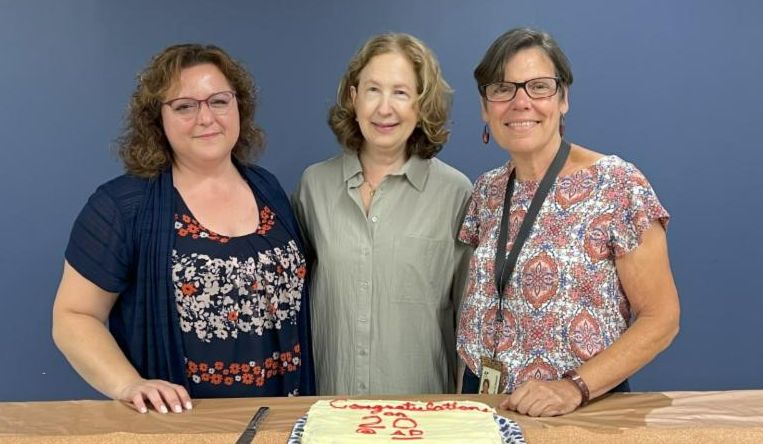
Carrot cake with cream cheese Icing made by Francesca Pitaro. From left: Sarit Hand, Digital archivist; Valerie Komor, director of Corporate Archives, and Francesca Pitaro, Archivist. AP Photos/Corporate Communications
Colleagues,
Good Thursday morning on this July 27, 2023,
Our colleague Valerie Komor, director of AP Corporate Archives and one of Connecting’s most valued contributors over its 10 years, celebrated her 20th anniversary with The Associated Press on Tuesday.
Corporate Communications, Corporate Archives and Human Resources joined in the celebration, which included a special guest appearance via prerecorded message from Kelly Smith Tunney, retired AP journalist and executive, who hired Valerie into the AP.
| 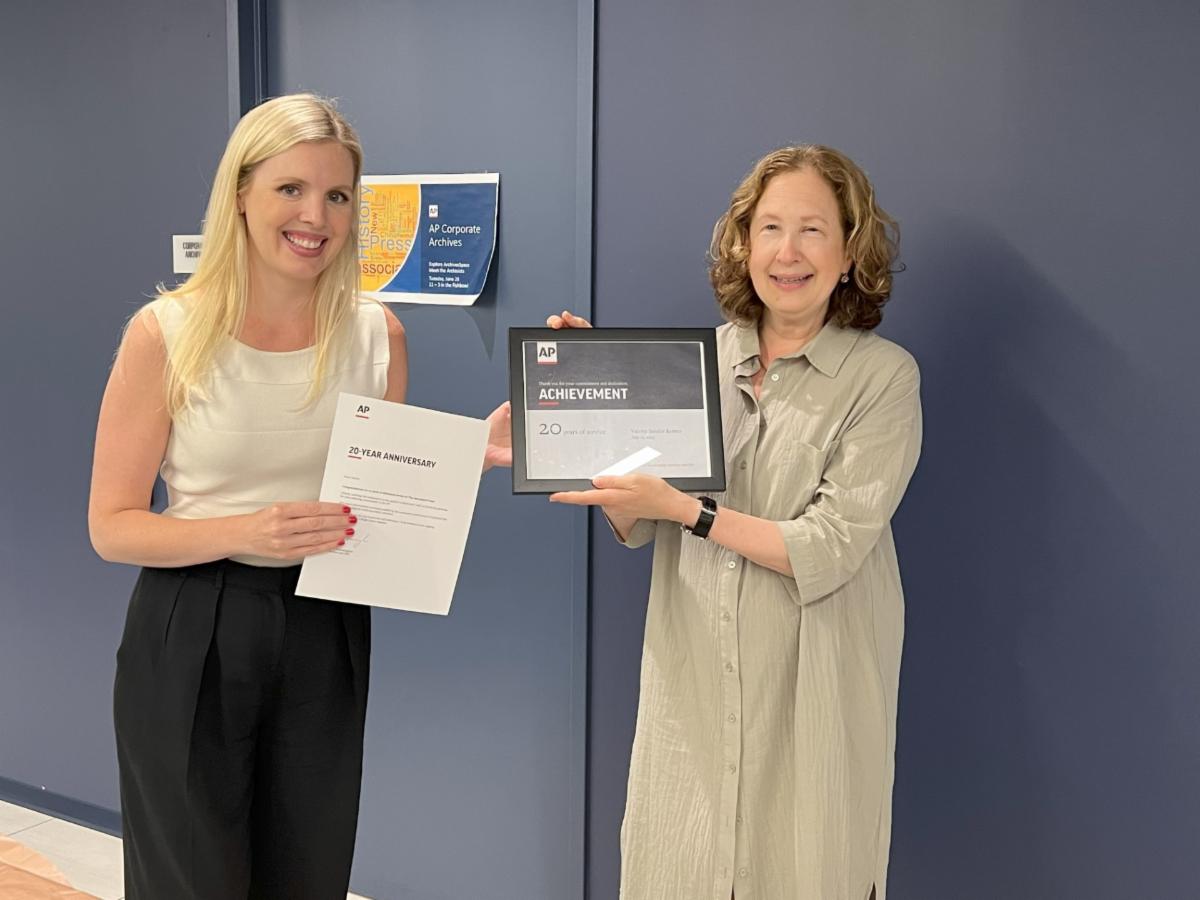 | |
ABOVE: Lauren Easton, VP Corporate Communications, left, and Valerie Komor, director of Corporate Archives.
RIGHT: Kelly Smith Tunney
Ye Olde Connecting Editor cannot emphasize to you enough the value that nearly daily assistance from Corporate Archives brings to our newsletter.
If you’d like to drop Valerie a note, her email –
vkomor@ap.org
ABOUT CORPORATE ARCHIVES: The AP Corporate Archives was established in 2003 to document the news, administrative and governance arms of the AP from its beginnings in 1846 to the present.
Unique among news archives for both scope and content, the collections contain over 4,000 linear feet of paper records and 10 terabytes of digital collections. They document nearly 175 years of AP institutional history and news reporting as well as the origin and development of American journalism.
Collections include governance records, bureau records, original wire copy, internal publications, personal papers, oral history interviews with AP staff, artifacts, photographs, film and video, the archive of AP Radio News, works of art, and a general reference collection centered on AP writers, journalism memoir and communications history.
Records are acquired through internal transfer from departments and bureaus or through outside donation. Archivists arrange, describe, preserve and make available archival collections for a variety of uses, including corporate projects, content licensing, research, documentaries and exhibitions.
Here’s to a great day – be safe, stay healthy, live it to your fullest.
Paul
Today's Saigon
Carl Robinson - During the Vietnam War, most foreign news agencies were based in downtown Saigon and where most media folks worked, lived and played. Back in Vietnam on an extended stay from the Australian Winter (ha ha), this former Saigon AP staffer brings former colleagues and others up to date with this selection of photographs:
|  | |
The successor to the Eden Building where AP had its 4th floor office with the ornate French colonial-era Hotel de Ville (city hall) at the top of Nguyen Hue Blvd and with the Rex Hotel, then a US military BOQ (Billeted Officers Quarters) and cinema, now all five-star luxury, across the park. (NBC had its office next door.) | |
This shows Lam Son Square with the Opera House, then the National Assembly building, with the Caravelle Hotel, since extended upwards to its right, where ABC and CBS were located, and its rooftop bar famously hosting high-flying television reporters like Walter Cronkite and others. | |
|
Across the square, the still-graceful Continental Hotel where Time/Life had its office and where visiting firemen also stayed and its open terrace, the Continental Shelf, a favourite spot for late afternoon drinks, now sadly enclosed. (NYT was up the street and UPI down by the Saigon River.)
Compared to the rest of Saigon, today's Ho Chi Minh City, with its hordes of traffic, downtown is literally another world, relatively quiet and where many tourists stay and visit nearby attractions.
How I got to AP
Dennis Kois - To the best of my hazy recollection … A long, long time ago (in the late 1960s) one of my journalism profs at Wisconsin-Milwaukee clued me in about a part-time gig at the Milwaukee bureau.
I made the connection, visited with news editor Bob O’Meara, and was hired.
Thanks to the terrific and generous support from staffers Tim Curran and Pete Seymour, I learned on the job.
In 1971, when I graduated from UWM, I was hired full-time.
I remained in that job for several years (nights and weekends mostly, and some sports), and moved on to corporate communications.
And that’s my story.
At RAGBRAI, ‘the ride will provide’ is the mantra for thousands as they bike across Iowa
| 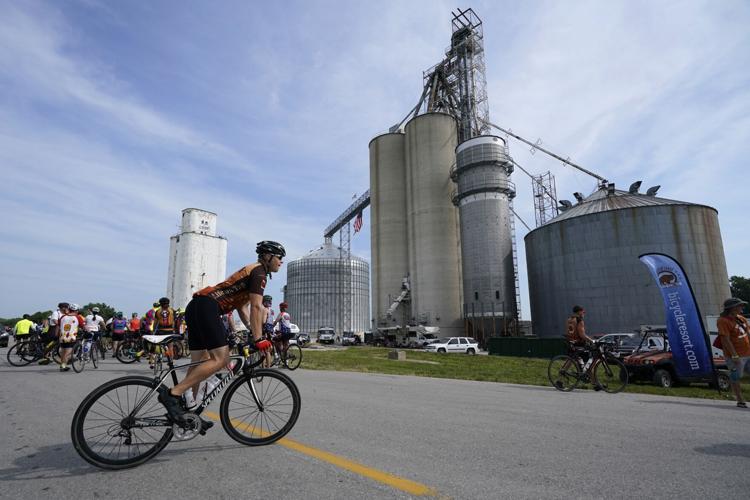 | AP Photos/Charlie Neibergall | |
BY DAVE SKRETTA
CARROLL, Iowa (AP) — It took me nearly a week of riding RAGBRAI the first time to learn the importance of pacing yourself.
That goes for the road and the beer gardens.
I also learned the value of a comfortable saddle over some 500 miles. To ride early, when the dew is still rising from the corn and soybean fields, and the midday heat is hours away. And the importance of good friends who will ride with you through the good times and the bad, because you will surely experience a little bit of both.
I grew up in a small town in northeast Iowa, and for me, the Register’s Annual Great Bicycle Ride Across Iowa was a rite of summer. You knew that for a week in late July, long stretches of country roads would shut down and every sleepy town along the way would wake up, celebrating 30,000-plus riders on their journey east.
Read more here. Shared by Peg Coughlin.
| |
Connecting wishes Happy Birthday | |
|
Stories of interest
Residents are at a loss after newspaper that bound community together shuts in declining coal county (AP)
BY LEAH WILLINGHAM
WELCH, W.Va. (AP) — Months after Missy Nester ended The Welch News’ 100-year run, she can barely stand to walk through the office doors of the newspaper her mother taught her to read with growing up in West Virginia’s southern coalfields. It’s still too painful.
The Welch News owner and publisher’s desk is covered with unpaid bills and her own paychecks — a year’s worth — she never cashed. Phones that used to ring through the day have gone silent. Tables covered with typewriters, awards and a century’s worth of other long-abandoned artifacts are reminders that her beloved paper has become an artifact, too.
Wiping away tears, Nester said she wishes people understood why she fought so hard to protect the last remaining news outlet in her community, and why it feels like the people left behind by the journalism industry are often those who need it most.
Read more here. Shared by Sibby Christensen, Richard Chady.
-0-
A Small-Town Paper Lands a Very Big Story (New Yorker)
By Paige Williams
Bruce Willingham, fifty-two years a newspaperman, owns and publishes the McCurtain Gazette, in McCurtain County, Oklahoma, a rolling sweep of timber and lakes that forms the southeastern corner of the state. McCurtain County is geographically larger than Rhode Island and less populous than the average Taylor Swift concert. Thirty-one thousand people live there; forty-four hundred buy the Gazette, which has been in print since 1905, before statehood. At that time, the paper was known as the Idabel Signal, referring to the county seat. An early masthead proclaimed “indian territory, choctaw nation.”
Willingham bought the newspaper in 1988, with his wife, Gwen, who gave up a nursing career to become the Gazette’s accountant. They operate out of a storefront office in downtown Idabel, between a package-shipping business and a pawnshop. The staff parks out back, within sight of an old Frisco railway station, and enters through the “morgue,” where the bound archives are kept. Until recently, no one had reason to lock the door during the day.
Three days a week (five, before the pandemic), readers can find the latest on rodeo queens, school cafeteria menus, hardwood-mill closings, heat advisories. Some headlines: “Large Cat Sighted in Idabel,” “Two of State’s Three Master Bladesmiths Live Here,” “Local Singing Group Enjoys Tuesdays.” Anyone who’s been cited for speeding, charged with a misdemeanor, applied for a marriage license, or filed for divorce will see his or her name listed in the “District Court Report.” In Willingham’s clutterbucket of an office, a hulking microfiche machine sits alongside his desktop computer amid lunar levels of dust; he uses the machine to unearth and reprint front pages from long ago. In 2017, he transported readers to 1934 via a banner headline: “negro slayer of white man killed.” The area has long been stuck with the nickname Little Dixie.
Read more here. Shared by Lindel Hutson.
-0-
Inside the Battle for CNN: Jeff Zucker, David Zaslav, Chris Licht and 18 Months of Crazy Backstabbing (Variety)
By Tatiana Siegel
Jeff Zucker was breezing through the Faena Hotel in Miami Beach when he spotted David Zaslav across the room. The former CNN chief was there on vacation on March 31, while the current Warner Bros. Discovery CEO was on hand for the Saudi-backed FII Institute’s Global Priority Summit. As corporate leaders mingled with Saudi princesses, Zucker approached Zaslav with tears in his eyes. Zucker complained that Chris Licht, his CNN successor, was unfairly maligning him in the press, according to sources familiar with the conversation. Zucker insisted he would never deploy such a low-blow tactic. It was a strange claim given that, to that point, Licht had only done a single published profile with The New York Times’ James B. Stewart, in which Zucker was never mentioned.
Zaslav stopped him. Instead, he wanted to know if Zucker was indulging in a different “fantasy,” as Zaslav put it — to assemble a team of investors to try to buy the network. Zucker vehemently denied that he had any desire to do so. But sources tell Variety that the opposite is true, and that Zucker has spent the past year traveling the globe to meet with potential partners in a bid for CNN.
Zucker and Zaslav’s power struggles over the cable news network — one of the most prestigious assets in the WBD portfolio and also one of the biggest perennial headaches for the parent company — shed light on the chaotic and roiling environment Zucker left behind after his 2022 ouster. The former network chief, who was forced out after failing to disclose a romantic relationship with a CNN subordinate and for committing ethical breaches in the newsgathering process, likely will fail in any bid to take back the network. But his battles with Zaslav and his behind-the-scenes attempts to undermine Licht (whom Zaslav fired last month) are more than just power plays from one of the media world’s most consequential egos. They suggest that Zucker sees an opening — however narrow — and isn’t worried about damaging CNN as he attempts to ram his way through it. At stake is the future of CNN, arguably the most iconic and influential news brand in the world and one that can make or break a presidential candidate as a divided America heads into the 2024 election cycle.
Read more here.
The Final Word
| |
Today in History - July 27, 2023 | |
|
Today is Thursday, July 27, the 208th day of 2023. There are 157 days left in the year.
On this date
In 1789, President George Washington signed a measure establishing the Department of Foreign Affairs, forerunner of the Department of State.
In 1909, during the first official test of the U.S. Army’s first airplane, Orville Wright flew himself and a passenger, Lt. Frank Lahm, above Fort Myer, Virginia, for one hour and 12 minutes.
In 1940, Billboard magazine published its first “music popularity chart” listing best-selling retail records. In first place was “I’ll Never Smile Again” recorded by Tommy Dorsey and His Orchestra.
In 1953, the Korean War armistice was signed at Panmunjom, ending three years of fighting.
In 1974, the House Judiciary Committee voted 27-11 to adopt the first of three articles of impeachment against President Richard Nixon, charging he had personally engaged in a course of conduct designed to obstruct justice in the Watergate case.
In 1981, 6-year-old Adam Walsh was abducted from a department store in Hollywood, Fla., and was later murdered.
In 1996, terror struck the Atlanta Olympics as a pipe bomb exploded at Centennial Olympic Park, directly killing one person and injuring 111.
Today’s Birthdays - TV producer Norman Lear is 101. Olympic gold medal figure skater Peggy Fleming is 75. Singer Maureen McGovern is 74. Comedian Bill Engvall is 66. Jazz singer Karrin Allyson is 61. Country singer Stacy Dean Campbell is 56. Comedian Maya Rudolph is 51. Rock musician Abe Cunningham is 50. Singer-songwriter Pete Yorn is 49. Former MLB All-Star Alex Rodriguez is 48. Actor Seamus Dever is 47. Actor Martha Madison is 46. Actor Jonathan Rhys Meyers is 46. Actor/comedian Heidi Gardner is 40. Actor Blair Redford is 40. Actor Taylor Schilling is 39. MLB All-Star pitcher Max Scherzer is 39. Singer Cheyenne Kimball is 33. Golfer Jordan Spieth is 30. Actor Alyvia Alyn Lind is 16.
| |
Got a story or photos to share? | |
|
Connecting is a daily newsletter published Monday through Friday that reaches more than 1,800 retired and former Associated Press employees, present-day employees, and news industry and journalism school colleagues. It began in 2013. Past issues can be found by clicking Connecting Archive in the masthead. Its author, Paul Stevens, retired from the AP in 2009 after a 36-year career as a newsman in Albany and St. Louis, correspondent in Wichita, chief of bureau in Albuquerque, Indianapolis and Kansas City, and Midwest vice president based in Kansas City.
Got a story to share? A favorite memory of your AP days? Don't keep them to yourself. Share with your colleagues by sending to Ye Olde Connecting Editor. And don't forget to include photos!
Here are some suggestions:
- Connecting "selfies" - a word and photo self-profile of you and your career, and what you are doing today. Both for new members and those who have been with us a while.
- Second chapters - You finished a great career. Now tell us about your second (and third and fourth?) chapters of life.
- Spousal support - How your spouse helped in supporting your work during your AP career.
- My most unusual story - tell us about an unusual, off the wall story that you covered.
- "A silly mistake that you make"- a chance to 'fess up with a memorable mistake in your journalistic career.
- Multigenerational AP families - profiles of families whose service spanned two or more generations.
- Volunteering - benefit your colleagues by sharing volunteer stories - with ideas on such work they can do themselves.
- First job - How did you get your first job in journalism?
- Most unusual place a story assignment took you.
Paul Stevens
Editor, Connecting newsletter
paulstevens46@gmail.com
| | | | |