| | |
Connecting
July 30, 2026
Click here for the sound of the Teletype
| | |
Colleagues,
Good Thursday morning on this July 30, 2026,
Burst of Joy.
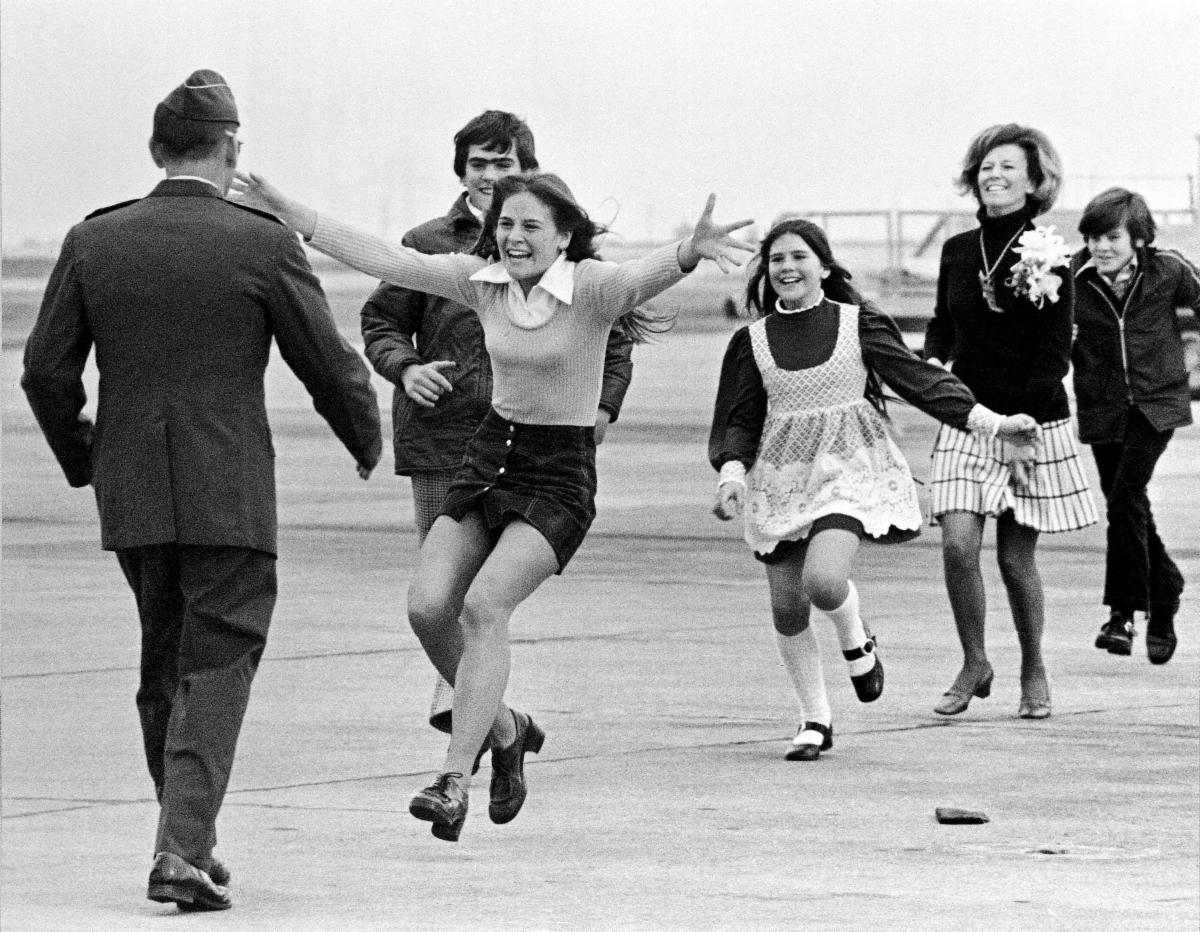
That’s how Associated Press photographer Sal Veder titled one of the most impactful images related to the Vietnam War.
It showed an Air Force pilot, Lt. Col. Robert Stirm, reuniting with his family on the tarmac at Travis AFB in California in 1973 after returning from more than five years as a prisoner of war. He was shot down over North Vietnam in 1967 while flying his F-105 fighter jet.
But like the Vietnam War itself, the story behind the photo was complicated.
Stirm, who was 39 when the photo was taken, told the AP 20 years later that he had several copies of it, but didn’t display it in his house. He had been handed a “Dear John” letter from his wife, Loretta, by a chaplain upon his release.
The couple divorced a year after Stirm returned from Vietnam and both remarried within six months. They came together for weddings and other family events. Loretta Adams died in 2010, of cancer. She was 74.
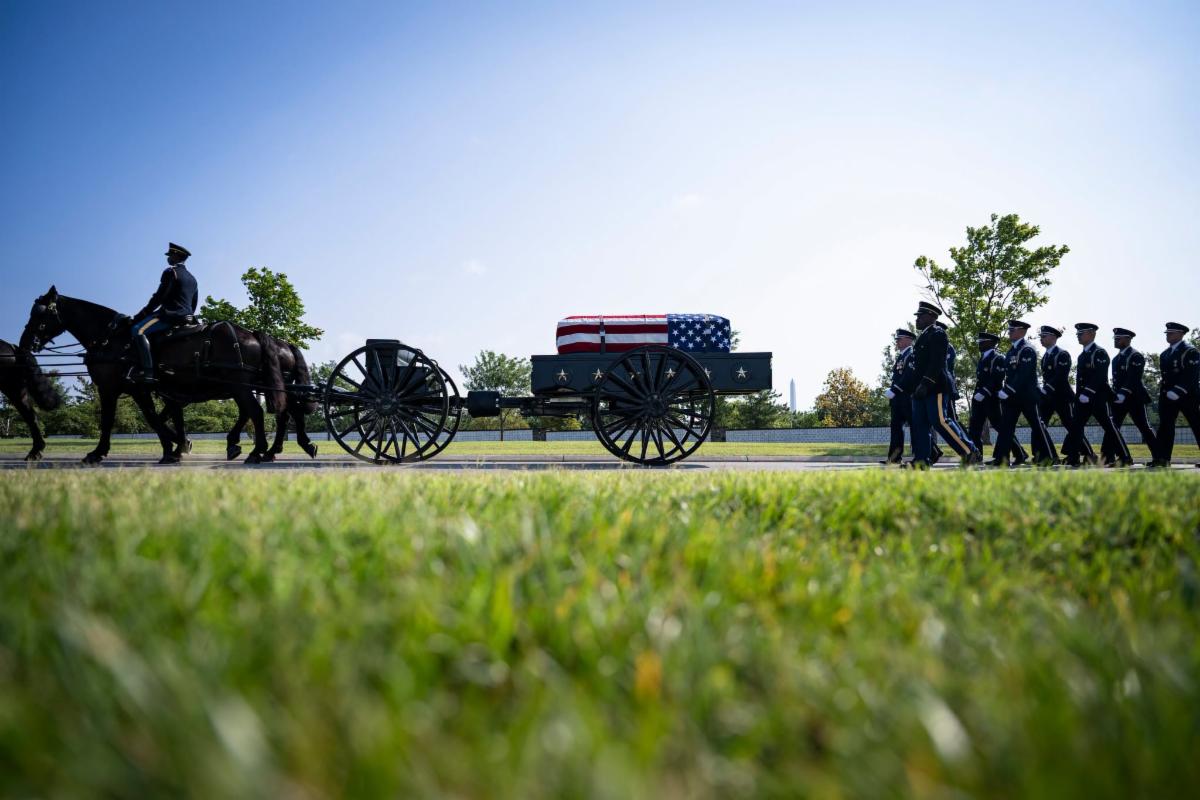
Stirm died in 2025 at the age of 92 and on Wednesday, he was laid to rest at Arlington National Cemetery. His daughter Lorrie (who was 15 when her father returned home), her surviving siblings and their families said goodbye to their father one last time.
Today’s issue brings more of your memories of our colleague Andy Lippman. His longtime friend Bobbie Seril may have put it best when she said, "If friends are life’s best souvenirs, then Andy elevated our collections to museum caliber."
Here’s to a great day – be safe, stay healthy, live it to your fullest.
Paul
Air Force Vietnam POW, Featured in Pulitzer Prize-Winning AP Photo, Laid to Rest
| Burst of Joy is a Pulitzer Prize–winning photograph showing Air Force Lt. Col. Robert L. Stirm meeting his family after five years as a POW in North Vietnam. The photo was taken by Slava "Sal" Veder, an Associated Press photographer, on March 17, 1973, at Travis Air Force Base in California. From left: Lt Col Stirm, Lorrie Stirm, Bo Stirm (Robert L. Stirm Jr.), Cindy Stirm, Loretta Stirm, and Roger Stirm. The image was widely published in newspapers and magazines and became one of the most recognizable photographs of the war's human aftermath. It won the 1974 Pulitzer Prize for Spot News Photography. | |
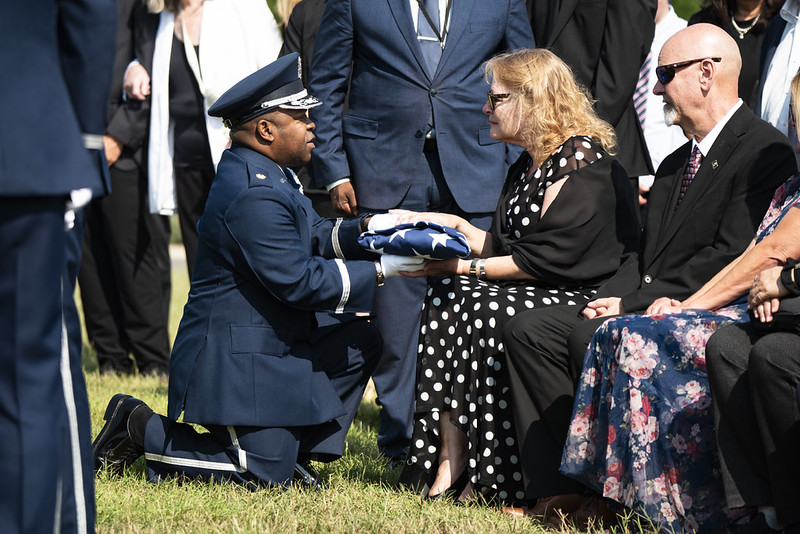
Lorrie Stirm, daughter of Maj. Robert Stirm, accepts the flag at his Arlington Cemetery services Wednesday. U.S. Army photos by Elizabeth Fraser.
By Army National Military Cemeteries Public Affairs Office
Lorrie Stirm remembered when her father left home for Vietnam in 1966, but the entire country would remember when he returned home in 1973. Lorrie’s father, U.S. Air Force Maj. Robert “Bob” Stirm, was shot down over Hanoi, North Vietnam, on Oct. 27, 1967. He spent more than five years—1,966 days—as a prisoner of war.
Before Stirm left his home outside of San Francisco, he told his four children to listen to their mother and do well in school. Then he hugged nine-year-old Lorrie, eight-year-old Bo, six-year-old Roger and five-year-old Cynthia. “We didn’t understand the gravity of the situation,” Lorrie recalled.
On March 17, 1973, Lorrie, her mother, Loretta, and her siblings sat in an Air Force station wagon on the tarmac at Travis Air Force Base in California, waiting for an aircraft to arrive with their father and other Vietnam POWs. When the driver told the family they could get out, they jumped out of the station wagon and ran to Stirm. Fifteen-year-old Lorrie, in the lead, threw out her arms to hug her father. In that instant, Associated Press photographer Slava “Sal” Veder snapped a photograph that would appear in publications across the United States and win the 1974 Pulitzer Prize for photography. Veder titled the photo, appropriately, “Burst of Joy.”
On Wednesday (July 29, 2026), Lorrie (now Kitching), her surviving siblings and their families said goodbye to their father one last time at Arlington National Cemetery. Stirm, who retired from the Air Force as a colonel, passed away at the age of 92. Lorrie wore her father’s watch and a Vietnam POW/MIA bracelet to the service, while other family members wore POW lapel pins.
In Vietnam, Stirm was shot down by a surface-to-air missile while leading a flight of F-105 fighters. When his aircraft was hit, jet fuel streamed into his cockpit, burning most of his body. He hit the eject button, but his canopy jammed, forcing him to eject through the glass. His parachute opened, but the wind caused him to swing wildly. As he swung up, his parachute dropped, yanking him downward until it refilled with air. As he neared the ground, someone shot him in the neck.
The North Vietnamese quickly took Stirm prisoner, beginning his long captivity and torture in POW camps that included the infamous "Hanoi Hilton." After returning home, he rarely spoke about his ordeal.
Back in the United States, Loretta sat her children down and explained that their father had been shot down, but the Air Force was searching for him. To soften the distressing news, she took them to the Humane Society to adopt a dog, who subsequently helped the children cope with their father’s absence. Loretta joined the League of Wives, a support group for wives of POW/MIA service members that lobbied the U.S. and North Vietnamese governments for more information, better treatment of POWs and the return of their husbands. Over time, however, Lorrie remembered becoming numb to her father’s absence. “I didn’t feel in my heart that he would ever be released,” she said.
Thanks in part to the group's efforts, Stirm was able to write letters to his family in 1970. He wrote that they should not worry about him, and that he thought of them constantly and hoped to see them someday. It would be another three years until Stirm saw his family. He was released as part of “Operation Homecoming,” which repatriated 591 American POWs from Vietnam following the signing of the Paris Peace Accords in January 1973.
On Jan. 21, 1973, Lorrie was in a doughnut shop when the clerk asked her how wonderful it was that her father would be coming home. Lorrie was stunned. Three months later, she found herself running toward her father and embracing him. “I could feel the fabric of his uniform against my cheek,” she recalled, choking up. “To this day I feel that hug.” She could also feel her heart open. “I didn’t realize how much I had held back hope of that moment,” she added. “It’s like my heart was released and I was able to feel again. It was a glorious day.”
After returning home, Stirm chose to remain in the Air Force until 1977. Although his marriage to Loretta did not last, he remained close to his children. During his later years, he grew especially close to Lorrie. He told her that he wanted to be laid to rest at Arlington National Cemetery, with his former POW friends and comrades. “Arlington meant something to my dad,” Lorrie said.
The full military funeral honors with escort service in Section 57 included a caisson detachment, an Air Force band, a bugler, a rifle team and a bagpiper. U.S. Air Force Chaplain (Capt.) Kevin Pew stated that Stirm had survived his confinement and torture “by holding fast to a single creed: Return With Honor.” Pew called Stirm’s return “not only a national symbol, but a family miracle.”
When the service ended, Lorrie laid a red rose on her father’s casket and then placed her hand on it one last time, telling her father, “I love you, Dad. You’re a warrior.”
Click here for link to this story. Shared by Peggy Walsh.
'If friends are life’s best souvenirs, then Andy elevated our collections to museum caliber'
| |
Bobbie Seril - Like all of you, I treasure countless memories of Andy’s friendship, generosity, wit and wisdom through the decades. As we cycle through increasing seasons of loss, the gift of memory becomes all the more precious.
If friends are life’s best souvenirs, then Andy elevated our collections to museum caliber.
From the beginning, he and I shared an unwavering appreciation and enjoyment of our Jewish faith and its many rich traditions. His strong beliefs sustained him through the years of illness up until the very end. We shared holiday rituals and recipes. After each of my sisters’ deaths, he called to recite the memorial prayer of Kaddish with me. He told me where to eat, shop and pray in the Venice Ghetto. He was the master of the mitzvah, or good deed, as evidenced in so many colleagues’ tributes. Every year, he helped me compose my New Year’s card – no surprise that his favorite one was about welcoming the stranger. And come each fall, he sent me a little jar of honey for a sweet new year.
So during Covid it was no surprise that Andy raised the sport of synagogue-hopping to Olympic levels via zooming and streaming. I dubbed him the Johnny Cash of shul-shopping, since “[He’s] Been Everywhere, Man,” which he thought was hilarious. Every week, he had a new recommendation, e.g. “you gotta hear that cantor in Petoskey,” or “Biloxi has a real fun service,” and “who knew Davenport’s readings were so interesting,” etc.
And he always tuned in to my synagogue when I was chanting. Once, after a long complicated reading, he gave me a mixed review: “Ya know, Bob, you nailed the Hebrew, but you were lookin’ a little Star Trekkie up there in that outfit. Maybe that’s just how they dress at your place. And why did you turn and giggle at the end?”
The reason got us both laughing so hard that we had stomach aches. Andy wasn’t the only one who felt my two-tone tailored suit, with a shiny, modern delta-shaped pin looked like it belonged on the Enterprise. Seated behind the lectern, the temple president whispered “live long and prosper.” Then when the cantor added “great job, now beam me up to finish the service,” I couldn’t keep a straight face. “You looked real snazzy – for a Star Trek character who reads Hebrew perfectly,” Andy said.
Though I did speak to Andy afterwards, I am so glad that something told me to save his last voicemail from July 3. “Gimme a call cause I got a funny story you’ll love. Don’t play with fireworks and have a Good Shabbos.”
Upon a person’s death, we say “may his life be for a blessing.” How could Andy’s life be anything but a constellation of blessings for us all?
-0-
Dennis Anderson - This is a tardy response on Andy Lippman. As I got the news from Peggy Walsh via the John Rogers obituary, I was sinking into a minor bout of pneumonia.
The news sunk me and I am still processing sorrow. That it followed John Brewer's untimely death was another knock.
Andy was thoughtful, kind, compassionate, humorous, and had the best damned North Vietnamese Army pith helmet I'd ever seen. He looked very stately in it the one time I saw him don it; otherwise, it was on his desk in L.A. He was proud that he had served as a cook in the Army, at Ft. Carson, I think. One small connection we shared.
I actually thought about him in that context because the chow hall chiefs take care of everybody. I recall during the Los Angeles riots when we were working 12-hour shifts, and mine was 8 p.m. to 8 a.m. Nobody went hungry, ever. If it wasn't pizza, it was Col. Sanders, if not that, Chinese. But the hot food kept coming as Los Angeles burned. And taking care of the troops is the COB's first trust.
I remain sad, and sorry my own comments were late. But like John Brewer, memories of Andy Lippman will resonate while the rest of us are still at it.
Thank you for the great coverage and tributes.
-0-
Candy Crowley - Before your recent newsletters, I was familiar only with the byline. Now, after your remembrances and those of others, I wish I had known the man.
It is very hard to lose someone who has been in the trenches with you, laughing and crying for all those years.
I am sorry for your loss of such a good friend.
Sharing a few ‘moments in time’ with Derek Williams
Robert Reid - I wasn’t a close friend or longtime colleague of Derek Williams, but we did share a few “moments in time” that I remember fondly, I hope forever.
Derek and I, along with Brad Martin of Newsweek, legendary Dutch photographer Hugh van Nes and Turkish camera operators Hami Sami and Urfuk Ur (seriously), were “guests” of the Afghan government for four days just after Soviet troops ousted the leadership in December 1979.
We’d all slipped into the country under the noses of the Afghan but were rounded up separately and held at the Intercontinental Hotel until flights resumed after a blizzard that had closed the airport.
We were the first Western journalists to reach Kabul after the Soviet invasion and had managed to slip into a closed country.
It was the biggest story in the world, but we couldn’t file a word about it because the Soviets had shut down all communications, both domestic and international.
Nevertheless, Derek’s infectious good humor made the whole experience not simply tolerable but entertaining and unforgettable.
The morning after we were detained, we all assembled for breakfast at the hotel’s rooftop restaurant.
A full cadre of waiters and busboys, all dressed in traditional Afghan attire, stood at the ready. We were their first - and only - customers.
The head waiter presented us with colorful menus offering Afghan and international breakfast fare.
Every order was followed by an apologetic “we don’t have any.”
Finally Derek asked “what do you have?” The waiter smiled and replied: “we have beer.”
With an impish grin, Derek responded: “Beer it is!” We all concurred.
Whatever tension over our precarious situation remained was soon washed away.
Thanks to Curt Anderson for Doing Our Job
Dennis Conrad - In my years, decades ago, as a young journalist at the Gainesville Sun, I had a chance to make the short drive to Florida’s Death Row near Starke to watch a man die.
At that newspaper, then owned by The New York Times Co., our executive editor, Ed Johnson, would have the assignment of covering an execution at Florida State Prison rotated among staffers volunteering for it.
There seemed to be too many opportunities even back then.
My former University of Florida journalism professor, H.G. “Buddy” Davis Jr., the Sun’s Pulitzer Prize-winning editorial writer, had the first assignment in 1979 when Florida resumed carrying out its death penalty after many years of court rulings. Buddy also served as the official witness for the Florida Press Association.
I never volunteered to watch a person die.
I never thought I could do it justice. Nothing could make me feel more incompetent. Thank God it was not a condition of my employment. I can understand how it needs to be done. I am just not the one to do it.
I have great admiration for those journalists such as former AP reporter/Connecting contributor Curt Anderson who are fully capable of the task and do it extraordinarily well. We need to know how our government performs all that it is asked of us to do from the cradle to the grave.
As for the death penalty, I know my mentor, Professor Davis, aka Buddy, was a passionate critic. I myself have always had a mixed view. I would have thought it inexcusable for Hitler not to have been tried for war crimes and not been hanged upon conviction. I also know Florida and other states have had prisoners incarcerated for decades only to find out they were innocent.
The biggest crime would be the public execution of an innocent man or woman with the full backing of the state.
Herein is Buddy Davis’ 1979 account as it ran in The Tampa Times on page one.
Perfect description of Andy
| |
Peggy Walsh - This is the perfect description of Andy Lippman. May Andy’s World go on and may all who were in it pay his remarkable love of everything forward.
Connecting sky shot
| Jim Reindl - The full moon rises over our home in São Sebastião das Aguas Claras, MG, Brazil on Wednesday, July 29. | | Connecting wishes Happy Birthday | | |
Stories of interest
Stephen Colbert wins an anti-censorship award after CBS ends ‘The Late Show’
By Hillel Italie
The Associated Press
Stephen Colbert, whose 11-year run as host of “The Late Show” was defined in part by his feud with President Donald Trump, has received an “anti-censorship” award from a foundation established by the author-playwright-publisher Ishmael Reed.
Colbert was among the recipients of the 47th annual American Book Awards. They were announced Wednesday by the Before Columbus Foundation, a non-profit organization based in Oakland, California, that champions diversity in U.S. literature and culture.
CBS ended Colbert’s program in May, removing a high-profile platform for one of Trump’s most prominent critics. The network cited economic reasons for its decision. Colbert and others have questioned that explanation.
Read more here. Shared by Doug Pizac.
-0-
How three newsrooms are charting different paths for AI use
By Eric P. Bucy and Milad Jalalian Ebrahimi
Nieman Lab
A labor dispute erupted at The Guardian’s London headquarters in December 2024, with nearly 500 journalists going on strike to protest the proposed sale of the Guardian-owned Observer.
With the newsroom hobbled, the British publication’s management allegedly deployed generative AI tools such as ChatGPT and Claude to suggest headlines and write descriptions of photos for people using screen readers. The National Union of Journalists cried foul, calling the move a clear attempt to undermine collective bargaining.
As media and communication scholars, we saw the outrage over management’s use of AI as more than routine wrangling over adherence to labor law. The incident showed how AI is becoming integrated into daily news work through translation, interview transcription, research, writing, and audience analytics. At the same time, the incorporation of AI in newsrooms has raised new worries about accuracy and bias.
In our recent research, we examined how three different media outlets — Reuters, the BBC, and The Guardian — were deploying AI in their workflows.
Read more here. Shared by Doug Pizac.
-0-
A Setback for the MAGA Media Takeover
By Michelle Goldberg
Opinion Columnist
The New York Times
In April, the attorney Norm Eisen was on his way into the Supreme Court as part of the legal team fighting to preserve birthright citizenship when he got a text from the actor Mark Ruffalo.
Along with several others in the entertainment industry, Ruffalo was searching for some way to stop the pending merger between Paramount and Warner Bros., which would leave the MAGA suck-up David Ellison in charge of two of the big five major movie studios, as well as HBO Max and CNN. After acquiring Paramount, CBS’s parent company, in 2025, Ellison delighted Donald Trump by installing the anti-woke editor Bari Weiss atop the news division, throwing “60 Minutes” and other programs into crisis. Variety wrote that his rising empire “skews alpha male,” raising fears that he’d “entwine the studio’s content more closely with MAGA messaging.” Ellison’s willingness to cater to the president — he threw a party in Trump’s honor in April — is almost certainly why Trump’s Justice Department approved Ellison’s bid for Warner Bros., reportedly overruling career officials who worried it would violate antitrust law.
Read more here. Shared by Dennis Conrad.
-0-
Prediction markets get their own media company
By Sara Fischer
Axios
A new media company called Eventual is launching in partnership with Polymarket to give the world's top prediction market traders a platform for news and analysis.
Just as FiveThirtyEight turned polling into a new way to understand politics, Eventual believes prediction market data can be used to analyze everything from elections to the economy.
"Prediction markets have gotten it right when pollsters, pundits and so-called experts got it wrong, over and over," said Eventual seed investor Richard Greenfield, a general partner at
Polymarket, one of the world's largest prediction market companies, is Eventual's launch sponsor and exclusive data partner. The company plans to sell ads and sponsorships against the brand's content on its own channels and social media.
Read more here. Shared by Doug Pizac.
-0-
Brand Buying
By Amos Barshad
Columbia Journalism Review
“At the worst moment of the world’s history, that’s where we began,” David Lane, the CEO of Sports Illustrated Tickets, told me. He was referring to early 2020, the outset of the COVID-19 pandemic. Over a few days in March, the major American sports leagues suspended or delayed their seasons. The live-music industry soon stopped in its tracks, too. Lane was running Lunatix, a website where people could buy and sell secondhand tickets for live music and sports events. “There’s no playbook when you’re a live-event company in a pandemic,” he said. He feared his company was doomed.
In search of a lifeline, Lane met with Authentic Brands Group, a licensing company with a unique specialty: scooping up brands that have fallen on hard times and leveraging their waning name recognition for profit.
In June of 2021, Authentic struck a deal with Lane, and Lunatix became Sports Illustrated Tickets. Authentic collects licensing fees from Sports Illustrated Tickets, as well as from Minute Media, the publisher of Sports Illustrated.
Compared with the likes of StubHub and SeatGeek, Sports Illustrated Tickets is a relatively small player. Since nearly going extinct in the pandemic, however, it’s on the upswing: this year, Lane said, he expects to reach five hundred million dollars in revenue.
Read more here. Shared by Doug Pizac.
-0-
How A.I. Books Sneak Their Way Into Stores
By Alexandra Alger
The New York Times
Jess Michaels, a historical romance writer, has released 117 novels since she started writing full time in 1999, most of them self-published. She’s built a devoted readership, and has had 10 USA Today best sellers.
But lately, sales have been so dismal that she might stop publishing.
“The glut of the A.I. work makes discoverability very difficult,” Michaels said. “You’re talking about directly pirating my work, putting it into an engine so that you can produce a ‘Jess Michaels-type book,’ and then glutting the market with it.
“I cannot tell you how soul-crushing it is,” she added. “It essentially erases actual authors.”
Read more here. Shared by Doug Pizac.
-0-
Radio, meet the hedge fund that hollowed out America’s newsrooms
By Mike Blinder
Editor and Publisher
Alden Global Capital is poised to hold a major voting stake in reorganized Cumulus Media. To many broadcasters, that may sound like another post-bankruptcy ownership story. To those of us in the newspaper business, it sounds like an alarm.
Alden is the hedge fund that built a newspaper empire by buying distressed publishers, cutting staffs, consolidating operations and monetizing real estate and other assets. Now it is coming to radio.
Read more here. Shared by Doug Pizac.
| Today in History - July 30, 2026 | | |
Today is Thursday, July 30, the 211th day of 2026. There are 154 days left in the year.
Today in history:
On July 30, 1976, Bruce Jenner, now known as Caitlyn Jenner, set a world record of 8,618 points and won the gold medal in the Olympic decathlon at the Montreal Summer Games.
Also on this date:
In 1619, the first representative assembly in colonial America convened in Jamestown in the Virginia Colony.
In 1864, during the Civil War, Union forces tried to take Petersburg, Virginia, by exploding a gunpowder-laden mine shaft beneath Confederate defense lines; the attack failed.
In 1916, German saboteurs blew up a munitions plant on Black Tom, an island near Jersey City, New Jersey, killing about a dozen people.
In 1930, Uruguay won the first FIFA World Cup, defeating Argentina 4-2.
In 1945, the heavy cruiser USS Indianapolis, having just delivered components of the atomic bomb to Tinian in the Mariana Islands during World War II, was torpedoed by a Japanese submarine; only 316 out of nearly 1,200 service members survived.
In 1956, President Dwight D. Eisenhower signed a measure making “In God We Trust” the national motto, replacing “E Pluribus Unum.”
In 1965, President Lyndon B. Johnson signed the Social Security Amendments of 1965, which led to the creation of Medicare and Medicaid.
In 2008, ex-Bosnian Serb leader Radovan Karadzic (RA’-doh-van KA’-ra-jich) was extradited to The Hague to face genocide charges after nearly 13 years on the run. (He was sentenced by a U.N. court in 2019 to life imprisonment after being convicted of genocide, crimes against humanity and war crimes.)
In 2012, three electric grids in India collapsed in a cascade, cutting power to 620 million people in the world’s biggest blackout.
In 2013, U.S. Army Pfc. Chelsea Manning was acquitted of aiding the enemy — the most serious charge she faced — but was convicted of espionage, theft and other charges at Fort Meade, Maryland, more than three years after she’d spilled secrets to WikiLeaks. (The former intelligence analyst was later sentenced to up to 35 years in prison, but the sentence was commuted by President Barack Obama.)
In 2016, 16 people died when a hot-air balloon caught fire and exploded after hitting high-tension power lines before crashing into a pasture near Lockhart, Texas, northeast of San Antonio.
In 2020, NASA launched its Perseverance rover and Ingenuity helicopter to Mars aboard an Atlas V rocket; the helicopter's initial flight on Mars was in April 2021.
Today’s Birthdays: Former Major League Baseball Commissioner Bud Selig is 92. Blues musician Buddy Guy is 90. Singer Paul Anka is 85. Actor and former California Gov. Arnold Schwarzenegger is 79. Actor Jean Reno is 78. Actor Ken Olin is 72. Actor Delta Burke is 70. Law professor Anita Hill is 70. Singer-songwriter Kate Bush is 68. Film director Richard Linklater is 66. Actor Laurence Fishburne is 65. TV personality Alton Brown is 64. Actor Lisa Kudrow is 63. Basketball Hall of Famer Chris Mullin is 63. Actor Vivica A. Fox is 62. Actor Terry Crews is 58. Actor Simon Baker is 57. Film director Christopher Nolan is 56. Actor Tom Green is 55. Actor Christine Taylor is 55. Actor Hilary Swank is 52. Olympic gold medal beach volleyball player Misty May-Treanor is 49. Actor Jaime Pressly is 49. Alt-country singer-musician Seth Avett (AY’-veht) is 46. Former soccer player Hope Solo is 45. Actor Yvonne Strahovski is 44. Actor Martin Starr is 44. Actor Gina Rodriguez is 42. Actor Nico Tortorella is 37. Actor Joey King is 27.
| | Got a photo or story to share? | | |
Connecting is a daily newsletter published Monday through Friday that reaches more than 2,000 retired and former Associated Press employees, present-day employees, and news industry and journalism school colleagues. It began in 2013. Its author, Paul Stevens, retired from the AP in 2009 after a 36-year career as a newsman in Albany and St. Louis, correspondent in Wichita, chief of bureau in Albuquerque, Indianapolis and Kansas City, and Central Region vice president based in Kansas City.
Got a story to share? A favorite memory of your AP days? Don't keep them to yourself. Share with your colleagues by sending to Ye Olde Connecting Editor. And don't forget to include photos!
Here are some suggestions:
- Connecting "selfies" - a word and photo self-profile of you and your career, and what you are doing today. Both for new members and those who have been with us a while.
- Second chapters - You finished a great career. Now tell us about your second (and third and fourth?) chapters of life.
- Spousal support - How your spouse helped in supporting your work during your AP career.
- My most unusual story - tell us about an unusual, off the wall story that you covered.
- "A silly mistake that you make"- a chance to 'fess up with a memorable mistake in your journalistic career.
- Multigenerational AP families - profiles of families whose service spanned two or more generations.
- Volunteering - benefit your colleagues by sharing volunteer stories - with ideas on such work they can do themselves.
- First job - How did you get your first job in journalism?
- Most unusual place a story assignment took you.
Paul Stevens
Editor, Connecting newsletter
paulstevens46@gmail.com
| | | | |