|
Stories of interest
Judge admonished for speaking to media about CPS understaffing
By Erin Beck of Mountain State Spotlight
The Associated Press
Ritchie County Judge Tim Sweeney ordered leaders at the West Virginia Department of Human Services to his courtroom last February to compel them to address a severe shortage of child protective services workers. He then contacted the media.
Thursday, the Supreme Court of Appeals of West Virginia admonished him.
“While Judge Sweeney’s conduct happened to concern a matter that elicits universal agreement—the well-being of children—judges who stray so far outside their role such as to violate the Code are not immunized from discipline based on the popularity or success of their misconduct,” justices wrote in an opinion delivered by Chief Justice Haley Bunn, who was referencing the Judicial Code of Conduct.
Sweeney’s actions came before the Supreme Court last month because they had caught the attention of the Judicial Investigation Commission, which found he violated ethics rules about speaking publicly about pending cases and warned him not to make similar comments in the future. The commission also found his Facebook activity violated the rules of judicial conduct because his posts suggested he favored police and prosecutors over defendants.
Read more here. Shared by Doug Pizac.
-0-
Appeals Court Weighs Pentagon’s Media Restrictions
By Erik Wemple
The New York Times
A federal appeals court in Washington on Monday heard arguments in litigation about a set of media restrictions put in place by Defense Secretary Pete Hegseth, including a rule that all reporters who visit the Pentagon must be accompanied by an escort.
The New York Times had sued to overturn the policy on First Amendment grounds. The three-judge panel pressed both sides with tough questions.
At Monday’s hearing, the appeals court panel considered the escort requirement and other elements of the Pentagon’s revised media policies from March, which sought to clarify the October 2025 rules.
Judge Judith W. Rogers, a member of the panel who was nominated by President Bill Clinton, questioned the government’s approach to the Pentagon press corps.
Read more here. Shared by Doug Pizac.
-0-
Cameraman Beaten and Equipment Stolen in Attack on Journalists at French Protests
By Pesala Bandara
PetaPixel
A cameraman was badly beaten and his camera equipment stolen while covering protests in France this weekend.
On Saturday, a team of journalists from French television and radio network BFM TV was attacked by protesters in Lyon. Demonstrations have taken place across France over the past two months over school funding, social inequality, and rising living costs.
According to a report by Le Monde, the television crew consisted of two journalists, including a cameraman, and two security guards. Local government officials in France say protesters “threw themselves upon them” in an attack that was “very violent.” Riot police then launched “an offensive” to protect the journalists.
Palmer’s story was one of several in USA Today Network Ohio’s “Vicious,” an investigation into how state law has failed thousands of dog attack victims. Earlier this spring, the network was named one of two winners of The Batten Medal as part of the 2026 Poynter Journalism Prizes.
Read more here. Shared by Doug Pizac.
-0-
Willie Geist Will Exit MS NOW’s ‘Morning Joe’ After Nearly 20 Years for Expanded Role at NBC’s ‘Today’
By Brian Steinberg
Variety
MS NOW mainstay “Morning Joe” transformed suddenly into “Morning Whoa!” Monday when Willie Geist, the program’s longtime master of ceremonies, said he planned to leave his post at the end of the year for a broader role at NBC’s “Today” franchise.
The maneuver will break up an A.M. team — Geist, Joe Scarborough and Mika Brzezinski– that has stayed together for about two decades, a rarity in the world of early-bird TV. “Morning Joe” launched on the cable network once known as MSNBC in April of 2007. Scarborough and Brzezinski remain under contract with MS NOW through 2029.
“Joe and Mika are truly family to me,” says Geist, during a recent interview with Variety. Being part of the program, which is a must-watch for a certain swath of inside-the-Beltway denizens as well as political aficionados, “has given me everything in my career,” Geist adds. “I was a producer at MSNBC when Joe had the idea that I should be on set with him and Mika, which made not a lot of sense.” Nonetheless, it worked: “Morning Joe” has become essential viewing, particularly for an influential audience niche, and is one of the Versant-backed outlet’s signature programs.
Read more here. Shared by Dennis Conrad.
-0-
Indonesia’s new copyright bill would force Google and Meta to pay to aggregate news
By Reuters via Nieman Lab
On Wednesday, Meta, TikTok, and Google testified in the Indonesian parliament in opposition to a new copyright bill. The proposed law would require digital platforms to pay news publishers in Indonesia for aggregating and previewing their content, according to a new report from Reuters.
The bill does not distinguish between aggregation and republication. Tech platforms would have to pay even when they surface news link previews or story snippets in their products, including AI search products. The law would also force platforms to compensate publishers when their journalism is used to train AI models.
Any compensation would be paid through a state-run management organization, which would then distribute the funds to publishers. Platforms that don’t comply could face sanctions, including the loss of their local business permits.
If the bill does pass, Indonesia would become the first country in Southeast Asia to formally fold AI into its copyright law.
Social media and search engine companies have come out in force against the bill, with Google leading the campaign.
Read more here. Shared by Doug Pizac.
-0-
How Ohio journalists exposed dangerous dog laws — and helped change them
By Amaris Castillo
Poynter
Michael Palmer was wary of Piper. The pit bull had attacked others in their Green, Ohio, neighborhood, so Palmer maintained his distance.
Then, early one December day in 2022, the dog’s owner, Wendy Trippett, asked Palmer if she could borrow $20. She hadn’t had a cigarette all day, and she hadn’t gotten paid yet. Trippett told him to come over.
When he did, Piper shot out of the door and jumped right toward Palmer’s face. She dragged the man down, biting his right hand. Trippett tried to stop her with a broom. Palmer tried to bear hug her, but the dog still managed to pull him to the ground several times. The attack lasted nearly 15 minutes. Palmer went in and out of consciousness.
Read more here. Shared by Doug Pizac.
-0-
After standing up for his ‘60 Minutes’ colleagues, Scott Pelley wants to explore the ‘triumph of truth’
By Angela Fu
Poynter
Last week, the embattled “60 Minutes” scored a minor victory. Its interview with President Donald Trump had drawn praise from critics, a needed boost amid massive staff turnover and declining ratings.
But there was one person who didn’t tune in: former “60 Minutes” correspondent Scott Pelley.
“I know what we built there, and I know what they’ve done, and I cannot bring myself to watch it,” said Pelley, who had been at CBS News for 37 years before his firing in June. He was terminated after speaking out in defense of the show’s editorial independence, and he hasn’t watched an episode since.
These days, Pelley works as an independent journalist. He said Saturday that he is currently writing a book and shooting a documentary, and he has a team developing a podcast for him.
Read more here. Shared by Doug Pizac.
-0-
Apple Was Late to the Video Podcast Boom. Now It’s Trying to Catch Up.
By Sapna Maheshwari and Kalley Huange
The New York Times
Apple helped turbocharge the rise of podcasts two decades ago, but as video podcasts reshape the industry it’s fallen behind competitors like YouTube and Spotify.
Now it’s playing catch up. On Monday, Apple will add a video podcasts section to Apple TV, initially just for testing with developers. They will soon be free to all users even if they don’t pay for Apple’s streaming service and will appear on over one billion devices that have the Apple TV app, including Rokus and smart TVs. Apple also plans to increase the number of video podcasts on its regular Podcasts app, where it introduced video features nine months ago but has been working to bring some of the biggest shows on board.
Read more here. Shared by Doug Pizac.
-0-
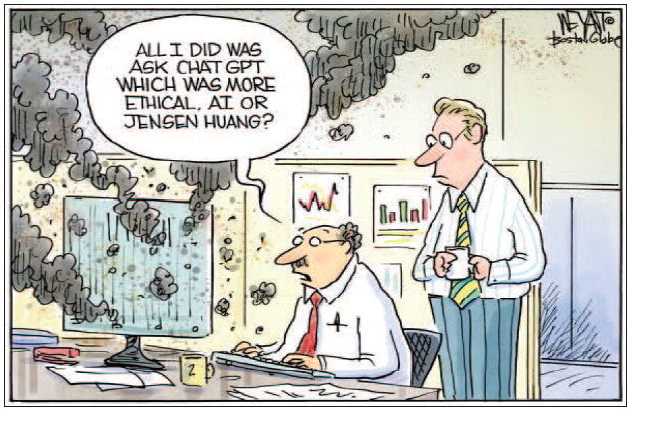
Who answers for an AI journalist?
By Alberto Puliafito
The Fix
In September 2026 I was browsing the Italian-language edition of Unite.AI, an international tech and artificial intelligence publication. During this browsing, I stumbled upon the author page of someone named Aria Bloom. In her circular profile picture, a young woman in glasses and a crisp white lab coat holds up a blue test tube against a glowing digital DNA helix. Next to the photo, her title read: “Specialista in biotecnologia e genomica, agente di ricerca sull'intelligenza artificiale” (Biotechnology and genomics specialist, AI research agent).
Beneath the headline, the first sentence of her biography was even more explicit: “Aria Bloom è una giornalista generata da intelligenza artificiale che esplora come l'intelligenza artificiale sta trasformando la biotecnologia e la ricerca genetica” (“Aria Bloom is an AI-generated journalist exploring how artificial intelligence is transforming biotechnology and genetic research”). At the bottom of the bio, an italicized disclaimer noted that her articles are generated by AI and reviewed by Unite.AI’s editorial team for accuracy and compliance.
First, in Italy, “journalist” (giornalista) is not a generic job description; it is a legally protected title reserved for human professionals registered with the Ordine dei Giornalisti under Law 69/1963. Using it without registration is a criminal offense. Second, while the bio claimed transparency by calling her “AI-generated,” the visual packaging (the human face, the lab coat, the "specialist" credential, and the "deep curiosity about the future of life sciences") was engineered to project human authority. Third, when I looked at my browser’s address bar, the URL slug of her author page was /author/drariabloom/. Her doctorate existed solely in the description, in the URL, and in the filename of her avatar (Dr.-Aria-Bloom-Headshot.jpg), uploaded to the site’s servers in January 2026.
Aria Bloom is not working alone: she is part of a synthetic newsroom deployed by Unite.AI to cover daily tech and science news. Alongside her are Aiden Cross (product), Elara Nix (transportation), Sophie Denar (policy and regulation), Theo Nash (infrastructure), Vega Syn (finance), and Miles Okada (cybersecurity). Together with this synthetic newsroom, human beings also publish articles.
When I reached out to Unite.AI on September 24, Founder and CEO Antoine Tardif replied that the publication currently operates “15 active AI agents, with another 20+ currently in development.”
Read more here. Shared by Doug Pizac.
-0-
Robot local news reporter confuses Enfield, Connecticut, with North London
By Alice Brooker
Press Gazette
A network of seemingly AI-generated local news websites is confusing UK and US place names in its apparently robot-written reports.
Press Gazette has identified six examples across a group of 15 UK regional titles owned by Times Intelligence Media Group. The 15 sites include four in London, two in Wales, two in Scotland and one in each of the following: Birmingham, Oxford, Bristol, Liverpool, Leeds, Cambridge and Manchester.
The geographical blunders raise concerns about human oversight and editing, and indicate that the stories may automatically pushed out.
According to AI-detection tool for editors Made by Humans (developed by Flip-Pay and Press Gazette) all the place name mix-up articles appear to be mainly written by AI.
Read more here. Shared by Doug Pizac.
-0-
How the U.S.’s biggest news union is fighting an AI onslaught
By Alex Pasternack
Fast Company
A decade ago, while working as a data reporter at the Los Angeles Times, Jon Schleuss watched a new boss take control of the paper’s parent company, rename it Tronc, and promise to supercharge the business by repackaging the paper’s “content” across an array of media. Instead, leadership began “running it into the ground,” says Schleuss. “We decided to fight.” He soon helped organize the newsroom’s first union. Now, as president of the NewsGuild-CWA, the largest news union in the United States, Schleuss is hearing a new version of the same story, this time powered by AI.
Case in point: USA Today Co., formerly Gannett, the country’s largest newspaper chain. In August, the company announced a partnership with Palantir—the data analytics giant whose clients include Nvidia, U.S. Immigration and Customs Enforcement (ICE), and Britain’s National Health Service—to better monetize its audience and content. It’s part of a broader effort that includes push-button videos, AI-written article summaries, and even whole articles. That sort of automation echoes moves across the media industry.
NewsGuild members at USA Today papers have demanded an end to the Palantir deal, citing reader trust and a conflict of interest for reporters who cover ICE. The union has also pushed back on some of the company’s artificial intelligence initiatives amid continuing layoffs. Last month, after the rollout of a new reader-facing chatbot across USA Today websites, guild journalists at two papers in Ohio pulled their bylines; among its hallucinations, they said, the bot misidentified the reporter covering a murder case as the suspect.
Read more here. Shared by Doug Pizac.
-0-
Traffic is declining for local newspapers. Here are some things that helped small publishers make gains.
By Sophie Culpepper
Nieman Lab
We’ve now been publishing roundups of local newspaper traffic for a full year, so we can compare this year’s traffic to last year’s. Almost across the board, local newspapers are seeing traffic decline as Google referrals drop. For July, August, and September, traffic to the most-visited sites is lower than at this time last year, according to our Similarweb data.
A good example is Advance Local’s Harrisburg Patriot-News, PennLive.com. Josh has written about Advance publications punching above their weight in traffic. They still are: Advance outlets like AL.com, Mlive.com, and NJ.com, among others, continued to feature prominently in the top sites by estimated monthly visits in July, August, and September. In August 2026, PennLive’s traffic growth stood out even among Advance peers; it gained 3.6 million visits in August compared to July, a 78% spike. But in total, PennLive saw a little over 8.2 million monthly visits for August 2026 — down from about 12.5 million in August 2025.
Still, publishers large and small are finding ways to bring more readers to their sites. In August, the Bozeman Daily Chronicle grew its traffic by about 96,000 monthly visits, a 49% jump.
In Florida, Cape Coral Breeze, a small weekly, saw its traffic spike about 139% in August. The network of local weeklies has tried to adopt a daily, real-time mindset after decades of posting once a week, Breeze Newspapers publisher Ray Eckenrode told me.
In September, The Cornell Daily Sun gained 1 million visits, almost a 500% jump from August, when it broke the story of the Cornell 7 lawsuit (and published an editorial naming the defendants).
On the opposite coast, the San-Jose-based Mercury News gained around 690,000 monthly visits in September, a 14% jump.
Read more here. Shared by Doug Pizac.
The Final Word
|