|
|
|
Connecting
Oct. 4, 2023
Click here for sound of the Teletype
| |
|
Colleagues,
Good Wednesday morning on this Oct. 4, 2023,
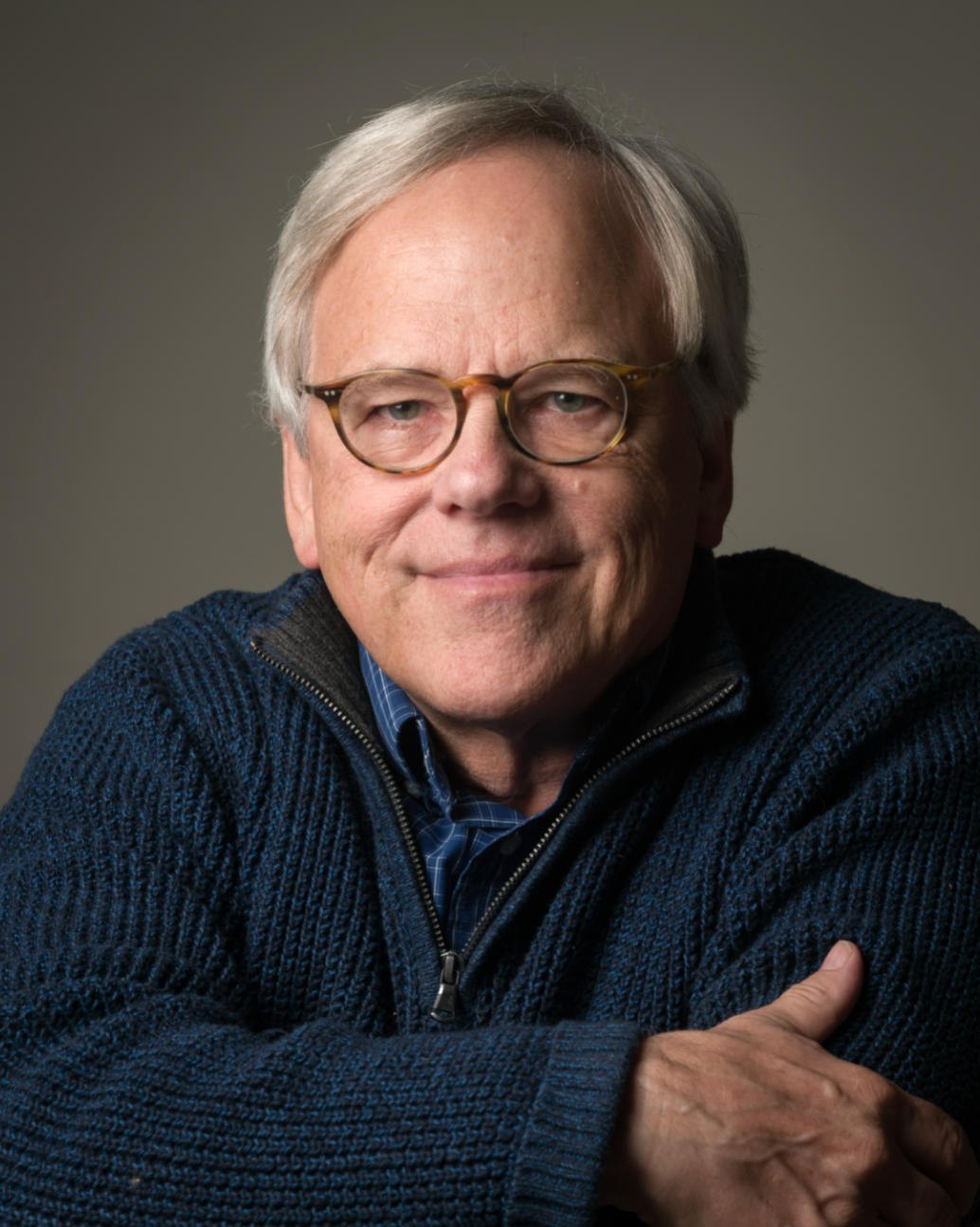
Today’s Connecting leads with news that J. David Ake, AP’s director of photography since 2018, will retire from The Associated Press after a 26-year AP career and four decades in the news business.
Ake, a Connecting colleague, is just the fifth person to hold the position since 1938 – his predecessors being Al Resch, Hal Buell, Vin Alabiso and Santiago Lyon. He will leave the AP at the end of the year.
There’s an irony in the timing of Tuesday’s announcement by Executive Editor Julie Pace. This is Newspaper Week – and David got his start at a small newspaper in Colorado, the Littleton Independent, which publishes today as a community weekly.
Asked by Connecting for his thoughts on starting new chapters, David responded:
“I’ve had a remarkable journalism career, I started as a newspaper carrier to support my photography hobby. That same newspaper published my first front-page photo—a picture of a wooden duck hanging on a barn door and covered in ice. They later asked if I could cover high school basketball, and thus a photojournalism career was born. Fast forward several decades, and here I sit as the Director of Photography for the greatest news agency on the face of the earth. I am humbled by the privilege and honor to call myself an AP photojournalist.”
Ake joined AP in 1997 as a photo editor in the Chicago bureau. He previously worked for Reuters, United Press International and Agence France-Presse, where he captured the presidencies of George H.W. Bush and Bill Clinton as a White House photographer. An accomplished photojournalist, Ake has documented major news stories in over two dozen countries on six continents.
Here’s to a great day – be safe, stay healthy, live it to your fullest.
Paul
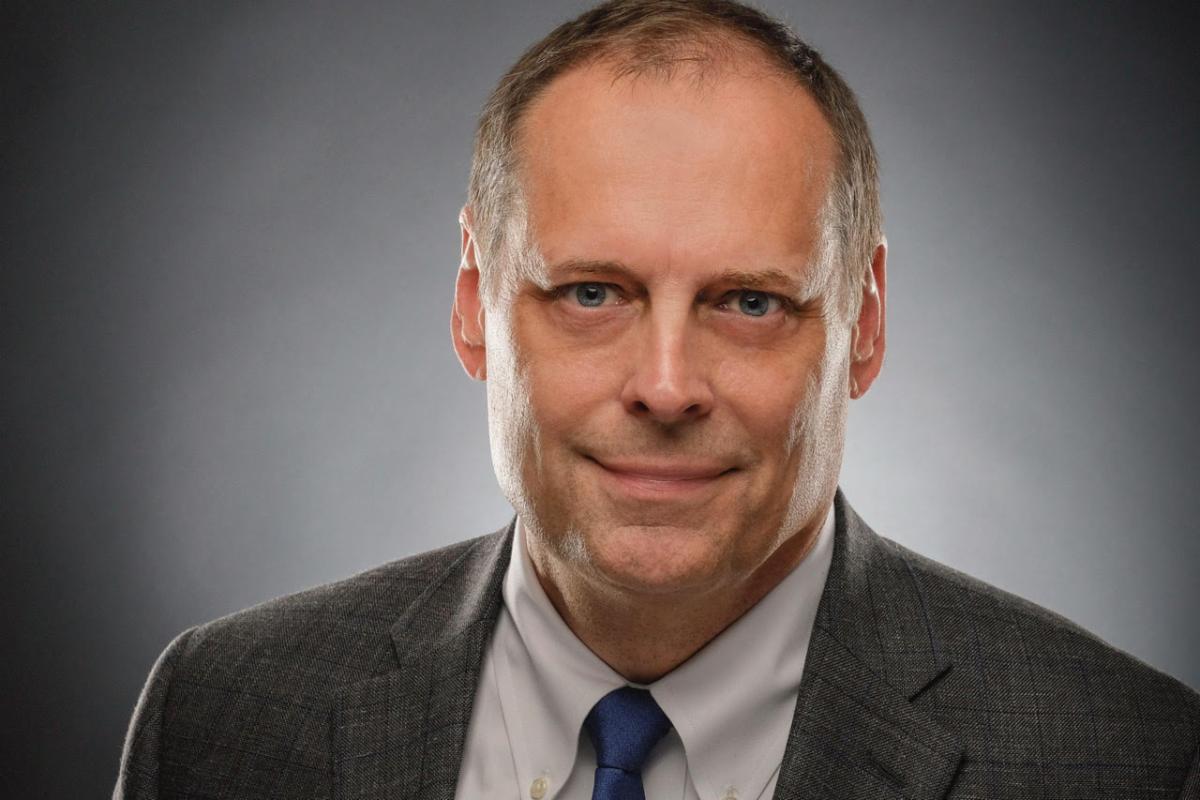
After four decades in news, including 26 with AP, David Ake plans to retire
|  | |
Executive Editor Julie Pace, in a note Tuesday to AP’s worldwide staff:
There are few jobs in journalism more impactful than Director of Photography for The Associated Press – and few who have done that job better than J. David Ake. Under David’s leadership, AP has dominated photo coverage of the world’s most significant news events, and been honored – repeatedly – with the industry’s highest awards.
So it is with great admiration that I want to let you know that David will be stepping away from news, and the AP, at the end of this year after a four-decade career. I hope you’ll join me in congratulating him on an exceptional run.
After stints at AFP, Reuters and UPI, David joined the AP in Chicago in 1997. He went on to hold numerous positions at AP, including deputy director of national photography in the U.S. and deputy chief of bureau for visual journalism in Washington. He guided AP’s photo coverage of the Sept. 11, 2001, attacks and Hurricane Katrina; multiple U.S. presidential contests; and the war in Ukraine. His sports credits include eight Olympics, more than 25 Super Bowls, six World Series, eight NBA Championships, five Masters Golf Tournaments, and so much more.
AP photographers have been awarded Pulitzer Prizes in four of the five years David has served as our Director of Photography. That includes this year’s Breaking News Photography award for stunning coverage of the Ukraine war.
But what none of these achievements capture is this: David is just a really great person, and really great colleague. He’s the ultimate team player, always willing to pitch in where needed and always ready to do the crucial behind-the-scenes work necessary to help his teams succeed. While he’s as competitive as they come on a big story, he also cares deeply about the people in the field and at the editing desk making the picture.
While David may be stepping away from the daily grind of news, he’s not hanging up his cameras. Instead, he’ll be returning to one of his first passions: fine art and landscape photography. And we’ll have plenty of time to toast him properly, as he’ll continue in his current role through the end of the year.
Obviously, this marks a moment of transition for photojournalism at AP, and we’ll be embarking on a broad search for our next Director of Photography. Photojournalism has long been a hallmark of our success as a news organization, and that won’t change. As audiences and our customers demand more visually-led news coverage, it’s more important than ever that photojournalism – and photojournalists – are at the center of the AP report.
David Ake’s email – jdake@ap.org
In the beginnings of AP’s Gramling Awards
| 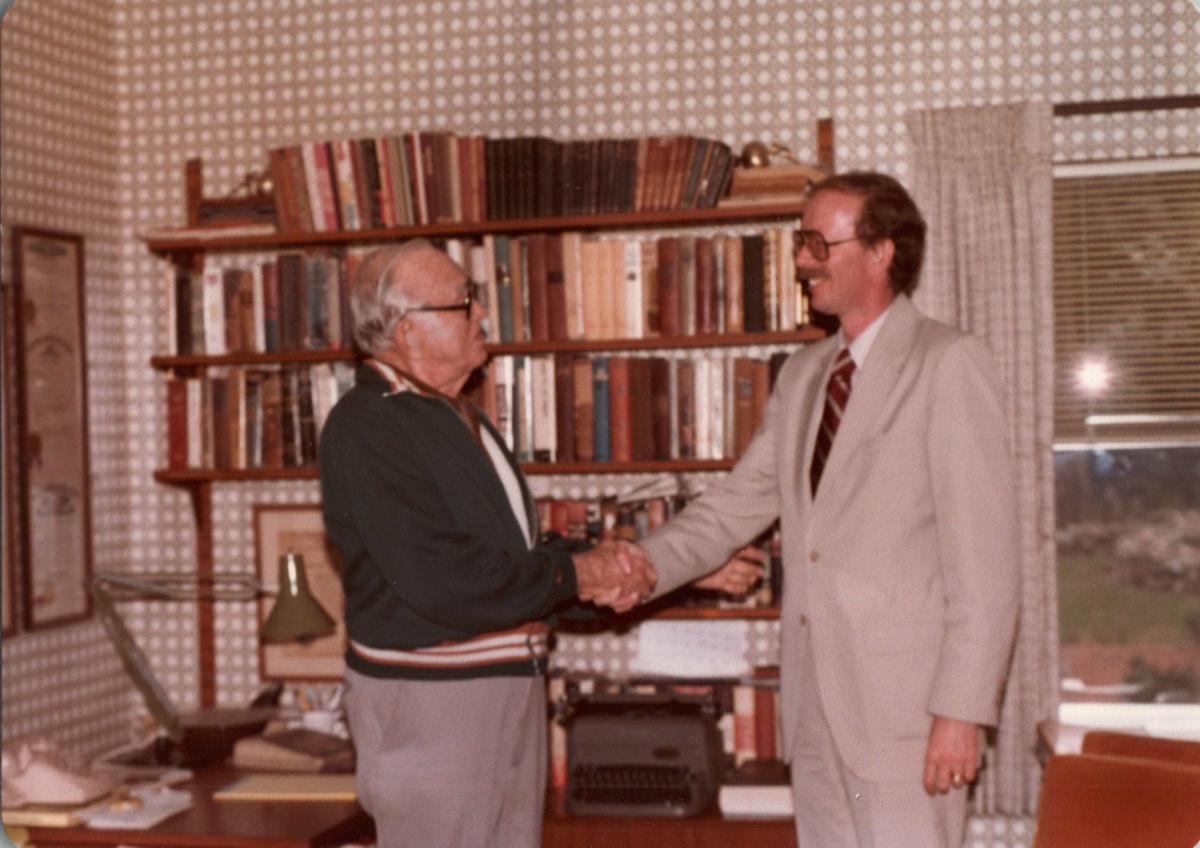 | |
Oliver Gramling (left) and Jim Hood shaking hands on what turned out to be a very initial agreement.
Jim Hood - It was a pleasure to be reminded that the Gramling Awards are still going strong (Connecting, Oct. 3). The awards came about somewhat haphazardly following a luncheon with Gram sometime in the early 1980s.
Roy Steinfort (then AP VP for Broadcast Services) and I were in Central Florida for a conference of some kind and went to visit Gramling afterwards. He had lived in the area since retiring from the AP, where he had headed the AP's broadcast division for many years.
Gram mentioned at lunch that, despite having owned several boats, he had nevertheless saved $1 million or so and wanted to do something worthwhile with it upon his demise. We tossed around a few ideas and Gram was taken with the idea of an annual awards dinner to honor outstanding work by staffers, whom he invariably referred to as "AP men." I was deputized to investigate the feasibility of the idea.
This was the first time I discovered that giving money away is not as easy as it sounds.
I went around, hat and virtual checkbook in hand, to several universities. All were eager to get money for their journalism programs but wary of the awards dinner idea. Gram was also a bit stuck on several details and I amassed quite a few frequent flier miles shutting back and forth to Florida. At one point, I recruited a lawyer friend to do a pro bono meeting with Gram to try to iron out the sticking points, including a requirement that his photo be displayed at the awards dinner each year.
Things were moving slowly but seemingly on track when I left the AP a few years later and I lost track of the final details but I'm happy each year to see the AP men -- and women -- honored for their work and to see that the program extends far beyond the strictures that had initially been proposed.
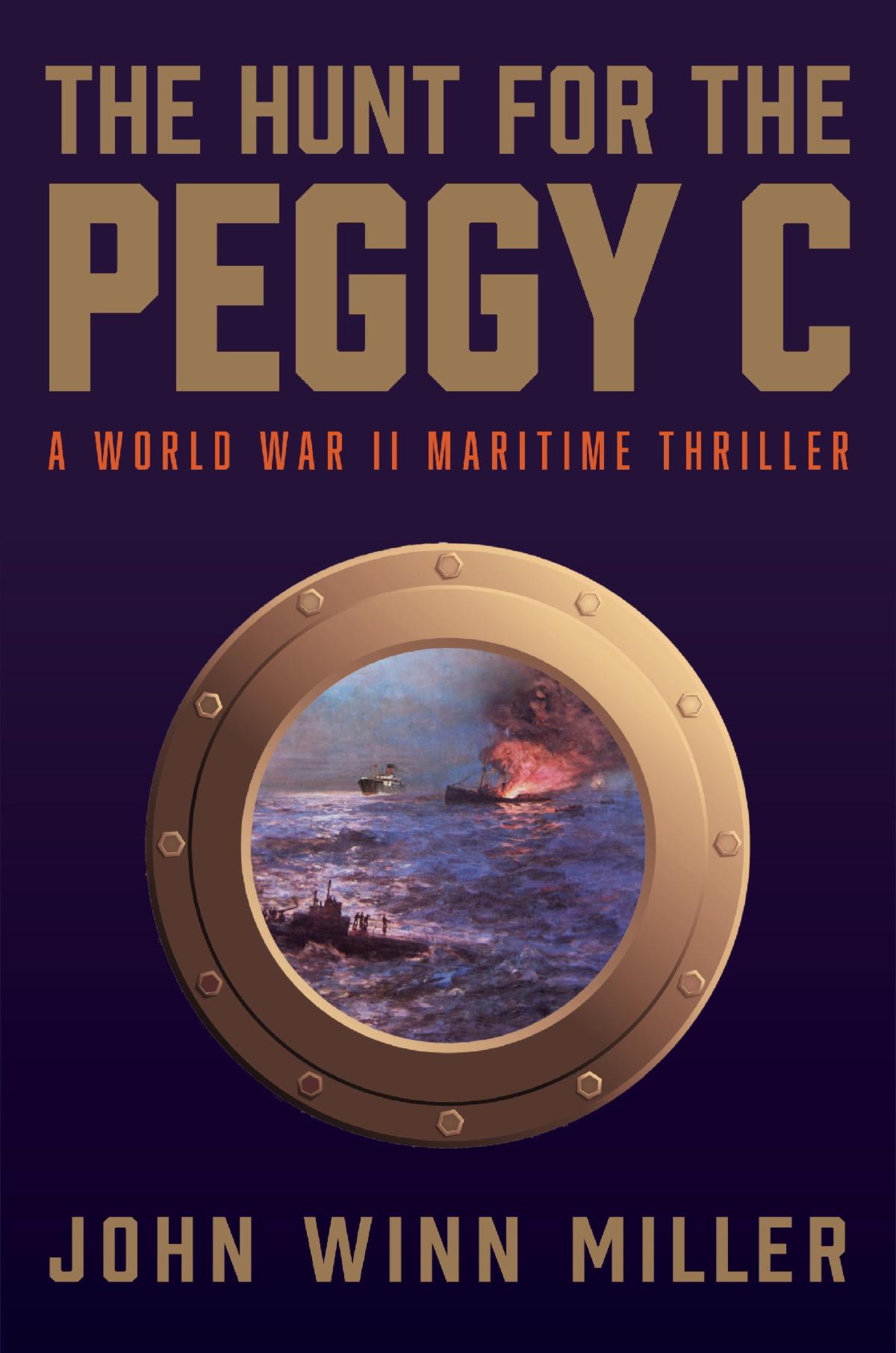
‘The Hunt for the Peggy C’ honored with Gold Medal
|  | |
John Miller - I just read (Connecting, Oct. 3) about Bob Dvorchak winning a Silver medal from the Military Writers Society of America.
I didn't think to let you know that my novel, "The Hunt for the Peggy C," won a Gold Medal for Historical Fiction, along with best-selling authors Lee Jackson and Buzz Bernard. It also has 56 five-star reviews on Amazon.
From Amazon:
John Winn Miller's THE HUNT FOR THE PEGGY C, a semifinalist in the Clive Cussler Adventure Writers Competition, captures the breathless suspense of early World War II in the North Atlantic. Captain Jake Rogers, experienced in running his tramp steamer through U-boat-infested waters to transport vital supplies and contraband to the highest bidder, takes on his most dangerous cargo yet after witnessing the oppression of Jews in Amsterdam: a Jewish family fleeing Nazi persecution.
The normally aloof Rogers finds himself drawn in by the family's warmth and faith, but he can't afford to let his guard down when Oberleutnant Viktor Brauer, a brutal U-boat captain, sets his sights on the Peggy C., Rogers finds himself pushed to the limits of his ingenuity as he evades Brauer's relentless stalking, faces a mutiny among his own crew, and grapples with his newfound feelings for Miriam, the young Jewish woman whom, along with her family, he must transport to safety.
When Rogers is seriously wounded, Miriam must prove she is as tough as her rhetoric to save everyone as the U-boat closes in for the kill. THE HUNT FOR THE PEGGY C is a masterpiece laced with nail-biting tension and unexpectedly heartwarming moments that any reader, not just fans of naval fiction, will enjoy.
The sequel comes out next October, and the third volume is in editing.
Here is the announcement:
http://www.mwsadispatches.com/2023-season#medals
And here is a link to the review:
https://www.mwsadispatches.com/library/2023/the-hunt-for-the-peggy-c
Axios Finish Line: Centenarians' hacks for living to 100
|  | |
Bill Kole, in Axios:
The way we're wired has a lot to do with whether we'll live to 100, but it's not the only factor — good news for those of us with ill-fitting genes.
Zoom out: As the oldest and fittest of the baby boomers age into triple digits over the next 25 years, and medicine finds new ways to treat and cure heart disease and cancer, more of us than ever before will see 100.
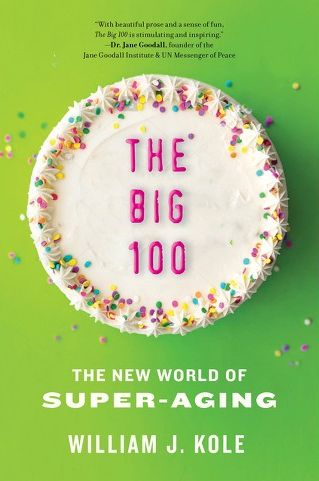
I dove deeper in my new book, THE BIG 100: The New World of Super-Aging, out Oct. 3.
Why it matters: Our behaviors — things like diet, exercise and sun exposure — account for 75% of what gets us to 90, and our genes play a 25% role.
Beyond 90, the script flips and genes play a decisive role in taking us the rest of the way to 100.
I interviewed dozens of longevity experts and centenarians, including a vibrant 112-year-old. I've distilled five life hacks for making the most of what we have to work with.
Chill out. Toxic stress is the enemy of longevity. Stress triggers a release of hormones that take energy away from our cells' longevity-promoting activities, says biologist Martin Picard of Columbia University. If there's a way to ease or avoid stress, do it.
Keep moving. That's supercentenarian Herlda Senhouse's best advice, and she should know: At 112, she dines out regularly, attends church and plays the slots at a casino outside Boston. Even something as humdrum as a little brisk vacuuming, experts say, can benefit our bodies and our minds.
Get your Zs. In a culture that pushes us to wring every last ounce of productivity from every waking hour, many of us neglect good sleep hygiene. The American College of Cardiology says healthy sleep habits boost life expectancy by 4.7 years for men and 2.4 years for women.
Stay connected. U.S. Surgeon General Vivek Murthy recently proclaimed loneliness and isolation a public health crisis, and the National Institute on Aging says their impact is like smoking 15 cigarettes a day.
Think positive. The world's oldest living person, American-born Spaniard Maria Branyas Morera, insists she's 116 because she always looks on the bright side. It's more than wishful thinking: A study of nearly 160,000 U.S. women ages 50 to 79 found that those who scored highest for optimism were 10% more likely to live beyond 90.
The bottom line: Although there are steps we can take to optimize our shot at 100, living past 105 requires hitting all five numbers in the genetic lottery plus the Powerball.
(EDITOR’S NOTE: Bill Kole is a Connecting colleague who retired last November from AP as New England news editor after a 31-year career.)
| |
Connecting wishes Happy Birthday | |
|
Stories of interest
Columbia Journalism Review editor leaving to encourage news outlets to devote more time to climate (AP)
NEW YORK (AP) — Saying that journalism isn’t showing enough urgency in covering climate change, the editor of the Columbia Journalism Review is leaving his job to devote his time to try and change that.
Kyle Pope, who has been editor and publisher of the magazine and website for journalists since 2016, said Tuesday that he is leaving to join Covering Climate Now, an organization he helped launch with Mark Hertsgaard, environment correspondent for The Nation.
Covering Climate Now works with newsrooms to prioritize coverage and train reporters, and is trying to convince more meteorologists to make the connection between climate change and their weather reports.
Pope said journalists need to bring the same focus to covering climate that they did to COVID-19 in the early days of that pandemic — perhaps not in the volume of stories but the sense that reporters on various beats need to be mindful of how climate change affects what they’re following.
Read more here. Shared by Richard Chady.
The Final Word
Joe Rosenthal Chapter Speaker Series
Bridging the Military and Civilian Divide Through Journalism
Wednesday, October 4 12:00 Pacific Time
Log in to Zoom here: https://us06web.zoom.us/j/9373013855
Meeting ID: 937 301 3855
Passcode: Va4ptQ You will need this passcode.
October speaker Thomas Brennan first appeared on our radar as founder of The War Horse, an award-winning nonprofit newsroom exploring the human impact of military service. He made a second, large blip on the screen when earlier this year he became the first enlisted Marine recipient of the Gen. John A. Lejeune Award for Leadership.
The War Horse seeks to strengthen our democracy by holding power to account and improving understanding of the true cost of military service. The War Horse's reporting has been published in partnership with leading newsrooms and magazines and has led to multiple changes in military and federal law.
And War Horse writing seminars have become the preeminent professional journalism development program for veterans and military family members. (Learn more at https://thewarhorse.org/impact)
Brennan served as a Marine infantryman in Iraq and Afghanistan before studying investigative reporting at Columbia University’s Graduate School of Journalism. His reporting has appeared in Vanity Fair, the Center for Investigative Reporting, and on the front page of The New York Times.
He has held fellowships at the Dart Center for Journalism and Trauma, The Center for a New American Security, and the George W. Bush Institute. Brennan is the recipient of two Fourth Estate Awards, three Edward R. Murrow Awards, and the Robert F. Kennedy Human Rights Journalism Award.
On October 4, he will share his thoughts on how veterans and military families can help restore America's trust in our Fourth Estate.
DO NOT MISS THIS MARINE VETERAN WHO CONTINUES TO SERVE AMERICA’S INTERESTS AND VALUES.
The Joe Rosenthal Chapter is part of the national USMC Combat Correspondents Association, comprising active duty, reserve, and retired Marines who served as Combat Correspondents or Combat Communicators on active duty or worked as a civilian in journalism, broadcasting, graphic arts, advertising and public relations. USMCCCA is the only professional organization of its kind in the US military services. Founded in 1947, the USMCCCA is a not-for-profit fraternal and patriotic organization.
The Chapter is named for former member, Joe Rosenthal (1911-2006), the Pulitzer Prize winning photographer who took the iconic Iwo Jima flag raising photo. The Joe Rosenthal Chapter Speaker series hosts a monthly virtual speaker on topics of interest to our audience, including military history, journalism and veterans issues.
We are petitioning the Secretary of the Navy to name a Navy warship for Joe Rosenthal, so his name and history will not be lost to time. You can sign the petition at www.USSJoe.org.
Tom Graves
Chapter Historian, USMC Combat Correspondents Association
| |
Today in History – Oct. 4, 2023 | |
|
Today is Wednesday, Oct. 4, the 277th day of 2023. There are 88 days left in the year.
Today’s Highlight in History:
On Oct. 4, 1957, the Space Age began as the Soviet Union launched Sputnik 1, the first artificial satellite, into orbit.
On this date:
In 1777, Gen. George Washington’s troops launched an assault on the British at Germantown, Pennsylvania, resulting in heavy American casualties.
In 1887, the International Herald Tribune had its beginnings as the Paris Herald, a European edition of the New York Herald.
In 1940, Germany’s Adolf Hitler and Italy’s Benito Mussolini conferred at Brenner Pass in the Alps.
In 1965, Pope Paul VI became the first pope to visit the Western Hemisphere as he addressed the U.N. General Assembly.
In 1970, rock singer Janis Joplin was found dead in her Hollywood hotel room at age 27.
In 1990, for the first time in nearly six decades, German lawmakers met in the Reichstag for the first meeting of the nation’s reunified parliament.
In 1991, 26 nations, including the United States, signed the Madrid Protocol, which imposed a 50-year ban on oil exploration and mining in Antarctica.
In 2001, a Russian airliner flying from Israel to Siberia was accidentally downed by a Ukrainian anti-aircraft missile over the Black Sea, killing all 78 people aboard.
In 2002, “American Taliban” John Walker Lindh received a 20-year sentence after a sobbing plea for forgiveness before a federal judge in Alexandria, Virginia. (He was released from prison in May, 2019.) In a federal court in Boston, a laughing Richard Reid pleaded guilty to trying to blow up a trans-Atlantic flight with explosives in his shoes (the British citizen was later sentenced to life in prison).
In 2004, the SpaceShipOne rocket plane broke through Earth’s atmosphere to the edge of space for the second time in five days, capturing the $10 million Ansari X prize aimed at opening the final frontier to tourists.
In 2010, the Supreme Court began a new era with three women serving together for the first time as Elena Kagan took her place at the end of the bench.
In 2013, Vo Nguyen Giap, the military commander who’d led Vietnamese Communist forces against the French and then the Americans, died in Hanoi at age 102.
In 2017, President Donald Trump visited hospital bedsides and a police base in Las Vegas in the aftermath of the shooting rampage three nights earlier that left 58 people dead.
In 2020, infected and contagious, President Donald Trump briefly ventured out in an SUV from the hospital where he was being treated for COVID-19 to salute cheering supporters. Trump’s medical team reported that his blood oxygen level had dropped suddenly twice in recent days and that they gave him a steroid typically only recommended for the very sick.
In 2022, Elon Musk abandoned his legal battle to back out of buying Twitter and offered to go through with his original $44 billion bid for the social media platform.
Today’s Birthdays: Country singer Leroy Van Dyke is 94. Actor Felicia Farr is 91. Author Roy Blount Jr. is 82. Actor Lori Saunders (TV: “Petticoat Junction”) is 82. Chicago White Sox manager Tony La Russa is 79. Actor Clifton Davis is 78. The former Chairman of the Joint Chiefs of Staff, Adm. Mike Mullen, is 77. Former Secretary of Defense Chuck Hagel is 77. Actor Susan Sarandon is 77. Blues musician Duke Robillard is 75. Playwright Lee Blessing is 74. Actor Armand Assante is 74. Actor Alan Rosenberg is 73. Actor Christoph Waltz is 67. Actor Bill Fagerbakke is 66. Music producer Russell Simmons is 66. Actor-singer Wendy Makkena is 65. Musician Chris Lowe (The Pet Shop Boys) is 64. Country musician Gregg “Hobie” Hubbard (Sawyer Brown) is 63. Actor David W. Harper is 62. Singer Jon Secada is 62. TV personality John Melendez is 58. Actor-comedian Jerry Minor is 56. Actor Liev Schreiber is 56. Actor Abraham Benrubi is 54. Country singer-musician Heidi Newfield is 53. Singer-guitarist M. Ward (She & Him) is 50. Actor Alicia Silverstone is 47. Actor Dana Davis is 45. Rock musician Robbie Bennett (The War on Drugs) is 45. Actor Phillip Glasser is 45. Rock singer-musician Marc Roberge (O.A.R.) is 45. Actor Brandon Barash is 44. Actor Rachael Leigh Cook is 44. Actor Tim Peper is 43. Actor Jimmy Workman is 43. Actor Michael Charles Roman is 36. Actor Melissa Benoist is 35. NBA All-Star Derrick Rose is 35. Actor Dakota Johnson is 34. Figure skater Kimmie Meisner is 34. Actor Leigh-Anne Pinnock (Little Mix) is 32. Actor Ryan Scott Lee is 27.
| |
Got a story or photos to share? | |
|
Connecting is a daily newsletter published Monday through Friday that reaches more than 1,800 retired and former Associated Press employees, present-day employees, and news industry and journalism school colleagues. It began in 2013. Past issues can be found by clicking Connecting Archive in the masthead. Its author, Paul Stevens, retired from the AP in 2009 after a 36-year career as a newsman in Albany and St. Louis, correspondent in Wichita, chief of bureau in Albuquerque, Indianapolis and Kansas City, and Central Region vice president based in Kansas City.
Got a story to share? A favorite memory of your AP days? Don't keep them to yourself. Share with your colleagues by sending to Ye Olde Connecting Editor. And don't forget to include photos!
Here are some suggestions:
- Connecting "selfies" - a word and photo self-profile of you and your career, and what you are doing today. Both for new members and those who have been with us a while.
- Second chapters - You finished a great career. Now tell us about your second (and third and fourth?) chapters of life.
- Spousal support - How your spouse helped in supporting your work during your AP career.
- My most unusual story - tell us about an unusual, off the wall story that you covered.
- "A silly mistake that you make"- a chance to 'fess up with a memorable mistake in your journalistic career.
- Multigenerational AP families - profiles of families whose service spanned two or more generations.
- Volunteering - benefit your colleagues by sharing volunteer stories - with ideas on such work they can do themselves.
- First job - How did you get your first job in journalism?
- Most unusual place a story assignment took you.
Paul Stevens
Editor, Connecting newsletter
paulstevens46@gmail.com
| | | | |