|
‘Urgent You Get To World Trade Center’
Brad Kalbfeld - deputy director, managing editor of AP Broadcast from 1987 to 2008 - I was supposed to be on the New York Shuttle the morning of Sept. 11, 2001, heading to 50 Rock for a meeting. The meeting wasn’t until early afternoon, so I stopped at the doctor’s office at 8:30 a.m. for a routine eye exam.
When I got back into the car at about 9:50, WTOP—Washington’s all-new radio station—sounded odd: the local anchors weren’t on the air, no traffic and weather on the eights. Instead, I was listening to an equally familiar, if distant sound: WCBS, New York’s Newsradio 88. And the reporter was talking about a small plane hitting the World Trade Center.
Being a native New Yorker, the first thing that popped into my mind was that a U.S. Army bomber had hit the Empire State Building in the 1940s. An uncle of mine had been in the building when it happened (he wasn’t hurt). I called my wife Jane (also a New Yorker) and suggested she turn on the TV.
My beeper went off: Ed Tobias, Broadcast’s assistant managing editor for news, assumed I was already in New York and urged me to head to the World Trade Center.
But I was still in Virginia, heading to Reagan National Airport. Before I could respond to Ed, I listened in astonishment as the WCBS reporter described the second plane’s impact. I slammed my hand onto the steering wheel and yelled, "freaking terrorists!" though the word wasn't exactly "freaking." No way I was going to New York now.
Almost immediately, my cell phone rang. I picked up the call: Jane, with the most urgent sound I have ever heard in her voice:
“A second plane hit! I saw it happen!”
“I know! I need to call in!”
It was the shortest call I have ever had with the love of my life.
The drive into DC was unreal. As I headed downtown, I kept seeing black Chevy Suburbans heading the other way, presumably Feds heading to the CIA or Pentagon.
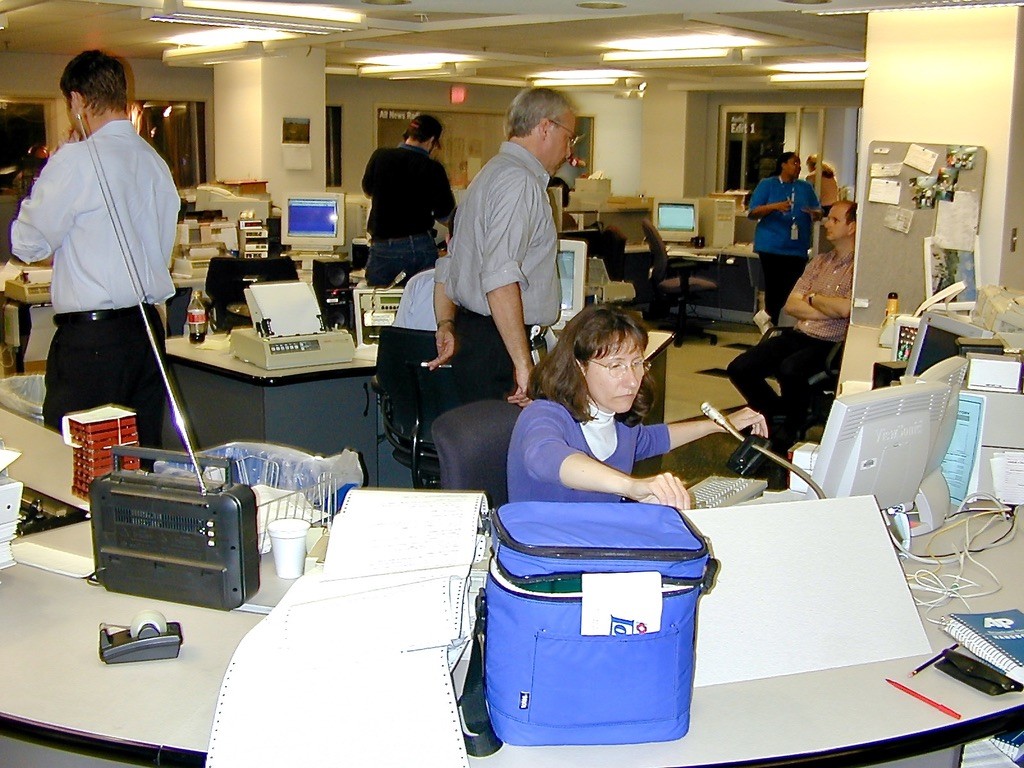
The Broadcast News Center of a quarter century ago was a fully multimedia newsroom. We did video, TV graphics, audio, and text. It was a uniquely complex newsgathering, producing and service operation. The events of 9/11 were covered in every medium and every format that newsroom produced.
We provided live video positions overlooking Ground Zero, the Pentagon, and the White House for video clients from around the world. Our video soundbites, b-roll and live coverage appeared on what was then known as the Global Video Wire. We wrote stories for the National Broadcast and Washington Metro wires. We told the story live, continuously, on AP All News Radio, our national all-news radio network, as well as AP Network News. Our audio packages, soundbites, and natural sound were posted on our online audio soundbite services, SoundBank and Prime Cuts. We posted graphic elements and finished television graphics on GraphicsBank.
Many talented people contributed to this rich, complicated report, making smart, creative choices under intense time pressure.
Within minutes of the story breaking, International Television Manager Denise Vance dispatched two camera crews in New York. We also deployed two crews from Washington and one from Miami. Our unilateral video from New York included smoke pouring out of the towers, debris on the ground and people covered in soot, plus soundbites with witnesses and victims.
Just minutes after the second plane hit the towers, Assistant Managing Editor Wally Hindes made the critical decision to break format on All News Radio and cover the story continuously. He supervised our on-air programming. The BNC news anchors did an incredible job of keeping radio and online listeners informed of fast-breaking developments. Their work in the first 53 hours of the crisis–virtually all unscripted, relaying information as it came into the newsroom, often guiding the audience through live events as they developed on the air–won AP RTNDA's 2002 Edward R. Murrow Award for spot news coverage.
Tobias was the glue that held the newsroom's audio and wire coverage together, coordinating the movement of reporters and providing hands-on direction of the supervisors.
Assistant Managing Editor Barbara Worth came in from vacation and assumed direction of the national and Washington Metro wires. World Editor Mike Hammer came in from vacation to take the chief editing position of the national Broadcast wire. World Editor Pat Fergus, on vacation in North Carolina, jumped into her car and drove back to Washington to help cover the story.
From the time the story broke until the second tower collapsed, about an hour and 50 minutes, we moved 16 NewsAlerts, 11 bulletins, two urgents, six tops and six separates.
AP GraphicsBank, under the direction of assistant managing editor Becky Krimstein, produced more than 40 images on the story–graphics, maps, photos, and frame grabs from video–on Sept. 11 alone.
Internet traffic and AP’s on-line infrastructure were smaller in those days. But on 9/11, the traffic for our web-delivered services (company-wide) was so intense that members couldn't reliably find or download material. It took a couple of hours to fix the external access issue, but we still had difficulty adding content from inside the AP network – so we deployed staffers from home to access and update the content.
Our reporters and producers, of course, were the heart of our coverage. AP Radio reporter Dave Winslow watched from his apartment as the airplane crashed into the Pentagon. He immediately went live on the radio network and we sent quotes to the Washington desk for the A-wire. Based on Winslow’s eyewitness report, we broke the fact that it was an airplane that hit the Pentagon.
APTN’s Eugenio Hernandez was on his way to work, driving on the highway adjacent to the Pentagon, when he spotted the attack. He pulled of the road, ran toward the building, and immediately approached a couple of tourists and asked if he could borrow their digital video camera. He filmed immediate reaction and fire billowing from the Pentagon.
Thelma LeBrecht was the only reporter in the triage area outside the Pentagon for the first several hours following the attack. That got us interviews with the people treating the victims and an up-close view of the damage.
Broadcast's New York regional reporter, Warren Levinson, was at the BNC for video training (he was learning to add the role of VJ to his portfolio of skills) when the planes went into the WTC. He rented a car and drove to back New York (planes had already been grounded), where he got a change of clothes and went straight to Ground Zero. He was soon joined by our Miami regional reporter, Tony Winton, who had also been in D.C. for video training. Winton later got former president Bill Clinton on camera, confirming he had authorized the killing of Osama bin Laden in 1998.
Broadcast White House correspondent Mark Smith was with President Bush in Florida when the planes struck. Mark wasn't the radio pool reporter for the return trip to Washington, so while the president flew to various air bases across the country, he was able to do live reporting from Longboat Key, Fla. He, along with other network and agency reporters, ended up taking a 19-hour bus ride back to Washington. He was back in time to cover Bush's visit to Ground Zero later in the week.
Our Broadcast Services operation (known today as AP 360) leveraged our newsgathering infrastructure to serve video clients from around the world. Its revenues helped offset the cost of live video coverage of the story. Serving clients on 9/11 was an extraordinarily complex operation: There was an overwhelming demand for services, there could be no conflicts in satellite windows, every service had to have an itemized record of what was done and when (so we could send an invoice), and it all had to run on time. Most important, it had to be coordinated with our news desks in Washington and London so they had transmission and editing facilities when they needed them.
We had satellite trucks strategically placed around New York Harbor and did a total of about 50 live shots per day from positions overlooking Ground Zero, the Pentagon, and the White House, as well as the New York APTN bureau and the BNC newsroom. The amazing team that handled this, under Denise's direction, included Broadcast Services Production Manager Chris Cowman, who supervised operation of the New York uplink trucks; Commercial Productions Production Manager June Appell and New York Bureau Manager Roger Raiford, who supervised all of the work done from the New York bureau; and Broadcast Services Production Coordinator Gail Connor, who carried the main burden of scheduling the Pentagon truck, the live-shot position on the Chamber of Commerce building overlooking the White House, and the BNC live shots.
Throughout the day, everyone in our newsroom shared news tips and logistical information with everyone else. If we saw something on a video monitor in master control, we made sure radio and the wires knew about it. Live radio reports were relayed to the wires and the television producers. Tips from Metro reporters were relayed to the national desks. Information from the A-wire and Broadcast wire was shared with every desk. Video shot by a radio reporter made it to the international video clients.
As shocking and frightening as the events of 9/11 were, I ended it, as I drove home long after dark, with a sense of pride that the entire Broadcast team, producing written, spoken, and visual reports, had worked in unity to cover the historic day for our members and clients around the world.
Your memories of 9/11
Sheila Norman-Culp - For those of us at AP headquarters in Rockefeller Center, 9/11 began as a sunny Tuesday morning and morphed into the biggest challenge of our careers. Behind every move we made on the General Desk that day was the realization that we had to get every detail as accurately as possible, for AP’s reputation would be defined by its 9/11 coverage for years to come.
We quickly decided that Marty Steinberg, the PMs supervisor, would handle the news alerts all day while Pete Brown, the General Desk supervisor, and myself, the AMs supervisor, would write the main 9/11 story sentence by sentence— basically a 13-hour urgent series. Whatever I wrote, Pete checked, and I did the same for him. Every three or four sentences, we sent a combo with material from the latest news alert. Later in the day we had some copy from AP writers but the sheer volume of raw material was ungodly. Still I don’t think I have ever worked more seamlessly with my AP colleagues before or since as a true sense of purpose swept through all of us that day.
Stephanie Nano took over the entire Pennsylvania plane crash and Paula Froke stepped in to tame the avalanche of stories and messages pouring into the AP New York computers. And all this was supported by a hive of other AP reporters, editors and photographers.
But it was not easy in the heat of the moment to figure out what was happening. We simply did not have the video resources we have today. We had to figure out what made a 60-story dust cloud: was a building blown up? Did it topple over sideways? Did 100 stories really crumble upon itself just like that?
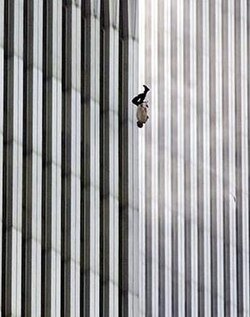
For example, we heard rumors that trapped World Trade Center office workers may be jumping to their deaths, but they could have also been flung out of the windows by the sheer impact of the plane. We couldn’t use such a devastating detail without an impeccable source. So we got AP photographer Richard Drew on a phone line, and I will never forget what he told us: “Yes, they are jumping, and it is the worst sound you have ever heard.”
Marty, Pete, myself and other AP workers who lived in New Jersey would be stuck in NY for three days, until late Thursday night, due to bridge and tunnel closures. Thank God our spouses were safe to watch over our children. AP put us up at the nearby Waldorf Astoria but we had nothing but our gritty ash-flecked, sweat-drenched clothes. Pete and Marty snagged the last package of men’s underwear in the one drugstore that was still open. Since the Waldorf didn’t sell any women’s clothing, I bought an XL men’s polo shirt, put a belt on it and called it a dress for the next two days. I still have that shirt.
We found out later that the entire Rockefeller Center complex had been evacuated due to security threats — except for the AP. We stayed because our computers at the time were unable to handle any remote workflow and we felt compelled to document such an historic moment.
Six months later, at the Salt Lake City Winter Olympics, I was woken up by a call from Amsterdam in which I was told I won a first-place World Press Photo award. Spoiler— it was not me but my roommate Gulnara Samoilova for her stunning shot of office workers covered in ash. Now I understood. Gulnara at the time had a racking, deep-throated, room-shaking cough — and once you have heard a 9/11 cough you will never forget it.
Fast forward 18 years later, and my daughter gave me and my husband tickets to a popular Broadway show “Come from Away” — the story of Gander, Newfoundland, during 9/11. Within 10 minutes of it starting, I broke into deep sobbing that lasted the entire length of the musical. I did not cry on 9/11, nor during the brutal work weeks and months that followed. I did not cry when I heard bagpipes 4x a day as St. Patrick’s Cathedral held 9/11 funerals for months. Somehow it took 18 years for this to come out.
I writing this today because for some inexplicable reason the AP account of how it handled 9/11 did not mention my name or Stephanie Nano’s. When I asked about it, a senior AP executive told me not to fuss because “we all know what you did, Sheila. “ But those who did know are dying out, so this is for younger generations.
-0-
Maura Kelly Lannan - It has been 25 years since that awful day of Sept. 11, 2001, but I remember it like it was yesterday. I was the early reporter for The Associated Press in Chicago, arriving at 6:30 a.m. in the newsroom. I remember the weather was perfect with a bright blue sky and no clouds. It was a quiet morning until another reporter arrived about 8 a.m. and told the newsroom a plane had just hit one of the Twin Towers in New York City. Assuming it was an accident, someone remarked that the New York AP office, where AP is headquartered, would be busy that day. Little did we know. We changed the television channel from a Chicago station to a national news program just after the second tower was hit by an airplane. We knew it wasn’t an accident.
My first thought was that it was around 8 a.m. and that most people probably were not at work in the World Trade Center yet, thankfully. Then the awful reality dawned on me that it was 9 a.m. in New York City and that those offices likely were filled with people.
I quickly called my parents at home in Connecticut -- I grew up only one hour north of New York City -- to tell them what happened and to have them turn on their television.
My editor told me to call the Sears Tower, which was the tallest building in Chicago and one of the tallest in the world, to find out if they were going to evacuate. I called the management office but no one knew anything. My editor immediately sent me to the Sears Tower, which was just one block from AP’s offices, to find out more. I couldn’t get in but spent most of the morning standing outside of the city’s tallest building interviewing workers as they streamed out, crying, confused and rushing to get away because they worried the Sears Tower would be the next building hit. As I asked if they officially had been evacuated, one woman frantically told me to leave because there was a plane headed for Chicago and the Sears Tower. I called the office from my cell phone to dictate a story and was told it was just a rumor. I stayed there and did my job, which I had just started a few weeks before at the AP. I called more quotes into the office to feed into a national story and received bad news each time: a plane hit the Pentagon, the first tower fell, a plane crashed in Pennsylvania.
At one point I went back to the office and heard the second tower had fallen. I was sent back out to interview people who were still downtown. I found a restaurant that was open and talked with people. I called quotes from the restaurant into the office and my editor then sent me to a mosque downtown as speculation swirled about who was responsible for the attacks. It was closed. He then sent me to cover Mass at Holy Name Cathedral. I interviewed people after Mass about the attacks, asking questions such as how they felt and what they prayed for during Mass. I went back to the office briefly. My shift should have ended at 3 p.m. but I told my editor I could stay.
I wrote up my notes and made some phone calls, talking to each of my sisters and parents. One of my sisters was stuck near the Hoover Dam, which had closed, and was in her hotel. She was driving with a friend across the country to start a new job in California.
My other sister was living in San Francisco. She had tried to go to work but was sent home. My father was a pharmacist at a hospital that was put on notice to expect mass casualties, which sadly never came. My mother was a high school teacher who was luckily home that morning. I knew my family was safe. They were mostly worried about me, still unsure if there were more planes that could have been hijacked and knowing I was near the Sears Tower, but they knew I was doing my job.
As evening fell, my editor sent me to a Chicago suburb to another mosque where I ran into other reporters I knew from The Chicago Tribune and other media outlets. Someone from the mosque told us they condemned the attacks.
By about 10:30 p.m., I went home to my apartment. I watched as much coverage of the attacks as I could and was horrified.
I was the 6:30 a.m. reporter the next day also and my editor told me to go straight to O’Hare International Airport where people were stranded because all planes had been grounded. O’Hare wasn’t letting people in so I had to try my best to get inside. I took the el there and ran into another reporter I knew from The Chicago Tribune. We both had the same plan, to enter the airport through the Chicago Hilton that was attached to O’Hare. We walked from the “L” to the hotel together and then easily into the airport.
He went one way and I went another after we were inside.
I found many stranded passengers and interviewed them about their experiences. I didn’t want security to see me or kick me out so I surreptitiously took notes on the front page of my copy of that day’s Chicago Sun-Times, which I still have. I called quotes and information into the office.
At one point that day, my editor told me I was the only AP reporter in the country inside an airport. He told me I might have to do a live interview with AP Radio. I was ready but the interview never happened.
I spent the entire day at O’Hare, as well as the entire next day, sneaking in the same way again. An AP photographer joined me.
I finally was able to watch coverage of the attacks that weekend. I had been so busy working that I missed seeing most of it. Chicago’s AP office was tasked with writing short obituaries for each of the 2,977 people who died in the attacks and keeping an accurate count of victims, which I helped do at times.
I wanted so badly to go to New York City, having grown up so close. I didn’t get there until later that fall when my parents and I went to Ground Zero. We saw pictures posted on a wall of missing people. We were struck by how there were several inches of dust still sitting on top of some lampposts and street signs, months later. We saw the twisted wreckage at the site. It was so sad.
I didn’t watch the planes hit or the towers collapse in real time as so many did because I was out covering how Chicago was reacting to the tragedy. As most people were sent home from work that day, my colleagues and I stayed at work to report on the events.
It’s what reporters do. I will never forget that day and week.
May we never forget that horrible day and always remember those whose lives were tragically lost.
-0-
Sally Hale - Many New Jersey Associated Press staffers, along with member editors, were converging on the Forsgate Country Club in Jamesburg for our annual state AP Managing Editors' meeting when the first jet crashed into the World Trade Center. By the time all the staffers arrived at the country club, the second jet had attacked the Twin Towers.
We quickly canceled the meeting and began dispatching reporters and photographers. News Editor Jennifer Yates hurried back to Trenton to direct the story, with help from Day Supervisor Bill Newill and Broadcast Editor Shawn Marsh.
State Capitol Editor John McAlpin and photographer Mike Derer headed to Liberty State Park, where ferry loads of the injured and refugees began arriving and where residents and tourists watched in horror as the Twin Towers collapsed.
In the Newark bureau, where the unfolding tragedy was visible outside east windows, newsman Jeff Gold kept a phone line open to the Trenton bureau and gave assignments to various AP New York staffers who couldn't get to the city, sending them to hospitals and to interview workers fleeing lower Manhattan. Newark newsman Wayne Parry and Chief Photographer Dan Hulshizer went to the airport, while photographer Brian Price drove to the ferry terminal at Weehawken.
Lori Hinnant visited Sayreville's high school, where rumors flew about missing relatives. J.J. Thompson took up a post at the state emergency command center. Dave Weinstein interviewed travelers at Turnpike service plazas. Atlantic City Correspondent John Curran wrote a state reaction piece.
Chief of Communications Tom Leone and his staff helped Dow Jones set up AP service at its South Brunswick office, where The Wall Street Journal quickly relocated.
Bureau Chief Sally Carpenter Hale was sent to the AP's technical center in Cranbury to set up a backup national editing desk.
In the days and weeks that followed, we developed attacks-related beats that became full-time jobs for many reporters. The entire Newark staff, led by Correspondent Amy Westfeldt, was assigned to the investigation. (Westfeldt was stuck in Canada on Sept. 11, but made it home when the border was reopened a few days later.) Curran took on the military beat. After the anthrax letters were mailed from New Jersey, McAlpin developed sources that led to several scoops.
…On a personal note, I will never forget driving home late at night on 9/11 and seeing a convoy of about 25 ambulances heading north on the New Jersey Turnpike, lights on but no sirens. There is no one to rescue, I thought. Everyone has either escaped, or they are dead.
-0-
Mark Mittelstadt - Sally Hale's recollection of the convoy of ambulances heading north on the New Jersey Turnpike as she drove home the night of 9/11 brought to mind a couple somber memories of that time.
Due to the terror attacks, Jody Calendar, Santos Chaparro and I were "stranded" for a day in Milwaukee. The air space over New York City, including Newark, was closed, and we were unsure when we would be able to return to the East Coast. We attempted to rent a car and drive back. By the time we got to an agency, all vehicle rentals were shut down.
Midwest Express Airlines, which Jody and I had flown from Newark, was able to schedule a late flight on Thursday the 13th -- the first out of Milwaukee -- but only to Philadelphia. The three of us boarded at a virtually empty Mitchell International Airport. Our flight included approximately 10 nurses who were being brought to Philadelphia to be taken to New York City. Puzzling as we already had seen reports that the expected rush of injured to New York City hospitals never materialized; most of the anticipated victims had perished.
We got to our homes early Friday morning. I had only a few hours of sleep but wanted to go to the office.
One of the New Jersey Transit rail lines at Newark had been closed to be used exclusively to take emergency workers and related personnel to and from the city. Exiting Penn Station in New York, I ended up in a large group waiting to cross 7th Avenue. Pedestrians were being held to clear the way for a long line of heavy construction equipment headed south towards the site of the collapsed towers.
It was a sad realization rescue had gone to recovery. And removal.
-0-
Michael Weinfeld - My wife, Tia M. Mayer, had a unique vantage point of the horrors of 9/11. She watched emergency crews battle the fire caused by the plane that crashed into the Pentagon from a hill in Arlington National Cemetery.
I asked Tia to recall that day for Connecting.
“My mother had come down to attend the military funeral for a family friend.” They were on their way shortly after the attack on the Pentagon.
Tia said the mood on the drive to Arlington was “sober.”
“We were driving down George Washigton Parkway and there was a break in the trees, and we could see the huge plume of smoke.”
“We happened to be the last car” allowed into Arlington before the gate was closed for security purposes.
They entered Henderson Hall “where people who are attending funerals gather.” Seeing the “big billow of smoke, people were confused” and wondering “what the hell was happening.”
“The funeral did not take place, and they kept us there for eight hours. The Marines were very nice. They had catered (for the funeral) so we were fed.”
“We didn’t know what was happening with Flight 93. The limousine drivers had walkie-talkies, and they were keeping tabs on what the chatter was. As far as they knew, this plane was heading either toward the Capitol or the White House. I was worried that we were going to get hit. I was very anxious and I remember my mother was trying to tell me to calm down.”
I was working at the AP BNC in Washington just blocks from the White House. I called Tia and asked her to go to a spot where she could get a better view of Pentagon so she could do a live shot for AP Radio. I was so proud that she was able to hold it together enough to describe what she saw.
She climbed up a hill where she was able to see “a big gaping hole smoking” in the Pentagon. “I was surprised to see how close the Pentagon was to the road and cars were driving by it. They hadn’t closed off the road yet. There were emergency vehicles all over the place and a lot of people scrambling around. There was just a big, black, smoking hole.”
Were you afraid?
“Yes. I was anxious. I was definitely anxious, but it wasn’t very long after that the limousine drivers told us that the plane had gone into a field in Pennsylvania. So, we knew that plane wasn’t heading for us.”
Tia’s voice cracked with emotion as she recalled “It was a shocking day. It was shocking to be going to a funeral for a beloved friend, and it was also horrible what was happening to our country. It was very scary.”
-0-
John Dowling - All these years later it’s hard to conjure how absolutely stupefying the events of that morning were. Suddenly a war was being fought in two of America’s great cities, with passenger jets as weapons, and it was being broadcast live on TV. We all know today that the Twin Towers collapsed, but who knew a moment before that it was going to happen? It would have seemed inconceivable. Then it happened. Anyone who thought twice would realize that hundreds if not thousands of innocent people perished in that moment. Whoever had launched such audacious and devastating attacks, what might they do next? What was the next target?
I wondered how colleagues in New York processed all of this as they put the incredible developments – in the city where they worked and some lived -- into words on a screen and sent them out to the world. I suspect that people who have worked for AP for a while just go into breaking news mode, focused solely on getting the story out, and leave the processing until later. I think that’s what I did with my miniscule piece of the effort.
I was a little more than a year into a new job as deputy director of training, working for Barbara King, after seven-plus years as news editor in Chicago. This was at the beginning of the enlightened era when AP realized that everyone who worked for headquarters need not work at headquarters, and actually might be better off that way. My colleague Sarah Nordgren, who had been Chicago ACOB, was in the same boat; she was deputy to State News Director Marty Thompson, but we had side-by-side offices in the far reaches of the Chicago bureau.
The newsroom had multiple large TVs so after the story broke, Sarah and I went out to watch coverage and see if we could help. It seemed like an “all hands-on-deck” moment. For whatever reason the Chicago bureau leadership decided Sarah and I should run coverage from Chicago. The bureau had a wealth of talent but whatever. We enlisted business writer Dave Carpenter, an ace filer from his days on the Foreign Desk and set up shop at his desk in the newsroom.
At that moment the U.S. air traffic system was in chaos. The hijackers had turned off the transponders on the planes they seized so they no longer transmitted their identity, location and direction. Three hijacked planes were known to have crashed. Every other plane in the sky had been ordered to land. Airlines were conducting a frantic inventory to determine whether any other planes were missing and possibly hijacked.
Fear of further attacks was widespread. Prominent buildings and institutions were seen as potential targets. The Chicago bureau was located about two blocks from the Sears Tower, until recently the world’s tallest building, and literally on top of the Chicago Mercantile Exchange, a global hub of futures trading. It had sure seemed like a good place to locate a bureau …
There were unconfirmed reports of a plane crash in Pennsylvania. I don’t remember whether Dave queried or whether Chicago-based United Airlines issued a statement, but in any event the airline said one of its passenger jets had crashed in southwest Pennsylvania. I asked Dave to file a news alert saying that. He followed with a quick urgent lead while I called New York to backstop. (Can you imagine what the National Desk incoming looked like that morning?) It was the first confirmation of a fourth crash from an authoritative source. I believe that of all the dozens of news alerts (and two flashes) filed that day, ours was the only one not filed from New York or Washington.
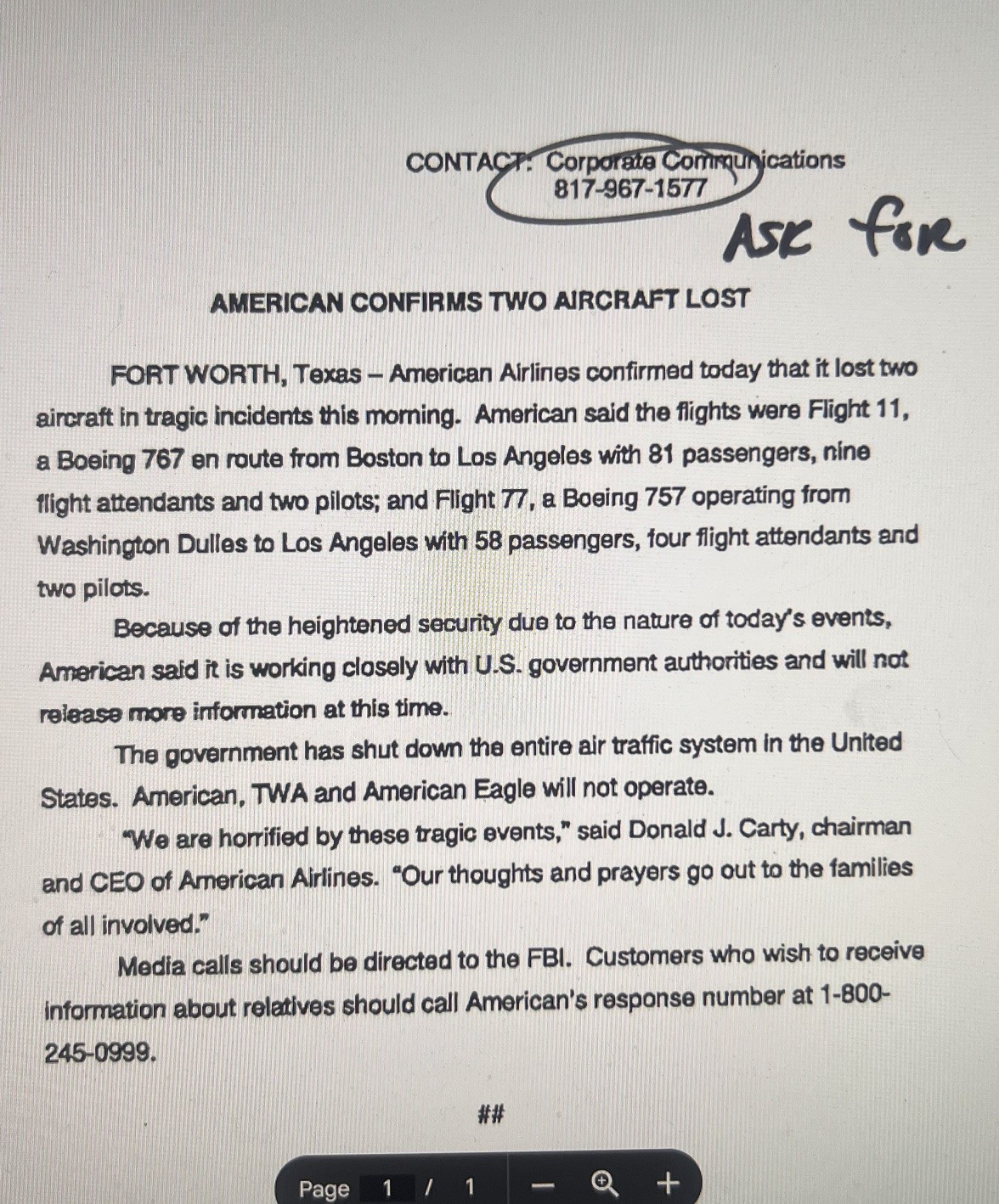
At that point something didn’t add up. I can’t remember the details but the numbers of hijacked planes and crashes we were reporting only made sense if American Airlines had lost three planes. Remember that the airlines were still trying to confirm their losses. We now knew that United had lost two and there were four confirmed crashes. I called Dallas news editor Linda Leavell and asked that her bureau go back at Fort Worth-based American and reconfirm what they knew. American said they had indeed lost two planes, one in New York and one at the Pentagon. Somehow that was communicated to New York; I don’t remember how.
And with that we were done. On any other day the crash of a passenger jetliner in the United States with dozens of fatalities would have been the dominant news story. On Sept. 11 this crash was a sidelight. The bravery of the passengers who forced the hijackers to crash Flight 93 was not known immediately. The Sears Tower and the “Merc” ended the day unscathed.
I had a long talk with Barbara about the horror of the day, hung around the bureau until after dark in case I could be helpful in some way, then caught a late train home. I saw that one of our neighbors had hung an American flag on his front porch, illuminated by a spotlight, and in that moment, I thought our country would be all right.
|