| | |
Connecting
Sept. 15, 2026
Click here for the sound of the Teletype
| | |
Colleagues,
Good Tuesday morning on this Sept. 15, 2026,
Victor Simpson was “one of a kind.”
That’s an apt description from retired AP President/CEO Lou Boccardi of the longtime AP Rome bureau chief whose four decades as a foreign correspondent spanned five popes, wars and violence that touched him personally.
Simpson, a 46-year AP veteran, died of cancer Sunday at his home in Rome, his children said Monday. He was 84. He covered many of the defining stories of the late 20th and early 21st centuries, including the papacy of Pope John Paul II, whom he accompanied on dozens of trips.
His children, Michael and Debbie, said in announcing his death that in keeping with their father’s wishes, two memorial services will be held in coming weeks – in Rome and in New York City – and that more details were forthcoming.
“He is now together with mom, his parents, his older brother, our uncle David, and his daughter, our sister Natasha,” they said. “The pain he carried for her loss has finally evaporated leaving only love behind.”
Simpson’s wife Daniela, who helped shape the AP’s fashion and Vatican coverage for nearly four decades, died in February at the age of 80.
Their daughter Natasha was killed in 1985, at the age of 11, when terrorists attacked Rome’s airport. The family was leaving for a vacation in New York when the attack started. Her father was hit in the hand as he tried to shield his daughter from the bullets. She died in his arms. Her 9-year-old brother, Michael, was severely wounded in the abdomen.
Today’s Connecting brings you his wire obituary by AP Rome journalist Colleen Barry, along with comments from his former colleagues. If you have a favorite memory to share, please send it along.
POLLY ANDERSON - Stephanie Nano – I saw Marty Steinberg’s comment about Polly’s contribution on 9/11….. Coincidentally, I heard from Polly’s niece on Sunday who wrote: “She’s still at the memory care facility in Midlothian, VA doing the best she can. I’ve been thinking about her so much this week; she had so much 9/11 paraphernalia at her apartment. She loves New York so so so much.”
Here’s to a great day – be safe, stay healthy, live it to your fullest.
Paul
Longtime AP Rome bureau chief Victor Simpson, who covered 5 popes, dies at 84
| |
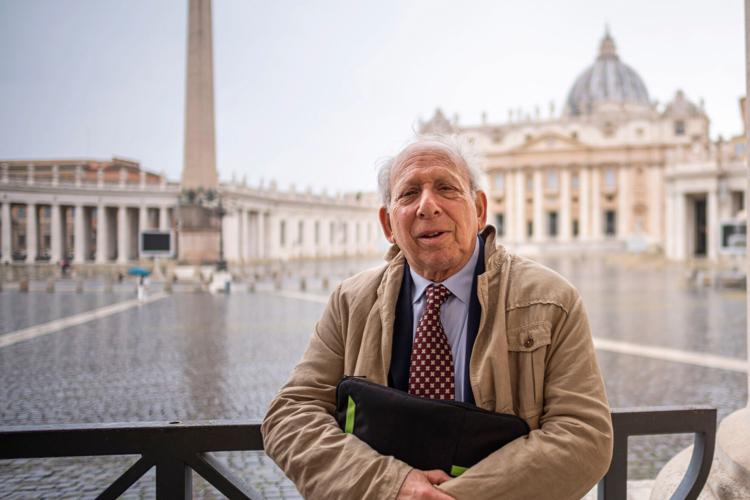
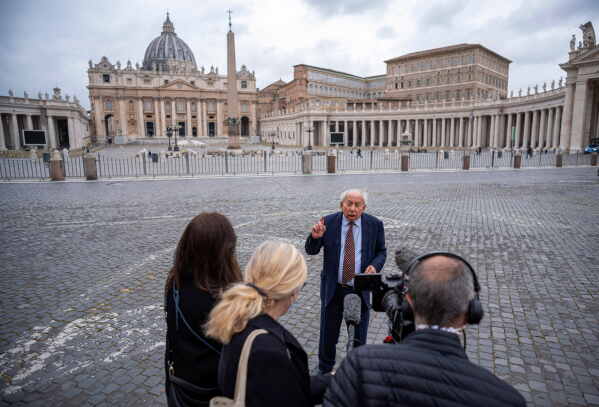
Former Associated Press Rome Bureau Chief Victor Simpson poses for a portrait after an interview with The Associated Press at the Vatican on April 29, 2021. (AP Photo/Domenico Stinellis, File)
By COLLEEN BARRY
The Associated Press
ROME (AP) — Victor L. Simpson, the longtime Rome bureau chief for The Associated Press whose four decades as a foreign correspondent spanned five popes, wars and violence that touched him personally, has died. He was 84.
Simpson died of cancer Sunday at his home in Rome, his children said Monday.
During a 46-year AP career, Simpson covered many of the defining stories of the late 20th and early 21st centuries, from the 1967 Newark, New Jersey, race riots and war in the Middle East to the papacy of Pope John Paul II, whom he accompanied on dozens of trips.
A native New Yorker, Simpson joined the AP in Newark in 1967, where he wrote an award-winning series on organized crime. He transferred to the General Desk in 1968, editing top domestic stories, and then to the Foreign Desk in 1970.
| |
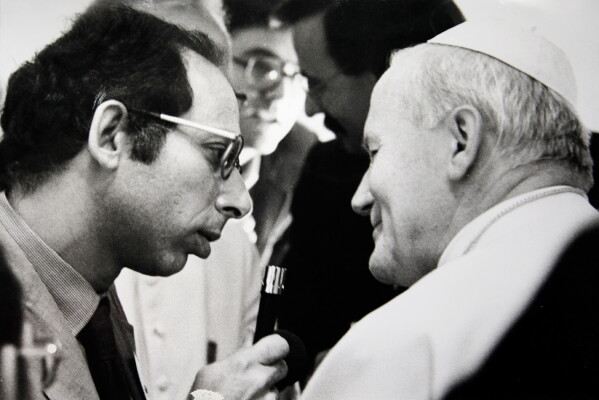
Associated Press correspondent Victor Simpson, left, interviews Pope John Paul II aboard the airplane in flight from Rome to Warsaw, June 2, 1979. (AP Photo, File)
He was assigned to Rome as news editor in 1972, where he promptly met his future wife, Daniela Petroff, who became a distinguished AP fashion and Vatican correspondent. She died in February at age 80.
He became Rome bureau chief in 2005. Simpson previously worked for the Hackensack (New Jersey) Record.
“Victor had an extraordinary life and career, and built a lasting legacy at the AP,” said AP Executive Editor Julie Pace. “Years after his retirement, he still comes up regularly in stories and conversations in AP bureaus around the world — a testament to the impact he had on generations of AP journalists. I know that legacy will endure for many years to come.”
Simpson loved to regale listeners about his journalistic feats, which included a private dinner conversation on the papal plane with John Paul and an interview with Svetlana Alliluyeva, the daughter of Soviet dictator Josef Stalin. He secured the scoop by showing up at Alliluyeva’s door in Princeton, New Jersey, where she lived after defecting from the USSR.
“He put a lasting mark on AP, from his days as a feisty young staffer in our Newark bureau, through years as an energetic mainstay on our central news desk in New York, and then during a storied career in Rome,” said retired AP President and CEO Louis D. Boccardi, who called him “one of a kind.”
His life was marked by tragedy
Simpson’s life was marked by two devastating personal tragedies: the shooting death of his father during a robbery in 1964, and the killing of his 11-year-old daughter, Natasha, by Palestinian militants who attacked Rome’s airport on Dec. 27, 1985.
Simpson was preparing to fly to the United States with his family when the militants stormed the airport, throwing grenades and firing automatic weapons. Natasha was among more than a dozen people killed. Simpson and the couple’s 9-year-old son, Michael, were both wounded.
Natasha’s killing “was a tragedy that affected us all deeply,” Boccardi recalled.
Two years later, Simpson and Petroff welcomed another daughter, Debbie. The pope called the family to congratulate them.
In announcing his death, his children, Michael and Debbie, said the pain he carried over Natasha’s killing “has finally evaporated, leaving only love behind.”
When Simpson was 22, his father, Leonard P. Simpson, a well-known New York lawyer, was shot and killed in the elevator of the family’s apartment building. He was 63.
“The murder was considered yet more proof of New York’s degradation,” Simpson wrote in his 2024 memoir “Life of a Reporter.”
He described how an “exuberant” Jimmy Breslin interviewed the family for a story about the difficulties of the middle class in the crime-ridden era. The experience taught him an important lesson in journalism about being considerate and sensitive with the victims of tragedy.
Simpson’s optimism and devotion to family and work sustained him through the tragedies.
| |
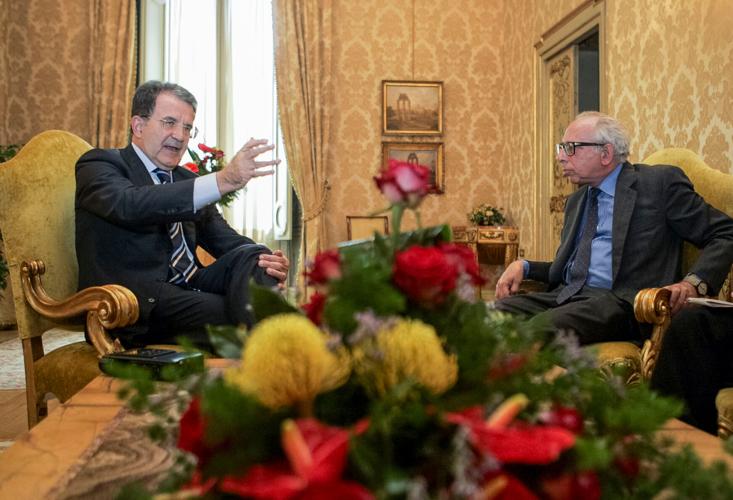
Italian Premier Romano Prodi, left, gestures as he is interviewed by Associated Press Rome Bureau Chief Victor Simpson at Chigi palace, in Rome, Wednesday, July 26, 2006. (AP Photo/Domenico Stinellis, File)
He was the unofficial dean of the Rome press corps
He was born May 11, 1942, and raised in a Jewish family. He said that while religion wasn’t a centerpiece, “tolerance was considered a precious value.” He graduated from Hobart College in 1963 and briefly served in the U.S. Army.
Simpson kept his extended family close, making overseas trips for weddings and bar and bat mitzvahs. “It meant a huge amount to me,” said his niece, Catherine Simpson Bueker.
Simpson was the unofficial dean of the Rome press corps and a first stop for new correspondents. Decades covering the Holy See made him one of the longest-serving Vatican correspondents of his generation, including 92 trips with John Paul and Pope Benedict XVI.
| |
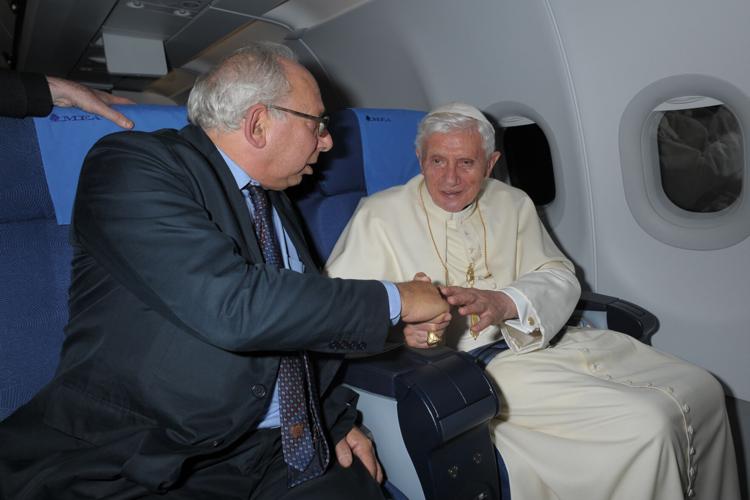
Rome Bureau Chief Victor Simpson, left, shakes hands with Pope Benedict XVI during the flight from Beirut to Rome, Sept. 16, 2012. (AP Photo/L'Osservatore Romano, File)
Simpson had a special bond with John Paul II
It was on one of those flights in 1986 that Simpson was invited to dine with John Paul on the final leg following a two-week tour of Asia and the Pacific.
Simpson, in a rumpled safari jacket detested by his fashion-writer wife, apologized to the pontiff for wearing “my working clothes.” The pope put him at ease, gripping his white robes and saying, “These are my working clothes.”
One of his biggest exclusives came on a 1988 flight to Uruguay when he asked John Paul about the Solidarity strikes challenging the communist government in his native Poland. John Paul responded with full papal support for the strikes.
“Here we are touching the heart of the problem,” the pope said. “It is not easy to bring democracy to a system that is by definition dictatorial and totalitarian.”
The remarks made front pages around the world and were later viewed as a landmark in the pope’s role in communism’s collapse in Eastern Europe.
Philip Pullella, longtime Vatican reporter for United Press International and then Reuters, said Simpson’s Jewish background allowed him to cover the Vatican with some distance without falling into “false awe” of the institutional pomp.
“He was the gold standard. I don’t think he was ever intimidated by the Vatican. He saw it as an institution that needed to be covered in an impartial way,” Pullella said.
Simpson’s assignments included the 1974 Turkish invasion of Cyprus, Egyptian President Anwar Sadat’s historic 1977 visit to Israel, and the 1982 Israeli invasion of Lebanon. His early Rome years focused heavily on domestic and international violence by militants, famous kidnappings and enduring mysteries like the 1980 Ustica air disaster that killed 81 people.
He loved tennis and reported from the Italian Open for years and once from Wimbledon.
A papal resignation changes his retirement plans
Simpson had planned to retire on Feb. 28, 2013, but Benedict stunned the world by announcing he would become the first pope in nearly 600 years to resign, effective the same date as Simpson’s departure.
Simpson always wondered if he had given the idea of retirement to the German pope. He had had a brief private conversation with Benedict while returning from Lebanon in September 2012 on what was to be Simpson’s last papal flight before retirement.
“When I told him that I had covered the Vatican for more than 30 years, he looked surprised. He sounded wistful as he said my retirement ‘is much deserved,’” Simpson recalled in a tribute after Benedict died.
Simpson stayed to cover one final papal transition, the 2013 conclave that elected Pope Francis.
| |
Former Associated Press Rome Bureau Chief Victor Simpson speaks during an interview with The Associated Press at the Vatican on April 29, 2021. (AP Photo/Domenico Stinellis, File)
——
AP writers Nicole Winfield and Andrew Dampf contributed.
Click here for link to this story.
Your memories of Victor Simpson
Charlie Hanley – Vic was a great friend, a wonderful man, and a superb journalist. When the Simpson byline topped a piece of copy, urgent or otherwise, or a “vls” signed off at the bottom, you knew you had the very best in newswriting.
All those popes, all those Italian governments, all those wars and crises, with Vic handling, AP knew it was covered.
Even after the horrendous, tragic blow of daughter Natasha’s murder, he was back at work, hand still bandaged from his own wound, guiding this reporter through Rome sources for stories on global terrorism. He loved the Italian people and told of awakening from hand surgery after the airport attack and seeing at his bedside his barber, who had heard what happened on the radio and rushed to the hospital. That kind of warm humanity must have rubbed off on Vic over his decades in Rome, while he also remained a real New York, Upper West Side guy, ebullient, smart, funny. His many AP friends will miss him dearly. Riposa in pace, vecchio amico.
-0-
Robert Reid - On June 2, 1979, Pope John Paul II arrived in Warsaw for his first visit to his then-Communist homeland since his elevation eight months earlier.
The visit had generated huge international attention even before the charismatic pontiff had landed and kissed the tarmac at Okecie airport.
How would the two sides deal with one another given their historic animosity in the era of Cold War and Mutually Assured Destruction?
With the pope due to visit numerous sites around the country, AP developed complex coverage plan of pre-positioned staff plus two reporters who would follow the pontiff in government-provided transport.
Victor Simpson and I would be the two travelers.
At the last minute, Communist authorities threw a spanner into the works - a $200-plus per day per head fee for international news organizations who planned to follow the papal party.
The fee was supposedly for “support services,” including translators, domestic transport and comfortable accommodations.
AP refused to pay, considering it a shakedown.
Victor and I were relegated to the B Team, along with journalists from Poland and Soviet Bloc countries.
Instead of a comfy air-conditioned bus, we were to travel to the first out-of-town venue, Gniezno, on an overnight train from Warsaw, about 200 miles to the west.
Before our late-night departure, Victor and I had dinner at a Warsaw hotel with Frankfurt bureau chief Steve Miller and translator Barbara Kapusto. Miller was to drive us to the train station in his rental car.
As we approached the station, a driver cut in front of our car. Steve swerved but clipped the vehicle.
As we waited in the middle of the street for the Polish police, Victor and I grabbed our bags and ran off, leaving Steve and Barbara to contend with the cops, who loved to hassle visiting “imperialists.”
We found the train, only to discover that our cabin was in a shabby car with barely enough space for two small men.
Poland was gripped by a heatwave - daytime temperatures in the mid-90s and nights only marginally cooler.
The cabin was broiling. The small fan wouldn’t work, the window was barred shut and the electrical switch was broken so we couldn’t shut off the overhead light.
After several sleepless hours in what we dubbed the “rolling sauna,” we chugged into Gniezno around dawn — tired and bathed in sweat. Did I mention? There was a sink in the cabin but without running water. No shaving or tooth brushing.
The government press office had laid on a bus from the Gniezno station to the venue where the pope was to say Mass and speak.
It turned out to be in a vast field under a blazing sun. We had no water, no snacks and more importantly, no shade.
The pope showed up about six hours later.
Unfortunately, the public address system wasn’t working properly so all we could hear was mumbling in a language neither of us understood.
Afterward our minders drove us to a makeshift press center with a few aged telex machines.
Fortunately, Victor was able to score an English language text of the pope’s remarks from one of his Vatican contacts.
Despite dehydration and sleep-deprived brain fog, Victor managed to bang out a publishable story, proving the accuracy of the legend that he really could write copy in his sleep.
The next stop was the university town of Gniezno, where they put us up in a decaying student dorm - tiny room with a bath and toilets down the hall.
Victor had had enough. He disappeared for a time and returned with a rental car and reservations at the best hotel in town.
When I questioned who was going to approve the expense, Victor smiled and replied: “Don’t worry, AP will pay!”
-0-
Kevin Costelloe - former Paris bureau chief - I was honored to count Victor as a colleague and mentor from the moment I transferred to Rome 43 years ago.
He and Daniela were also wonderful friends, not just to me but also to Barbara and our children Isabella, Daniel and Sylvia. We had many great times together.
Victor was the best and most loyal friend you could ask for.
He will be missed terribly, but what he left behind is so very important to all of us.
A chapter has closed, and what a truly grand chapter it was.
-0-
John Daniszewski - Word reached me Monday morning, via retired NYT correspondent John Tagliabue, that our mutual friend Victor Simpson had passed away in Rome. He had been ill and had recently undergone surgery. John, former AP Rome staffer Dan Wakin and I had been trading news of Victor’s health woes. Dan spoke with him just last week.
Victor was an AP original, a connoisseur of all things Italian, a fount of knowledge on the modern papacy, an amazingly good-humored and fun-to-be-around colleague, whose life was twice marred by bitter tragedy but who retained his zest for living. His thick, gravely, staccato New York accent always struck me as a little out of whack for someone who spent almost his entire adult life in the Eternal City. But he was also a link to old, pre-yuppified New York and he would tell stories of his early reporting years in New Jersey, where he had been a standout AP reporter in the Newark bureau before transferring to the foreign desk and his stellar overseas career.
I first met him in 1987 when he was traveling on Pope John Paul II’s second pilgrimage to Poland, visiting eight Polish cities in as many days. I was a veteran of the General Desk, and a newly minted foreign correspondent myself, and I was awed by his ability to wade through the lengthy texts of the pope’s speeches to quickly find the nuggets of news among all the mostly religious and scriptural passages. I also noted his prodigious energy and flair as a reporter, managing to mix it up with the papal handlers and spokespeople and covering the Vatican in a wonderfully cynical but respectful way.
As news editor and later bureau chief in Rome, Victor was helpful to generations of AP reporters passing through. He introduced me to his favorite espresso bar near the AP office and took Drusie and me out to dinner once overlooking the city. As international editor from 2006-2016, I always looked forward to Victor’s trips home and had been anticipating seeing him in New York this fall before he became ill.
Victor was purely old-school and believed in the mission of the AP to tell the facts straight, without a lot of bells and whistles. His memoir “Life of a Reporter,” originally published in Italian, is remarkable for his unassuming way of recounting an extraordinary life.
While I feel sad that he has passed on, only a few months after the passing of Danny, I am so grateful for the life he led with great grace and aplomb in spite of the terrible losses that he endured, and I feel enriched to have known him even a little.
Here’s your pen
| | |
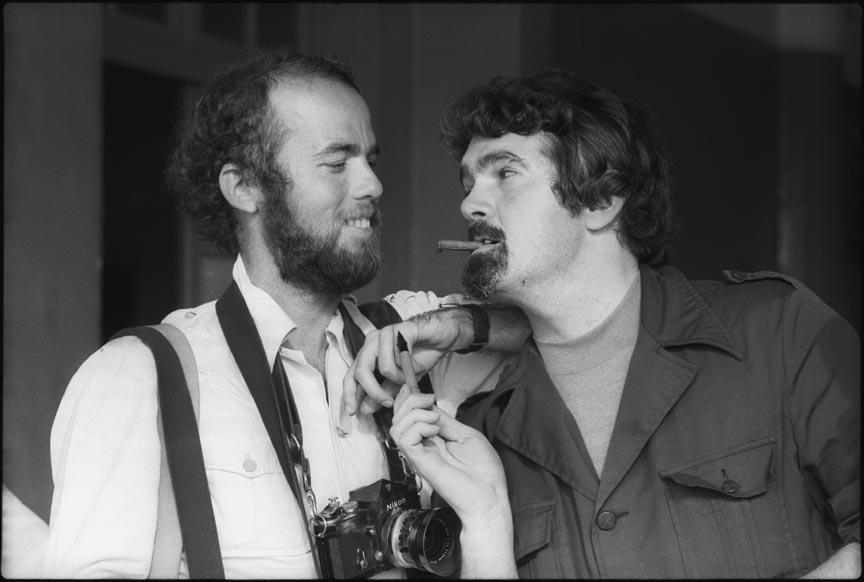
Neal Ulevich – Chick Harrity (right) appears to be returning a pen to David Kennerly in the AP Saigon bureau in 1973. Both were in Vietnam to help with coverage of the Paris Peace Accords, Harrity for AP and Kennerly for Time-Life. Photo by Neal Ulevich.
AP and denial of rights to Butler photo
David Bauder - I know you linked today to the voluminous Times piece on press restrictions that Jim Rutenberg and Maggie Haberman had in Sunday’s paper. But wondered if you noticed this paragraph that they had…
Soon after his inauguration, the White House banned The Associated Press from the Oval Office and Air Force One, ostensibly because the wire service would not call the Gulf of Mexico by Mr. Trump’s preferred name, the Gulf of America. Another reason for the ban: the A.P. would not give the Trump team rights to its photo of Mr. Trump, bloodied with a raised fist, after he was shot in Butler, Pa., in 2024. At a private lunch with Mr. Trump and network anchors last year, White House aides tied the A.P. ban to the denial of the rights to the photo, according to two people briefed on the event.
A 9/11 story, 20 years later
| |
Tom Throne - We covered the local stories about how Leavenworth and Fort Leavenworth, in particular, were affected by 9/11. We ran AP stories and appreciated the AP allowing papers to use AP photos to augment our local coverage.
My story takes place a little over 20 years later. My wife, Pam, and I traveled to New York City to celebrate her 70th birthday. We took in shows, toured the Statue of Liberty and Ellis Island and visited the World Trade Center site.
When the first plane struck the North Tower of the World Trade Center, I watched it hit just before I headed to work as editor and publisher of the Leavenworth Times. Little did we know that we, like many others, would know someone who lost their life.
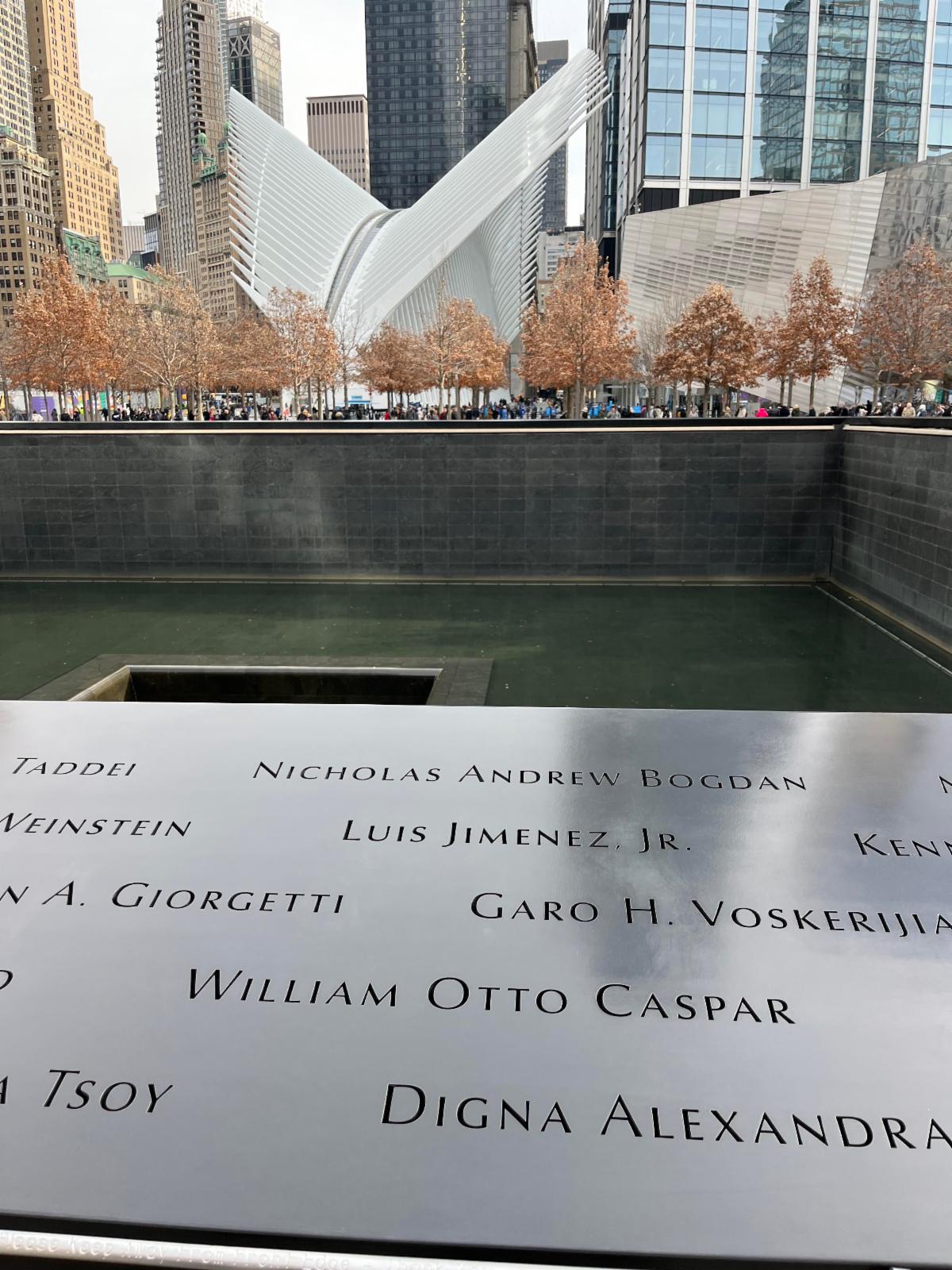
William “Bill” Otto Caspar was a native of Junction City, KS. He and my wife worked together at Central National Bank shortly after we were married in 1973. I was the photographer at the Junction City Daily Union at the time.
On that fateful day, Bill, 57, was a data processing specialist for Marsh and McLennan, working on the 95th floor of the North Tower when the plane hit.
After our tour, we were outside looking at the memorial for the North Tower. Pam wanted to see if we could find Bill’s name. I told her that might be a tough task, but we started looking over the hundreds of names craved into the black granite around the memorial.
We were about to give up hope, when Pam looked down and there was his name -- “William Otto Caspar.” Although we hadn’t seen Bill in nearly 50 years, it was like he willed us to stop and look a little harder – “here I am.” There were a few tears shed that sunny, cold afternoon.
If you’re ever in Junction City, there is a small memorial display in Bill’s honor in the auditorium at the Municipal Building.
Exotic water toy
| | |
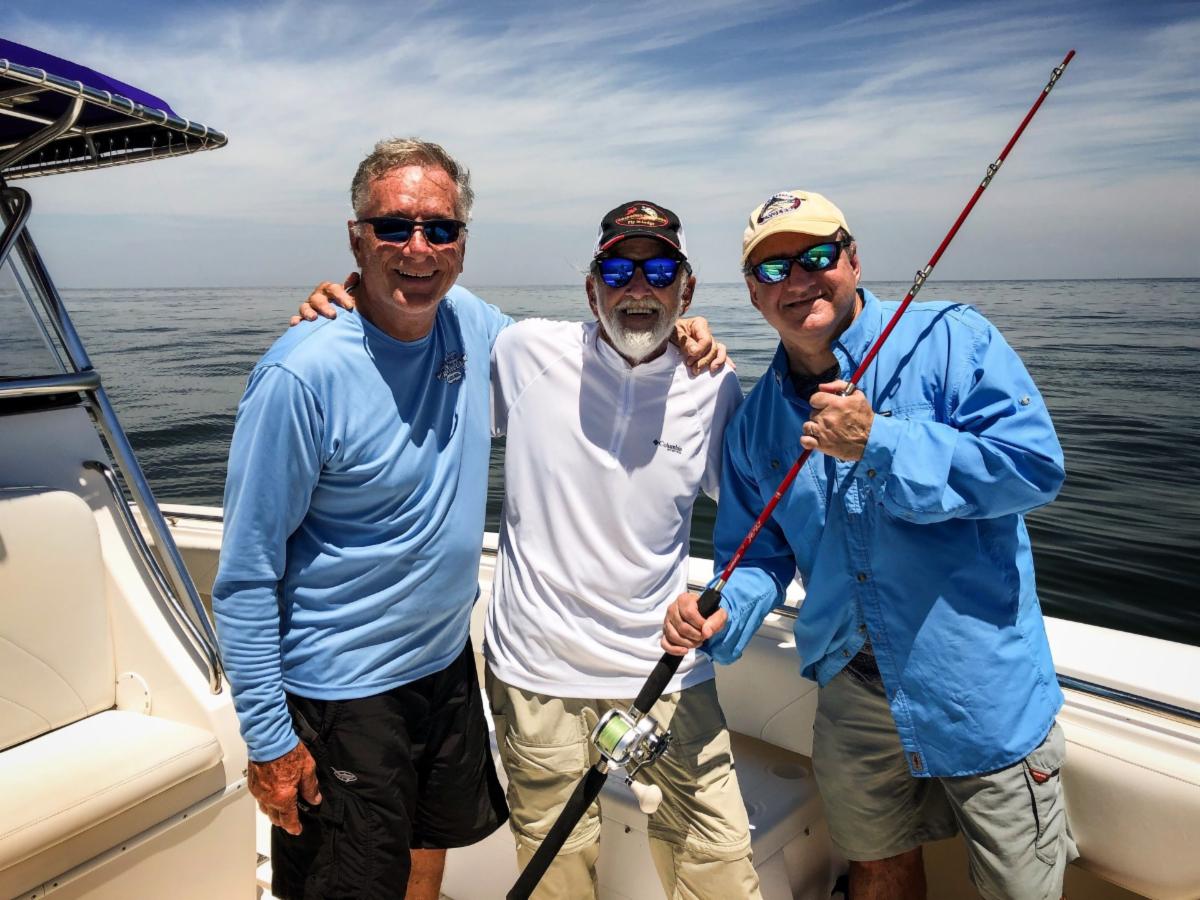
Fishing crew – from left: Steve Helber, Ron Edmonds, Wash DC photo editor Wayne Partlow. Taken 6/30/2018 in the Chesapeake Bay.
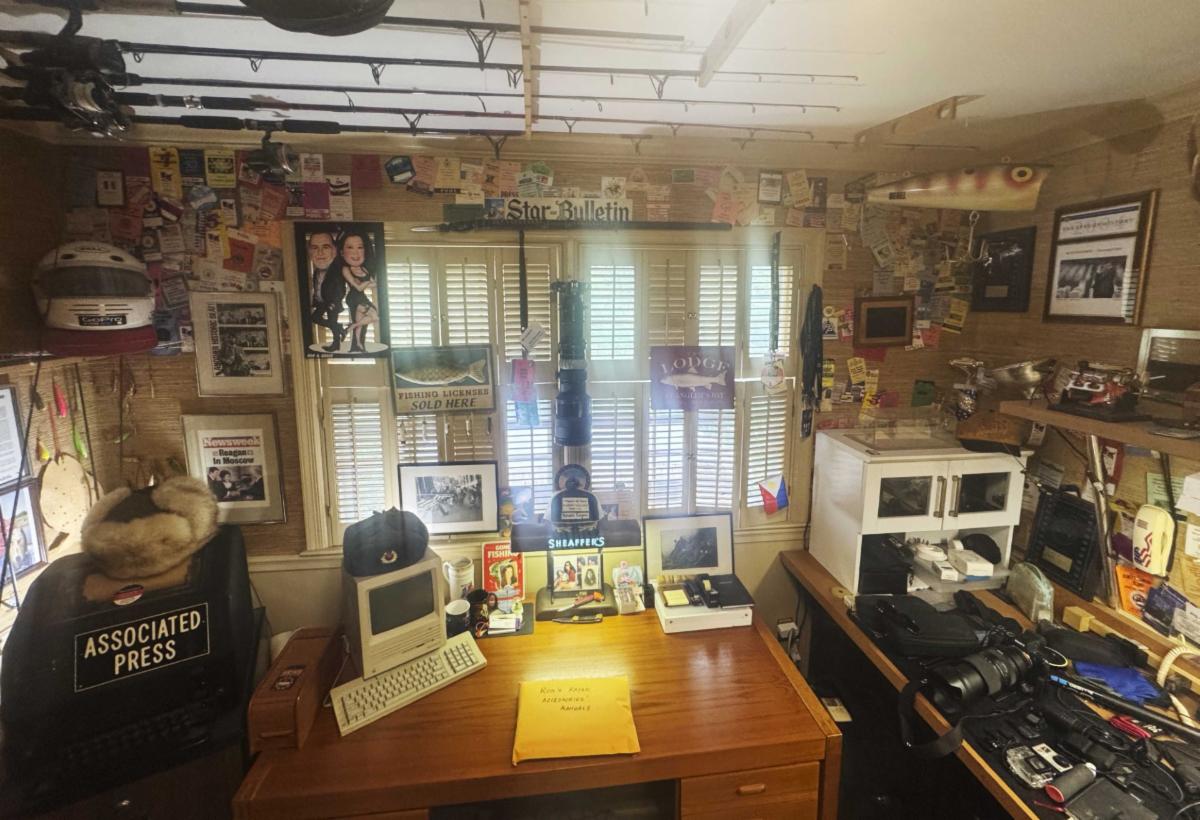
Steve Helber - Several months ago, I got a call from the sweetest person on the planet, Grace Edmonds, wife of the late Pulitzer Prize-winning Associated Press photojournalist Ron Edmonds. She was enlisting my help to find a new home for one of Ron’s more exotic water toys.
Ron, who had toyed with the idea of becoming a professional bass fisherman in his younger years, eventually sold two bass boats and downsized to a 14-foot motorized pro fishing kayak. In typical Ron fashion, he customized the simple kayak with every accessory available. Not only did it have an electric motor in the stern, but also a trolling motor up front and two high-end Garmin screens—one a GPS chartplotter and the other a live-view fish finder. It had two Power-Poles that anchored the boat to the bottom with the touch of a button, running and courtesy lights, and remote controls for everything that could be operated from the main seat.
Grace said Ron told his daughter Ashley that he had as much fun rigging the kayak as he did using it. The only thing missing was a blender for making margaritas while stalking bass on those hot summer days.
| |
While picking up the kayak to help sell it, I was treated to a tour of Ron’s man cave, as well as what looked like a Newseum display of his substantial career, with mementos, photographs, old passes, and awards all on display in his home. It was a treat to look over the history he witnessed and so skillfully documented.
I started a year or so before Ron joined the AP and got acquainted with him when he burst on the scene with his photos from the Reagan assassination attempt. I worked with him many times at conventions, political rallies and presidential visits. During the film days, I mostly did processing, printing, editing and transmitting of his stellar images. With digital I did back stand duty. Ron was a pleasure to work with and always helpful.
It took several months to find the kayak a new home. In the end, it went to someone who appreciated all the time, thought, and unmistakable Ron ingenuity that went into it. For Grace, letting go of one of Ron’s prized water toys was one small step toward moving forward while preserving the memories behind it.
| | Connecting wishes Happy Birthday | | |
Stories of interest
How a photographer sees images of daily life as a unifying force
| |
A child dressed as an angel runs during an event dubbed the Little Angels’ Parade, a Christian-themed street performance featuring dozens of children wearing angel costumes, in Bucharest, Romania, Saturday, Sept. 5, 2026. (AP Photo/ Vadim Ghirda)
By Vadim Ghirda
The Associated Press
BUCHAREST, Romania (AP) — Vadim Ghirda is a Bucharest, Romania-based Associated Press photographer who has documented major news, conflict and humanitarian stories for more than 35 years.
Here’s what he had to say about this extraordinary photo:
Why this photo
I enjoy shooting events outside the mainstream hard-news agenda. They often offer a more intimate perspective on human nature, and photography is one of the greatest vehicles for exploring it. Photography and other forms of visual journalism are a universal language, accessible to all humans regardless of the things that mislead us into thinking we are different: race, gender, social status, access to education, sexual orientation, or religion. Speak it well and you have a good shot at breaking down the cultural barriers that separate us. This has always been an important mission, and in times of growing division, it is more important than ever.
Read more here. Shared by Doug Pizac.
-0-
Trump renamed Lake Ontario. Newsrooms still have to decide what to call it
By Matthew Crowley
Poynter
The AP is sticking with Lake Ontario, as it did with Gulf of Mexico. Its decision shows why changing a name doesn’t necessarily change common usage.
For the Associated Press stylebook, Gulf of Mexico stayed. Lake Ontario will, too.
In January 2025, Donald Trump, fresh into his second term, issued an executive order to rename the Gulf of Mexico as Gulf of America and restore the name Mount McKinley to Alaska’s Denali. On Aug. 27, embroiled in a trade war with Canada, Trump issued a new executive order to rename Lake Ontario as Lake America.
“If you think about it, we have a gulf and we have a lake,” Trump said when he signed the order. “Now, all we need is an ocean.”
In 2025, The Associated Press, which produces the stylebook that reaches 45.5 million users monthly in 100 countries, honored the directive on McKinley, which had been the mountain’s name from 1917 to 2015. The AP said the mountain was solely in the United States and that Trump, as president, had the authority to change federal geographical names within the country.
But the AP kept Gulf of Mexico, saying the name had stuck for four centuries and that, as a global news agency, it needed to keep place names and geography easily recognizable to all audiences.
Read more here. Shared by Doug Pizac.
-0-
Inside the US Treasury secretary’s tense relationship with financial media
By Max Tani
Semafor
Last September, Bloomberg News Editor-in-Chief John Micklethwait got a call from US Treasury Secretary Scott Bessent.
The secretary had been a regular on Bloomberg’s TV programming and in its reporting for years, first as the founder of a hedge fund, and increasingly as he rose in Donald Trump’s circle to become the most powerful financial official in the now-president’s Cabinet.
He was furious that Bloomberg reporters Anthony Cormier and Zachary Mider planned to report that Bessent had agreed to simultaneously occupy two different houses as his “principal residence,” two people familiar with the exchange told Semafor — just as Trump was trying to use the same rationale to justify firing Federal Reserve Governor Lisa Cook. During the conversation, Bessent told Micklethwait that if Bloomberg went ahead with a piece whose accuracy he heatedly disputed the financial news giant could expect different treatment from the Treasury Department — including no more appearances by the Treasury secretary, a coveted TV guest. Bessent’s team also wanted more time to provide further documentation.
Bloomberg published the article anyway. But in the year since, Bessent has followed through on his threat. The secretary stopped appearing on Bloomberg Television.
Some of its reporters privately complain that they no longer receive certain press releases with key financial information. Bloomberg and Wall Street Journal journalists were also denied credentials to join Bessent at a G20 meeting of financial leaders in Asheville, North Carolina, earlier this month; a Times reporter was also denied credentials, though another was included among some 300 reporters credentialed.
Read more here. Shared by Mark Mittelstadt, Doug Pizac.
-0-
‘60 Minutes’ opens 59th season on CBS with no direct mention of show’s off-season turmoil
NEW YORK (AP) — The venerable newsmagazine “60 Minutes” opened its 59th season on CBS-TV on Sunday night with no direct mention of the turmoil and departures that have unfolded behind the scenes in recent months.
Hosts waited until the show’s end to acknowledge that anything different was going on.
While speaking about the claim that there is a narrow window to make artificial intelligence safe for humanity, an announcer segued into the topics of journalism and “60 Minutes”: “For almost 60 years it has meant the same thing — journalism you can trust. Where we’re headed we’re going to need it,” the announcer said at the end of the show.
He also noted that there were going to be “new faces” on the show this season.
CBS News leader Bari Weiss has said that the news show would take a “new approach.” That included firing the top producer and two correspondents, among others, and installing a new chief with no TV broadcast experience. One of the show’s most famous and enduring faces, Scott Pelley, was absent, fired after a tense confrontation with bosses earlier this year.
Read more here. Shared by Adolphe Bernotas.
-0-
The Knowing introduces an all-digital reimagining of classic Black magazines.
By Feven Merid
Columbia Journalism Review
Geneva S. Thomas was letting her gel manicure dry when she had an idea. “It just dropped into my lap like a feather,” Thomas, a veteran of digital media, said. She pulled her hands from the LED dryer, grabbed her phone, and started typing. “It was like a download.” She started writing notes for what would eventually become The Knowing, a digital magazine delivered via newsletter for Black millennials and Gen Z audiences. She’s calling it the “world’s first inbox magazine.”
It took Thomas, who is forty-three, roughly three years to get from feather-idea to The Knowing’s debut last month, developing a subscription plan and working with a user-experience designer, creative director, and developers. “As you move through the issue in your email, you feel like you’re reading this premium glossy; the vision was to innovate newsletters,” she said. The inaugural cover story was about Black women workers wantonly pushed out of their jobs because of the Trump administration’s dismantling of diversity and inclusion efforts. A feature story looked at why Gladys Knight is still working at eighty-two. The pieces hark back to a bygone era of Ebony and Essence—Thomas’s undergraduate thesis was about the latter’s history—that offered a rare space for Black women and buoyed readers aspiring to America’s professional class.
Now, in this era of racist and sexist backlash, Thomas thinks it’s time to rebuild that space. A vertical in The Knowing called “Sanctuary” provides a space for confessions on how “women move in between worlds” and “how they’re defining themselves in between.” There are six verticals in total, spanning culture, politics, music, beauty. And in addition to the inbox magazine—which Thomas refers to, faithfully, as “the hero product”—there are other offerings coming, she said, including a summit and private dinner “collection.” Professional, entrepreneurial women are the target. “We’re bringing this autonomous brand identity and editorial identity, not just in our programming and coverage across news, culture, beauty, and wellness, but actually in the visuals that you see,” she said. The Knowing’s tagline is “News, Culture & Sovereignty.”
Read more here. Shared by Doug Pizac.
-0-
Google rolls out pay-per-value AI licensing program to publishers
By Jessica Davies and Sara Guaglione
DIGIDAY
Google has been quietly scaling a pay-per-value AI licensing scheme for publishers. But critics say the program looks less like a meaningful payout and more like a legal fig leaf.
The tech giant, which has steered clear of the large lump-sum licensing deals struck between other AI rivals like OpenAI and major news publishers, has been quietly testing a Search Console-based program that pays publishers when their content “significantly” contributes to AI-generated responses across Gemini, AI Overviews and AI mode, according to multiple industry sources close to the situation.
Once a publisher joins the “AI contribution pilot,” they receive an extra AI earnings widget via their Search Console dashboard. This displays a monthly earnings number (with some history), though no other detailed information on how payouts are calculated currently. Payments are based more on value than raw usage, meaning Google only pays when it judges that a piece of content has meaningfully contributed to an AI-generated response. Publishers can opt out at any time.
Google confirmed the scheme is an early-stage learning pilot to test how best to reward high-quality content, on top of the traffic and tools it already provides. The company pointed back to a June blog post, noting that it is testing a new model for working with websites whose content helps keep its generative AI answers fresh and accurate, by using that material to ground responses.
Read more here. Shared by Doug Pizac.
-0-
Pablo Torre uncovered the Kawhi Leonard scandal and won a Pulitzer. He’s still searching for something more
By Bruce Arthur
Toronto Star
Pablo Torre is a curious soul and he is happy to tell you about it, and that’s the basic thesis of “Pablo Torre Finds Out,” his podcast which, among other things, drove the Kawhi Leonard salary-cap circumvention case. It was Torre who got a tip involving bankruptcy documents in California almost two years ago, and he and his staff haven’t stopped digging. The show had already won a Pulitzer for the coverage, but when the NBA hammered the Los Angeles Clippers last week Torre was vindicated beyond imagination.
And amid the plaudits, Torre is struggling with something. People kept asking him if he felt validated by the punishment. Intellectually, he knows that’s not the bar. More than ever, journalists know the truth doesn’t always lead to consequences for the powerful.
“A corporation’s outside counsel is not the approval I’m seeking,” said Torre in a phone interview. “My own standard is in the work itself, which speaks for itself, is what I always think to myself.
“But the thing that I’ve been feeling more than ever this week is why these consequences have made me feel more energized and inspired to do the next thing.”
Part of it has to be the glory, right? It’s nice to be feted, to be appreciated, to be called a beacon of journalism. But there’s something else, too.
Read more here. Shared by Doug Pizac.
-0-
The golden age wasn’t so golden
By Michael Schudson
Nieman Lab
People have felt grave doubts about the press long before the Internet or social media, at times when politics was polarized and at times when it was not. In the United States, the steady decline in media trust from 1970 and onwards has, in my opinion, been badly misread. It has produced or justified anxiety about what we have come to call “the media” among journalists and pundits alike.
In the same era (1970–present) when measured trust in most American institutions has declined, leading news institutions have undergone a dramatic transformation whose reverberations have yet to be fully acknowledged — even by journalists themselves. Dissatisfaction with journalism inside journalism and outside grew in the 1960s. What came to be widely acknowledged as either “he said, she said” journalism or “false balance” journalism or “bothsidesism” has been the object of sharp, even derisive, and ultimately potent critique. As multiple scholars have documented, news since the 1960s has become deeper, more investigative, and more likely to take “holding government accountable” or “speaking truth to power” to be essential goals. In these past six decades, mainstream media not only continued to be fact-centered and verification-oriented but also guided by a more explicit avowal of the public service function of holding government accountable, just as important a value as the ideal of “objectivity” itself.
There is a large literature on the question of trust in the media, some of it very rich and carefully done, including work by the editors of (and other contributors to) this volume.1 2 3 4 At the same time, there is a kind of romantic — or just plain mythical — nostalgia for a media past that never was and that in a democracy never should have been.
Read more here. Shared by Doug Pizac.
| Today in History - Sept. 15, 2026 | | |
Today is Tuesday, Sept. 15, the 258th day of 2026. There are 107 days left in the year.
Today in history:
On Sept. 15, 1963, four Black girls were killed when a bomb went off during Sunday services at the 16th Street Baptist Church in Birmingham, Alabama. (Three Ku Klux Klansmen were eventually convicted for their roles in the blast.)
Also on this date:
In 1835, Charles Darwin reached the Galápagos Islands aboard the HMS Beagle.
In 1935, the Nuremberg Laws were enacted in Nazi Germany, depriving German Jews of their citizenship.
In 1940, the tide turned in the Battle of Britain in World War II, as the Royal Air Force inflicted heavy losses upon the Luftwaffe.
In 1958, a commuter train headed for New York City plunged into Newark Bay after missing a stop signal and sliding off the open Newark Bay lift bridge, killing 48 people.
In 1959, Nikita Khrushchev became the first Soviet head of state to visit the United States as he arrived at Andrews Air Force Base outside Washington.
In 1978, Muhammad Ali became the first boxer to capture the heavyweight title three times, winning by unanimous decision in his rematch with Leon Spinks.
In 2008, as a result of the subprime mortgage crisis, Lehman Brothers filed for Chapter 11 in the largest bankruptcy filing in U.S. history.
In 2021, SpaceX’s first private flight streaked into orbit with two contest winners, a healthcare worker and their billionaire sponsor, in the most ambitious leap yet in space tourism. The trip dubbed Inspiration4 marked the first time a spacecraft circled Earth with an all-amateur crew and no professional astronauts.
In 2020, Israel signed historic diplomatic pacts with two Gulf Arab states at a White House ceremony President Donald Trump called the “dawn of a new Middle East.” The bilateral agreements formalized the normalization of Israeli relations with the United Arab Emirates and Bahrain.
In 2024, a man aiming a rifle through shrubs as then-presidential candidate Donald Trump played golf at his West Palm Beach, Florida, country club was spotted by a Secret Service agent who fired at him, prompting the man to drop his gun and run without firing a shot. Ryan Routh was later convicted of trying to assassinate Trump and sentenced to life in prison.
Today’s Birthdays: Writer-director Ron Shelton is 81. Actor Tommy Lee Jones is 80. Film director Oliver Stone is 80. TV personality Lisa Vanderpump is 66. Football Hall of Famer Dan Marino is 65. Actor Josh Charles is 55. Olympic gold medal swimmer Tom Dolan is 51. Actor Tom Hardy is 49. Actor Amy Davidson is 47. Actor Dave Annable is 47. Prince Harry, Duke of Sussex, is 42. TV personality Heidi Montag is 40. Singer-songwriter Ella Boh is 25.
| | Got a photo or story to share? | | |
Connecting is a daily newsletter published Monday through Friday that reaches more than 2,000 retired and former Associated Press employees, present-day employees, and news industry and journalism school colleagues. It began in 2013. Its author, Paul Stevens, retired from the AP in 2009 after a 36-year career as a newsman in Albany and St. Louis, correspondent in Wichita, chief of bureau in Albuquerque, Indianapolis and Kansas City, and Central Region vice president based in Kansas City.
Got a story to share? A favorite memory of your AP days? Don't keep them to yourself. Share with your colleagues by sending to Ye Olde Connecting Editor. And don't forget to include photos!
Here are some suggestions:
- Connecting "selfies" - a word and photo self-profile of you and your career, and what you are doing today. Both for new members and those who have been with us a while.
- Second chapters - You finished a great career. Now tell us about your second (and third and fourth?) chapters of life.
- Spousal support - How your spouse helped in supporting your work during your AP career.
- My most unusual story - tell us about an unusual, off the wall story that you covered.
- "A silly mistake that you make"- a chance to 'fess up with a memorable mistake in your journalistic career.
- Multigenerational AP families - profiles of families whose service spanned two or more generations.
- Volunteering - benefit your colleagues by sharing volunteer stories - with ideas on such work they can do themselves.
- First job - How did you get your first job in journalism?
- Most unusual place a story assignment took you.
Paul Stevens
Editor, Connecting newsletter
paulstevens46@gmail.com
| | | | |