Your generosity fuels research and provides people who have stomach cancer the information, support, and hope they need to navigate their journey. 

Connecting Patients to Clinical Trials Drives Progress in Treating Gastric Cancer

More than 200 clinical trials of experimental gastric cancer treatments are underway and recruiting patients in the United States, according to ClinicalTrials.gov - offering significant opportunities for patients to help drive progress in treating the disease. Clinical trials are vital to expanding the gastric cancer toolbox: They are the only way drug developers can determine if experimental treatments are better than the existing standard of care, and they generate data necessary for regulatory approval. For patients, clinical trials can provide opportunities to get access to novel treatment approaches before they are approved for general use.

Clinical trials can be a viable option for patients at any stage of their gastric cancer journey. They don’t have to wait until the disease is advanced or all other options have been exhausted.

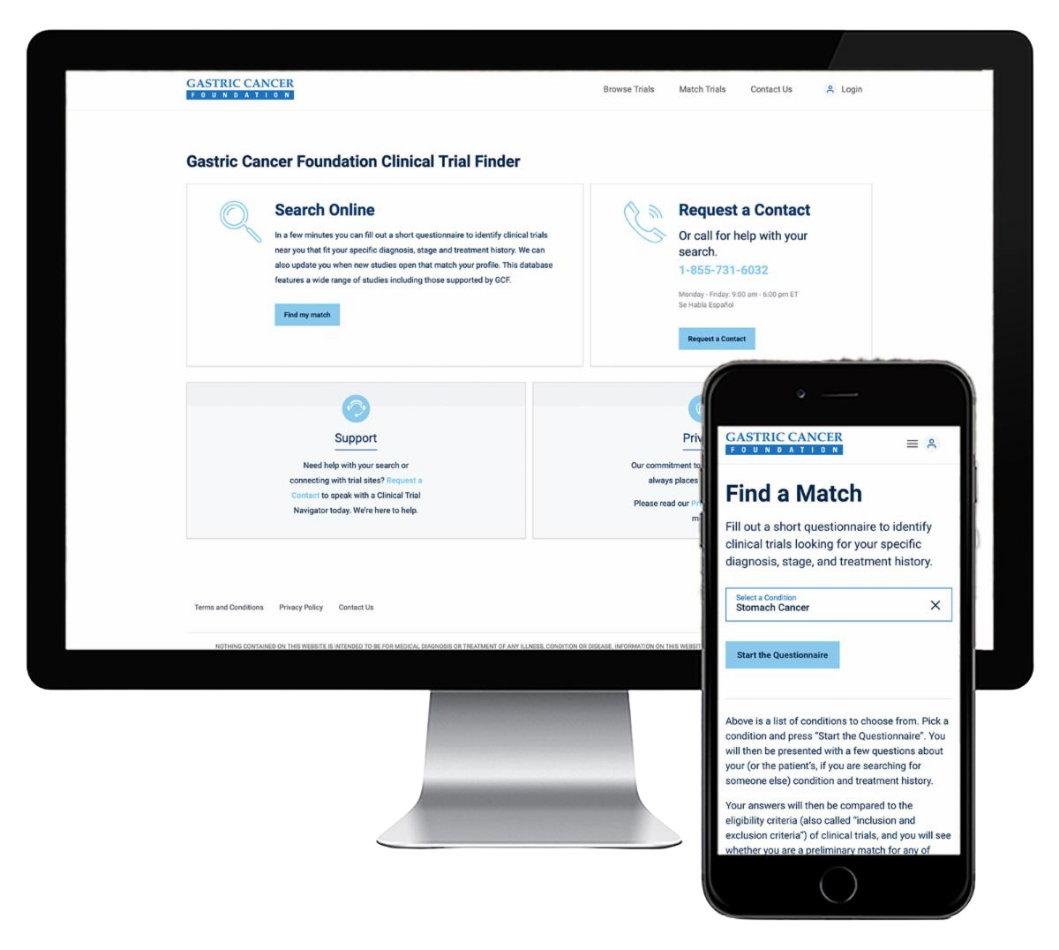
Gastric Cancer Foundation’s Clinical Trial Finder has been helping match patients with appropriate clinical trials since we launched the online tool in 2018. Under the management of Carebox Healthcare Solutions, the clinical trial finder makes it easy for patients to search online for clinical trials near their homes. Patients can also access free, one-on-one help from skilled navigators who can work with them on the phone to help find and enroll in clinical trials. The number of visits to the clinical trial navigator grew from 463 in 2022 to over 4,000 in the first 9 months of 2025. Read more >>

You are not alone. Our free online forum offers peer-to-peer support in a safe and confidential space.

Feed Your Recovery: Learning to Manage Your Blood Sugar


Chef Hans Rueffert joins clinical oncology dietitian Alison DeVries to talk about understanding and managing blood sugar after gastric surgery. They explore how to monitor glucose levels, what affects spikes and drops, and how to work with your care team to access a glucose monitor. Learn practical ways to stabilize energy and support recovery through smarter nutrition choices.

In a small human trial co-authored by Gastric Cancer Foundation grantee Eunyoung Choi of Vanderbilt University, the targeted cancer drug trametinib showed promise in reprogramming early-stage stomach lesions in a way that may prevent them from becoming cancerous. Trametinib is a MEK inhibitor used to treat some patients with melanoma. The trial was funded by the U.S. Department of Defense, which is also supporting Vanderbilt’s study of another MEK inhibitor, pyrvinium, in gastric cancer.


In a phase 2 trial, Jazz Pharmaceuticals' bispecific antibody Ziihera (zanidatamab) was effective in patients with HER2-positive gastric cancer. Patients who received the drug as a first-line treatment in combination with chemotherapy showed median overall survival of 36.5 months.


Second-line treatment with Enhertu (trastuzumab deruxtecan) from Daiichi Sankyo led to a significant and meaningful improvement in overall survival when compared to chemotherapy in a phase 3 trial in patients with HER2-positive gastric cancer. The drug significantly reduced the risk of disease progression and death over standard treatment, with an objective response rate of 44.3%.

Quick Links to Resources

Special Thanks to Our
National Sustaining Sponsors
Facebook  Twitter  Linkedin  Youtube  
Spread the word. Share the Gastric Cancer Foundation Newsletter.
X Share This Email
LinkedIn Share This Email