|
Greetings!
Today is World Elephant Day - A day dedicated to the conservation and protection of the world's elephants. In the wild, ivory poaching, habitat destruction, competition with humans for dwindling resources, trophy hunting, and capture for captivity all threaten their freedom and survival. Through Conservation, Advocacy, Research and Education (CARE), ElephantVoices promotes the protection and kinder treatment of elephants wherever they may be.
Elephants need protection both as a species and as individuals. As illustrated in the stories below individual elephants are building blocks of their society and some, like the older males and females, are the keystones. Removing any of these individuals can have lasting and cascading effects on their societies. Older males, such as those targeted by trophy hunters, are role models to younger males. Recent research has shown that it is these elephants who coordinate movement among groups of close male companions, just as influential females do within families and larger aggregations.
We now know that elephants create and use names for one another. Imagine what this really means. If they can create and use names for one another, what else might they refer to by name? Places? Specific threats? As one of our followers wrote, this discovery should "cause the world to shift a little." Once again elephants are breaking down barriers between humans and other animals, block by block.
Today is a day to reflect on the special nature of elephants and what they mean to you.
| | Elephant names study creates global media splash | | |
In our previous newsletter, we shared the exciting news about our groundbreaking collaborative study on African elephant communication, which revealed that elephants, like us, have names for each other.
Our research, conducted in Kenya by a team from ElephantVoices, Save the Elephants, and Colorado State University, utilized machine learning to discover that elephants use individually specific calls, or 'vocal labels,' to address each other. This study offers unprecedented insights into animal cognition and the evolution of language.
Our study, led by Mickey Pardo, received significant media attention with coverage by The New York Times, NPR, BBC, Scientific American, National Geographic, New Scientist, Washington Post and VOX Media.
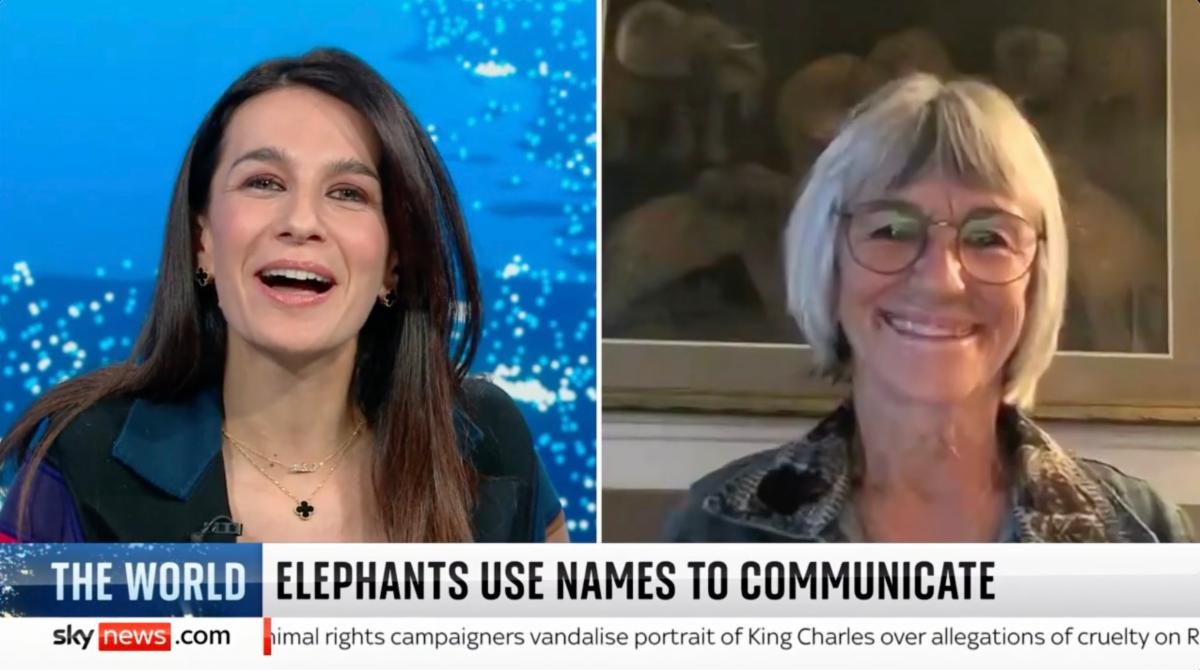
| | Joyce was also interviewed for Sky News by her favorite news anchor, Yalda Hakim. If you missed it, you can watch the interview here (it starts at around 36 minutes in). Please note that the recordings of Shirley and Echo don’t match the elephant footage shown on screen. | | Trophy hunting of elephants from the cross-border Amboseli-West Kilimanjaro Population | | |
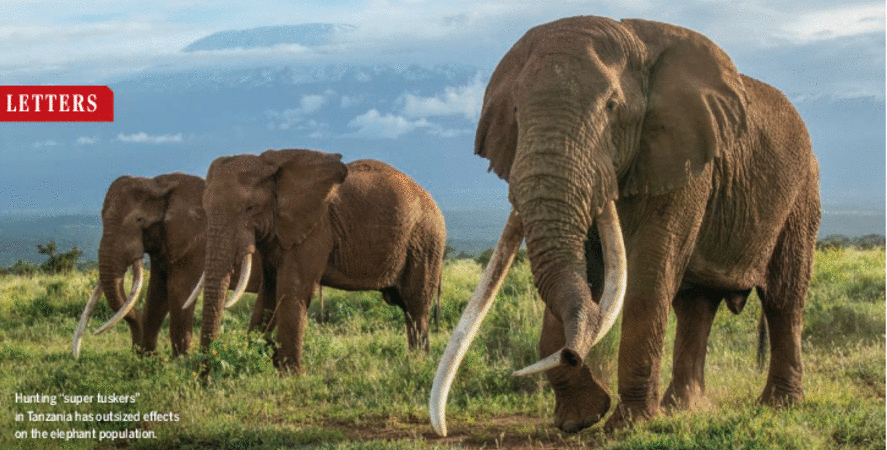
Together with 21 of our colleagues, we published a Letter to Science addressing the issue of trophy hunting of this long-studied cross-border population, entitled "Stop elephant hunting in Tanzania borderlands." Our Letter was published online in Science on June 27th, and appeared in the print version on July 23rd.
Together with the Amboseli Trust for Elephants and the Center for Biological Diversity, we have also filed a petition to the U.S. Department of the Interior and the U.S. Fish and Wildlife Service. The petition seeks a permanent ban on U.S. trophy imports from the Amboseli-West Kilimanjaro elephant population. You can read the petition here.
ElephantVoices' Joyce Poole has played a central role speaking to the media about the threat and both publications were covered broadly and reached a wide global audience. It was crucial for us to engage with an East African demographic, so we were especially gratified by the excellent coverage last week by Pauline Kairu in The East African.
Today, on World Elephant Day, we will be participating in a Press Conference held in Nairobi to further highlight the the ongoing threat of trophy hunting to this cross border population.
We are grateful to the online petition platform, AVAAZ, for supporting our cause to stop the killing of these elephants. They recently reworded and republished our petition to the President Samia Suluhu Hassan of Tanzania. This petition has currently garnered over 510,000 signatures. You can add your name to the petition here.
Below we share a video from the Elephant Ethogram that features Esau, the son of Ella and the nephew of Amboseli's most famous matriarch, Echo. Filmed in 2020, the video illustrates a mating between Esau and Amparo and a subsequent mating-pandemonium. Now, at not quite 34 years old, Esau is only just entering his reproductive prime. His tusks have already surpassed the 100-pound mark, classifying him as a "Super Tusker". There may be fewer than 100 such individuals across Africa. Despite growing up in central Amboseli National Park, Esau now spends much of his time on the Tanzanian side of the border, making him a prime target for trophy hunters.
Esau exemplifies the problem: Born into a family studied since 1972; extremely habituated; just entering his reproductive prime; tusks that in 2024 almost touch the ground. Should a hunter be permitted to take his life for a one-off fee or should Esau be permitted to live out his life and father more great tuskers over the coming 20+ years, bringing benefits to his population and tourism revenue to the human community in which he lives? To safeguard him, he was collared in March of this year. You can read more about this story on Big Life's website.
| | |
Amparo is Chased by Esau and other males. Esau tries Reaching-Over but she keeps running. She Tail-Swats to monitor how close Esau is. We hear her bond-group Rumbling and Social-Trumpeting in excitement in the background. Then we hear her emit a series of Estrous-Running-Rumbles and two Estrous-Roars as she is caught and Mounted by Esau. It appears to be a successful Mating and we hear the start of a Mating-Pandemonium as her family rushes to the scene. This is very intricate behavior to try to annotate and we have only marked some of the behaviors that occur during a Mating-Pandemonium.
As Amparo begins her Estrous-Song with a series of Open-Mouthed Estrous-Rumbles that are associated with Rapid-Ear-Flapping members of her family Rumble and Social-Trumpet overlapping their calls with hers. We see a young tuskless female, Dram, come in from the left Rumbling with an Open-Mouth and Rapid-Ear-Flapping as she moves to join Amparo. Dram is followed by a straight tusked female (and several calves) who appears to be Qapella. She Runs-Toward Amparo Rapid-Ear-Flapping and we believe she gives a Social-Trumpet. She moves to Amparo's side and Amparo greets her Trunk-to-Mouth - both display Head-Raising and Open-Mouths as they do. The calling continues though softer and is drowned out by the wind. (Amboseli, Kenya)
The behavior illustrated in this video is Mating-Pandemonium: A mated female’s relatives and companions joining her in calling and displaying following a mating. Females streaming with Temporin, engage in Open-Mouth vocalising, calling with powerful Mating-Pandemonium-Rumbles, Roars, and Social-Trumpets while Head-Raising, Ear-Lifting and Tail-Raising. Their calls are associated with Rapid-Ear-Flapping and the aroused participants may Urinate and Defecate in excitement. Females may turn toward the male, reaching their trunks to touch his penis or his semen on the ground, or to touch one another, and, then, turn rapidly outward in a kind of Pirouette (away from the male; probably to ensure long-distance advertisement of availability of the oestrus female) and again, while Head-Raising, Ear-Lifting and Rapid-Ear-Flapping, continue to call. The Mating-Pandemonium is a form of Bonding-Ceremony and may include High-Fiving.
Visit The Elephant Ethogram to learn more about African elephants behavior.
| |
Field Note: The son of a legend
| | | | Photo credit: Amboseli Trust For Elephants | | |
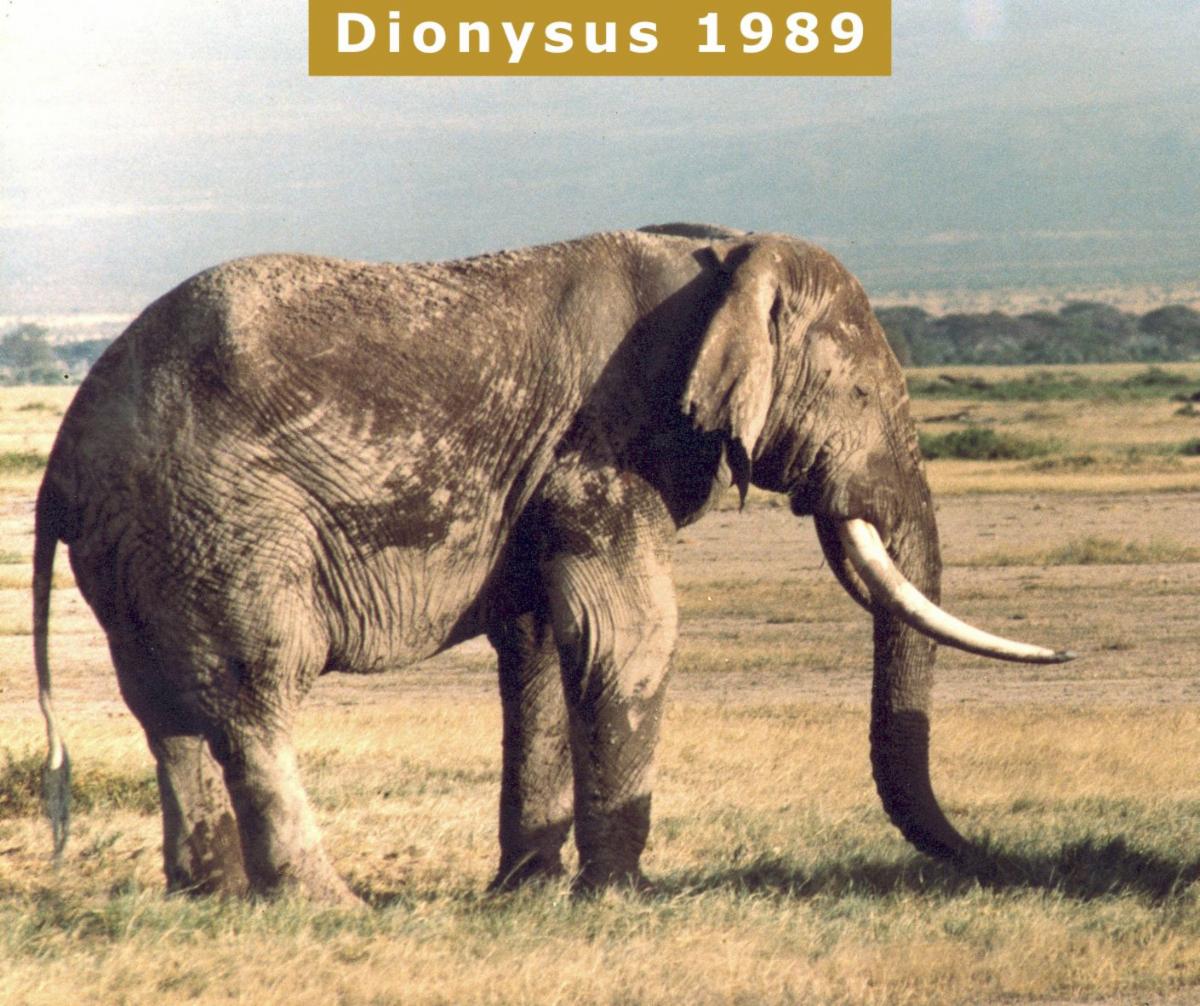
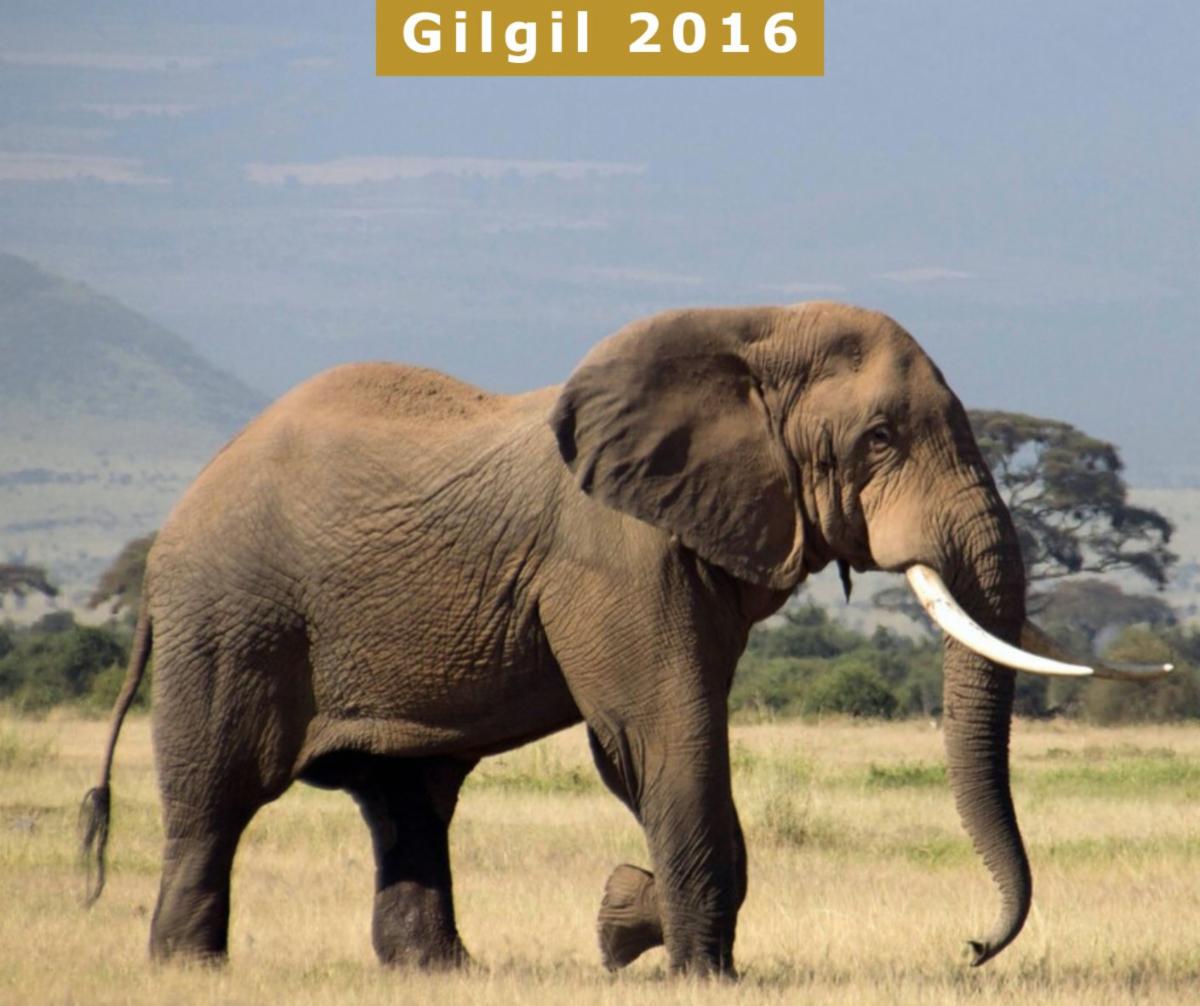
The trophy hunters burned and buried the bodies of the five males that they killed, concealing their identities and argued that they were not habituated members of the long-studied population. But, one photograph surfaced of the first male killed in September 2023. Amboseli Trust for Elephants was able to identify him as Gilgil, the first born son of Golda, matriarch of the GB family and putative son the extraordinary Dionysus of BBC fame.
The hunters also claimed that they only shot old post-reproductive males. Yet, Gilgil was was shot and killed when he was 35 years old, just as he was entering his reproductive prime. His father, Dionysus, was reproductively active for another two decades.
Dionysus was a celebrity featuring in several documentaries, including the IMAX film, Africa's Elephant Kingdom, Discovery's Ivory Wars and BBC's Echo of the Elephants, where many will remember the iconic voice of David Attenborough saying, “Enter Dionysus.”
Dionysus was one of Amboseli's most well known elephants. Protected in his home of Kenya he lived to 63 years of age and was reproductively active almost to the very end. Dionysus’ life is a testament to what Gilgil’s could have been and what the world has now been deprived of.
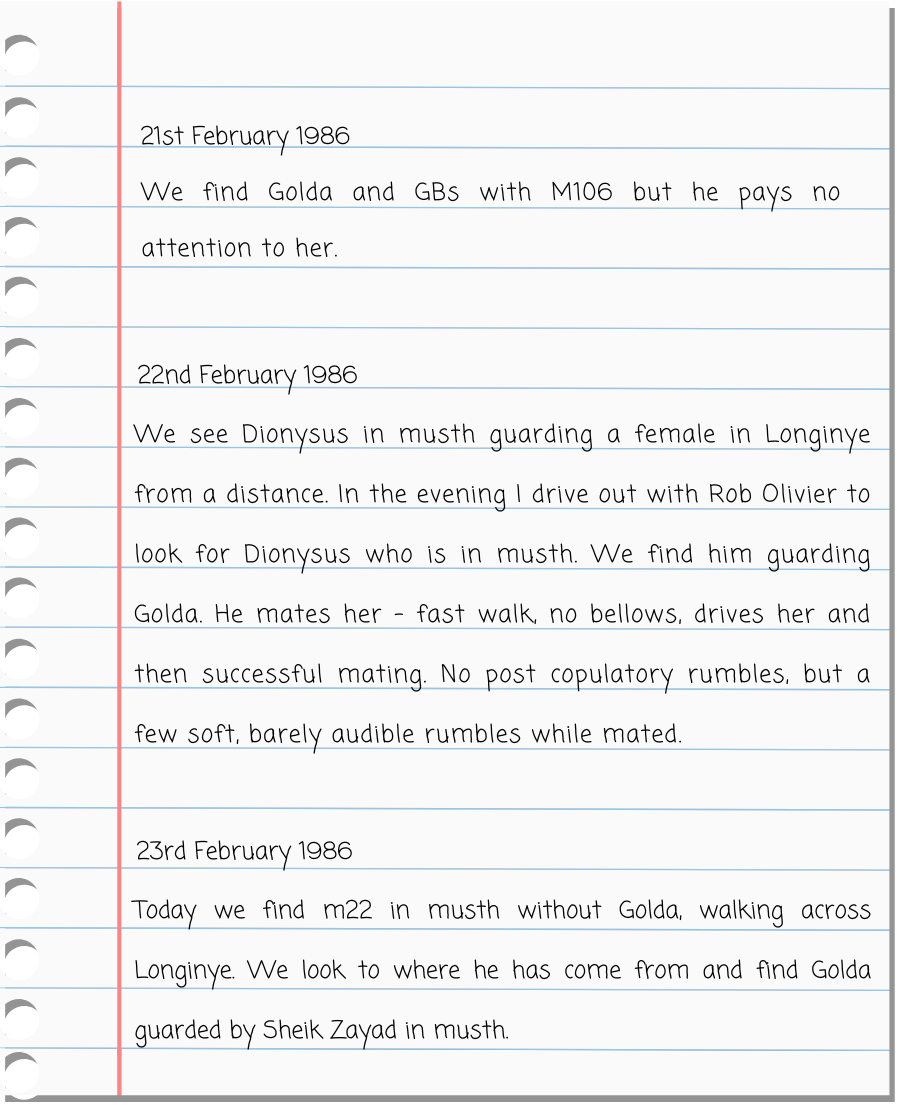
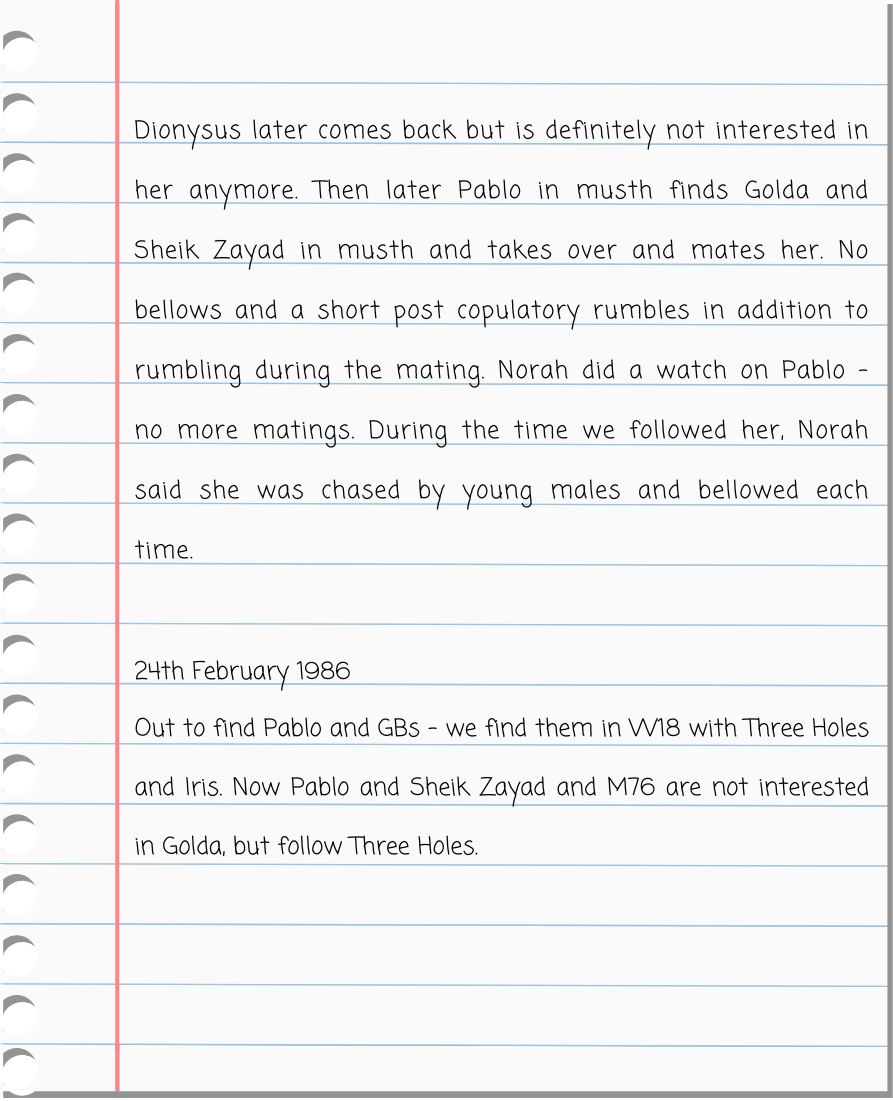
Why do we think that Gilgil was the son of this legend? Dionysus was one of the males that ElephantVoices' Joyce Poole's studied during her long research of musth and reproductive success. In February 1986, her field notes document the progression of Golda’s estrous period over 4 days and Dionysus’ successful guarding and mating with her.
| | In conclusion, based on what we know about the progression of estrus, male dominance and their priority of access to receptive females, Golda’s peak estrus was when she was mated and guarded by Dionysus. Dionysus (born ca 1940) was 46 years old at the time and Golda (born 1974) was only 12. Gilgil was born in December 1987. Gilgil’s tusks may look unimpressive but just like his father's they were wide, splayed heavy tusks. They look like father and son. | | Follow us on Social Media to keep up to date on all things ElephantVoices. | | ElephantVoices is a registered 501(c)(3) charity in California and the District of Columbia. | | | | |