|
Voting Reforms, Protections Highly Selective
By J. Fulgham
Director of Policy & Communications
Delaware House of Representatives
Republican Caucus
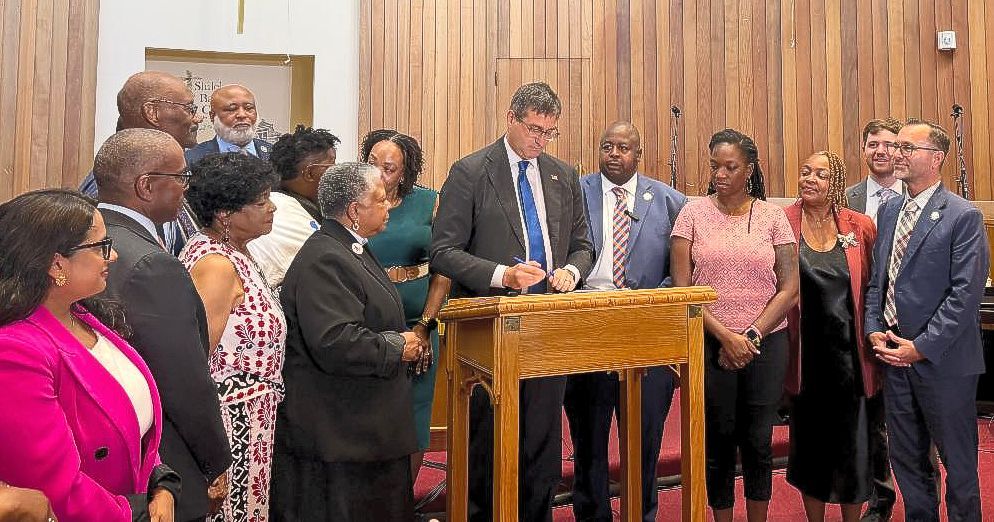
Governor Matt Meyer on Thursday signed the Delaware John Lewis Voting Rights Act (HB 444), ostensibly to establish a system of state-level voting rights protections.
Introduced during the final month of the legislative session in an election year, the bill was fast-tracked through the legislative process. Filed in early June, it cleared four committees and was approved by the House and Senate chambers by June 30th.
The governor sounded a partisan note in enacting the legislation. “Today, we sent a clear message to the nation: when Washington retreats on voting rights, Delaware steps up.”
The measure faced opposition in the House, with 11 members voting against its passage. Among the concerns is that the measure defines voter suppression so broadly that almost any election rule—such as voter ID, signature checks, or standard polling hours—could be challenged if statistical voting differences occur between designated minority groups and the general population.
Additionally, the bill eliminates intent as a factor in determining whether voter suppression has occurred. Bias claims would not require any proof of an intentional act of discrimination.
The new law is expected to have an annual operational cost of $300,000, but the additional cost to taxpayers could be significantly higher. According to a financial analysis of the measure conducted by the non-partisan Office of the Controller General: "This Act provides additional opportunities to bring forth legal challenges to election laws and practices from either organizations or the Attorney General. Further, among its provisions, it provides for the recovery of attorney’s fees, litigation costs, and certain expert and demographic analysis costs."
While the Department of Justice estimates an annual fiscal impact of approximately $500,000, the Controller General's analysis concluded the actual legal costs cannot be accurately determined because the impact of future lawsuits cannot be predicted.
“It has only been 61 years since Black Americans gained the right to vote without obstruction, and yet we are already seeing our hard-fought voting protections being stripped away,” said House Speaker Melissa Minor-Brown (D-New Castle) in a statement released following the bill signing. “But Delaware will not go back to a time where only one group has a say in our democratic process. We are a state built on progress, not control; we celebrate diversity and encourage more voices to come to the table.”
But Delaware has essentially been a state in which "only one group has a say in our democratic process" for most of the last two decades. Since 2008, Democrats have held the governor's office and large majorities in both chambers of the General Assembly.
Every House and Senate committee, including the budget-writing Joint Finance and Bond Bill committees, has substantial Democratic majorities, ensuring that any Republican-sponsored legislation that fails an ideological litmus test rarely advances.
This unilateral, politically influenced control is apparent even in election law proposals, the very area in which Democratic leaders insist they "celebrate diversity and encourage more voices to come to the table.”
In late April, Governor Meyer signed Executive Order 19, establishing the Delaware Task Force on Free, Fair, and Secure Elections, characterizing the action as an effort to safeguard the state from unconstitutional federal interference.
The 20-member task force consists of six law enforcement officials, one representative of the Delaware National Guard, and 13 officials who are either Democratic officeholders or appointed by Democratic officeholders.
While claiming to safeguard the electoral process, Delaware House and Senate Democrats have repeatedly blocked Republican proposals in recent years aimed at strengthening election integrity. These measures included studying ways to improve the accuracy of voter registration lists and increasing penalties for voter fraud.
In the current legislative session alone, three election reform bills were killed.
House Bill 86, sponsored by State Rep. Bryan Shupe (R-Milford South), would have expanded mandatory recounts to any election decided by a margin of 1 percent or less, doubling the current threshold. After sitting in the Senate Elections & Government Affairs Committee for more than a year without a hearing, it expired at the close of this year's session.
House Substitute 2 for House Bill 317 would have required periodic verification of the automatic voter registrations performed through Delaware's Motor Voter program. Implementing those audits would have cost only a fraction of the expense associated with the Delaware John Lewis Voting Rights Act, yet the proposal died in the House Appropriations Committee.
Sponsored by State Rep. Mike Smith (R-Pike Creek Valley), House Bill 188 would have allowed Delaware's unaffiliated voters to participate in primary elections. Approximately 170,000 Delawareans are not registered with either major political party and are therefore barred from voting in primary contests. Unaffiliated voters are on track to become the state's largest voting bloc, yet they remain excluded from a significant portion of Delaware's electoral process. That bill died in the Senate without a vote.
Delaware's Democratic leaders may sincerely believe that every voice deserves to be heard. Their legislative record, however, suggests that principle applies selectively. They appear eager to expand participation when it advances their priorities while routinely sidelining proposals that do not.
|