The voice for pharmacy compounding | January 24, 2020
|
Enjoy our latest edition. Send your suggestions and questions to
info@a4pc.org
.
|
From APC's President...
My APC presidency is starting off like a whirlwind.
In the past seven days I've been two nights in Dallas for an APC Board meeting and a Foundation strategic planning session, home for a night, then off to Washington, DC, for two days of meetings representing APC. (Note to self: Get a travel pillow.)
But I'm not complaining, because it's been an extremely productive week!
I can't say enough good things about our 2020 APC Board of Directors. They're passionate and diverse and deeply committed to APC's success on your behalf. They're fun to hang out with, too, which made for great bonding. We got good work done, and you'll soon be seeing the fruit of that.
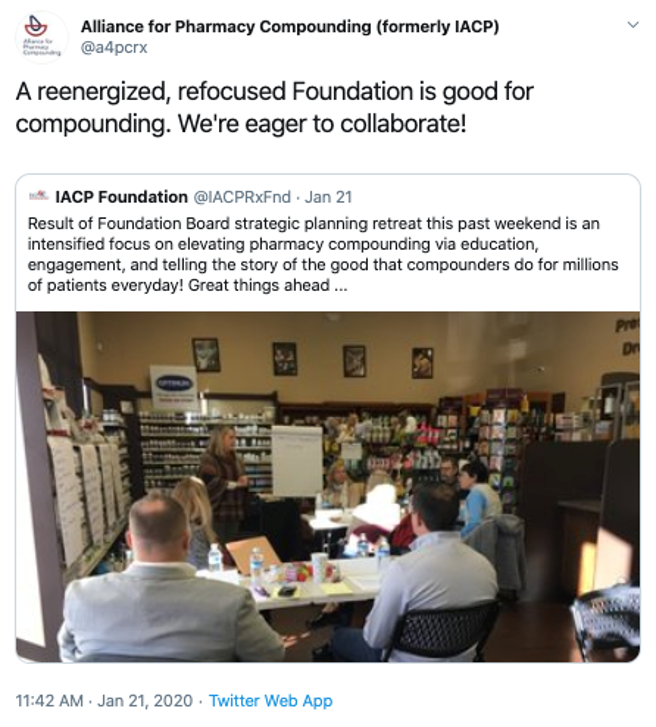
I'm also thrilled about the new direction being charted for the Foundation - formerly the IACP Foundation, soon to be the Pharmacy Compounding Foundation. Under the leadership of outgoing president Erin Michael and incoming president Tracy Acosta, the Foundation is fine-tuning its focus on work that educates compounders and elevates the profession.
But it's the DC meetings I want to tell you about - and want you to read more about below.
Tuesday was a face-to-face session with FDA Center for Veterinary Medicine Director Dr. Stephen Solomon and his team to discuss the Animal Compounding GFI. For me it was refreshing to get a warm welcome from Dr. Solomon and team. (Our APC CEO Scott Brunner quipped that it was the first time he'd ever seen an FDA official smile.) I sensed from their questions that they're sincerely interested in our input. I felt like we were heard and did good work in representing you. Keep reading below for details.
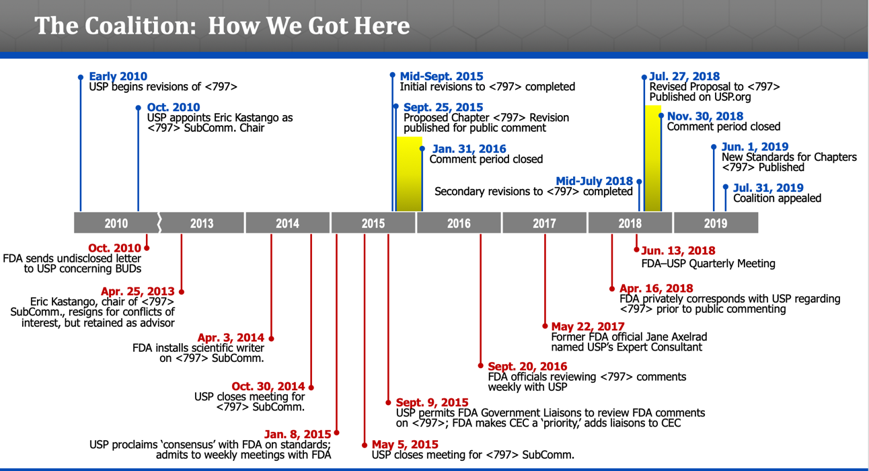
And then it was Wednesday, and our long-awaited hearing before the appeal panel at USP, the result of our formal appeal of beyond-use date restrictions in the new compounding chapters. Our attorney's methodical demonstration of how USP not only failed to show the scientific validity of the BUD restrictions they implemented but failed to follow their own bylaws and policies in the process was one of the most extraordinary - and for USP, damning - presentations I've ever seen. He used USP's own documents, some of them secret documents, to show how USP was in many ways a puppet of FDA in drafting and implementing the new chapters. FDA even supplied a staff technical writer to create and polish the draft.
Our presentation was based on verifiable facts. We look forward to hearing what the appeals panel recommends. At a minimum, we believe they must remand the issue back to the new Expert Committee and start over. But they have some additional work do in restoring their credibility as an independent standards-setting body, too.
Lots more below. Read on ...
Shawn Hodges, PharmD
President
P.S. The biggest, best EduCon ever is about 75 days away. If you're not registered yet, get a move on. We guarantee you'll come home smarter and better equipped to serve your patients!
|
|
UPCOMING:
January 28:
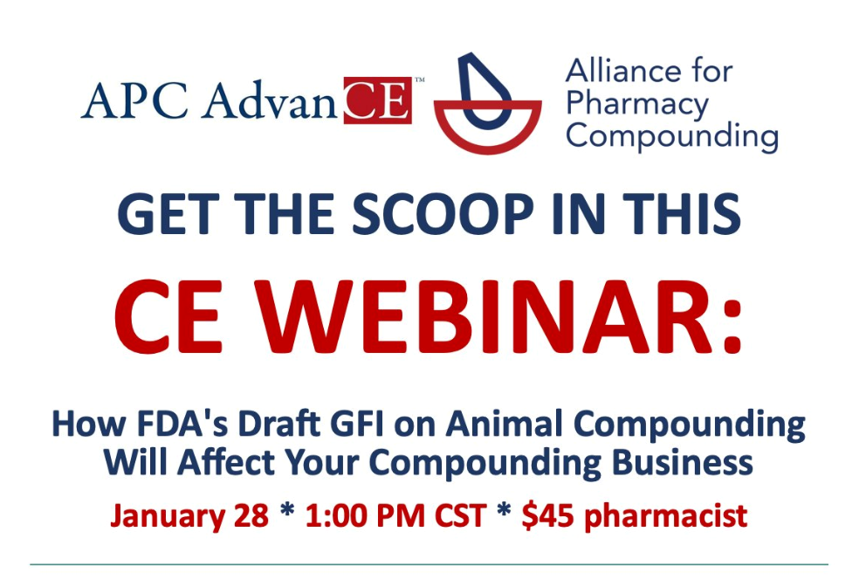
WEBINAR: How FDA's Draft GFI on Animal Compounding Will Affect Your Compounding Business
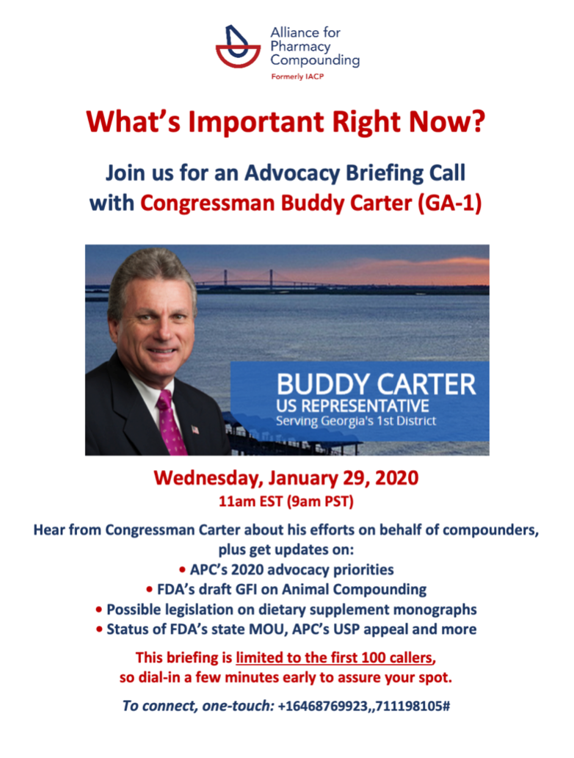
January 29: APC Advocacy Town Hall Briefing Call with Congressman Buddy Carter
|
|
USP appeal hearing: "The process was as flawed as the science"
FDA "secretly scripted USP's recent changes to the USP <795> and <797> chapters," undermining USP's standing as an independent standards-setting body, the attorney for APC, Wedgewood Pharmacy and Innovation Compounding asserted at a USP appeal hearing this past Wednesday.
Citing documents obtained from USP, attorney Derek Shaffer of the Quinn Emmanuel law firm demonstrated methodically how, over several years, USP gave preference to input from FDA officials and consultants, including hosting secret and closed-door meetings and relying on privileged communication from FDA in restricting beyond-use dates in the new <795> and <797> chapters.
"USP functioned as FDA's proxy," Shaffer told the panel, "Doing the bidding of FDA and allowing FDA to regulate through USP while circumventing laws and due process, as well as USP's conflict of interest policies."
"No similar access was offered to other stakeholders, including my clients," Shaffer added.
Shaffer went on to state that the FDA's concerns about beyond-use dates were not rooted in science, and supported his assertion with examples, including a detailed letter from esteemed compounding educator Dr. Loyd Allen that outlined flaws in USP's approach in restricting the BUDs.
He concluded by asking the panel to remand the two chapters to the newly constituted USP Compounding Expert Committee to start anew with a mended process, including full transparency and public participation.
"The facts based on USP's own documents show that the process was as flawed as the science," said APC's Board Chair Jennifer Burch of Durham, NC, who attended the Wednesday hearing.
The hearing was the final step in USP's appeal process. The APC coalition was one of three groups that appealed of BUD restrictions in the new USP <795> and <797> chapters last fall.
The APC Coalition's appeal raised four main substantive concerns:
- Shortened BUDs are not based on science and conflict with scientifically sound information found elsewhere in USP's standards.
- The rationale for the revised BUDs is based on the premise that the previous Chapter <797> standards could not provide adequate assurance of sterility, thereby calling into question the value of the entire chapter.
- Shortened BUDs will have a profoundly negative impact on patient safety due to a lack of availability of compounded pharmaceuticals and/or treatment interruptions.
- Compounders will now face tremendous difficulties in trying to comply with the onerous, unprecedented demands imposed by the new standards, including by forcing them to produce smaller CSP and CNSP batches at a much higher cost.
In a preliminary hearing in August, the USP Compounding Expert Committee rejected APC's concerns, as well as those of the two other appeal groups. All three groups chose to appeal that decision and were subsequently invited to present their case before a special USP appeal panel this week.
|
|
APC shares animal use GFI concerns with FDA's Dr. Solomon
APC leaders met Tuesday afternoon with FDA Center for Veterinary Medicine Director Dr. Steven Solomon and his lieutenants to discuss our concerns with draft GFI #256 on animal compounding that was released back in November.
"We view this draft GFI as yet another effort by FDA to regulate without clear statutory authority and outside the regulatory rule-making process, and we made that point to Dr. Solomon and his team," said APC President Shawn Hodges.
Representing APC at the meeting were President Shawn Hodges of Kennesaw, Georgia; Board Chair Jennifer Burch of Durham, NC; Legis & Regulatory Chair Anthony Grzib of Swedesboro, NJ; Wedgewood Pharmacy CEO Marcy Bliss of Swedesboro, NJ; and APC's CEO Scott Brunner, CAE.
"Solomon and his team seemed genuinely interested in our concerns and perspective. They asked several questions and took lots of notes. That's a hopeful sign," said APC's Brunner.
The new draft is similar to a previous guidance issued by FDA in 2015 that was withdrawn in 2017 after complaints from veterinarians, pharmacy organizations, pet owners and congress that it exceeded FDA's statutory authority, interfered with the state regulated practice of veterinary medicine and pharmacy, and endangered the health of companion and exotic animals.
In brief, draft GFI #256:
- Requires use of the FDA-approved products as the source of API unless there is a clinical need that requires avoidance of that product.
- Requires veterinarians to document on the prescription that the compounded drug produces a clinical difference in that a manufactured drug cannot provide for their animal patient and that there is medical rationale for the prescription.
- Would restrict veterinarians' ability to obtain compounded medications for office use from a compounding pharmacy even if state law allows it, compromising animal health and patient treatment.
The new draft borrows extensively from the Drug Quality & Security Act, which is expressly limited to human health. "We think it's a leap to try to apply those principles to animal health in a way that Congress didn't intend or authorize," Brunner said in the meeting.
If their questions and note-taking are any indication, Solomon's team seemed most interested in the following points raised by APC in the meeting:
- Starting with finished goods may not be in the best interest of the patient for several clinical and formulation reasons, in addition to higher financial costs to patients.
- How much compounders know about the APIs we use (regarding potency and purity based on the CofA and internal identity testing).
- The frequency and chronic state of backorders in animal health manufacturing.
- That many distributors and manufacturers won't sell compounders finished goods for compounding.
- The veterinarians' perceptions about the negative health impact on humans.
- The idea that the GFI will limit access.
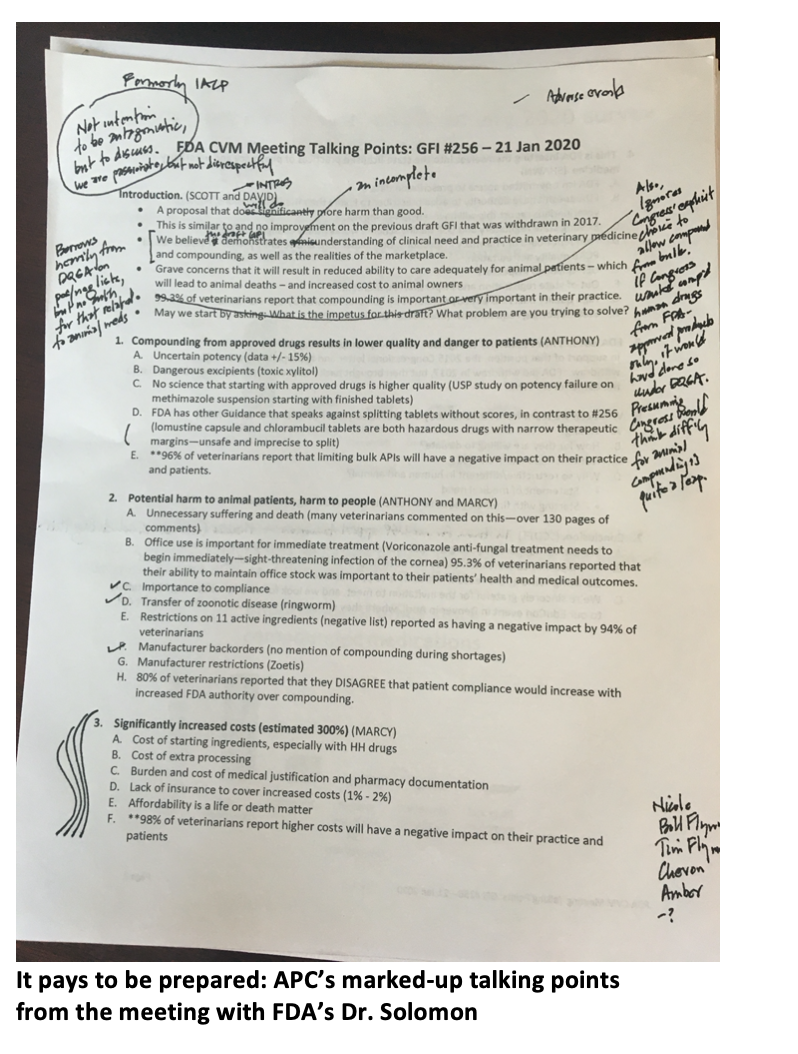
Read the talking points we used at the meeting.
APC will be offering formal comments on GFI #256 prior to the February 18 deadline.
WHAT YOU CAN DO: Submit comments on the GFI to FDA.
|
To be clear: FDA's animal GFI isn't only about office-use
FDA's draft animal health GFI asserts that using bulk API in animal health compounds is illegal drug manufacturing
regardless of whether the compound is for an identified individual patient or for office use
. The GFI spells out that FDA expects compounders to use a commercially available finished dosage form as the source of API
for all animal compounds
.
Furthermore, the way the GFI defines a copy is restrictive in that if the substance has the same active ingredient and can be given by the same route of administration and is the same or substitutable strength, then it considered a copy and prohibited. And there is a new requirement that the vet document the medical rationale for using the substance and the clinical difference from the FDA approved product.
The GFI describes the circumstances under which the FDA will exercise enforcement discretion and not undertake enforcement action for the use of bulk API.
It's here where we see the GFI specifying a different set of requirements for patient-specific animal compounds versus office-use compounds. For both, the GFI applies restrictions on the use of bulk API that are neither clear nor practical. Whether compounding patient-specific or office-use animal medications, the GFI places additional burdens on pharmacists and veterinarians that will decrease the quality of the finished compound, increase costs to prepare compounds, and ultimately limit patient access.
|
Okay, you're just messing with us, right?
APC's EduCon2020 is less than three months away, and it's promising to be our biggest, best ever.
But here's the thing: We're only about a third of the way to our registration goal, and it's making us nervous. If you're holding out just to mess with us, it's working.
Get yourself and your pharmacy team registered now to take advantage of all there is to learn that the pharmacy compounding event of the year ... and so our staff won't have a coronary infarction because we're stressed about making budget.
We've mentioned them before, but these details bear repeating:
- Co-located with NHIA's Annual Convention at the Gaylord Rockies Resort
- 1300+ attendees and a 125-booth Expo
- 11 hours of timely, top-notch compounding continuing education, including:
- Best Practices for Your cBHRT Practice
- Fast & Fabulous Ideas to Fire-Up Your Pharmacy Team
- Putting Safety at the Center of Your Compounding Operation
- More Than Counting, Pouring, Licking and Sticking: How to Leverage Your Technicians for Pharmacy Success
- Try a Little Strategery: How Strategic Planning Can Fuel Your Pharmacy's Future
- Minor Chapters, Major Impacts: What USP <51>, <61> and <1112> Mean for Your Practice
- Compliance with USP 800 - Sterile Requirements
- Compliance with USP 800 - Nonsterile Requirements
- What Else is in There?! Excipients, Inert Ingredients, and Fillers for Nonsterile Compounding
- CBD and Compounding: What Was, What Is, and What Might Be
- FDA Presentation on the Proposed Draft Animal Compounding GFI
- PLUS: Morning symposia on a variety of topics
- We'll send you the link to reserve your hotel room when you register for the conference
|
|
Advocacy Town Hall Call is this Wednesday...
Cool stuff on our website:
|
Comment on reclass of some NDAs as biologics
We've heard concerns from many of you about FDA's scheduled reclassification of some NDAs as biologics, set for March 23, 2020. Drugs reclassified as biologics may not be compounded without a biologics license, according to the FDA. It's not too late to submit comments to the FDA on that issue. We're making available here, two draft letters, one for providers and the other for patients, that you can customize and submit to the docket.
Note that both letters include instructions at the bottom for submitting to the docket. That verbiage should be deleted in your actual letter.
In op-ed, NCPA chief says SCOTUS can rein-in PBMs
In an opinion piece in
Morning Consult
this week, NCPA CEO Douglas Hoey said the U.S. Supreme Court has a rare opportunity to strengthen states' ability to regulate pharmacy benefit managers. An excerpt:
For its part, Washington hasn't done much to rein in the PBMs despite bipartisan support on Capitol Hill to do so. In the meantime, the states are acting.
They're developing and enacting their own policies to promote access to care, lower costs and rein in PBMs. But states are finding themselves hamstrung by the inconsistency in how courts have ruled on whether laws regulating PBMs relate to and are pre-empted by the Employee Retirement Income Security Act.
The Supreme Court will soon have the opportunity to provide clarity in a case where the PBM lobby challenged an Arkansas law that, among other things, required PBMs to reimburse pharmacies at or above what the pharmacy paid to acquire certain drugs and required that they not pay their competition in community pharmacies less than they reimburse their own PBM-owned pharmacies.
|
Foundation on the rise...
|
3 things you can do NOW to assure APC's continued success:
- Help us grow our membership. If you're reading this, you're likely our member. Thank you. But are your pharmacy teammates members? If not, ASK THEM TO JOIN. If they enter the code NEWYEAR at www.a4pc.org/join before Feb. 15, they can save on their annual membership dues. Also, when it's time to renew your APC dues this year, do it timely.
- Invest in One Fund. It fuels our entire advocacy operation. Last year, we fell short of our OneFund investment goal bigtime. That shortfall will affect what we can accomplish in 2020 on a range of issues, from the proposed animal compounding GFI to the USP appeals to bulks lists to legislation on dietary supplement monographs. Please invest in OneFund NOW and help us make-up this shortfall.
- Help support members of Congress who think like you do about pharmacy compounding. Make an investment in COMP-PAC, our political action committee, to help make sure we're heard on issues that matter to your profession.
|
COMING THIS TUESDAY:
Don't miss these pre-recorded webinars, ready when you need them:
|
We appreciate
our 2020 Corporate Patrons
...
APC couldn't do what it does without them: our corporate supporters whose generosity helps fund our operations. We're grateful for their support. You should be, too.
PLATINUM LEVEL
SILVER LEVEL
BRONZE LEVEL
|
|