Updated: Friday, December 15, 2023 | |
Welcome to the quarterly issue of the HEAL Data2Action (HD2A) Digest! Please share with colleagues, friends, and anyone else you know who might be interested in our work and encourage them to subscribe to our newsletter. | |
|
Dear Colleagues,
We're thrilled to have you as part of our mission to improve opioid use disorder and pain management through data and action-oriented projects.
As we build community around this work, we're thankful for your partnership and hope you will take a moment to read this newsletter and explore updates about our research and resources, upcoming opportunities, and how our work together is being celebrated in the field.
In partnership,
The HD2A Team
| |
|
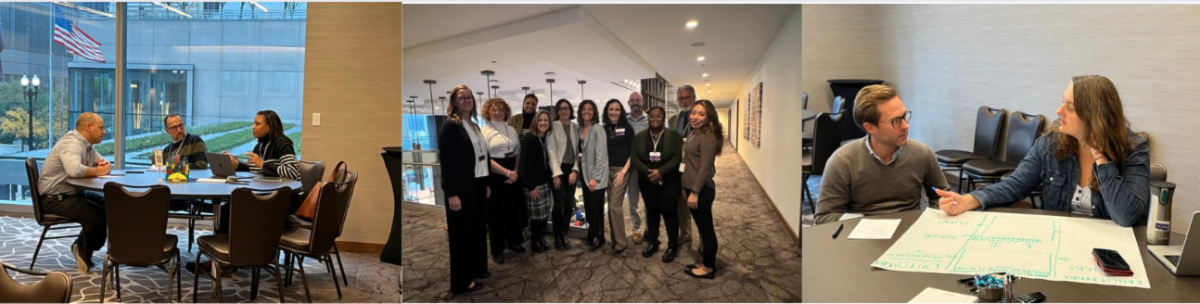
Over 50 individuals from across the country gathered in Chicago, Illinois, on November 7-8, 2023 for the HD2A in-person meeting. The meeting was a success, bringing together a community of researchers and experts in data, opioid use disorder, and pain management. The event highlighted how we can grow our work together and become agents of change.
The event also provided an opportunity for in-depth conversations about engaging partners, mapping our work, and utilizing implementation research logic models.
| |
Innovation & Acceleration Projects | |
HD2A Innovation Projects are innovative approaches to using data to drive action and change in real-world settings while Acceleration Projects develop data or methods that improve the timeliness, quality, accessibility, or usefulness of existing data ecosystems. We're excited to add four new projects to the HD2A roster! For more information about the other HD2A projects, visit our website here. | |
Chicago Data-driven OUD Screening, Engagement, Treatment, and Planning System | |
Health services for opioid use disorder in Chicago's west side are fragmented, contributing to higher mortality rates. This study aims to unite elements of the University of Illinois Health System using a data-driven approach. It will craft an opioid response plan alongside key partners: local health departments, community organizations, healthcare providers, and individuals with lived experience. Learn more.
Principal Investigator: Niranjan S. Karnik
| |
The Use of Novel Linked Databases to Reduce Postoperative Opioid Use Among Patients Undergoing Inpatient Surgery | |
More than half of US surgical procedures involve older adults, increasing their risk for opioid misuse, opioid use disorder (OUD), overdose, and poor surgical outcomes. This project aims to determine if perioperative interventions targeting opioid-related issues during surgery affect long-term postoperative opioid use. Learn more.
Principal Investigators: Eric Sun, Douglas Colquhoun
| |
Leveraging Data to Action: Accelerating Emergency Department OUD Care by Improving Data Access and Infrastructure | |
Emergency departments (EDs) play a crucial role in identifying and treating opioid use disorder (OUD). However, there's a lack of data-driven evaluations and interventions for OUD care in ED settings, along with gaps in data systems hindering research. This project aims to create an automated data system by integrating electronic health records and administrative data from EDs into the Clinical Emergency Department Registry in collaboration with the American College of Emergency Physicians. Learn more.
Principal Investigators: Arjun Venkatesh, Kathryn Hawk, Andrew Taylor
| |
Supporting Data-driven Decision-making to Support Substance Use Service Expansion Policies and to Prevent Overdoses | |
Oregon, ranking last in US substance use service access, approved a groundbreaking ballot measure with substantial funding to expand services and decriminalize personal substance possession. This study focuses on developing and evaluating Discovery and Design Sessions to optimize policy implementation. Learn more.
Principal Investigator: Gracelyn Cruden
| |
Creating a Data Management and Sharing (DMS) Plan aligning with NIH and HEAL data sharing policies can be complex due to diverse requirements across various sources of policy guidance. HEAL studies involving varied data types may cause confusion in defining data sharing approaches. | |
|
That's why the HD2A Data Infrastructure Support Center (DISC) at Wake Forest University School of Medicine has developed the HD2A Addiction and Chronic Pain Template DMPTool–an optional-source online application that helps researchers create DMS plans. Access the tool here. | |
HEAL Investigators Meeting | On February 7-8, 2024, the NIH HEAL Initiative will host the HEAL Investigators Meeting. This gathering aims to unite HEAL grantees, federal officials, individuals with lived experience, and stakeholders. The event will facilitate sharing research findings, discussing trends, addressing common challenges, and identifying opportunities to progress the initiative's goals. | |
This will be a hybrid meeting with opportunities to participate in person and virtually. The in-person event will be held in Bethesda, Maryland at Bethesda North Marriott Hotel & Conference Center. The meeting will also include scientific symposia, discussion groups, networking, and poster sessions for in-person and virtual attendees. Register here. | |
|
Dr. Ben Linas is an Infectious Diseases physician scientist focused on the overlapping epidemics (syndemic) of substance use disorders and infectious diseases. He is also an HIV and HCV provider at Boston Medical Center and the Boston Healthcare for the Homeless Program, where he provides primary care and sub-specialty management of HIV, HCV, and HIV/HCV co-infected patients, most of whom have opioid use disorder. His research investigates the comparative- and cost-effectiveness of interventions to identify and treat OUD, HIV, HCV, and serious injection-related bacterial infections in the real world, where resources are limited and the best strategies for obtaining good outcomes are not certain.
| |
As an MPI on the HD2A Modeling and Economic Resource Center (MERC), he provides expertise and consultation on simulation modeling and economic evaluation methods to support the HD2A Innovation Projects and conduct original research. | |
Here are a few articles and news items that we've been reading and wanted to share with you: | |
-
The New York Times piece about 48 million Americans living with addiction and what can be done to help.
-
The protocol paper for the Neighbors, Bao, and Ramsey Innovation Project in the Journal PLoS One.
| |
You are receiving this email because you either subscribed to receive updates from us or someone you know thinks you'd be interested in our work. If this email was forwarded to you, please subscribe to our newsletter so you can continue getting updates. | | |
|
This work is supported by grant 1U2CDA057717
from the National Institute on Drug Abuse, National Institutes of Health.
|
| | | |