|
NEMWI Weekly
Update
November 4th, 2025
| |
| |
NEMWI To Host Event on Great Lakes Marine Sanctuaries: CORRECTION and NEW DATE
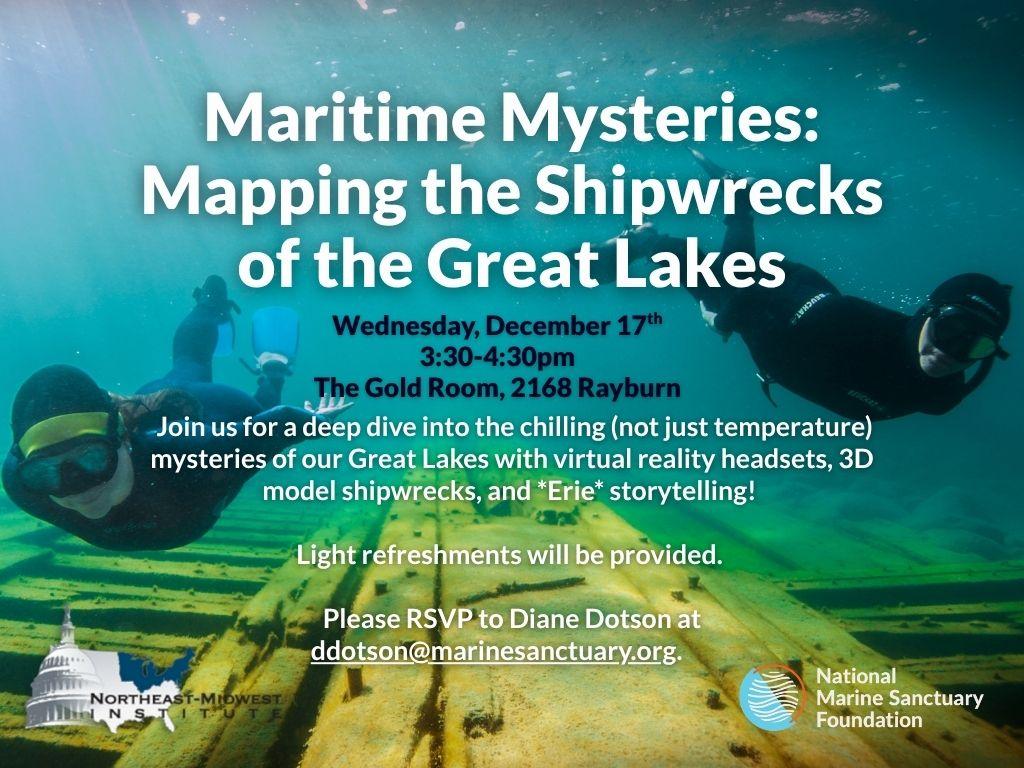
The Northeast-Midwest Institute and the National Marine Sanctuary Foundation will co-host a Congressional briefing on Great Lakes marine sanctuaries on Wednesday, December 17th, from 3:30-4:30 p.m. in Rayburn 2168. The briefing is a session of NEMWI’s Great Lakes Primer and Orientation Program, sponsored by the Erb Family Foundation.
Join us for a deep dive into the chilling mysteries of the Great Lakes with virtual reality headsets, 3-D shipwreck models, and *Erie* storytelling!
Covering about 10,000 miles of coastline, America’s Great Lakes serve as gateways for trade and tourism, centers for biodiversity and science innovation, and underwater museums for national maritime heritage. Only about 15% of these lakebeds are mapped to modern standards, leaving huge gaps in the data needed to create updated nautical charts, discover untold stories and shipwrecks, and manage the region’s extraordinary natural and cultural resources. The recent designations of national marine sanctuaries in the Great Lakes have led to intensive mapping efforts and new discoveries by NOAA and its commercial, academic, and federal partners.
The answers to many maritime mysteries lie in the depths of these largely unexplored waters, preserving evidence and glimpses into the past, for those who dare to discover. The briefing will focus on the network of America’s premier marine places in the Great Lakes and the new discoveries, innovative technologies, and immersive experiences benefiting their communities.
Light refreshments will be provided.
Please RSVP to Diane Dotson at ddotson@marinesanctuary.org.
| | |
|
NEMWI Releases Report on Local Government Administration in Legacy Cities
The Northeast-Midwest Institute has released a report that explores some defining characteristics and persistent challenges of local governments in the legacy cities of the northeastern and midwestern United States. Once thriving industrial hubs, these cities have suffered decades of population loss, economic disinvestment, and decline in stature.
A central focus of the report is the issue of limited local government capacity, which impedes effective service delivery, innovation, and long-term revitalization. The report analyzes contributing factors such as fragmentation, staffing shortages, and technological gaps, and proposes solutions rooted in cross-sector leadership, collaborative governance, university partnerships, digital modernization, and federal support. It advocates for institutional reforms that can equip legacy city governments to meet the demands of the 21st century.
The report, written by NEMWI intern Eloise Wyatt of Bates College, is part of NEMWI’s Revitalizing Older Cities program, which conducts research on former industrial hubs in the midwest and northeast United States that have experienced significant economic, demographic, and infrastructural decline.
Read the report here.
| |
Great Lakes Fishery Research Reauthorization Act Passes Committee with Bipartisan Support
The Senate Committee on Environment and Public Works held a hearing on Wednesday, October 29th, during which the Great Lakes Fishery Research Reauthorization Act advanced with bipartisan support.
“The Great Lakes Science Center helps protect the freshwater fisheries and habitats that are invaluable economic and ecological assets for Michigan and the entire Great Lakes Region,” said Senator Peters, Co-Chair of the Senate Great Lakes Task Force, in a press release. “The Trump Administration’s attempt to slash staffing at the Center is outrageous and recklessly endangers the health of our Great Lakes, which is why it’s more important than ever that we pass this bill and put this essential program on sound financial footing.”
A companion bill advanced out of the House Natural Resources Committee in July. The legislation seeks to reauthorize the fishery research program for five years, through 2030. It provides $15 million annually to support the U.S. Geological Survey’s Great Lakes Science Center, which conducts critical research guiding fishery management across the Great Lakes Basin. The Center’s work underpins the region’s $5 billion fishery, helping maintain both ecological balance and economic vitality. Reauthorization of the program would allow for the continuation of essential programs, including the development of reintroduction plans for culturally and ecologically significant fish populations—initiatives vital to the long-term health of the Great Lakes ecosystem.
The bipartisan measure now advances to the full Senate amid the Trump Administration’s ongoing efforts to reduce staffing at the Center’s Ann Arbor headquarters. Those cuts, which would lay off 79% of the Center’s workforce, have been stopped by court action for now.
Reported by NEMWI Intern Christina Mina, University of Texas at Dallas
| | | |
Line 5 Granted Federal Permit
Enbridge’s Line 5 oil pipeline has been granted a federal permit by the Army Corps of Engineers to re-route the pipeline in northern Wisconsin. The pipeline, which carries 22.68 million gallons of crude oil per day from western to eastern Canada, currently runs through the reservation of the Bad River Band of Lake Superior Chippewa. The permit would allow Enbirdge to run the pipeline around the reservation instead, though the Tribe and other opponents argue that the project poses a threat to the surrounding wetlands and the watershed on which the reservation sits, both because of damage done during construction and the potential for a spill.
“The approval of the Enbridge Line 5 reroute application is a great success and will advance the President’s energy dominance agenda for America,” said Adam Telle, Assistant Secretary of the Army for Civil Works. “This permit decision demonstrates the Corps of Engineers’ role in ensuring a balanced approach to infrastructure development and environmental regulation consistent with statutory direction.”
The Environmental Protection Agency expressed its support for the project this year in a reversal of its opposition during the Biden Administration. In a May hearing, the EPA argued that the project would not harm the Bad River Band’s water quality. Environmental advocates, on the other hand, expressed concern about the environmental impacts and the permit issuance. “This is a clear violation of the Clean Water Act,” said Rob Lee, staff attorney for Midwest Environmental Advocates, which is challenging the project in court. “It appears the Army Corps is fast-tracking a fossil fuel project at the expense of environmental protection and legal due process.”
The decision does not mean construction can begin imminently. State permits are currently held up in Wisconsin courts, and Enbridge and the Army Corps would have to sign a Proffered Permit. The Corps has not yet weighed in on a separate project, to move the portion of the pipeline that crosses the Straights of Mackinac underground to protect against anchor strikes, though a decision is expected this year. Earlier this year, the Trump administration had fast-tracked the permitting review for that project as part of the President’s “Energy Dominance” agenda.
| |
Senate Subcommittee Holds Hearing on U.S. Shipbuilding
The Senate Subcommittee on Commerce, Science, and Transportation convened on Tuesday to discuss U.S. shipbuilding. For nearly two centuries, Wisconsin and other Great Lakes states have produced world-class vessels crucial for transporting goods and the US Navy. This year, however, China significantly outpaced the US, producing 717 large commercial vessels compared to just one in the U.S.
During the hearing, Senator and Great Lakes Task Force member Tammy Baldwin (D-WI) questioned industry leaders on behalf of the Great Lakes region, seeking insight on how the shipbuilding industry can better utilize the region’s workforce to meet rising commercial and naval demands. Matt Paxton, President of the Shipbuilders Council of America, responded that last year the U.S. delivered 964 ships of various models, with 750 ships produced this year. Paxton emphasized that, although the U.S. falls short of China’s large commercial ship output, many US-built vessels serve critical roles in inland waterways and the Great Lakes.
Senator Baldwin and Paxton agreed on the importance of the Small Shipyard Grant Program, which helps coastal communities maintain and expand their shipbuilding capacity by supporting the construction, repair, and modernization of vessels and related industrial machinery.
Senator Bernie Moreno (R-OH), Co-Chair of the Great Lakes Task Force, raised the issue of keeping the St. Lawrence Seaway open year-round; Paxton reiterated the importance of the Seaway for the industry. Both Senator Baldwin and Senator Moreno affirmed that their states are prepared and equipped to support further growth in the shipbuilding industry.
Reported by NEMWI Intern Christina Uytingco, University of Michigan
| | | |
Connect With the Northeast-Midwest Institute
on Social Media
The Northeast-Midwest Institute is on social media with new updates and information on its regional research and policy education program and with announcements for upcoming briefings and events. NEMWI is posting our research reports on current regional issues and ongoing policy education on the page to make keeping up with our policy work easier than ever. The Institute also is updating the page with announcements of upcoming policy briefings and webinars. NEMWI is excited for the opportunity to connect with as many people as possible.
Please check out our LinkedIn here, our Twitter/X here, our Facebook here, and our Bluesky here. Be sure to like and follow us to keep up to date with NEMWI!
On Bluesky, also check out our Great Lakes feed at "NEMW Great Lakes Feed" and if you are a Great Lakes organization on Bluesky, contact Great Lakes Program Manager Alex Eastman at aeastman@nemw.org so that we can add your posts to the feed!
| | | |
|
Great Lakes Events
(all times eastern)
| | | |
In the House:
The House has district work periods this week.
In the Senate:
No relevant hearings this week.
| | | | |