|
Council Member Manny Teodoro examines the role of justice in delivering on the Safe Drinking Water Act’s promise more than 50 years after its passage. Drawing on research highlighted in the Madison Declaration, he explores how equity is not a peripheral concern, but central to protecting public health, maintaining trust in institutions, and ensuring effective drinking water governance.
His analysis looks at persistent disparities in drinking water outcomes across communities and considers how emerging regulatory priorities, including PFAS, add new layers of complexity. As expectations evolve, Dr. Teodoro points to important questions about how enforcement, funding, and data can be better aligned to ensure reliable, safe drinking water for all communities.
| | | |
Council Member Chad Seidel on Water System Resilience and Long-Term Planning
Council Member Chad Seidel recently joined the Make Water Work Podcast to discuss water system resilience, public health priorities, and the long-term implications of infrastructure decisions tied to economic growth.
During the conversation, Chad examined the risks utilities face when expanding capacity for large industrial users, such as data centers, and emphasized the importance of planning for long-term operational and financial sustainability to protect safe, reliable drinking water service.
| |
Council Chair Kathryn Sorensen on the Future of the Colorado River
Council Chair Kathryn Sorensen, Director of Research at the Kyl Center for Water Policy at Arizona State University, will be a featured panelist at the upcoming Urban Water Institute Spring Conference, where water leaders from across the West will examine the future of Colorado River management. The session will explore what must change for Upper and Lower Basin states to reach resolution amid tightening deadlines, and how governance, policy, and planning may need to adapt in response to long-term hydrologic and institutional shifts.
| | |
Council Member Alan Roberson Briefs U.S. Conference of Mayors on PFAS Updates
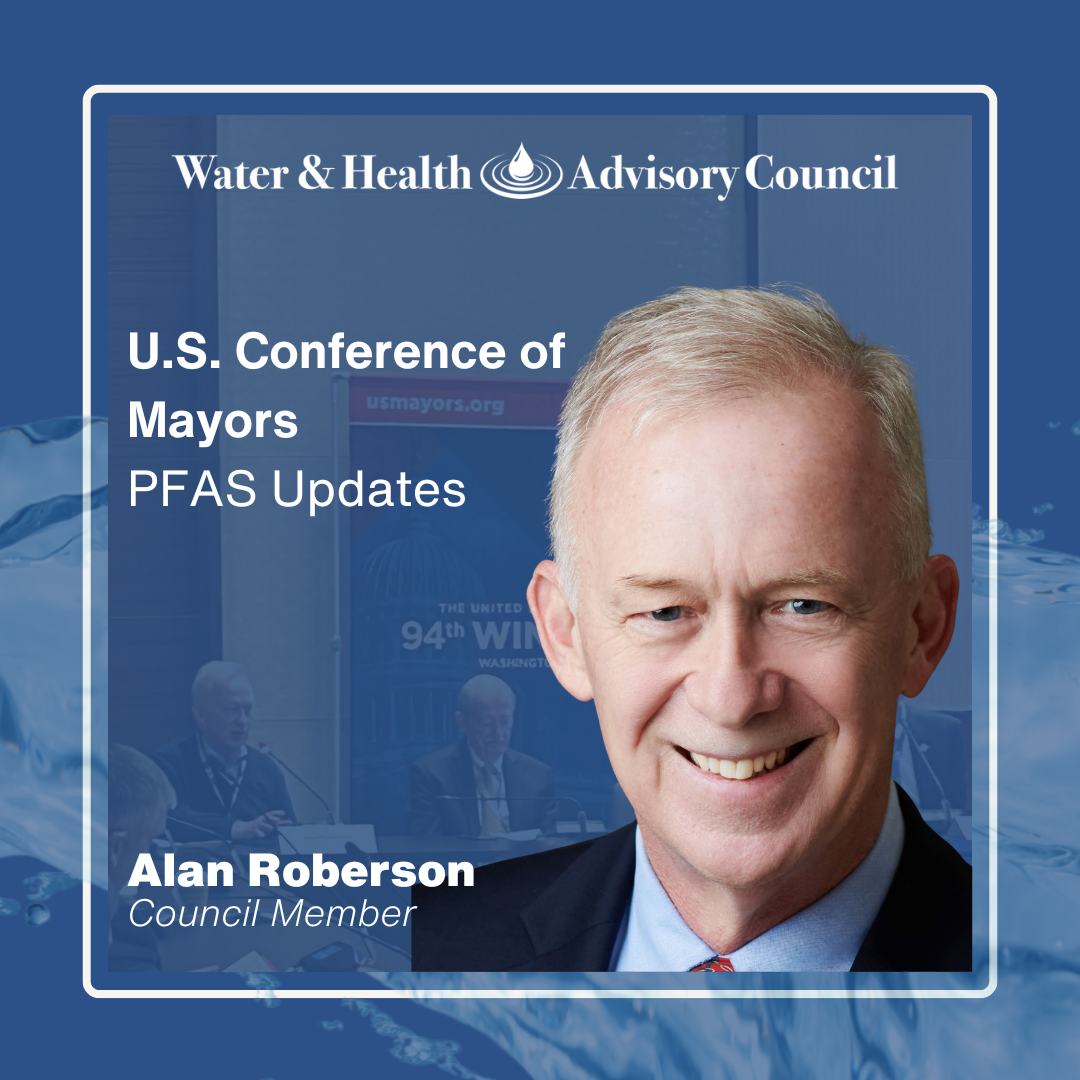
Water & Health Advisory Council member Alan Roberson recently presented to the U.S. Conference of Mayors Mayors Water Council, sharing an update on PFAS drinking water developments and practical steps cities and towns should be considering now.
His remarks focused on testing and communications planning, evaluating treatment and source options, and preparing for the financial and regulatory challenges ahead as PFAS, funding, and lead continue to shape local water decisions.
| | | | |
National Law Review: PFAS Drinking Water Rule Not Vacated (Yet)
A federal appeals court denied EPA’s request to vacate portions of the PFAS drinking water rule, sending the case to a merits panel and extending regulatory uncertainty for water utilities, states, and regulated entities as the case moves toward a merits decision later in 2026.
| |
European Commission Study Quantifies Long-Term Costs of PFAS Contamination
A new EU study by the European Commission’s Directorate-General for Environment estimates that continued PFAS pollution could cost Europe up to €440 billion by 2050, even under conservative assumptions.
The findings highlight that early action to reduce PFAS emissions at the source would substantially lower long-term health, environmental, and societal costs compared with relying on remediation alone.
| | |
JD Supra: What EPA’s Draft Risk Assessment Means for Industry and Municipalities
EPA’s 2025 Draft Risk Assessment finds that biosolids containing low levels of PFOA and PFOS may pose significant human health risks under common land application and disposal scenarios, signaling the potential for more restrictive future regulations.
At the same time, evolving federal actions and a patchwork of state-level bans, thresholds, and monitoring requirements are creating regulatory uncertainty and increased compliance, operational, and liability challenges for municipalities and industry.
|
Smart Water Magazine: American Water To Invest Up to $48 Billion In Infrastructure Upgrades Over The Next Decade
American Water announced plans to invest up to $48 billion over the next decade to modernize its water and wastewater infrastructure, focusing on reducing leaks, improving efficiency, and strengthening system resilience.
The investment builds on the company’s ongoing efforts to support public health and environmental protection across its multi-state service footprint.
|
El Paso Times: Major Water Line Breaks in Northeast El Paso, Depletes Reservoirs
El Paso Water is working to repair a major water main break that drained multiple reservoirs and left thousands of customers without service, with partial restoration already underway.
A precautionary boil water notice remains in effect as crews continue repairs, refill reservoirs, and conduct water quality testing in coordination with state regulators.
| |
Waste Water Digest: Key opportunities on Capitol Hill for water stakeholders in 2026
WWD outlines key legislative developments on Capitol Hill in 2026 that will affect water stakeholders, including appropriations, EPA program reauthorization, and the Water Resources Development Act.
Early engagement and awareness of competing policy priorities will be important as Congress navigates a crowded agenda with implications for water infrastructure funding and project delivery.
| |
The Baltimore Sun: Maryland's Water Infrastructure Gets a Mediocre Grade
The 2025 ASCE Maryland Infrastructure Report Card gives the state’s drinking water and wastewater systems grades of C and C+, showing only modest improvement, underscoring the need for sustained investment and modernization.
The article highlights that long-term funding, workforce development, and coordinated action among utilities, regulators, and policymakers are essential to strengthen Maryland's water infrastructure and economy.
|
Metro News West Virginia: West Virginia American Water Is Working to Keep WV’s Water Safe and Reliable.
Findings from a new ASCE report show that West Virginia’s drinking water and wastewater systems are in crisis, with poor grades reflecting aging infrastructure and significant investment needs.
While West Virginia American Water’s is engaging in ongoing infrastructure investments and emergency support efforts, long-term solutions will require sustained funding mechanisms and collaboration among utilities, regulators, and policymakers.
| | | | |