|
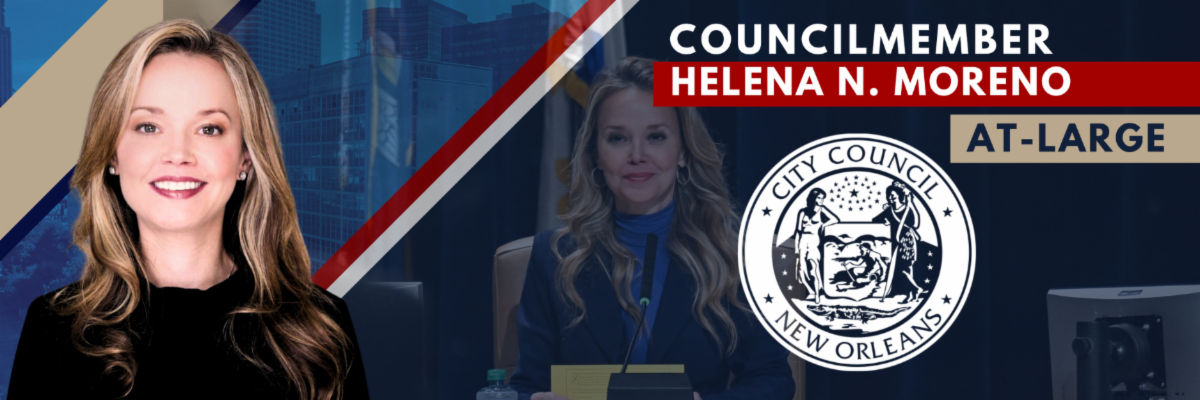
NEW ORLEANS - After months of work with numerous stakeholders, Council Vice President Helena Moreno is introducing a proposal to create clear and concise regulations for developers to receive a Restoration Tax Abatement (RTA). For far too long, existing guidelines have been confusing to applicants, appeared inconsistent, and contained some outdated policies that do not support good development projects, nor do they ensure accountability on behalf of RTA recipients. Plus, approvals for RTAs appeared to be subjective. Moreno now wants to ensure that the determination is based on meeting criteria along with providing clarity and accountability to the program.
The Restoration Tax Abatement (RTA) Program provided by state law allows the City Council the ability to approve a tax abatement for commercial property owners and homeowners who expand, restore, improve, or develop an existing structure in a downtown development district, opportunity zone, economic development district, or historic district. If approved, the owner has the right to pay ad valorem taxes based on the assessed valuation of the property for the year prior to the commencement of the project for five years after completion of the work.
“This took months to get right and a great deal of collaboration with internal and outside agencies to finally clarify and improve the application and approval process for RTAs, as well to clearly define eligibility and approval criteria,” said Council Vice President Moreno. “These revisions for RTA initial applications, renewals, and transfers will help ensure greater transparency, a more delineated and linear process to promote clarity among applicants, and a program that promotes development in our city while balancing public benefit.”
"I applaud Council Vice President Moreno, her dedicated staff, and numerous community
organizations for working to streamline this critical program. Improving the RTA application process and creating clear criteria for applicants is good government practice that ensures much-needed transparency. I am in full support of this legislation because when economic development grows, the community grows too,” said Council President JP Morrell.
“By clarifying language and making clear the qualifications of the program we have enhanced the Restoration Tax Abatement Program, which can be a valuable tool for economic development when used in the investment process. These measures show the City’s commitment to supporting local businesses and promoting growth and revitalization within our communities,” said Councilman Eugene J. Green, Jr., Council District D.
“I commend the efforts of city staff and community stakeholders who have worked collaboratively to recommend these improvements. By streamlining the RTA application process and approval criteria, we not only provide clarity for property owners and developers, but we also uphold our charge to steward public resources responsibly. I look forward to seeing these revisions implemented in a way that fosters economic development and preserves the character of our neighborhoods,” said Councilman Oliver Thomas, Council District E.
The office is grateful to all stakeholders who took part in this collaborative process and provided critical input including the Office of Economic Development, Safety & Permits’ Inclusionary Zoning Office, Council’s Executive Counsel and Land Use Officer, Greater New Orleans, Inc., and Housing NOLA, among others.
The resolution and accompanying exhibit were heard at the May 14, 2025 Economic Development and Special Development Projects Committee and will move forward at the next regular City Council meeting on May 22, 2025 beginning at 10 a.m. in City Council Chambers. For more information or to watch live, please go to www.council.nola.gov.
|