|
Source: Harris County Proposed Budget, p. 18.
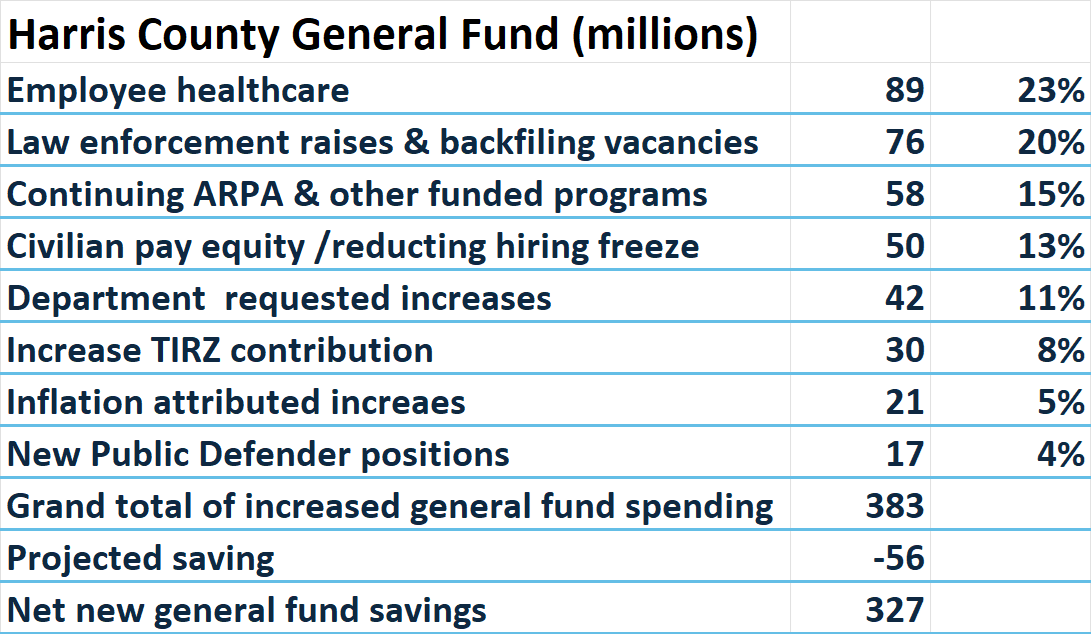
Law Enforcement Raises & Positions – The County previously approved across-the-board raises for its law enforcement officers. Those increases will cost about $45 million next year. The balance covers the cost of filling vacant law enforcement positions previously authorized.
Programs Previously Funded Outside the General Fund – The County operates many programs funded by sources other than property taxes and fees, often federal or state grants. These programs are accounted for in various special funds. The number of these programs expanded greatly with the historic pandemic funding from the federal government (ARPA). However, ARPA funds ran out this year, as did several other funding sources. Instead of winding down these programs, the proposed budget would continue them, transferring the cost to the General Fund and property taxpayers. Continuing those programs will add $58 million to this year's tax bills.
Civilian Personnel Costs – Based on a study by an outside consultant, the County adopted a program that would increase the compensation of a large number of employees across the County. This was euphemistically referred to as the “pay equity” plan. In addition, last year the County implemented a hiring freeze because of budget concerns. The proposed budget would roll back most of the hiring freezes. The new cost of the “pay equity” plan and reversing the hiring freezes will cost an additional $50 million next year.
Increased TIRZ Contributions – The proposed budget would increase the County’s contributions to TIRZs by $30 million next year. Don’t get me started.
Most of the other increases are fairly routine. However, it is worth repeating that the budget relies on about $56 million of various cuts and cost savings. I will not bore you with the details. Some of these savings will likely be realized, but others depend on the County’s execution of initiatives, such as reducing the number of jail inmates outsourced to other jurisdictions. And, as we have already seen, Commissioners’ Court rejected $9 million of these savings related to the employee health insurance plan. So, there is a very real question as to whether the County can actually realize all $56 million of the proposed savings.
In 2024, the budget office warned Commissioners’ Court that it was routinely increasing spending faster than the County’s revenue was growing and that if it did not change the trajectory, it would begin to face serious shortfalls. The Commissioners’ Court failed to heed that warning and has since accelerated spending. The failure to exercise even a modicum of fiscal discipline has resulted in the County’s shortfall this year. Unfortunately, taxpayers will pay the price for their lack of fiscal discipline.
Ironically, the only department in the County to actually reduce its budget was the budget office, which cut its budget by 2%. That, my friends, is walking the talk. If only the Commissioners’ Court would follow its budget office’s example.
|