News and information to help journalists serve the public and stay safe.
|
|
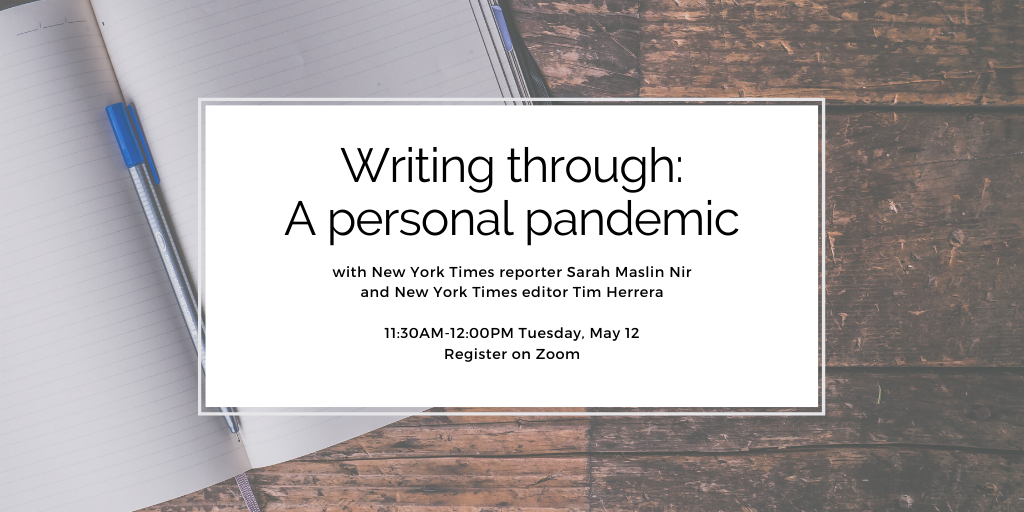
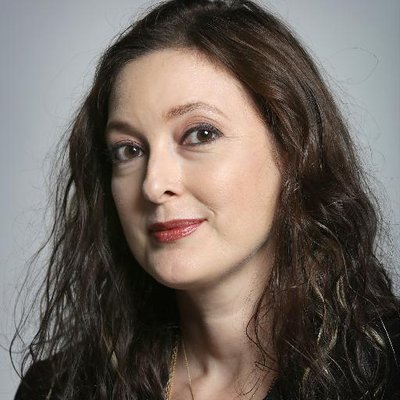
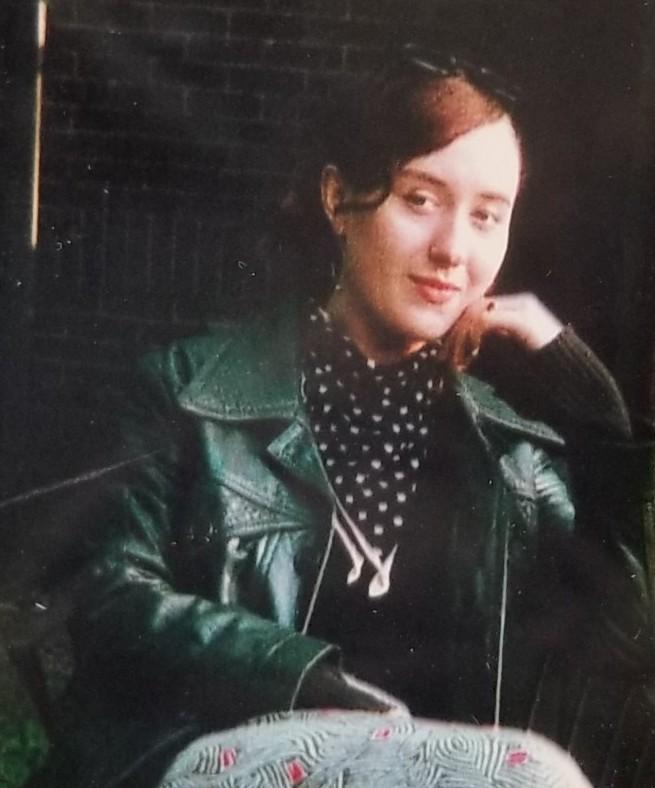
The first part of this Zoom webinar on May 12 will be a 15-minute conversation with Sarah and Tim about writing through a personal pandemic. The second part of the program will be a 15-minute Q&A with participants.
Registration is open
.
|
|
Someday newsrooms will reopen.
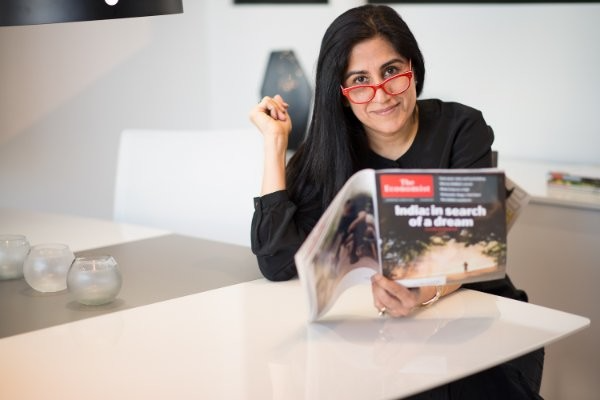
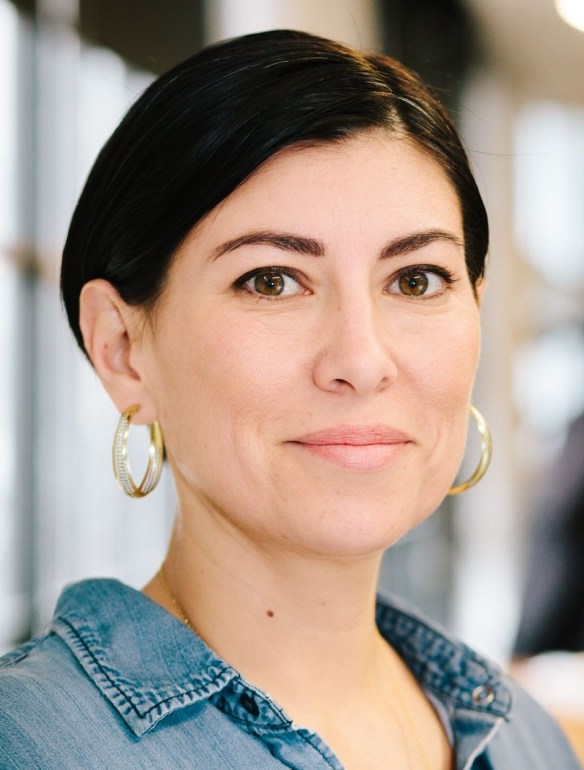
Sumita Arora
’s job is envisioning what that will look like.
As a principal at Gensler, and leader of the architectural firm’s media arm, Arora not only has to visualize a post-COVID-19 workplace, but also what journalistic habits acquired during the pandemic might be suitable in new newsroom settings.
“Leading up to this crisis, the workplace had become very dense, and particularly so in the case of newsrooms where collaboration, and eye contact and access to breaking news on digital media was very, very important,” Arora, whose clients have included The Washington Post and The Dallas Morning News, said in an interview. “I think there's going to be a phased re-entry into the workplace. Because the same real estate footprint is not going to be able to support the population that it ordinarily would at max capacity.”
That means retaining some of the digital workflows and virtual newsrooms developed and perfected during the past two months.
“It's a little too early to fully understand the impact of these new habits, which haven't really settled in yet, but I think they will, because I think we're a little ways away from getting a vaccine,” she said.
With health and safety as priorities, newsrooms, like other workplaces, will have to adapt ideas from the healthcare sector. That includes improved air purification systems, infrared fever screening systems, and a higher level of automation. Think voice activation, hands-free tools, automatic doors and touchless soap dispensers.
Newsrooms will have to be clutter-free to allow regular deep cleaning. Imagine fewer huddle rooms, more assigned work spaces and no shared keyboards or headsets. Imagine more signage with reminders to wipe down workspaces or indicating room occupancy limits.
Read on
for Arora’s take on how the news media work space might change.
|
'Return to the Workplace' originally published on
gensler.com
.
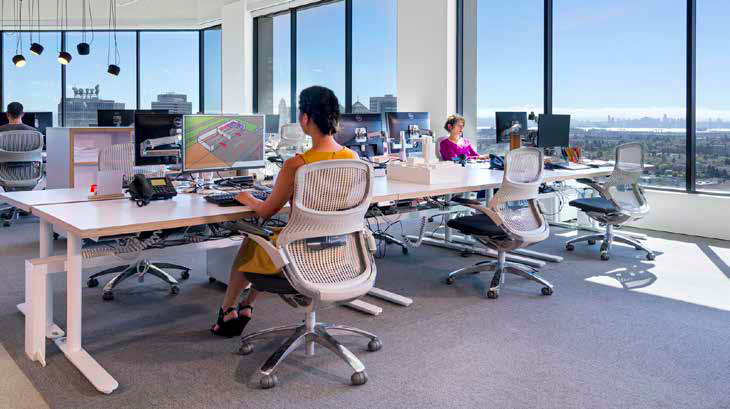
Gensler is recommending adding screening on three sides to the social distancing depicted in this photo.
|
|
Emily Spicer
had a bad day Tuesday. Three days — and 300 journalists later — she’s in a much different place, literally.
After starting the “
Where I’m writing from
” group on Facebook, Spicer and the group’s members connect while getting a glimpse of journalists’ real-life, work-from-home spaces. Members share a photo of their home “offices,” which range from the artfully curated to space carved out in a child’s closet. All show the WFH reality journalists face, and members have found support along the way.
Spicer, features editor for the San Antonio (TX) Express-News, told us how the idea and growing community came about.
“I started the group because I was having a bad day. I had just hit a kind of wall emotionally with work. I had been looking at the ‘
View from my Window
’ Facebook page, and it was starting to make me feel bad — like the fashion magazine effect on women.
All these places on the page were starting to look like a travel magazine, and I started thinking, ‘Why don’t I live in a beachside house in Oahu? Why don’t I have a home overlooking a UNESCO World Heritage fjord in whatever country it was instead of a small 1950s rock ranch house overlooking a lawn?’ I started to feel bad about my house, and I love my house and my little office.
So, at some point that morning, I just decided, ‘You know, what I really want is a Facebook group where I can see the reality of where journalists are working now.’ I wanted to see something real and have people share positivity about that. I want to create a space, a community, where stressed-out, hardworking journalists of all stripes could safely share photos and stories of their spaces as a way to illustrate and remind others that they’re not alone, that everyone in journalism is struggling and trying.
But you’re still working, you’re still writing or editing or photographing or whatever you do and that’s important and that’s necessary. And that’s awesome. I just love, love, love how people have responded and how the group is growing.”
|
|
|
The National Press Club Journalism Institute is spotlighting
the next generation of journalists
, students graduating from college or Master’s programs this spring into
a challenging job market
, in hopes they’ll meet future bosses and colleagues here, who will reach out and support them in building journalism’s future together.
School
: Wayne State University
Location
: Detroit, Michigan
Best Moment
: Receiving the Armand and Eleanor Gerbert Scholarship
If you could meet any journalist and ask for her/his advice, who would it be and why?
Buhl:
I really admire
Sarah Alvarez of Outlier Media
and her work because she's truly interested in getting the news that matters to the people who need it most, i.e. low income families in Detroit. I would love to ask for her advice on how to do the work that matters to you most while still being able to pay the bills! I'd also like to ask for her advice on how to stay strong as a female journalist in the age of the internet and online trolling and harassment.
Sarah Alvarez
responds
: I’m truly flattered you would be interested in my advice and will do my best to give you something useful. Like I say to all my sources, you’ll have to let me know what happens. It's the only way I’ll know if the information was any good.
It might sound counterintuitive but one of my guiding principles is, I'm willing to walk away at any moment. Reporting and working in news and information is bound up with what I care deeply about. That’s a privilege my ancestors have worked for me to have - very specifically - and I’m going to stretch in this space and stay here as long as I can.
Still, if I can’t do this work in a way that is consistent with my values and in spaces where my dignity is acknowledged I’ll just do different work. I’m not willing to go broke. I won’t work in an environment where power and respect aren’t easily shared. As long as I’m able to make choices about the work I do, those are choices I’m going to make.
I encourage you to think about why you do this work. Be really honest with yourself. You’ll have to keep that close and check-in with yourself. Ask yourself, often, if you’re putting out into the world what you hoped you would. Are you getting what you need?
Protect your hunger to do your best work! Your value is with you - not your work - so always know you can do something else, create value in other ways. That goes for the trolls too, any place you work for needs to help protect you from abuse. If they can’t they need to help you navigate through abuse by paying for the resources you’ll need.
I asked two of the women I respect most, Candice Fortman and Katlyn Alo, for the advice they would give you. Candice says, “The power in your work will come from understanding the needs of your community, not by assumption, but by asking them what they need from you and treating them as collaborative partners at each step. Do not underestimate their ability to know what they need and to be able to guide your hand in producing it in ways that make it useful.”
Katlyn says, “We work on getting information to people who need it most and who are faced with systematic barriers to accessing that information. If that work were easy, more newsrooms
would be doing it. Don't mistake something no one has ever done before for something that's impossible. We have a duty to correct the course of an industry that has balanced its books on advertising over creating business models for equity.”
Happy graduation. I’m sorry most of the traditional ways you would celebrate are not available to you because of what’s going on in the world. As a graduation gift, I’d like to commission a piece from you. Pitch me a few options. I’ll pay you $500, I’ll edit you and I’ll help you find the right place
to publish it.
|
|
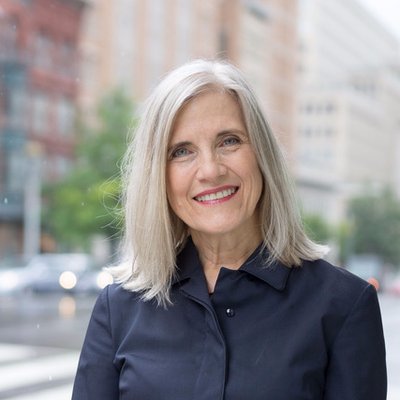
Bill Plante Chair in Leadership & Media Integrity, Loyola University Chicago
Freedom Forum Fellow in Women’s Leadership
Whenever I teach managers about coaching and the power of questions, I anticipate this very legitimate question: Are there situations when coaching isn’t the right option, and you should just give people directions? The answer is yes - without a doubt.
When should you give coaching a rest and just tell people what to do?
- When the issue is urgent and time is limited. (Two team members want the same assignment during a breaking news story. You decide now and perhaps have career coaching conversations later.)
- When the situation involves a high level of risk. (You remind people about maintaining adherence to COVID-19 safety protocols. Some things are non-negotiable.)
- When the other person makes it clear they want - and need - direction on a very specific topic. (Your reporter hits a dead-end on a story and is very frustrated. You share two sources of yours that you know will be helpful.)
- When the other person is impervious to coaching. (Your previous coaching attempts have turned into debates, the person consistently blames others, or doesn’t follow through on ideas that emerged in many past coaching sessions.)
But here’s the secret: the more you learn about coaching and the better you are at coaching people, the more confidence you will have in knowing when to set that skill aside. You’ll know that you aren’t just defaulting to an old habit of giving advice and orders, or fixing problems rather than teaching others how to find their own solutions.
You’ll be a coach who knows when to fix.
|
|
|
- Plan early and be willing to pivot at the last minute. Frerking said the paper deployed numerous reporters to hit the streets and editors looked for themes through reopening day as reporters filed their feeds. “The most interesting one, which we didn’t expect, was people were still being pretty cautious. A lot of places weren’t opening… One of the very basic things we said (to reporters) was, ‘If you notice several shops that aren’t open, even though you are looking to speak to owners and patrons and workers, also make notes about the ones that didn’t open.’ And that was the part of the reporting that informed us being able to say ‘Not everybody did.’”
- Represent all sides of a community. That means “all demographic groups, all races, all ethnicities, all neighborhoods and all types of workers,” Frerking said. “Be willing to throw a lot of boots on the ground, with the added caution of being safe.” Reporters were instructed to keep their distance, wear masks and keep hand sanitizer in their cars. Editors created a Slack channel for reporters to send their feeds and assigned one writer to the story. The result was a front page story that was a veritable tour of Dallas neighborhoods and its suburbs featuring a diverse array of voices, from an out-of-work hairdresser, to a gun range owner, to customers at a wine bar.
- Go beyond the rhetoric and look for nuance. In a politically-charged climate, certain events become flash points and the players become caricatures, as in the case of salon owner Shelley Luther, jailed this week for refusing to close her business. (Under the governor’s gradual return to business, salons weren’t scheduled to open until today). Luther quickly became a hero of conservatives and the judge who ordered her jailed, Eric Moye, the target of their anger. The DMN profiled each separately, assigning two reporters to each story. “We saw a moment where this was heading, we planned for it and we recognized that the rest of the country would be looking at us to find out who is Shelley Luther? Who is Eric Moye?” Frerking said. “By reading these two stories, you realize both of these people are very complex and deep and have their own nuances. We did a really good job of fairly presenting them.”
|
|
This newsletter is written & edited by the National Press Club Journalism Institute staff: Beth Francesco, Holly Butcher Grant, Jim Kuhnhenn, and Julie Moos.
Send us your questions and suggestions
for topics to cover.
|
|
The National Press Club Journalism Institute promotes an engaged global citizenry through an independent and free press, and equips journalists with skills and standards to inform the public in ways that inspire civic engagement. Support our important work with a tax-deductible contribution today.
|
|
|
|
|
|
|