News and information that journalists need to serve the public and stay safe.
|
|
Latinos in the U.S., many employed in hard-hit service industries and less likely to have health insurance, have more
concerns about the coronavirus
than Americans overall. That means journalists have an added responsibility to keep Latino communities informed and represented in their stories.
That’s no easy task as the coronavirus has shrunk newsrooms and forced many journalists to work from home, away from neighborhoods and gathering places where many stories reside.
- Diversify your newsroom by contracting with a freelancer of color.
- Become familiar with the geographic communities. If you can’t go there, at least know the neighborhoods. It will help when you contact residents remotely.
- Look for Facebook groups and neighborhood listservs and introduce yourself to community members there. On Twitter, follow hashtags that may be trending on Latino issues to understand concerns and unanswered questions you can explore.
- Invite community members into the newsroom. Show people (through virtual meetings these days) how journalism works and editorial decisions are made.
- Read community publications. You will find stories and sources there.
- Get to know the religious organizations, agencies and nonprofit groups that serve Latino communities. Communicate with the leadership of these organizations.
- Consider translating some of your stories into Spanish and sharing them. In one recent example, the News & Observer in Charlotte, N.C, collaborated with the Spanish language Enlace Latino on a story about the coronavirus and immigrant farmworkers. On a larger scale, here is how ProPublica and Univision joined forces.
|
|
Bill Plante Chair in Leadership & Media Integrity, Loyola University Chicago
Freedom Forum Fellow in Women’s Leadership
- Our “gives” are very clear to us. We keep track of what we’ve done, the degree of difficulty, the extra effort and sacrifice.
- Our “give” side also contains our good intentions. We judge ourselves by those, even when we make mistakes. As in “Oh, I meant to call you but I got busy.” or “I didn’t mean to offend you with the suggestion, I was trying to be helpful.”
- Our “give” side is key to our sense of self-worth and self-image.
That’s why it’s so important for every manager to see their team members as people - not just producers. Every person keeps a different ledger. When I, the supervisor, know you well enough, I have insights into your bookkeeping and how to make sure that both of our “give” and “get” perceptions are in sync. Sometimes, I have to show you what I hope you’re getting from me.
Feedback is the best tool for this and cannot become a casualty of the coronavirus crush. It’s more important than ever when people are working under extreme stress to let them know that you see what they’re giving and the conditions under which they’re working and to praise what’s working and carefully address what needs to be better; to provide guidance that’s realistic and respectful.
If not, you will create a “tipping point” moment when they think the ledger just blew up. They may not quit, but they sure as heck won’t throw themselves into their work. They may hold back when they could have volunteered ideas. They may do “just enough” and no more. They may complain to others. If they’re influential, their negativity becomes contagious.
|
|
|
How mapping, photos, on-the-ground reporting combined to illustrate an industry at risk
|
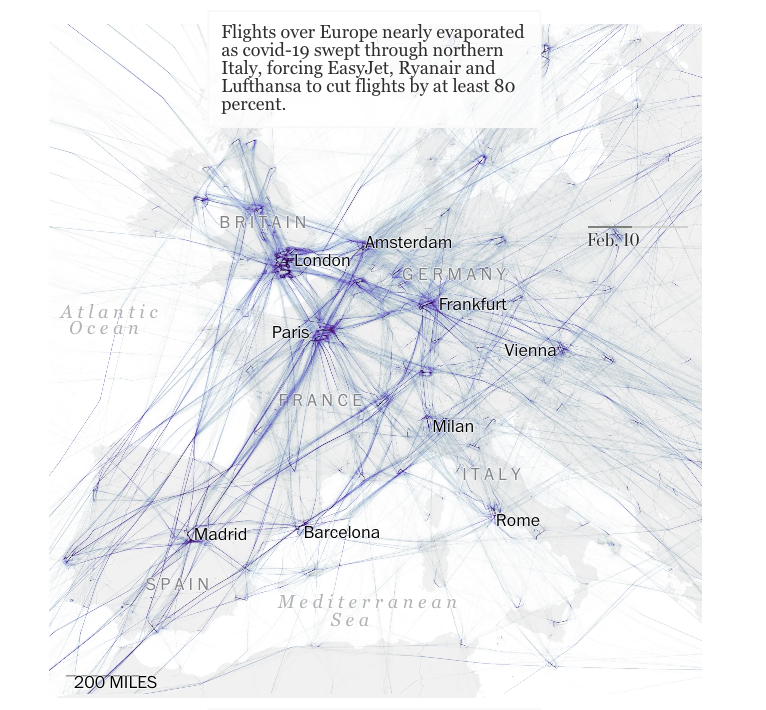
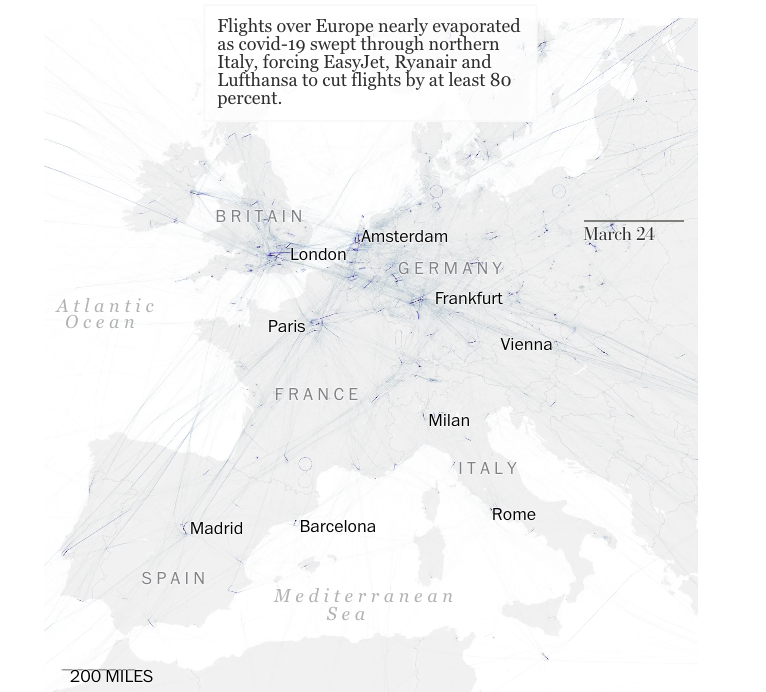
“I started to see the drastic flight cuts announced by airlines all over the world in rapid-fire, from American Airlines to Lufthansa Group. I wondered if we could have a map showing the before and after of planes in the air, and some satellite photos of where airlines have been parking their aircraft while they're not being used.
“We put a group together with a talented bunch of data and graphics reporters to report out the story of how quickly and deeply this crisis has affected the aviation industry, and to come up with a design to convey the numbers that would appeal beyond the aviation geek crowd.
“We reached out to satellite companies, including Maxar and Planet Labs, to obtain satellite photos of airports where airlines were reportedly sending their fleets. In one case, we had a reporter on the ground on another assignment confirm some aircraft arrivals, purely by Slack and happenstance.
"Ultimately this story is about people — the pilots and flight attendants affected by an unprecedented disruption, and the passengers who've virtually disappeared. So this also included a good deal of reporting. All in all: a team effort, and an example of how a relatively simple idea can turn into a project with greater ambition.”
|
|
This newsletter is written & edited by the National Press Club Journalism Institute staff: Beth Francesco, Holly Butcher Grant, Jim Kuhnhenn, and Julie Moos.
Send us your questions and suggestions
for topics to cover.
|
|
The National Press Club Journalism Institute promotes an engaged global citizenry through an independent and free press, and equips journalists with skills and standards to inform the public in ways that inspire civic engagement. Support our important work with a tax-deductible contribution today.
|
|
|
|
|
|
|